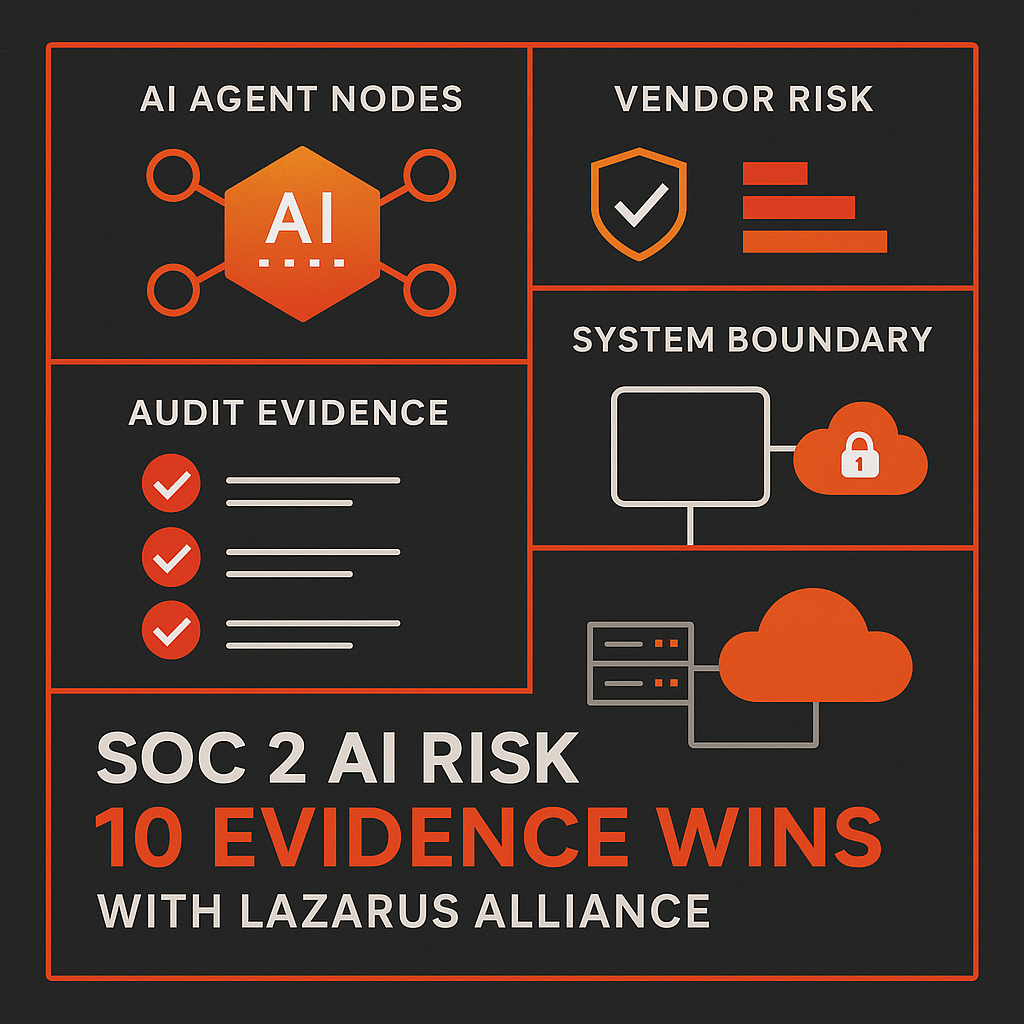
The hardest SOC 2 AI risk problem is not whether an AI tool is innovative; it is whether the auditor can see where the tool starts, what it can touch, who owns it, and what evidence proves it behaved as intended. AI agents, embedded copilots, retrieval-augmented generation, automated support bots, and vendor-hosted models create a new evidence challenge: they often act like users, integrations, processors, and decision engines at the same time.
For Lazarus Alliance, the practical answer is not to bolt a vague AI policy onto a SOC 2 audit. The answer is to convert AI risk into testable audit evidence mapped to system boundaries, vendor risk management, access control, logging, change management, privacy, confidentiality, and customer assurance. The AICPA explains that SOC 2 description criteria support evaluation of a service organization’s system across security, availability, processing integrity, confidentiality, and privacy, which means AI capabilities must be described and evidenced when they are relevant to the service commitment or system boundary AICPA & CIMA, SOC 2 Description Criteria.
This article gives CISOs, compliance officers, IT directors, and audit owners a field-tested evidence model: 10 SOC 2 evidence wins for AI agents, AI vendors, and AI system boundaries.
SOC 2 audit evidence must evolve for AI risk
A SOC 2 audit is not an abstract policy review. It is an examination of whether controls are suitably designed and, for a Type 2 report, whether they operated effectively over the review period, based on the service organization’s system description and applicable trust services categories AICPA & CIMA, SOC 2 Description Criteria. When an AI agent can read support tickets, summarize customer data, trigger workflows, generate code, or route transactions, the agent becomes part of the control environment if those actions support the in-scope service.
The mistake we see most often is treating AI as a feature instead of a boundary decision. In audit terms, the first question is not, Do we use AI? The first question is, Does the AI component store, process, transmit, influence, or secure in-scope data or service commitments? If yes, it belongs in the evidence plan.
NIST’s AI Risk Management Framework organizes AI risk work around Govern, Map, Measure, and Manage functions, providing a governance vocabulary that fits naturally with SOC 2 scoping, control ownership, and risk assessment evidence NIST, AI Risk Management Framework. Lazarus Alliance applies that same logic in SOC 1 and SOC 2 readiness engagements, helping organizations convert AI governance into auditable artifacts rather than aspirational principles Lazarus Alliance, SOC 1 and SOC 2 Services.
Define the AI system boundary before collecting audit evidence
A system boundary is the logical and technical perimeter of the services, infrastructure, people, processes, data flows, vendors, and controls included in the SOC 2 report. AI complicates that perimeter because modern agents may depend on multiple components: identity providers, SaaS platforms, model APIs, orchestration layers, vector databases, logging pipelines, data loss prevention tools, human approval workflows, and downstream ticketing or deployment systems.
For SOC 2 AI risk, Lazarus Alliance recommends a boundary statement that answers six questions:
- Purpose: What business service or control objective does the AI capability support?
- Data: What customer data, confidential information, regulated data, prompts, outputs, logs, embeddings, and training or tuning data are in scope?
- Identity: Which human users, non-human identities, service accounts, API keys, and agents can initiate or approve actions?
- Execution: Can the AI only suggest, or can it act in production systems?
- Vendors: Which subservice organizations provide model hosting, inference, storage, telemetry, monitoring, or workflow automation?
- Controls: Which preventive, detective, corrective, and governance controls restrict and monitor the AI behavior?
This boundary discipline also supports multi-framework programs. NIST SP 800-53 control AC-2 addresses account management, IA-2 addresses identification and authentication, AU-2 and AU-6 address event logging and audit review, CM-8 addresses system component inventory, RA-3 addresses risk assessment, and SR-3 addresses supply-chain controls NIST, SP 800-53 Rev. 5. Those same control ideas appear in FedRAMP, FISMA, GovRAMP, CMMC, DFARS NIST SP 800-171, CJIS, HIPAA, PCI DSS, IRS 1075, C5, ISO 27001, ISO 42001, and LADMF assurance conversations. Lazarus Alliance’s NIST 800-53 and FISMA services help organizations map these shared control expectations into assessment-ready evidence Lazarus Alliance, FISMA and NIST Audit Services.
10 evidence wins for SOC 2 AI risk, vendors, and customer assurance
1. AI capability inventory with owner, data class, and control impact
Evidence win: Maintain an AI inventory that identifies each AI agent, model, plugin, vendor API, embedded copilot, training dataset, retrieval source, orchestration layer, vector store, service account, and business owner.
The auditor should be able to reconcile this inventory against cloud assets, SaaS integrations, identity provider records, repositories, data catalogs, and vendor lists. NIST SP 800-53 CM-8 addresses system component inventory, while RA-3 addresses risk assessment NIST, SP 800-53 Rev. 5. For AI, inventory evidence should include whether the capability affects security, availability, processing integrity, confidentiality, or privacy.
Common pitfall: Organizations inventory sanctioned AI vendors but miss embedded AI functions inside CRM, ticketing, coding, email, analytics, and call-center tools. If those tools process customer information, confidential content, or operational decisions, they belong in the SOC 2 scoping discussion.
2. AI boundary and data-flow diagrams that show prompts, outputs, and retention
Evidence win: Produce architecture diagrams that show data inputs, prompts, outputs, retrieval stores, customer data paths, log destinations, human review points, vendor endpoints, and deletion or retention rules.
SOC 2 description criteria require a clear description of the system under examination, and AI data flows are now part of that description when they support the in-scope service AICPA & CIMA, SOC 2 Description Criteria. For regulated environments, the same diagram can support HIPAA risk analysis expectations under 45 CFR 164.308(a)(1)(ii)(A) eCFR, 45 CFR 164.308, PCI DSS cardholder data environment scoping PCI Security Standards Council, PCI DSS Standards, and CJIS data protection conversations FBI, CJIS Security Policy Resource Center.
Implementation step: Add an AI-specific swimlane to existing data-flow diagrams. Label where prompts are constructed, where context is retrieved, where model outputs are stored, where humans approve actions, and where customer data exits your environment.
3. Non-human identity governance for agents, keys, and service accounts
Evidence win: Treat AI agents as identities. Evidence should show approval, ownership, least privilege, authentication method, key rotation, expiration, segregation of duties, periodic access review, and emergency revocation.
NIST SP 800-53 AC-2 addresses account management, AC-6 addresses least privilege, and IA-2 addresses identification and authentication NIST, SP 800-53 Rev. 5. NIST SP 800-171 also addresses access control and identification requirements for organizations protecting controlled unclassified information NIST, SP 800-171 Rev. 3. In a SOC 2 audit, the practical evidence might include identity provider exports, privileged access management records, access review signoffs, API gateway policies, and logs showing that the agent used only approved scopes.
Real-world scenario: A support AI agent can summarize customer tickets and create draft responses. If it can also update customer records, reset settings, or trigger refunds, the agent needs access approvals and logging comparable to a privileged user, not a generic integration.
4. Vendor risk management evidence for AI subservice organizations
Evidence win: Build an AI vendor file that includes risk tiering, due diligence questionnaires, contract security terms, data-processing restrictions, subcontractor review, incident notification obligations, model-use restrictions, evidence of monitoring, and management review.
NIST SP 800-53 SR-3 addresses supply-chain controls, while SA-9 addresses external system services NIST, SP 800-53 Rev. 5. For defense contractors, DoD’s CMMC program is tied to safeguarding federal contract information and controlled unclassified information across contractor environments and suppliers DoD CIO, Cybersecurity Maturity Model Certification. Lazarus Alliance’s CMMC services help organizations align supplier evidence with defense-sector assessment expectations Lazarus Alliance, CMMC Services.
Common pitfall: Procurement approves the AI vendor, but security does not verify whether prompts, customer content, embeddings, or outputs are retained, used to improve models, transmitted to subprocessors, or excluded from enterprise deletion workflows.
5. AI change management and model release evidence
Evidence win: Maintain change tickets for prompt templates, retrieval sources, agent permissions, model versions, safety filters, evaluation datasets, orchestration logic, and vendor configuration changes.
NIST SP 800-53 CM-3 addresses configuration change control, CM-6 addresses configuration settings, and SI-2 addresses flaw remediation NIST, SP 800-53 Rev. 5. In SOC 2 testing, auditors commonly look for evidence that changes were authorized, tested, approved, and monitored. For AI, a release can be a prompt change, a new retrieval index, a new tool permission, or a vendor-side model update that changes behavior.
Implementation step: Add AI release fields to the normal software development lifecycle: intended behavior, prohibited behavior, evaluation results, rollback plan, data impact, security review, privacy review, and customer-impact assessment.
6. Logging, monitoring, and explainability that prove operating effectiveness
Evidence win: Capture audit logs for agent identity, user initiating the request, prompt metadata, retrieval sources, tools invoked, data accessed, decision path, output destination, administrative changes, exception handling, and human approval.
NIST SP 800-53 AU-2 addresses event logging, AU-6 addresses audit record review and analysis, and SI-4 addresses system monitoring NIST, SP 800-53 Rev. 5. FedRAMP’s modernization work emphasizes automation and continuous validation concepts for cloud assurance, making machine-readable evidence increasingly important for organizations that operate in public-sector supply chains FedRAMP, 20x.
Audit test example: Select a sample of AI-generated customer actions. Trace each action from the initiating user to the agent identity, tool call, data source, approval record, output, and monitoring alert. If the organization cannot reconstruct the event, it likely cannot prove operating effectiveness.
7. Privacy, confidentiality, and data-minimization controls for prompts and outputs
Evidence win: Show that sensitive data is classified, masked, restricted, encrypted, retained according to policy, and excluded from unapproved training or vendor improvement use.
The AICPA identifies confidentiality and privacy as SOC 2 trust services categories that may be in scope depending on service commitments AICPA & CIMA, SOC 2 Description Criteria. HIPAA covered entities and business associates must implement risk analysis and risk management processes under 45 CFR 164.308(a)(1) eCFR, 45 CFR 164.308. IRS Publication 1075 safeguards apply to federal tax information handled by agencies and authorized recipients IRS, Safeguards Program. The NTIS Limited Access Death Master File program governs access to LADMF data NTIS, Limited Access Death Master File.
Implementation step: Add prompt and output stores to the data-retention schedule. If prompts are logs, treat them as logs. If outputs contain customer confidential information, treat them as customer confidential information.
8. AI incident response and abuse-case testing
Evidence win: Extend incident response playbooks to include prompt injection, unauthorized tool use, data leakage through outputs, model abuse, rogue agent credentials, vendor compromise, and unsafe automated actions.
NIST SP 800-53 IR-4 addresses incident handling, IR-6 addresses incident reporting, and CA-7 addresses continuous monitoring NIST, SP 800-53 Rev. 5. NIST’s AI Risk Management Framework also emphasizes measuring and managing AI risks throughout the lifecycle NIST, AI Risk Management Framework.
Case walkthrough: A customer uploads malicious instructions into a document processed by a retrieval-augmented support bot. The bot attempts to override its normal policy and access an unrelated customer record. Strong evidence includes input validation rules, retrieval access controls, blocked tool-call logs, alert triage, incident classification, and a post-test remediation ticket.
9. Customer assurance package for AI transparency
Evidence win: Prepare a customer-facing AI assurance package that aligns with the SOC 2 report but does not over-disclose sensitive architecture. Include AI use cases, data categories, vendor dependencies, customer-configurable controls, retention practices, human oversight, incident contact path, and shared-responsibility assumptions.
Customer assurance is becoming a procurement requirement, especially where cloud services intersect with government, healthcare, financial services, payment systems, and public safety. PCI DSS applies to payment account data environments through the PCI Security Standards Council’s standards program PCI Security Standards Council, PCI DSS Standards. CJIS cloud and service-provider conversations require attention to law-enforcement data protection expectations FBI, CJIS Security Policy Resource Center. Germany’s BSI C5 program provides cloud computing compliance criteria used in cloud assurance discussions BSI, Cloud Computing Compliance Criteria Catalogue.
Common pitfall: Sales teams answer AI security questionnaires inconsistently because legal, security, privacy, and product teams lack a single approved assurance narrative.
10. Continuous evidence automation for audit readiness
Evidence win: Automate evidence collection for identity, configuration, access reviews, vendor monitoring, vulnerability management, change approvals, logging, policy attestations, and AI governance workflows.
FedRAMP 20x reinforces the market movement toward automated, machine-readable, continuously validated assurance for cloud security programs FedRAMP, 20x. Continuum GRC’s 2026 Audit Readiness Benchmark Report examines audit readiness across 275 organizations, and its findings are useful context for leaders comparing manual evidence collection with structured GRC operations Continuum GRC, 2026 Audit Readiness Benchmark Report. Continuum GRC’s AI Governance and Risk capabilities support structured AI control mapping, risk workflows, and evidence organization for audit teams Continuum GRC, AI Governance and Risk.
Implementation step: Build an evidence calendar by control, owner, system, source of truth, collection frequency, reviewer, and retention location. AI audit evidence should not live in screenshots scattered across chat threads.
How Lazarus Alliance maps SOC 2 AI risk across frameworks
The strongest AI assurance programs do not create a one-off AI checklist. They map AI risk into the organization’s existing control architecture. That is how evidence becomes reusable across SOC 2, SOC 1, ISO 27001, ISO 42001, FedRAMP, GovRAMP, CMMC, DFARS NIST SP 800-171, HIPAA, PCI DSS, CJIS, IRS 1075, C5, and LADMF.
ISO 27001 provides a management-system structure for information security, while ISO 42001 provides an AI management-system structure for organizations that develop or use AI systems ISO, ISO/IEC 27001 Information Security Management ISO, ISO/IEC 42001 Artificial Intelligence Management System. NIST SP 800-171 provides security requirements for protecting controlled unclassified information in nonfederal systems NIST, SP 800-171 Rev. 3. FedRAMP and GovRAMP assurance efforts rely heavily on NIST-style control evidence for cloud services FedRAMP, 20x GovRAMP, Program Information.
Lazarus Alliance’s methodology starts with scope, then evidence. We validate the AI use case, map it to trust services categories, identify inherited and vendor controls, test control operation, and package evidence for customer assurance. The result is not just a cleaner SOC 2 audit. It is a defensible compliance assessment that buyers, boards, regulators, and procurement teams can understand.
Executive takeaways for SOC 2 AI risk
- Do not scope AI by product name. Scope it by data flow, access, decision authority, vendor dependency, and customer commitment.
- Do not treat AI agents as ordinary features. Treat them as identities, processors, workflow actors, and potential privileged users.
- Do not rely on AI policies alone. Auditors need evidence: tickets, logs, approvals, access reviews, diagrams, risk assessments, monitoring records, and vendor files.
- Do not wait for the SOC 2 fieldwork request list. Build continuous evidence now, especially for access, logging, vendor risk management, and change control.
- Do not separate AI governance from customer assurance. Your buyers want to know whether AI changes their risk, their data exposure, and their contractual obligations.
Bottom line: SOC 2 AI risk is an evidence discipline. The organizations that win customer trust will be the ones that can show exactly where AI operates, what data it touches, who controls it, which vendors support it, and how its behavior is monitored over time. Lazarus Alliance helps organizations turn that discipline into audit-ready evidence, stronger vendor risk management, and clearer customer assurance.
Sources and References
- AICPA & CIMA, SOC 2 Description Criteria
- NIST, AI Risk Management Framework
- NIST, SP 800-53 Rev. 5 Security and Privacy Controls
- NIST, SP 800-171 Rev. 3 Protecting Controlled Unclassified Information
- FedRAMP, 20x
- DoD CIO, Cybersecurity Maturity Model Certification
- PCI Security Standards Council, PCI DSS Standards
- eCFR, 45 CFR 164.308 Administrative Safeguards
- FBI, CJIS Security Policy Resource Center
- IRS, Safeguards Program
- NTIS, Limited Access Death Master File
- BSI, Cloud Computing Compliance Criteria Catalogue
- ISO, ISO/IEC 27001 Information Security Management
- ISO, ISO/IEC 42001 Artificial Intelligence Management System
- GovRAMP, Program Information
- Lazarus Alliance, SOC 1 and SOC 2 Services
- Lazarus Alliance, FISMA and NIST Audit Services
- Lazarus Alliance, CMMC Services
- Continuum GRC, 2026 Audit Readiness Benchmark Report
- Continuum GRC, AI Governance and Risk
About Lazarus Alliance
To learn more about how Lazarus Alliance can help, contact us.
- FedRAMP
- GovRAMP
- NIST 800-53
- DFARS NIST 800-171
- CMMC
- SOC 1 & SOC 2
- C5
- HIPAA, HITECH, & Meaningful Use
- PCI DSS RoC & SAQ
- IRS 1075 & 4812
- CJIS
- LA DMF
- ISO 27001, ISO 27002, ISO 27005, ISO 27017, ISO 27018, ISO 27701, ISO 22301, ISO 17020, ISO 17021, ISO 17025, ISO 17065, ISO 9001, & ISO 90003
- And dozens more!
Related Posts