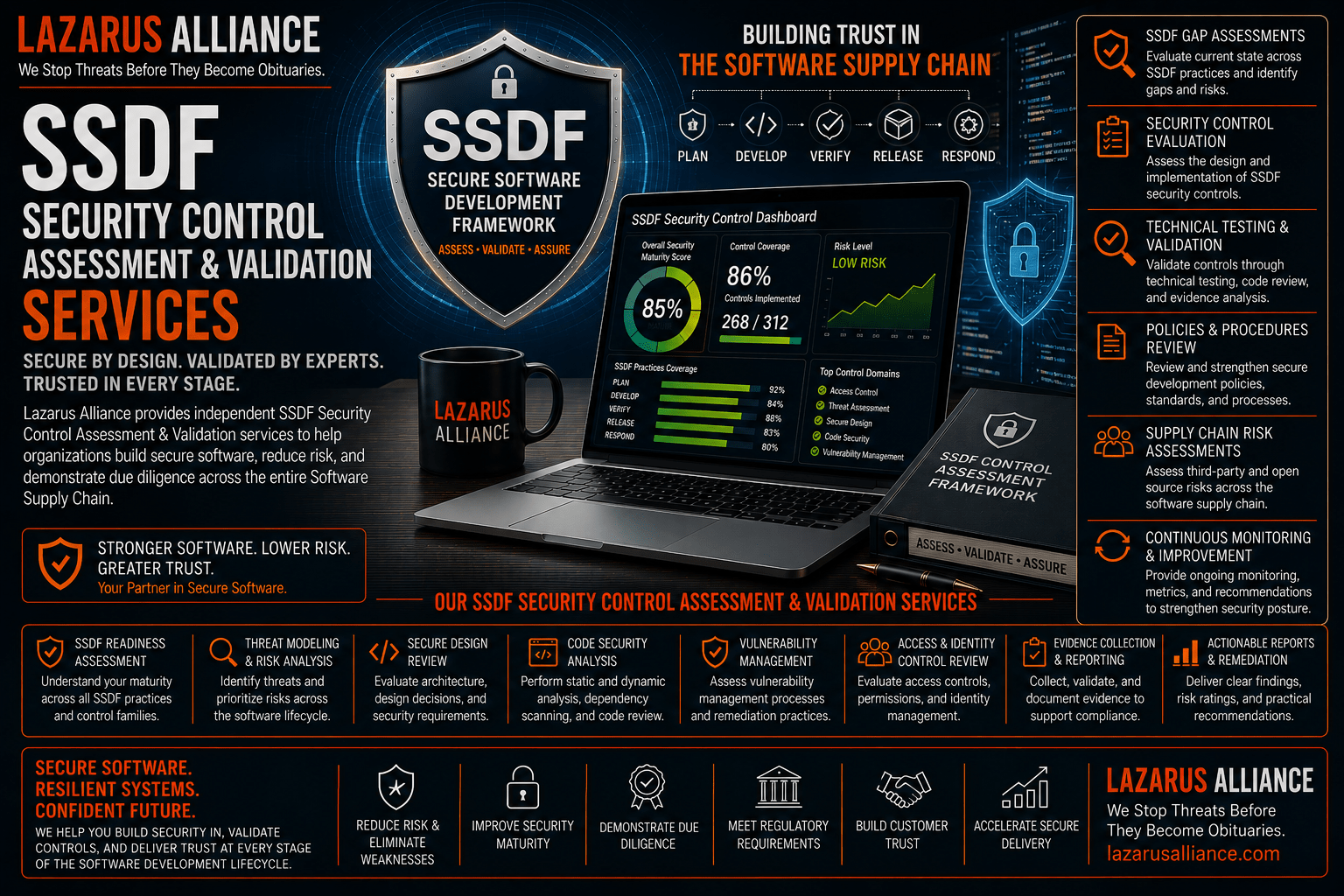
NIST 800-218 SSDF Assessment & Validation Services from Lazarus Alliance. Call +1 (888) 896-7580 today!
Table of Contents
ToggleStrengthen software supply chain security and demonstrate alignment with NIST Secure Software Development Framework (SSDF) requirements through independent cybersecurity assessments from Lazarus Alliance. Our experienced Cybervisors® help software developers, technology providers, federal contractors, and enterprise organizations evaluate secure development practices, identify compliance gaps, and validate security controls across the software development lifecycle. Our assessments address secure coding, vulnerability management, software integrity, supply chain risk, and NIST SP 800-218 practices to improve software security, support federal procurement requirements, and strengthen compliance readiness with confidence.
Turn compliance requirements into a competitive advantage.
Call +1-888-896-7580 or schedule your free consultation today.
The Secure Software Development Framework (SSDF) is defined in NIST Special Publication (SP) 800-218. It is a set of high-level, outcome-based best practices for integrating security into every stage of the software development lifecycle (SDLC). It is organized around four main practice groups:
- Prepare the Organization (PO) – Establish governance, risk management, training, and processes.
- Protect the Software (PS) – Secure the development environment, tools, and supply chain.
- Produce Well-Secured Software (PW) – Implement secure design, coding, testing, and review practices.
- Respond to Vulnerabilities (RV) – Identify, report, and remediate vulnerabilities effectively.
The goal is to reduce the number and severity of vulnerabilities in software before it is released, especially in the software supply chain.
What does an “SSDF audit” actually involve?
There is no formal NIST certification or mandatory “SSDF audit” like a SOC 2 or ISO audit. Instead, the term “SSDF audit” is commonly used to describe:
-
Internal self-assessment – An organization reviews its own SDLC against the SSDF practices (often using the SSDF table or mapping tools) to identify gaps and prepare evidence.
-
Third-party assessment – A qualified independent assessor (frequently a FedRAMP-authorized Third-Party Assessment Organization, or 3PAO) reviews documentation, processes, tools, and evidence of SSDF implementation. This produces a report that supports formal attestation.
-
Attestation – The required output for U.S. federal government contracts. Software producers must submit a Secure Software Development Attestation Form (published by CISA) declaring that they follow a specific subset of SSDF practices. This is mandated by Executive Order 14028 and OMB Memorandum M-22-18 (updated by M-23-16).
- Self-attestation is the baseline (signed by an executive).
- Many organizations choose third-party assessment + attestation for stronger credibility and to reduce risk under the False Claims Act.
Deadlines for federal software suppliers were June/September 2024 (depending on whether the software is “critical”).
Why it matters
- Federal contracts — Almost all software sold to U.S. government agencies now requires this attestation.
- Supply-chain security — It helps organizations demonstrate they are reducing risks that could affect downstream users (e.g., SolarWinds-style incidents).
- Broader compliance — Aligns with other regulations (FDA cybersecurity for medical devices, EU Cyber Resilience Act, etc.).
In short: An SSDF audit is the practical process of checking and proving that your software is built securely using the NIST SSDF framework, usually so you can legally sell to the U.S. government or strengthen your overall security posture. If you’re preparing for one, most companies start with a gap analysis against the SSDF practices and then decide between self-attestation or a 3PAO-led assessment.
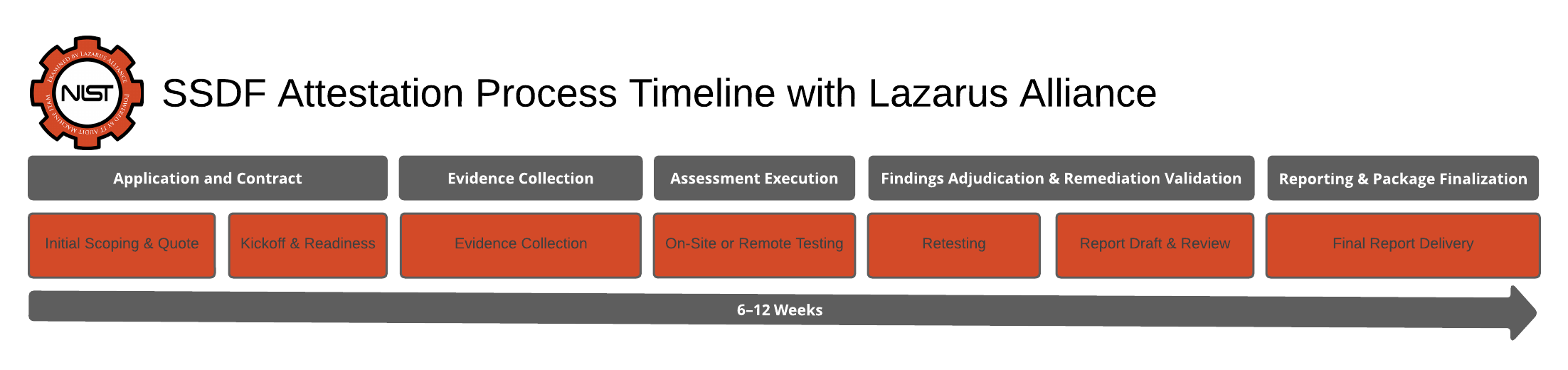
Audit Timeline: What to Expect with Lazarus Alliance
(Typical Duration: 7–9 Weeks from Kickoff to Final Secure Software Development Attestation Delivery – Accelerated via Lazarus Alliance's Critical Path Methodology and IT Audit Machine™ Platform.
For SSDF services that reduce costs and leverage the number one ranked SSDF NIST 800-218 audit software platform, call +1 (888) 896-7580 to get started. — Michael Peters, CEO & Founder
With Lazarus Alliance, an SSDF audit (or more accurately, a third-party SSDF assessment/attestation readiness engagement) follows our standardized, efficient process and runs 7–9 weeks end-to-end for most organizations. This is faster than heavier frameworks like full NIST 800-53 or FedRAMP because SSDF is outcome-based and does not require the same level of formal certification.
Lazarus Alliance follows this structured 6-phase process for SSDF engagements under NIST SP 800-218 requirements.
| Phase | Activities | Typical Duration | Key Deliverables & Tools |
|---|---|---|---|
| Phase 0 – Pre-Engagement & Decision |
Initial consultation, define scope (SSDF practices PO/PS/PW/RV), NDA, engagement letter, and repository access. |
1–2 weeks | Signed SOW, project charter, and Continuum GRC portal access |
| Phase 1 – Kickoff & Scoping |
Kickoff meeting + full gap assessment of your SDLC against NIST SSDF practices. Governance, tools, processes, and evidence reviewed. |
Week 0–1 |
Gap report, prioritized remediation roadmap |
| Phase 2 – Evidence Collection & Readiness |
Optional remediation support (if gaps exist), evidence collection/upload to Continuum GRC portal, policy/procedure updates. |
Weeks 1–4 |
Complete evidence package, updated SSDF mapping |
| Phase 3 – Assessment Fieldwork |
In-depth review of code practices, secure design/testing, vulnerability management, supply-chain controls, interviews, and tool/config reviews. |
Weeks 4–7 |
Testing results, preliminary findings, real-time dashboards |
| Phase 4 – Reporting & Findings Resolution |
Draft report review, Plan of Action & Milestones (POA&M) if needed, and final remediation verification. |
Weeks 7–9 |
Final assessment report + attestation-ready package |
| Phase 5 – Attestation & Ongoing Support |
Executive attestation form completion, submission support to CISA’s Repository (or your agency), and annual surveillance planning. |
Immediate upon approval + ongoing |
Official SSDF attestation package, continuous monitoring roadmap |
Why clients finish faster with Lazarus Alliance: Planning estimates vary by software portfolio, development environments, evidence availability and the scope of the requested assessment. Lazarus Alliance confirms schedule and deliverables after scoping; NIST SP 800-218 does not prescribe a universal assessment duration.”
Fastest Realistic Timeline (Well-Prepared Customer with Lazarus Alliance)
~6–8 weeks total (leveraging full platform automation and pre-loaded evidence).
Average Timeline (Most Organizations)
8–10 weeks (includes minor remediation).
Longest Common Timeline
10–12+ weeks (complex scopes, extensive POA&Ms, or custom integrations).
Pro Tip from Lazarus Alliance: Engage early with a free Cybervisor™ readiness consultation (+1-888-896-7580) to upload evidence 2–4 weeks pre-kickoff. Our methodology emphasizes year-round continuous auditing to avoid end-of-cycle rushes, ensuring attestation success with minimal disruption.

Frequently Asked Questions
What is an SSDF Audit and Attestation?
An SSDF audit is a structured third-party assessment of your software development lifecycle against the NIST Secure Software Development Framework (NIST SP 800-218). Lazarus Alliance evaluates your practices across the four SSDF practice groups—Prepare the Organization, Protect the Software, Produce Well-Secured Software, and Respond to Vulnerabilities—and delivers the complete evidence package needed to complete your official CISA Secure Software Development Attestation Form.
Who needs to complete an SSDF Attestation?
Any organization that develops, sells, or supplies software to the U.S. federal government must provide an SSDF attestation under Executive Order 14028 and OMB Memoranda M-22-18/M-23-16. This requirement applies to both commercial off-the-shelf (COTS) products and custom-developed solutions. Many prime contractors also flow this requirement down to subcontractors.
How long does the SSDF audit process take with Lazarus Alliance?
Most clients complete the full engagement in 4–8 weeks from kickoff to final report. Well-prepared organizations can finish in as little as 4–6 weeks. Our proprietary Continuum GRC IT Audit Machine™ platform and pre-built SSDF templates dramatically accelerate evidence collection and review.
Do you offer third-party SSDF assessments or only self-attestation support?
Lazarus Alliance specializes in independent third-party SSDF assessments. While we can support self-attestation, the majority of our clients choose a full third-party assessment because it carries significantly more weight with federal agencies, contracting officers, and prime contractors.
Will my SSDF assessment from Lazarus Alliance be accepted by federal agencies?
Yes. Lazarus Alliance is an experienced A2LA-accredited compliance provider with deep expertise in federal cybersecurity requirements. Our SSDF assessment packages are specifically designed to meet or exceed the expectations of CISA, federal contracting officers, and prime contractors.
What kind of evidence is required for an SSDF audit?
We review policies, procedures, training records, secure coding standards, code review and testing processes, vulnerability management workflows, Software Bill of Materials (SBOM) practices, and tool configurations. You’ll receive a tailored evidence request list at the start of the engagement so nothing is left to guesswork.
What does the SSDF assessment process include?
Our proven process includes a detailed gap analysis, evidence collection and review, interviews with your development and security teams, examination of tools, pipelines, and supply-chain controls, plus a comprehensive final report with any required remediation roadmap.
Can Lazarus Alliance help us remediate gaps before the final assessment?
Yes. We offer an optional remediation and readiness phase. Many organizations use this step to close identified gaps quickly so they can achieve a clean assessment result and submit their attestation without open findings.
Credentials You Can Count On
American Association for Laboratory Accreditation (A2LA) ISO/IEC 17020 accredited certification number 3822.01.
Talk with one of our experts
Our Lazarus Alliance Cybervisor™ teams have experience performing thousands of assessments for organizations providing services to clients around the world.
We're here to answer any questions you may have.

Key Benefits of SSDF Compliance (with Independent Security Control Assessment & Validation)
Achieving NIST SP 800-218 Secure Software Development Framework (SSDF) compliance through Lazarus Alliance’s independent third-party assessment delivers far more than a checkbox for federal contracts. It provides measurable security, business, and credibility advantages—especially when your controls are independently validated rather than self-attested.
Here are the top benefits organizations gain:
- Unlocks and Protects Federal (and Prime Contractor) Revenue SSDF attestation is mandatory for selling software to U.S. government agencies under EO 14028 and OMB M-22-18/M-23-16. Independent validation by Lazarus Alliance gives contracting officers and prime contractors immediate confidence, accelerating approvals and reducing the risk of contract disqualification.
- Delivers Credible, Defensible Third-Party Validation Unlike self-attestation, Lazarus Alliance’s independent security control assessment and validation produces an objective, A2LA-accredited report that stands up to scrutiny. This significantly lowers False Claims Act exposure and strengthens your position in audits or disputes.
- Reduces Vulnerabilities and Supply-Chain Risk SSDF integrates security into every phase of the SDLC (Prepare, Protect, Produce, Respond). Independent assessment identifies gaps early, resulting in fewer vulnerabilities in released software and stronger protection against supply-chain attacks like SolarWinds.
- Lowers Long-Term Remediation and Breach Costs Fixing security issues during development is exponentially cheaper than post-release patches or incident response. Our validated SSDF program helps you shift left, reducing expensive rework and potential breach-related losses.
- Builds Customer Trust and Competitive Advantage Third-party validated SSDF compliance serves as powerful proof of your secure-by-design commitment. It differentiates you in RFPs, sales cycles, and customer due diligence—especially with enterprises and regulated industries that demand supply-chain transparency.
- Provides a Clear, Prioritized Roadmap for Continuous Improvement Lazarus Alliance’s assessment doesn’t just check boxes—it delivers a tailored gap analysis, evidence package, and remediation roadmap. You gain ongoing visibility into your security posture via the Continuum GRC platform.
- Streamlines Future Compliance Efforts SSDF practices align with FedRAMP, FISMA, CMMC, ISO 27001, and other frameworks. A validated SSDF program creates reusable artifacts and processes that accelerate audits across multiple compliance initiatives.
- Strengthens Executive Accountability and Board Confidence Independent validation gives leadership and boards assurance that your software development practices meet the highest federal standards—reducing personal and organizational risk while demonstrating proactive governance.
Bottom line: Self-attestation gets you in the door. Lazarus Alliance’s independent SSDF assessment and validation gives you a defensible, market-leading security posture that wins contracts, reduces risk, and builds lasting trust.