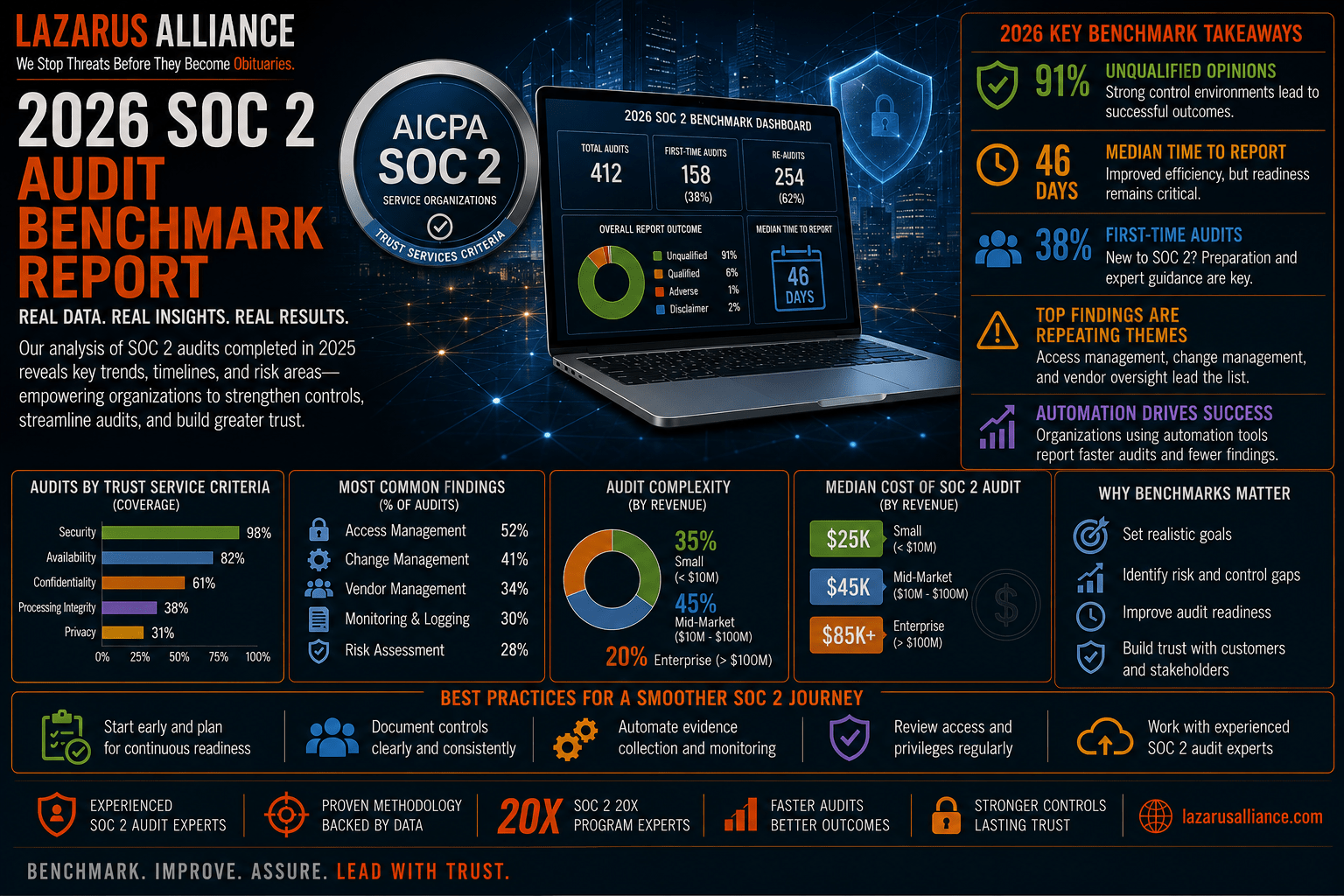
2026 SOC 2 Audit
Benchmark Report
Table of Contents
ToggleAggregate Anonymized Insights from Lazarus Alliance
SOC 2 Examinations
Reporting Period: January 2025 – June 2026 • Published August 2026 • Version 1.0
Examinations
Fieldwork Window
(53 of 75)
Evidence (66 of 75)
Lazarus Alliance, Inc.
CPA Firm · SOC 2 Examinations
A2LA-Accredited FedRAMP 3PAO • Authorized CMMC C3PAO (CPN 10251) • PCI DSS QSA • Veteran-Owned Small Business
Title: 2026 SOC 2 Audit Benchmark Report
Version: 1.0 (August 2026)
Dataset: N = 75 completed SOC 2 Type 1 and Type 2 examinations performed by Lazarus Alliance (Delaware CPA firm) between January 2025 and June 2026. All organizational identifiers removed.
Publisher: Lazarus Alliance, Inc., Scottsdale, Arizona
License: © 2026 Lazarus Alliance, Inc. All rights reserved. Aggregate statistics may be cited with attribution.
1. Purpose & Methodology
This benchmark report aggregates anonymized findings from N = 75 SOC 2 examinations (Type 1 and Type 2) performed by Lazarus Alliance between January 2025 and June 2026. Figures represent observed patterns across the examination population and are intended to provide service organizations with realistic expectations for duration, evidence, exceptions, and scope decisions.
Scope of Data: Completed SOC 2 examinations only (readiness assessments and gap analyses excluded). Both first-time and renewal examinations are included. Trust Services Criteria combinations vary (Security only through full five-criteria reports). Percentages use N = 75 unless otherwise noted.
Disclaimer: These benchmarks are observational and do not constitute guarantees of future performance, report outcomes, or timelines. Individual results vary based on control maturity, system description quality, evidence readiness, and scope. Lazarus Alliance maintains independence under AICPA professional standards.
2. Executive Summary – Key Benchmarks
| Metric | Observed Value | Notes |
|---|---|---|
| Sample size | N = 75 | Completed SOC 2 Type 1 & Type 2 examinations |
| Typical formal fieldwork window | 6–10 weeks | From kickoff / evidence acceptance to draft report |
| Examinations with ≥1 exception | 71% (53 of 75) | Median 2 exceptions when present |
| Required additional evidence | 88% (66 of 75) | At least one clarification cycle |
| Type 2 share of dataset | 73% (55 of 75) | Type 1: 27% (20 of 75) |
| First-time vs renewal | 42% first / 58% renewal | N = 75 |
| Average evidence volume | ~1,450 artifacts | Range roughly 400 – 4,200 |
Type 1 vs Type 2 (N = 75)
Exceptions Present
3. How Long Does a SOC 2 Audit Take?
Formal examination window
- Typical formal fieldwork: 6–10 weeks
- Faster end of range: Mature renewals with clean Type 2 observation periods and complete evidence
- Longer end of range: First-time Type 2 examinations, multi-criteria scope, or significant mid-exam evidence remediation
End-to-end phases
| Phase | Typical Duration | Notes |
|---|---|---|
| Readiness / gap analysis | 4–12 weeks | Control design, system description, evidence planning |
| Remediation & evidence packaging | 4–16 weeks | Longer for first-time Type 2 (observation period) |
| Formal examination fieldwork | 6–10 weeks | Kickoff → draft report |
| Exception remediation & report finalization | 2–6 weeks | Depends on exception severity and management response |
Type 2 examinations require an observation period (commonly 3–12 months). That period is not part of formal fieldwork duration but is a critical driver of overall calendar time to a Type 2 report.
Factors that shorten or lengthen duration
- Shorten: Complete system description, practice-mapped evidence, mature access/logging/change controls, prior SOC 2 experience, focused criteria set
- Lengthen: First-time examinations, incomplete evidence, multi-criteria scope without preparation, weak system description, mid-exam control gaps
4. 7 Most Common SOC 2 Audit Exceptions
Across N = 75 examinations, 71% (53 of 75) had at least one exception. When exceptions were present, the median number was 2. The following areas generated exceptions most frequently (examinations may appear in more than one category):
| Rank | Exception Area | Count | % of N = 75 |
|---|---|---|---|
| 1 | Access Control & User Provisioning | 38 | 51% |
| 2 | Change Management | 31 | 41% |
| 3 | Logging, Monitoring & Alerting | 28 | 37% |
| 4 | Risk Assessment & Vendor Management | 24 | 32% |
| 5 | System Description Accuracy | 21 | 28% |
| 6 | Security Configuration & Vulnerability Management | 18 | 24% |
| 7 | Incident Response & Continuity Testing | 14 | 19% |
Detail by area:
Access Control & User Provisioning
Incomplete joiner/mover/leaver evidence, delayed deprovisioning, or insufficient periodic access reviews. Least-privilege not fully evidenced for privileged roles.
Change Management
Changes implemented without complete approval trails, missing testing evidence, or emergency changes not retrospectively documented.
Logging, Monitoring & Alerting
Incomplete log coverage for in-scope systems, alerts not reviewed on defined cadence, or retention gaps during the observation period (Type 2).
Risk Assessment & Vendor Management
Risk assessments not updated on the stated cadence; vendor due diligence incomplete for critical subservice organizations; SOC reports from vendors not obtained or reviewed.
System Description Accuracy
System description that does not match the implemented environment, incomplete boundary, or missing complementary user entity controls (CUECs).
Security Configuration & Vulnerability Management
Baselines not maintained; vulnerability scanning incomplete or remediation outside stated SLAs without documented risk acceptance.
Incident Response & Continuity Testing
Incident response or disaster recovery plans exist but lack evidence of testing within the required period; lessons-learned not documented.
Exceptions related to multi-factor authentication coverage, encryption key management, and board/management oversight also appeared, particularly in first-time examinations.
5. How Much Evidence Does a SOC 2 Audit Require?
| Metric | Value |
|---|---|
| Average discrete artifacts | ~1,450 |
| Observed range | ~400 – 4,200 |
| Required additional evidence | 88% (66 of 75) |
| Most common additional requests | Access reviews, change tickets, log samples, vendor SOC reports, system description updates |
Common evidence deficiencies
- Screenshots without dates, system identifiers, or context
- Policies without operational proof (tickets, reviews, logs)
- Incomplete samples for the Type 2 observation period
- System description that drifts from the live environment
- Missing vendor SOC reports or due-diligence records for critical subservice organizations
- Access reviews that are incomplete or not performed on the stated cadence
Organizations that pre-mapped controls to evidence and maintained living system descriptions required fewer clarification cycles.
6. SOC 2 Type 1 vs Type 2: What Our Audit Data Shows
| Metric | Type 1 (N = 20) | Type 2 (N = 55) |
|---|---|---|
| Share of dataset | 27% (20 of 75) | 73% (55 of 75) |
| Median formal fieldwork | 6 weeks | 8 weeks |
| Examinations with ≥1 exception | 55% (11 of 20) | 76% (42 of 55) |
| Median exceptions (when present) | 1 | 2 |
| Average evidence artifacts | ~900 | ~1,650 |
| Required additional evidence | 75% (15 of 20) | 93% (51 of 55) |
| Average clarification cycles | 1.2 | 1.8 |
Type 2 examinations were 38% more likely to contain at least one exception than Type 1 (76% vs 55%). They also required substantially more evidence (~1,650 vs ~900 average artifacts) and more clarification cycles. Type 2 reports dominate customer demand. Type 1 remains useful as a first step or when a point-in-time design opinion is sufficient. Organizations moving from Type 1 to Type 2 should plan for a full observation period and stronger operational evidence — the step-up in evidence rigor is material.
7. First SOC 2 Audit vs. Renewal: What the Data Shows
| Metric | First-Time (N = 32) | Renewal (N = 43) |
|---|---|---|
| Share of dataset | 42% (32 of 75) | 58% (43 of 75) |
| Median formal fieldwork | 9 weeks | 7 weeks |
| Examinations with ≥1 exception | 84% (27 of 32) | 60% (26 of 43) |
| Median exceptions (when present) | 2 | 1 |
| Average evidence artifacts | ~1,600 | ~1,350 |
| Required additional evidence | 94% (30 of 32) | 84% (36 of 43) |
| Average clarification cycles | 2.1 | 1.3 |
First-time SOC 2 examinations were 40% more likely to contain at least one exception than renewals (84% vs 60%). They also required longer median fieldwork (9 vs 7 weeks) and more clarification cycles (2.1 vs 1.3). Renewal examinations benefited from prior system descriptions, established control ownership, and institutional knowledge of sampling and evidence expectations. Organizations preparing for a first SOC 2 should budget extra time for system description quality and operational evidence, not only policy documentation.
8. Scope & Complexity
Trust Services Criteria selection
- Security only — most common starting point; still the majority of first-time reports
- Security + Availability — frequent for SaaS and infrastructure providers
- Security + Confidentiality — common when handling sensitive customer data
- Three or more criteria — more common in renewals and enterprise-facing providers; higher evidence and testing load
Scope drivers of effort
- System boundary clarity — well-defined product / service boundaries reduced testing friction
- Number of in-scope systems and locations — multi-product or multi-region environments increased sampling and evidence volume
- Subservice organizations — critical vendors without current SOC reports created exceptions and follow-up
- Criteria count — each additional Trust Services Category expands control population and evidence demand
- Type 2 observation period length — longer periods require more samples and sustained control operation
Practical scoping guidance
- Start with a clear system description and boundary before expanding criteria.
- Prefer a clean Security-only Type 1 or Type 2 over a rushed multi-criteria first report.
- Identify critical subservice organizations early and obtain their SOC reports.
- For Type 2, align observation period length with operational readiness — longer is not always better if controls are not stable.
- Treat renewals as an opportunity to refine scope and system description, not only to “pass again.”
9. Key Insights for Service Organizations
- 1. Budget real time for the system description. Inaccurate or incomplete descriptions drive exceptions and delay.
- 2. Map evidence to criteria before fieldwork. 88% of examinations still needed additional evidence; pre-mapping reduces cycles.
- 3. Expect exceptions. 71% of examinations had at least one; quality of management response matters.
- 4. Type 2 is a different evidence game than Type 1. Plan the observation period deliberately.
- 5. First-time audits cost more calendar time. Renewals benefit from institutional knowledge — invest in that knowledge early.
- 6. Scope discipline pays off. Clear boundaries and right-sized criteria sets outperform ambitious, under-prepared scopes.
10. Authors, Reviewers & How to Cite
Lead Author
Michael D. Peters, CEO & Founder, Lazarus Alliance, Inc.
Delaware CPA firm principal; A2LA-accredited FedRAMP 3PAO; Authorized CMMC C3PAO; PCI DSS QSA. 26+ years in proactive cybersecurity, audit, and compliance.
Technical Review
SOC 2 Examination Team, Lazarus Alliance (AICPA professional standards).
How to Cite This Report
Peters, M. D. (2026). 2026 SOC 2 Audit Benchmark Report: Aggregate Anonymized Insights from Lazarus Alliance SOC 2 Examinations (Version 1.0). Lazarus Alliance, Inc. https://lazarusalliance.com/2026-soc-2-audit-benchmark-report/
Recommended short citation: Lazarus Alliance (2026). 2026 SOC 2 Audit Benchmark Report (N=75).
11. About & Contact
Lazarus Alliance is a Delaware CPA firm providing SOC 2 examinations, an A2LA-accredited FedRAMP 3PAO, an authorized CMMC C3PAO (CPN 10251), a PCI DSS QSA, and a veteran-owned small business headquartered in Scottsdale, Arizona.
Lazarus Alliance, Inc.
27743 N. 70th Street, Suite 100, Scottsdale, AZ 85266
1-888-896-7580 • [email protected]
https://lazarusalliance.com
© 2026 Lazarus Alliance, Inc. All rights reserved. Proactive Cybersecurity®, Cybervisor®, and IT Audit Machine® are trademarks of Lazarus Alliance or its affiliates. Aggregate data is anonymized; individual examination outcomes remain confidential.
Scottsdale, Arizona • 1-888-896-7580 • lazarusalliance.com
Additional Analysis
- How Long Does a SOC 2 Audit Take?
- 7 Most Common SOC 2 Audit Exceptions
- How Much Evidence Does a SOC 2 Audit Require?
- SOC 2 Type 1 vs Type 2: What Our Audit Data Shows
- First SOC 2 Audit vs. Renewal: What the Data Shows
- Scope & Complexity
Talk with one of our experts
Our Lazarus Alliance Cybervisor™ teams have experience performing thousands of assessments for organizations providing services to clients around the world.
We're here to answer any questions you may have.