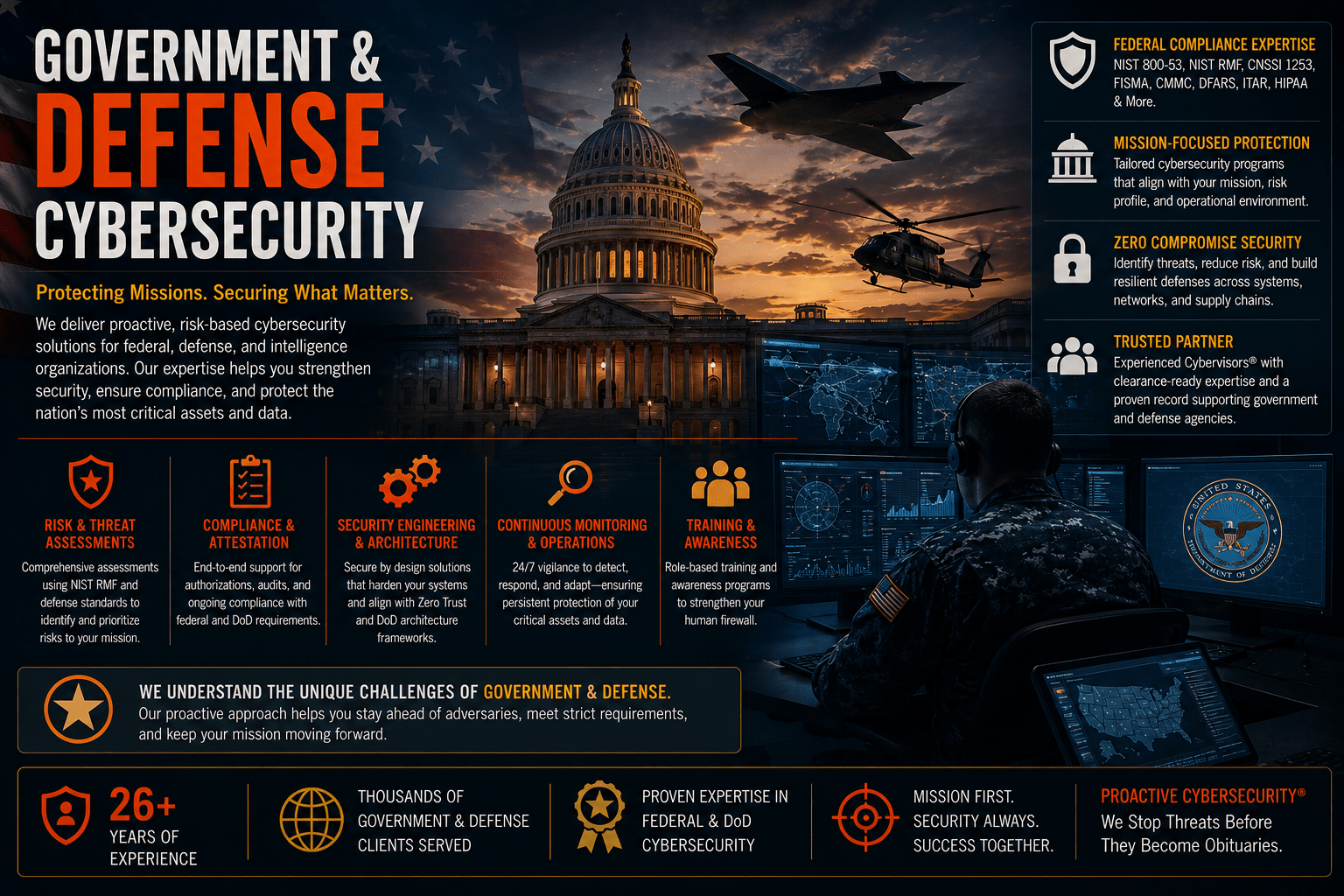
Government & Defense Cybersecurity
Table of Contents
ToggleIndependent Cybersecurity Assessment, Compliance & Risk Management for Government and the Defense Industrial Base
Lazarus Alliance helps federal agencies, defense contractors, cloud service providers, state and local government technology providers, and organizations throughout the Defense Industrial Base navigate complex cybersecurity assessment, compliance, and risk management requirements.

Our expertise spans CMMC, FedRAMP, NIST SP 800-171, NIST SP 800-172, NIST SP 800-53, DFARS, FISMA, CJIS, LADMF, IRS Publication 1075, IRS Publication 4812, CNSSI 1253, GovRAMP, and other government cybersecurity requirements.
Lazarus Alliance combines independent assessment expertise with practical knowledge gained from real-world cybersecurity engagements to help organizations protect sensitive government information, demonstrate compliance, reduce cybersecurity risk, and maintain defensible security programs.
Protect sensitive information. Demonstrate compliance. Strengthen mission assurance.
Talk With a Government & Defense Cybersecurity Expert
Discuss your organization's government cybersecurity requirements, assessment objectives, system environment, and applicable compliance obligations with Lazarus Alliance.
Which Government Cybersecurity Requirement Applies to You?
Government cybersecurity requirements vary based on the information your organization handles, the systems you operate, the customers you serve, and your contractual obligations. Use this guide as a starting point for identifying the cybersecurity frameworks and programs that may apply.
| If Your Organization... | Start With | Why It Matters |
|---|---|---|
| Handles Controlled Unclassified Information (CUI) for Department of Defense contracts | CMMC , DFARS , NIST SP 800-171 | These requirements work together to protect CUI within the Defense Industrial Base and establish applicable contractual, technical, and assessment obligations. |
| Protects CUI associated with critical programs or higher-threat environments | NIST SP 800-172 | NIST SP 800-172 adds enhanced security requirements designed to address advanced and persistent cyber threats beyond the foundational protections of NIST SP 800-171. |
| Provides SaaS, PaaS, or IaaS cloud services to U.S. federal agencies | FedRAMP | FedRAMP provides a standardized federal approach to cloud security assessment, authorization, and continuous monitoring based on NIST security controls. |
| Operates or supports a federal information system | FISMA , NIST SP 800-53 | FISMA establishes federal information-security responsibilities while NIST SP 800-53 provides the security and privacy control catalog used across federal systems. |
| Provides cloud services to state, local, education, or other public-sector organizations | GovRAMP | GovRAMP provides a standardized security assessment and authorization framework for cloud service providers serving participating public-sector organizations. |
| Accesses, processes, stores, or transmits Criminal Justice Information (CJI) | CJIS | CJIS security requirements protect sensitive criminal justice and law-enforcement information through administrative, technical, and operational safeguards. |
| Requires ongoing access to the Limited Access Death Master File | LADMF | LADMF access requires organizations to demonstrate appropriate systems safeguards and, where applicable, complete an independent conformity assessment. |
| Receives, processes, stores, or transmits Federal Tax Information (FTI) | IRS Publication 1075 | IRS Publication 1075 establishes safeguards for protecting Federal Tax Information handled by federal, state, local, and other authorized organizations. |
| Supports applicable IRS systems, information exchanges, or security environments | IRS Publication 4812 | IRS Publication 4812 provides cybersecurity guidance for applicable IRS systems, information exchanges, and associated security controls. |
| Operates, supports, or provides technology for a National Security System (NSS) | CNSSI 1253 , NIST SP 800-53 | CNSSI 1253 provides security categorization and control-selection guidance for National Security Systems and works in conjunction with NIST SP 800-53 security controls. |
Independent Cybersecurity Expertise for the Federal Ecosystem
Government cybersecurity requirements extend far beyond implementing a checklist of security controls. Organizations must understand which requirements apply, what systems and information are in scope, how controls are implemented, what evidence demonstrates effectiveness, and how compliance will be maintained over time.
Lazarus Alliance works across the federal cybersecurity ecosystem, helping organizations address security and assurance requirements involving Controlled Unclassified Information (CUI), federal information systems, cloud services, contractor environments, supply chains, and regulated data.
Our capabilities include independent cybersecurity assessments, security control assessments, compliance examinations, risk assessments, technical security testing, continuous monitoring, and ongoing cybersecurity assurance.
Defense Industrial Base & CUI Protection
CMMC Cybersecurity Assessments
Defense contractors, subcontractors, and organizations throughout the Defense Industrial Base (DIB) that handle Federal Contract Information (FCI) or Controlled Unclassified Information (CUI) may be required to demonstrate implementation of applicable cybersecurity requirements through the Cybersecurity Maturity Model Certification (CMMC) program.
CMMC is the Department of Defense cybersecurity assessment and certification program designed to verify that organizations within the defense supply chain have implemented required safeguards for protecting sensitive federal information. CMMC requirements are closely connected with DFARS and NIST SP 800-171, with assessment requirements determined by the CMMC level specified for the applicable contract or information environment.
Lazarus Alliance provides independent CMMC cybersecurity assessments as an authorized CMMC Third-Party Assessment Organization (C3PAO), helping Defense Industrial Base organizations demonstrate implementation of applicable CMMC security requirements through formal assessment.
Assessment activities can include:
- CMMC Level 1 and Level 2 assessments
- CUI and FCI environment evaluation
- CMMC assessment-scope and boundary validation
- NIST SP 800-171 security requirement assessment
- System Security Plan (SSP) evaluation
- Security control implementation and effectiveness testing
- Assessment evidence review and validation
- Access control and least-privilege assessment
- Identification, authentication, and MFA validation
- Audit logging and security monitoring assessment
- Configuration and vulnerability management assessment
- Encryption and CUI protection validation
- Incident response capability assessment
- Technical evidence validation
- Assessment findings and reporting
- POA&M evaluation where permitted by applicable CMMC requirements
- Ongoing assessment and compliance assurance
For organizations participating in the Defense Industrial Base, Lazarus Alliance's experience with CMMC, NIST SP 800-171, NIST SP 800-172, DFARS, CUI protection, and related Department of Defense cybersecurity requirements provides an integrated understanding of how these requirements interact while maintaining the independence required for formal CMMC assessment activities.
DFARS Cybersecurity Compliance Assessments
Defense contractors, subcontractors, and organizations throughout the Defense Industrial Base (DIB) may be subject to cybersecurity requirements established by the Defense Federal Acquisition Regulation Supplement (DFARS) when performing Department of Defense contracts involving sensitive federal information, including Controlled Unclassified Information (CUI).
DFARS supplements the Federal Acquisition Regulation with requirements specific to Department of Defense procurement. Applicable DFARS clauses establish cybersecurity, safeguarding, incident-reporting, and assessment obligations for contractors and subcontractors, including requirements closely connected with NIST SP 800-171 and CMMC.
Lazarus Alliance provides independent DFARS cybersecurity assessment and compliance services to help organizations evaluate applicable security requirements, identify implementation gaps, validate technical and operational safeguards, and develop defensible evidence demonstrating the protection of CUI and other covered defense information.
Assessment activities can include:
- DFARS cybersecurity compliance assessments
- NIST SP 800-171 security requirement assessments
- CUI identification and data-flow analysis
- CUI environment and system-boundary validation
- System Security Plan (SSP) evaluation
- Plan of Action and Milestones (POA&M) review
- Security control implementation and effectiveness testing
- DoD Assessment Methodology readiness and evidence review
- Access control and least-privilege assessment
- Identification, authentication, and MFA validation
- Audit logging and security monitoring assessment
- Configuration and vulnerability management assessment
- Encryption and CUI data-protection validation
- Incident response and cyber-incident reporting readiness
- Security documentation and evidence validation
- Technical security and penetration testing
- Remediation validation
- Continuous monitoring and ongoing compliance assurance
For organizations participating in the Defense Industrial Base, Lazarus Alliance's experience with DFARS, NIST SP 800-171, NIST SP 800-172, CMMC, and CUI protection requirements helps organizations understand how contractual cybersecurity obligations, technical safeguards, and formal assessment requirements interact while maintaining the distinctions between DFARS compliance, NIST implementation, and CMMC certification.
NIST SP 800-171 Cybersecurity Assessments
Defense contractors, subcontractors, service providers, and other nonfederal organizations that process, store, or transmit Controlled Unclassified Information (CUI) must implement appropriate cybersecurity safeguards to protect that information from unauthorized access, disclosure, and cyber threats.
NIST SP 800-171, Protecting Controlled Unclassified Information in Nonfederal Systems and Organizations, establishes security requirements for safeguarding CUI when it resides in nonfederal systems and environments. The standard is foundational to cybersecurity requirements throughout the Defense Industrial Base (DIB) and is closely associated with DFARS and CMMC compliance obligations.
Lazarus Alliance provides independent NIST SP 800-171 cybersecurity assessment services to help organizations evaluate security requirement implementation, identify deficiencies, validate technical and operational safeguards, and develop defensible evidence demonstrating that applicable CUI protections are implemented and operating as intended.
Assessment activities can include:
- NIST SP 800-171 security requirement assessments
- CUI identification and data-flow analysis
- CUI environment and assessment-boundary validation
- Security control implementation and effectiveness testing
- System Security Plan (SSP) evaluation
- Plan of Action and Milestones (POA&M) review
- Access control and least-privilege assessment
- Identification, authentication, and MFA validation
- Audit logging and security monitoring assessment
- Configuration and vulnerability management assessment
- Encryption and CUI data-protection validation
- Incident response and recovery capability assessment
- Security documentation and evidence validation
- Technical security and penetration testing
- Remediation validation
- Continuous monitoring and ongoing security assurance
For organizations participating in the Defense Industrial Base, Lazarus Alliance's experience with NIST SP 800-171, CMMC, DFARS, NIST SP 800-172, and related Department of Defense cybersecurity requirements helps organizations understand how CUI protection requirements interact while maintaining the distinct contractual, assessment, and certification obligations applicable to each program.
NIST SP 800-172 Cybersecurity Assessments
Defense contractors, subcontractors, and organizations within the Defense Industrial Base that handle particularly sensitive Controlled Unclassified Information (CUI) may require enhanced cybersecurity protections to address advanced and persistent cyber threats beyond the foundational safeguards established by NIST SP 800-171.
NIST SP 800-172, Enhanced Security Requirements for Protecting Controlled Unclassified Information, provides enhanced security requirements for protecting CUI in nonfederal systems and organizations when the information is associated with a critical program or high-value asset and requires protection against Advanced Persistent Threats (APTs).
Lazarus Alliance provides independent NIST SP 800-172 cybersecurity assessment services to help organizations evaluate enhanced security requirements, identify implementation gaps, validate technical and operational safeguards, and demonstrate that applicable protections are implemented and operating as intended.
Assessment activities can include:
- Enhanced security requirement assessments
- CUI environment and system-boundary evaluation
- NIST SP 800-171 and SP 800-172 control alignment
- Security architecture and segmentation assessment
- Privileged access and administrative control testing
- Advanced authentication and access-control evaluation
- Network, system, and security monitoring assessment
- Cyber threat hunting and detection capability evaluation
- Configuration and vulnerability assessment
- Penetration and technical security testing
- Security documentation and evidence validation
- Incident response and recovery capability assessment
- Assessment reporting and remediation validation
- Continuous monitoring and ongoing security assurance
For organizations supporting sensitive Department of Defense missions and programs, Lazarus Alliance's experience with NIST SP 800-172, NIST SP 800-171, CMMC, DFARS, and related Defense Industrial Base cybersecurity requirements helps organizations understand how enhanced security requirements extend foundational CUI protections while addressing the increased risks posed by sophisticated and persistent cyber threats.
Federal Systems & Cloud Security
FedRAMP Cybersecurity Assessments
Federal agencies increasingly rely on commercial cloud services while requiring cloud providers to demonstrate that federal information and systems are protected through independently validated cybersecurity controls.
FedRAMP (Federal Risk and Authorization Management Program) provides a standardized security assessment, authorization, and continuous monitoring framework for cloud products and services used by U.S. federal agencies.
Lazarus Alliance provides independent FedRAMP cybersecurity assessment services for Cloud Service Providers (CSPs) pursuing or maintaining FedRAMP authorization, including cloud environments operating across SaaS, PaaS, and IaaS delivery models.
Assessment activities can include:
- Security control assessment
- Assessment planning and evidence validation
- NIST SP 800-53 control testing
- Authorization boundary and data-flow evaluation
- Penetration testing
- Vulnerability and configuration assessment
- Security assessment reporting
- Remediation validation
- Continuous monitoring assessment
- Ongoing independent security assurance
For cloud service providers operating across government markets, Lazarus Alliance's experience with FedRAMP, NIST SP 800-53, FISMA, GovRAMP, and related government cybersecurity requirements helps organizations understand where security and assurance activities intersect while maintaining the distinct requirements of each program.
FISMA Cybersecurity Assessments
Federal agencies and organizations that operate, support, or provide information systems on behalf of the federal government must maintain cybersecurity programs that protect government information and manage information-security risk throughout the system lifecycle.
FISMA (Federal Information Security Modernization Act) establishes federal information-security requirements and responsibilities for agencies and applicable systems, supporting a risk-based approach to cybersecurity through standards and guidance developed by NIST and other federal authorities.
Lazarus Alliance provides independent FISMA cybersecurity assessment and compliance services to help federal agencies, contractors, and service providers evaluate security controls, identify deficiencies, validate implementation, and demonstrate alignment with applicable federal security requirements.
Assessment activities can include:
- Security control assessments
- NIST SP 800-53 control testing
- NIST Risk Management Framework (RMF) support
- System security categorization and scoping
- Security documentation and evidence validation
- Vulnerability and configuration assessments
- Penetration testing
- Security assessment reporting
- Remediation validation
- Continuous monitoring assessments
- Ongoing risk and compliance evaluation
For organizations operating across multiple federal environments, Lazarus Alliance's experience with FISMA, NIST SP 800-53, the NIST Risk Management Framework, FedRAMP, CNSSI 1253, and related government cybersecurity requirements helps organizations understand how federal security requirements intersect while maintaining the distinct authorization, assessment, and risk-management obligations applicable to each system.
NIST SP 800-53 Cybersecurity Assessments
Federal agencies, government contractors, cloud service providers, and organizations supporting federal information systems must implement security and privacy controls appropriate to the risks associated with their systems, information, and mission requirements.
NIST SP 800-53, Security and Privacy Controls for Information Systems and Organizations, provides a comprehensive catalog of security and privacy controls used throughout the federal government and serves as a foundation for numerous federal cybersecurity and risk-management programs.
Lazarus Alliance provides independent NIST SP 800-53 cybersecurity assessment services to help organizations evaluate security and privacy control implementation, identify deficiencies, validate technical and operational safeguards, and demonstrate that applicable controls are implemented and operating as intended.
Assessment activities can include:
- Security and privacy control assessments
- Control implementation and effectiveness testing
- NIST Risk Management Framework (RMF) support
- System categorization and control selection
- Security documentation and evidence validation
- Access control and identity-management testing
- Audit logging and monitoring assessment
- Configuration and vulnerability assessment
- Penetration and technical security testing
- Security assessment reporting
- Remediation validation
- Continuous monitoring and ongoing assessment
For organizations operating across multiple government cybersecurity programs, Lazarus Alliance's experience with NIST SP 800-53, FISMA, FedRAMP, CNSSI 1253, GovRAMP, and related federal security requirements helps organizations understand how common NIST controls support different compliance and authorization programs while maintaining the distinct requirements applicable to each environment.
GovRAMP Cybersecurity Assessments
State and local governments increasingly rely on cloud services while requiring providers to demonstrate that sensitive government information and systems are protected through independently validated cybersecurity controls.
GovRAMP provides a standardized security assessment and authorization framework for cloud service providers serving state, local, education, and other public-sector organizations.
Lazarus Alliance provides independent cybersecurity assessment expertise for organizations pursuing or maintaining GovRAMP authorization, including cloud environments operating across SaaS, PaaS, and IaaS delivery models.
Assessment activities can include:
- Security control assessment
- Assessment planning
- Evidence review and validation
- NIST SP 800-53 control testing
- Penetration testing
- Vulnerability assessment
- Security assessment reporting
- Remediation validation
- Continuous monitoring
- Ongoing assessment support
For cloud service providers operating across multiple government markets, Lazarus Alliance's experience with GovRAMP, FedRAMP, NIST SP 800-53, and related government cybersecurity requirements can help organizations understand where assurance activities intersect while maintaining the distinctions between individual programs.
Government Data & Specialized Security Programs
CJIS Security Compliance
Organizations that access, process, store, or transmit Criminal Justice Information (CJI) must address stringent security requirements designed to protect sensitive law-enforcement and criminal justice information.
Lazarus Alliance provides independent CJIS cybersecurity assessment services to help organizations evaluate security controls, identify compliance gaps, validate technical and administrative safeguards, and demonstrate alignment with applicable CJIS security requirements. Lazarus Alliance's established cybersecurity audit portfolio includes CJIS third-party assessment services.
Our assessment expertise helps organizations address areas such as:
- Access control and identity management
- Authentication and authorization
- Encryption and data protection
- Audit logging and accountability
- Security awareness and personnel controls
- Incident response
- Vulnerability and configuration management
- System and communications protection
- Policies, procedures, and supporting evidence
For organizations providing technology, cloud, managed services, or other capabilities to criminal justice agencies, independent assessment can provide objective evidence that required safeguards have been implemented and operate as intended.
LADMF Compliance & ACAB Certification
Organizations requiring ongoing access to the Limited Access Death Master File (LADMF) must satisfy security and certification requirements administered through the U.S. Department of Commerce's National Technical Information Service (NTIS).
Lazarus Alliance is an Accredited Conformity Assessment Body (ACAB) providing independent LADMF systems-safeguards assessments and certification services. Lazarus Alliance evaluates the systems, facilities, procedures, and security controls organizations use to protect LADMF information and, following satisfactory completion, submits the applicable systems-safeguards attestation to NTIS on the client's behalf.
LADMF assessment activities address areas including:
- Secure storage of LADMF information
- Access restrictions and authorization
- Protection of Social Security and death-record information
- Information disposal
- Security policies and procedures
- System safeguards
- Audit evidence and control effectiveness
- Applicable NIST-aligned security practices
Lazarus Alliance's LADMF practice can also consider relevant existing FedRAMP, SOC 1, SOC 2, StateRAMP/GovRAMP, and ISO 27001 assessment or certification evidence when determining applicable testing and opportunities to leverage prior assurance work.
IRS Publication 1075 Compliance
Organizations that receive, process, store, or transmit Federal Tax Information (FTI) must implement safeguards designed to protect the confidentiality and security of that information in accordance with IRS Publication 1075, Tax Information Security Guidelines for Federal, State and Local Agencies.
Lazarus Alliance helps organizations evaluate cybersecurity controls and safeguards associated with protecting FTI, including the administrative, technical, and operational measures required throughout systems and environments that handle sensitive tax information.
Assessment and compliance activities can address areas including:
- Access control and least privilege
- Identification and authentication
- Audit logging and monitoring
- Encryption and data protection
- Configuration and vulnerability management
- Incident response
- Personnel and physical security
- System and communications protection
- Security policies and procedures
- Evidence demonstrating control implementation and effectiveness
Lazarus Alliance combines cybersecurity assessment expertise with practical experience evaluating regulated environments against NIST-aligned federal security requirements.
IRS Publication 4812 Security Compliance
IRS Publication 4812 provides security guidance associated with protecting sensitive information and systems within applicable IRS-related environments and information exchanges.
Lazarus Alliance helps organizations understand applicable IRS Publication 4812 cybersecurity requirements, evaluate the security controls supporting regulated systems and information, identify gaps, and develop defensible evidence demonstrating that required safeguards have been implemented.
Assessment activities can encompass:
- System security and access controls
- Authentication and account management
- Data protection
- Security logging and monitoring
- Vulnerability and configuration management
- Incident response
- Security documentation
- Technical and procedural evidence
- Ongoing security and compliance monitoring
Where multiple federal requirements apply, Lazarus Alliance can help organizations understand the relationship between IRS requirements, NIST controls, FISMA obligations, and other applicable cybersecurity frameworks.
CNSSI 1253 & National Security Systems
Organizations operating or supporting National Security Systems (NSS) can face cybersecurity requirements established through the Committee on National Security Systems and related federal security standards.
CNSSI No. 1253, Security Categorization and Control Selection for National Security Systems, provides a methodology for categorizing National Security Systems and selecting security controls appropriate to their mission and risk.
Lazarus Alliance helps organizations evaluate cybersecurity requirements involving CNSSI 1253, NIST SP 800-53, security control implementation, risk management, system categorization, and assessment evidence.
Capabilities can include:
- Security categorization
- Security control selection
- NIST SP 800-53 control assessment
- Security control implementation review
- Risk assessment
- System security documentation
- Technical security testing
- Assessment evidence evaluation
- Continuous monitoring and ongoing assurance
This expertise helps organizations connect National Security System requirements with the broader NIST and federal cybersecurity control ecosystem.
How These Government Cybersecurity Frameworks Relate
Government cybersecurity requirements often share security controls, risk-management principles, and assessment methodologies, but they serve different regulatory, contractual, authorization, and information-protection purposes. Understanding these relationships can help organizations determine which requirements apply and where existing cybersecurity investments may support multiple compliance obligations.
| Relationship | Frameworks & Programs | How They Relate |
|---|---|---|
| Defense Industrial Base & CUI | CMMC , DFARS , NIST SP 800-171 | DFARS establishes applicable contractual cybersecurity obligations for Department of Defense contractors. NIST SP 800-171 establishes security requirements for protecting Controlled Unclassified Information (CUI) in nonfederal systems. CMMC provides a DoD assessment and certification mechanism for verifying applicable cybersecurity requirements within the Defense Industrial Base. |
| Foundational vs. Enhanced CUI Protection | NIST SP 800-171 , NIST SP 800-172 | NIST SP 800-171 establishes foundational security requirements for protecting CUI in nonfederal systems and organizations. NIST SP 800-172 supplements those protections with enhanced security requirements for critical programs and high-value assets where additional protection against advanced and persistent threats is required. |
| Federal Information Systems | FISMA , NIST SP 800-53 | FISMA establishes federal information-security responsibilities and risk-management requirements. NIST SP 800-53 provides the catalog of security and privacy controls used to help federal organizations implement and assess safeguards appropriate to system risk and mission requirements. |
| Federal Cloud Security | FedRAMP , NIST SP 800-53 , FISMA | FedRAMP applies a standardized security assessment, authorization, and continuous-monitoring approach to cloud services used by federal agencies. Its security requirements are built on NIST SP 800-53 controls and operate within the broader federal information-security and risk-management environment associated with FISMA. |
| Federal vs. State & Local Cloud | FedRAMP , GovRAMP | FedRAMP provides standardized cloud security assessment and authorization for cloud services used by U.S. federal agencies. GovRAMP provides a related cloud security assurance model for participating state, local, education, and other public-sector organizations. Although control requirements may overlap, each program maintains its own authorization and assessment requirements. |
| Criminal Justice Information | CJIS | CJIS security requirements apply to environments that access, process, store, or transmit Criminal Justice Information. Organizations may also be subject to NIST, cloud security, contractual, or other government requirements depending on the systems involved and the agencies they support. |
| Restricted Federal Data | LADMF | Limited Access Death Master File requirements focus on protecting restricted death-record information. Organizations seeking continued LADMF access must demonstrate appropriate systems safeguards and, where applicable, complete an independent conformity assessment. |
| Federal Tax & IRS Information | IRS Publication 1075 , IRS Publication 4812 | IRS Publication 1075 establishes safeguards for organizations receiving or handling Federal Tax Information (FTI). IRS Publication 4812 addresses applicable cybersecurity requirements associated with IRS systems, information exchanges, and security environments. The specific requirements depend on the information, system, and IRS relationship involved. |
| National Security Systems | CNSSI 1253 , NIST SP 800-53 | CNSSI 1253 provides security categorization and control-selection guidance for National Security Systems (NSS). It works with the NIST SP 800-53 security control catalog while addressing the specialized security requirements associated with national security environments. |
| Shared Security Controls | NIST-based and government cybersecurity programs | Many government cybersecurity programs share underlying security concepts such as access control, identification and authentication, configuration management, incident response, vulnerability management, audit logging, risk assessment, and continuous monitoring. Existing controls and evidence may therefore support multiple compliance efforts, but satisfying one framework does not automatically establish compliance with another. |
Accredited, Authorized & Independent Cybersecurity Assessment Expertise
Government and defense cybersecurity programs often require more than technical expertise. Formal assessments may need to be performed by organizations that meet specific accreditation, authorization, independence, competency, and quality-management requirements.
Lazarus Alliance maintains recognized assessment credentials across government, defense, cloud, and regulated cybersecurity programs. These credentials enable our assessment professionals to provide independent evaluations of security controls, cybersecurity programs, and compliance requirements within the scope of each applicable accreditation or authorization.
Independent Assessment Credentials
Lazarus Alliance maintains recognized accreditations, authorizations, and professional credentials supporting independent cybersecurity assessments, examinations, certifications, and conformity assessment activities.
| Credential | Accreditation / Authority | Independent Assessment Area |
|---|---|---|
| Authorized C3PAO | CMMC Ecosystem | CMMC , NIST SP 800-171, Controlled Unclassified Information (CUI), and Defense Industrial Base assessments. |
| Accredited FedRAMP 3PAO | A2LA / FedRAMP | FedRAMP , NIST SP 800-53, federal cloud security, technical testing, and continuous monitoring assessments. |
| ISO/IEC 17020 Accredited | A2LA | Independent inspection and conformity assessment activities performed within the applicable accredited scope. |
| Accredited Conformity Assessment Body (ACAB) | NTIS | LADMF systems-safeguards assessments for organizations requiring access to the Limited Access Death Master File. |
| ISO/IEC 17021 Accredited Certification Body | American Accreditation Association (AAA) | Independent management-system certification audits for applicable ISO standards within the organization's accredited certification scope. |
| Licensed CPA Firm | Delaware State Board of Accountancy | Independent SOC 1, SOC 2, and SOC 3 examinations and related assurance services. |
CMMC Authorized C3PAO
Cybersecurity Maturity Model Certification (CMMC)
Lazarus Alliance is an authorized CMMC Third-Party Assessment Organization (C3PAO), CPN 10251, providing independent CMMC assessments for organizations throughout the Defense Industrial Base.
As a C3PAO, Lazarus Alliance performs formal assessments of applicable CMMC requirements, including evaluation of the implementation of security requirements used to protect Controlled Unclassified Information (CUI). Lazarus's current services page identifies the company as an authorized C3PAO.
Credential: Authorized CMMC C3PAO
Primary Focus: CMMC · NIST SP 800-171 · CUI · Defense Industrial Base
FedRAMP Accredited 3PAO
Federal Risk and Authorization Management Program (FedRAMP)
Lazarus Alliance is an A2LA-accredited FedRAMP Third-Party Assessment Organization (3PAO) providing independent security assessment services for Cloud Service Providers pursuing and maintaining FedRAMP authorization.
FedRAMP 3PAO assessment activities include independent evaluation of applicable security controls, technical testing, evidence validation, penetration testing, security assessment reporting, and continuous monitoring activities for federal cloud environments.
Credential: Accredited FedRAMP 3PAO
Primary Focus: FedRAMP · NIST SP 800-53 · Federal Cloud Security
LADMF Accredited Conformity Assessment Body
Limited Access Death Master File (LADMF)
Lazarus Alliance is an NTIS-approved Accredited Conformity Assessment Body (ACAB) providing independent systems-safeguards assessments for organizations requiring access to the Limited Access Death Master File. Lazarus's published credentials identify the company as an NTIS-approved ACAB.
The assessment evaluates whether appropriate safeguards are implemented to protect LADMF information in accordance with applicable program requirements.
Credential: NTIS-Approved ACAB
Primary Focus: LADMF · Systems Safeguards · Restricted Federal Data
ISO/IEC 17020 Accreditation
Independent Inspection & Assessment
Lazarus Alliance maintains A2LA ISO/IEC 17020 accreditation, certification number 3822.01, supporting independent conformity-assessment activities within the applicable accredited scope.
ISO/IEC 17020 establishes requirements addressing the competence, impartiality, and consistent operation of bodies performing inspection activities.
Credential: A2LA ISO/IEC 17020 Accredited
Accreditation Number: 3822.01
Primary Focus: Independent conformity assessment within accredited scope
ISO Certification Body
Independent ISO Certification Audits
Lazarus Alliance is an ISO/IEC 17021-accredited certification body through the American Accreditation Association (AAA), certification number SC21202.
Within its accredited scope, Lazarus Alliance performs independent management-system certification audits for applicable ISO standards, maintaining the impartiality requirements that separate formal certification from implementation consulting.
Credential: ISO/IEC 17021 Accredited Certification Body
Certification Number: SC21202
Primary Focus: Independent ISO management-system certification
Delaware Licensed CPA Firm
Independent SOC Examinations
Lazarus Alliance operates as a Delaware-licensed CPA firm, supporting independent SOC examination services. Lazarus's published credential materials identify Delaware State Board of Accountancy firm license CF-0010876.
This capability supports independent SOC 1, SOC 2, and SOC 3 examinations for organizations requiring third-party assurance over controls.
Credential: Licensed CPA Firm
License: CF-0010876
Primary Focus: SOC 1 · SOC 2 · SOC 3
Why Independent Assessment Credentials Matter
Accreditation and authorization are not simply professional designations. They establish requirements for competence, impartiality, assessment methodology, quality management, and independent judgment.
For organizations subject to formal government or regulatory cybersecurity assessments, the distinction between preparing for an assessment and performing an authorized independent assessment can be critical.
Lazarus Alliance maintains appropriate separation between consulting, readiness, and formal independent assessment activities where required by the applicable accreditation or program.
Government & Defense Cybersecurity Research
Original assessment intelligence from Lazarus Alliance Research
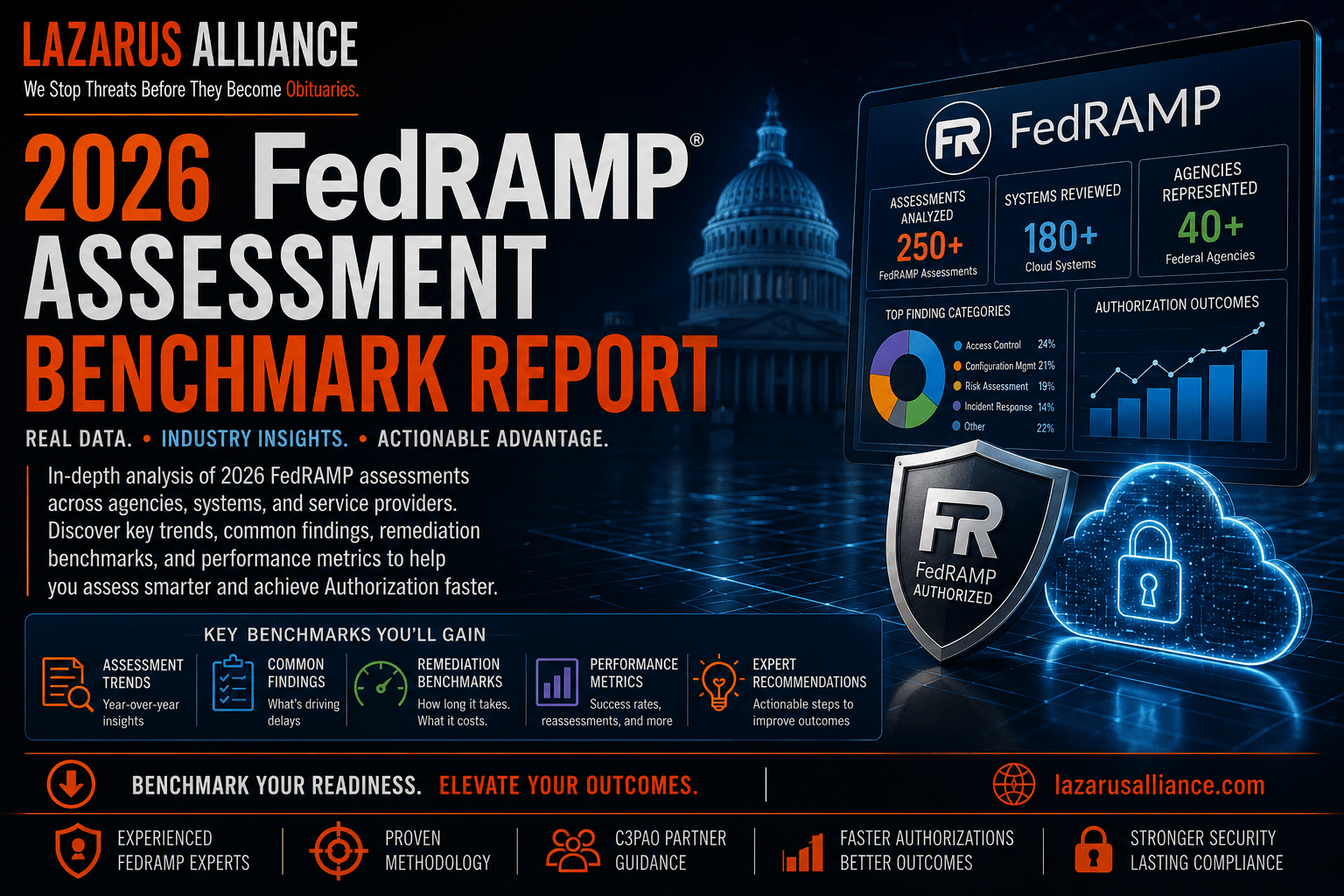
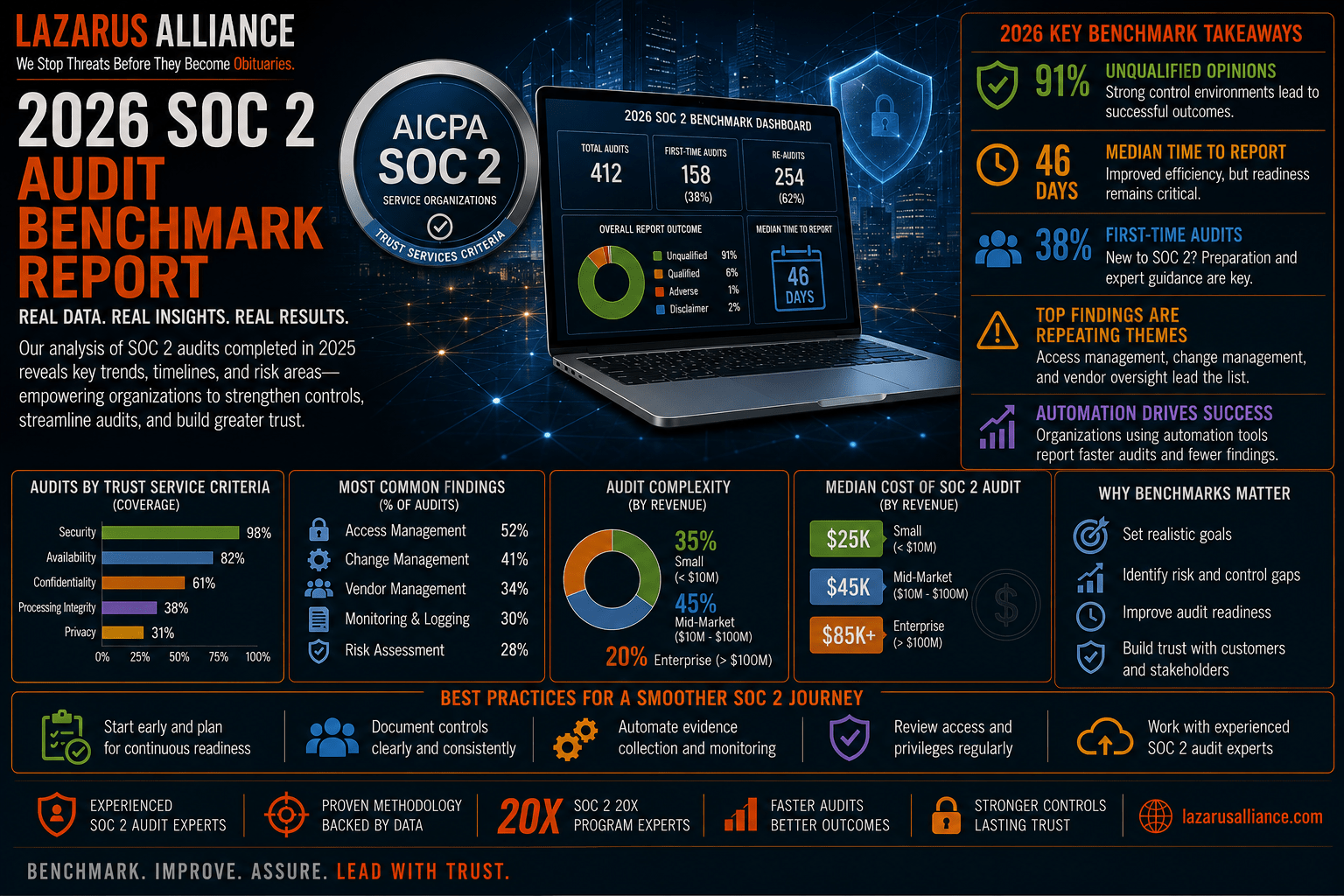
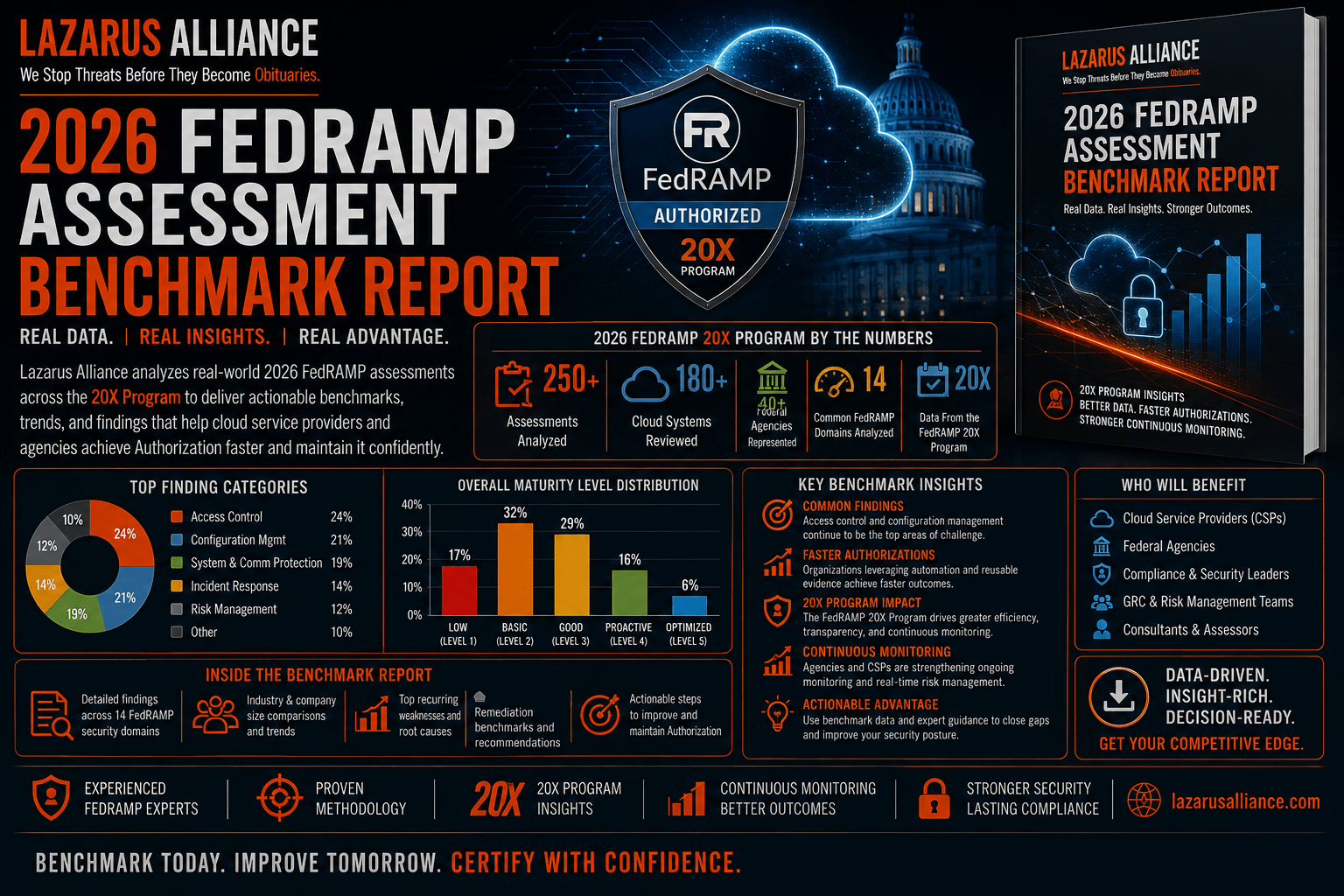
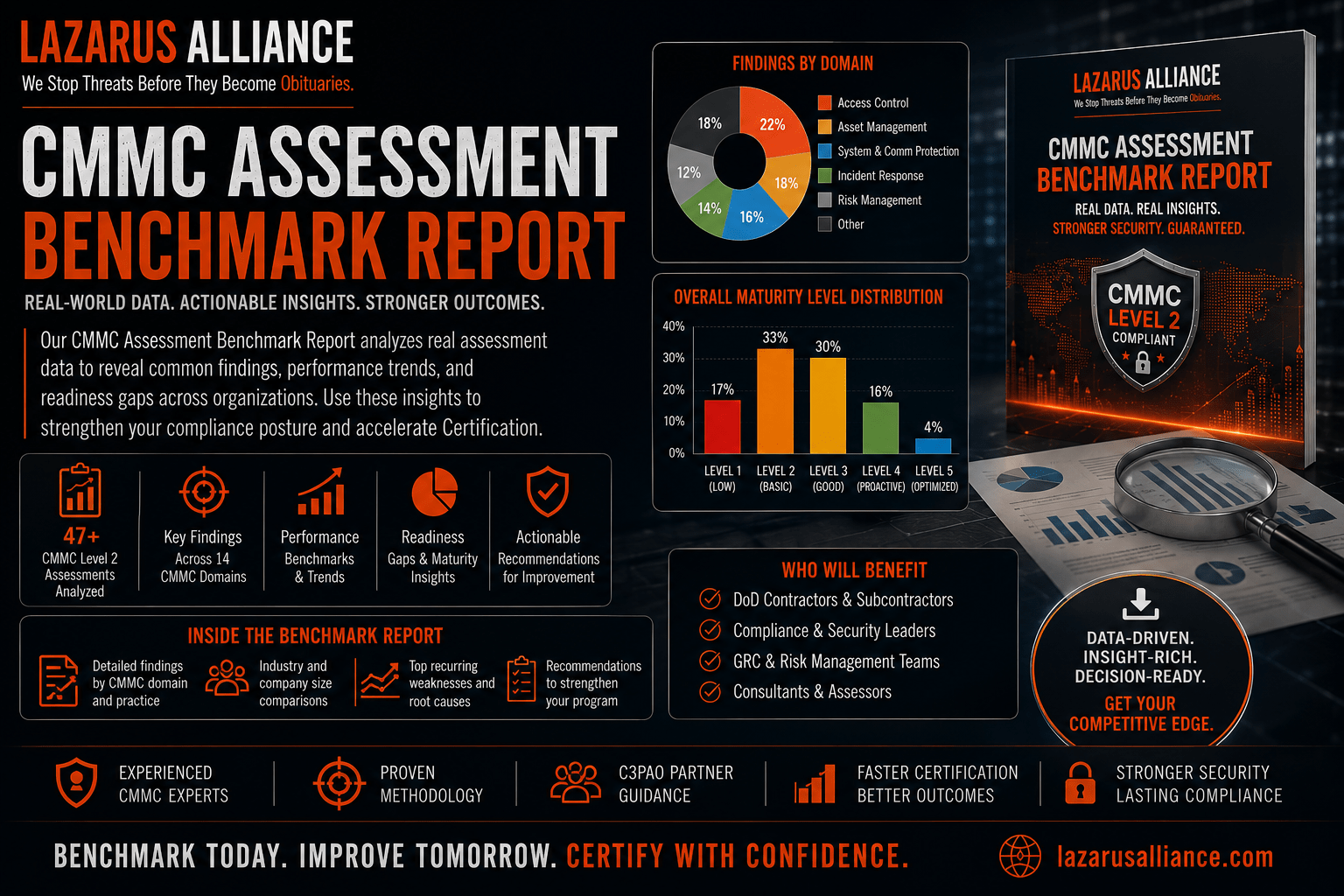
Lazarus Alliance Research publishes aggregate, anonymized findings from completed cybersecurity assessments to provide empirical insight into assessment duration, evidence requirements, common findings, scope complexity, and other factors affecting government cybersecurity compliance.
Frequently Asked Questions
Lazarus Alliance provides independent cybersecurity assessment, audit, compliance, and risk-management services across government and defense requirements including CMMC, FedRAMP, NIST SP 800-171, NIST SP 800-172, NIST SP 800-53, DFARS, FISMA, GovRAMP, CJIS, LADMF, IRS Publication 1075, IRS Publication 4812, and CNSSI 1253, along with other applicable federal, defense, and public-sector security requirements. Certain government cybersecurity programs require assessments to be performed by organizations that meet defined authorization, accreditation, competency, impartiality, or independence requirements. An appropriately qualified independent assessor provides objective evaluation of whether security requirements have been implemented and whether supporting evidence demonstrates that controls operate as required. Lazarus Alliance maintains recognized independent assessment credentials across government and regulated cybersecurity programs, including capabilities supporting CMMC, FedRAMP, LADMF, and other independent assurance activities within the scope of applicable authorizations and accreditations. Applicability depends on factors including the government customers you serve, contracts you hold, information you process or store, systems you operate, cloud services you provide, and regulatory or program requirements incorporated into those relationships. An organization can be subject to multiple cybersecurity frameworks simultaneously, so applicability should be evaluated against the specific environment and obligations rather than determined from industry alone. These requirements are closely related but serve different purposes. DFARS establishes contractual cybersecurity obligations for applicable Department of Defense contractors. NIST SP 800-171 establishes security requirements for protecting Controlled Unclassified Information in nonfederal systems and organizations. CMMC provides the Department of Defense with a program for assessing implementation of applicable cybersecurity requirements within the Defense Industrial Base. FISMA establishes federal information-security responsibilities and a risk-based approach to protecting federal information and information systems. NIST SP 800-53 provides the catalog of security and privacy controls used extensively by federal organizations to implement and assess safeguards. NIST SP 800-53 therefore supports the broader federal risk-management and security objectives associated with FISMA. CJIS security requirements apply to organizations and environments with authorized access to Criminal Justice Information (CJI) and associated systems or services. This can include criminal justice agencies as well as applicable contractors, cloud providers, technology providers, and service organizations supporting those agencies. Requirements depend on the organization's role, access to CJI, system architecture, and applicable CJIS obligations. Government cybersecurity frameworks frequently share security concepts and controls, particularly when they are based on NIST standards. Existing controls, documentation, technical evidence, and previous assessment results may therefore support more than one compliance effort. However, completing one assessment does not automatically establish compliance with another framework. Each program can have different applicability criteria, scoping rules, testing procedures, evidence requirements, authorization processes, and contractual obligations. Organizations that process, store, or transmit Controlled Unclassified Information (CUI) for the Department of Defense may be subject to CMMC requirements when the applicable DoD solicitation or contract includes those requirements. CUI protection can also create obligations under DFARS and NIST SP 800-171. The applicable CMMC level and assessment requirements should be determined from the specific contract, information environment, and current DoD requirements. NIST SP 800-171 establishes foundational security requirements for protecting Controlled Unclassified Information in nonfederal systems and organizations. NIST SP 800-172 supplements those requirements with enhanced protections intended for CUI associated with critical programs or high-value assets where additional safeguards against advanced and persistent threats are required. FISMA addresses information-security responsibilities across federal agencies and applicable federal information systems. FedRAMP provides a standardized security assessment, authorization, and continuous-monitoring program specifically for cloud products and services used by federal agencies. FedRAMP builds upon NIST security controls while adding cloud-specific program, assessment, authorization, and continuous-monitoring requirements. FedRAMP provides standardized cloud security assessment and authorization for cloud products and services used by U.S. federal agencies. GovRAMP provides a standardized cloud security assurance framework for participating state, local, education, and other public-sector organizations. The programs share security concepts and may have overlapping controls, but they have distinct program requirements, assessment processes, and authorization environments. Organizations receiving, processing, storing, or transmitting Federal Tax Information (FTI) may be subject to the safeguarding requirements of IRS Publication 1075. The publication establishes requirements for protecting FTI and applies to authorized organizations receiving federal tax information. Other IRS security requirements may also apply depending on the organization's systems, information exchanges, and relationship with the IRS.
What government cybersecurity frameworks does Lazarus Alliance assess?
Why use an accredited or authorized independent cybersecurity assessor?
How do I determine which government cybersecurity requirements apply to my organization?
What is the relationship between CMMC, DFARS, and NIST SP 800-171?
What is the relationship between FISMA and NIST SP 800-53?
When do CJIS Security Policy requirements apply?
Can one cybersecurity assessment satisfy multiple government frameworks?
Does handling Controlled Unclassified Information require CMMC?
What is the difference between NIST SP 800-171 and NIST SP 800-172?
What is the difference between FedRAMP and FISMA?
What is the difference between FedRAMP and GovRAMP?
Which cybersecurity requirements apply to Federal Tax Information?
Government Cybersecurity Requirements Are Complex. Your Assessment Strategy Shouldn’t Be.
Government and defense organizations operate within an increasingly complex cybersecurity environment where regulatory requirements, contractual obligations, security frameworks, and independent assessment requirements often intersect.
Whether your organization is protecting Controlled Unclassified Information (CUI), preparing for a CMMC assessment, pursuing FedRAMP authorization, securing a federal information system, supporting a National Security System, handling regulated government data, or providing cloud services to the public sector, Lazarus Alliance provides the independent cybersecurity assessment expertise needed to navigate these requirements with confidence.
Our government cybersecurity capabilities span CMMC, FedRAMP, NIST SP 800-171, NIST SP 800-172, NIST SP 800-53, DFARS, FISMA, GovRAMP, CJIS, LADMF, IRS Publication 1075, IRS Publication 4812, CNSSI 1253, and related government security requirements.
Move From Requirements to Defensible Assurance
Lazarus Alliance combines accredited and authorized independent assessment capabilities, technical cybersecurity expertise, and experience gained from real-world government and defense engagements to help organizations:
- Determine which cybersecurity requirements apply to their environment
- Define defensible system and assessment boundaries
- Evaluate security control implementation and effectiveness
- Validate technical, operational, and documentary evidence
- Identify cybersecurity and compliance gaps
- Prepare for formal independent assessments and authorization activities
- Maintain security and compliance through continuous monitoring
- Demonstrate cybersecurity assurance to government customers and stakeholders
Protect sensitive government information. Demonstrate compliance. Strengthen mission assurance.