NIST CSF 2.0 Assessment & Implementation Services | Lazarus Alliance
Table of Contents
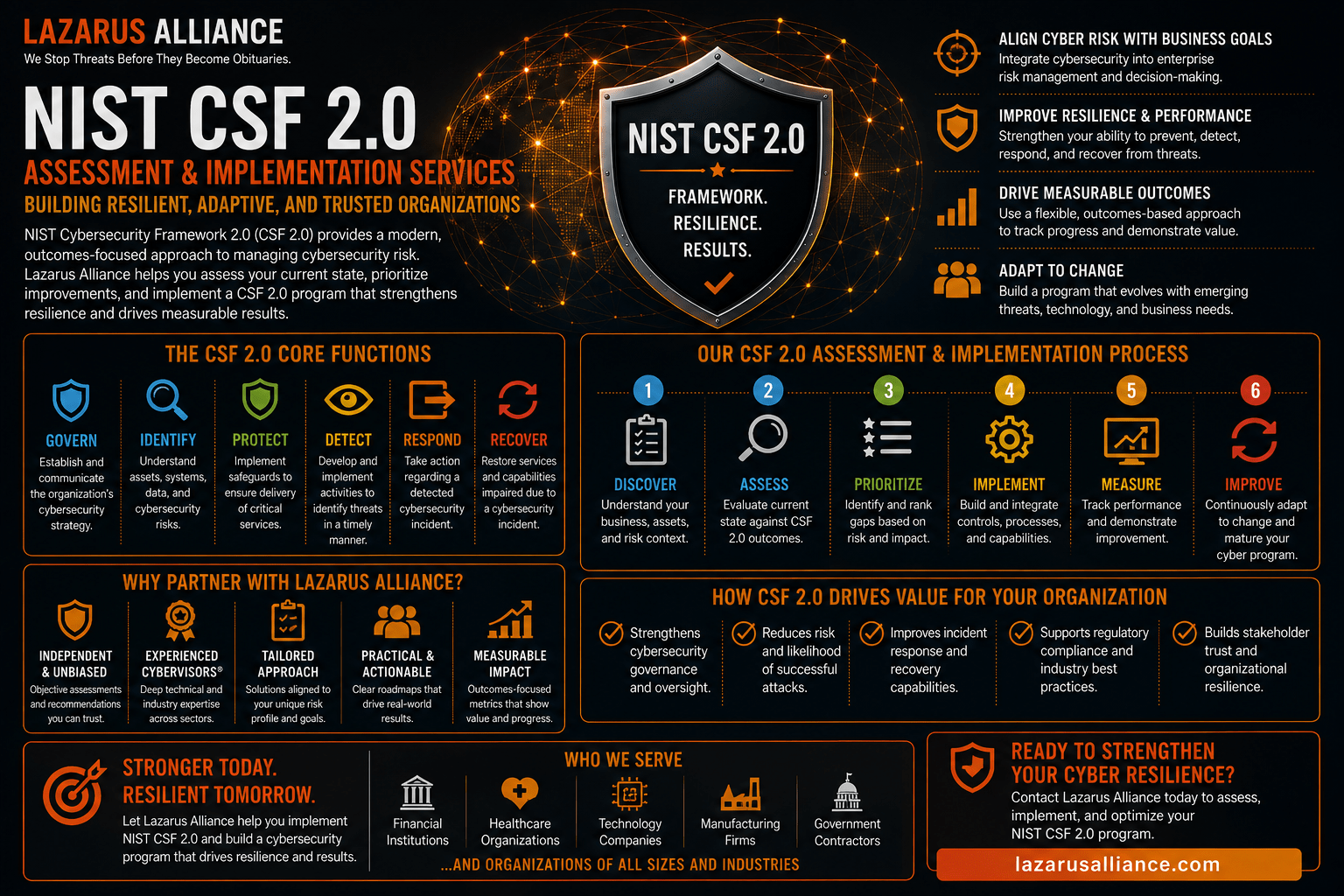
ToggleStrengthen your organization's cybersecurity resilience and risk management capabilities with NIST Cybersecurity Framework (CSF) 2.0 assessment and implementation services from Lazarus Alliance. Our experienced Cybervisors® help organizations evaluate cybersecurity maturity, identify security gaps, align governance and risk management practices with the six NIST CSF 2.0 core functions, and develop actionable improvement roadmaps to enhance security, resilience, and regulatory readiness with confidence.
Turn compliance requirements into a competitive advantage.
Call +1-888-896-7580 or schedule your free consultation today.
Lazarus Alliance: Proactive NIST Cybersecurity Framework Services. Call +1 (888) 896-7580 today.
Lazarus Alliance helps organizations turn NIST CSF 2.0 from a slide deck into an operating cybersecurity program. As an A2LA-accredited Third-Party Assessment Organization (3PAO), authorized CMMC C3PAO, FedRAMP 3PAO, PCI DSS QSA, and veteran-owned small business, we assess CSF outcomes against the controls that actually prove them — typically NIST SP 800-53 Rev. 5 — using our proprietary Continuum GRC IT Audit Machine® (ITAM) and Cybervisor® advisory teams.
NIST CSF 2.0 is voluntary, outcome-based, and designed for any organization. Boards use it to govern cyber risk. Operators use it to prioritize work. Assessors use it to show whether Identify, Protect, Detect, Respond, Recover — and now Govern — are real. Lazarus Alliance bridges that gap: we build Current and Target Profiles, map 106 Subcategories to auditable controls, close gaps, and produce defensible evidence your executives, customers, insurers, and regulators can trust.
What Is NIST CSF 2.0?
The NIST Cybersecurity Framework 2.0, published February 26, 2024, is the first major update since the Framework’s 2014 launch. It expands the original critical-infrastructure focus to every organization — small businesses, manufacturers, SaaS providers, healthcare systems, financial institutions, state and local government, and federal contractors.
CSF 2.0 is not a control catalog. It is a taxonomy of cybersecurity outcomes organized as:
- 6 Functions — Govern, Identify, Protect, Detect, Respond, Recover
- 22 Categories under those Functions
- 106 Subcategories describing desired outcomes
- Organizational Profiles that describe current and target posture
- Implementation Tiers (Partial, Risk Informed, Repeatable, Adaptive) that describe the rigor of risk governance
The defining addition in 2.0 is the Govern (GV) Function. Cyber risk is no longer treated as an IT workstream. CSF 2.0 expects leadership to set strategy, roles, policy, oversight, and supply-chain expectations — and to monitor whether those decisions actually change outcomes.
Why Organizations Adopt NIST CSF 2.0
- A common language for the board and the SOC. Executives talk outcomes; engineers talk controls. CSF translates both.
- A foundation for other mandates. CSF maps to NIST 800-53, 800-171, CMMC, FedRAMP, SOC 2, ISO 27001, HIPAA, CJIS, and CISA Cross-Sector Cybersecurity Performance Goals.
- Supply-chain and third-party risk. CSF 2.0 elevates GV.SC so vendor risk is governed, not merely inventoried.
- Insurability and customer diligence. Carriers, primes, and enterprise buyers increasingly ask for CSF Profiles and evidence, not slogans.
- Scalable maturity. Start with a Current Profile. Set a Target Profile. Close the gap. Raise the Tier when the business can sustain it.
The Six NIST CSF 2.0 Functions
Outcome-based Core of the NIST Cybersecurity Framework 2.0 — 6 Functions, 22 Categories, 106 Subcategories.
| Function | What “done” looks like |
|---|---|
| Govern GV | The organization’s cybersecurity risk management strategy, expectations, and policy are established, communicated, and monitored. |
| Identify ID | The organization’s current cybersecurity risks are understood — assets, data, suppliers, and exposures are known so work can be prioritized. |
| Protect PR | Safeguards to manage the organization’s cybersecurity risks are used, including identity, access, data security, awareness, and platform resilience. |
| Detect DE | Possible cybersecurity attacks and compromises are found and analyzed in time to matter. |
| Respond RS | Actions regarding a detected cybersecurity incident are taken — contain, communicate, analyze, and improve. |
| Recover RC | Assets and operations affected by a cybersecurity incident are restored, and recovery capability is improved after every event. |
Lazarus Alliance NIST CSF Services
We deliver a full CSF lifecycle — advisory, implementation support, independent assessment, and continuous monitoring — without forcing you into a one-size program.
1. CSF Readiness & Current Profile
We inventory assets, data flows, suppliers, existing policies, and control evidence, then score each of the 106 Subcategories against your actual operating environment. You receive a Current Profile, a prioritized gap register, and a board-ready heat map — not a 200-page binder no one will read.
2. Target Profile, Tiers & Roadmap
Together we set a Target Profile aligned to your risk appetite, contracts, insurance requirements, and regulatory path (FISMA/RMF, FedRAMP, CMMC, SOC 2, ISO, HIPAA, CJIS, StateRAMP/GovRAMP). We recommend an Implementation Tier that your organization can actually sustain, then sequence remediation into a critical-path roadmap.
3. Control Mapping & Evidence Architecture
Every CSF Subcategory is mapped to the underlying 800-53 (and other framework) controls that will stand up in an audit. Evidence is loaded into Continuum GRC ITAM so one artifact can satisfy CSF, 800-53, CMMC, FedRAMP, and SOC 2 where the control is shared. That is how clients stop rebuilding the same program four times.
4. Gap Remediation & Policy Support
Cybervisor® advisors help close high-risk gaps: governance charters, risk strategy, supply-chain requirements, identity and access, logging and detection, incident response, backup and recovery, and workforce training. Policies are written in business language and remain audit-defensible.
5. Independent CSF + 800-53 Assessment (SCA-V)
As an A2LA-accredited 3PAO laboratory, Lazarus Alliance performs Security Control Assessment & Validation (SCA-V). We test the controls that implement your CSF outcomes using SP 800-53A procedures. Deliverables typically include a Security Assessment Report (SAR), residual-risk analysis, POA&M, and an attestation package suitable for internal authorization, customer diligence, or a federal ATO path.
6. Continuous Monitoring & Profile Maintenance
CSF is not a one-time project. We leave you with dashboards, recurring control tests, supplier reviews, and an annual Profile refresh so the Target state does not decay the month after the report is issued.
Who This Service Is For
- Commercial enterprises that need a board-level cyber risk program without adopting a full federal control baseline on day one.
- Critical infrastructure and regulated industries (energy, healthcare, finance, manufacturing, transportation, water, communications).
- Federal contractors and CSPs using CSF as the executive layer over NIST 800-53, FedRAMP, CMMC, or RMF.
- State, local, tribal, and territorial governments aligning to CSF and CISA performance goals.
- Organizations preparing for cyber insurance, M&A diligence, or customer security questionnaires.
How CSF Connects to Other Lazarus Alliance Programs
NIST CSF 2.0 is the executive layer. Lazarus Alliance maps it to the assessable frameworks your contracts actually require.
| Framework | How CSF 2.0 is used |
|---|---|
| NIST SP 800-53 Rev. 5 Primary mapping | Primary Informative Reference. CSF outcomes are validated by assessing the underlying 800-53 controls with SP 800-53A procedures. |
| FISMA / NIST RMF (800-37) Authorization | CSF Profiles inform system categorization, control selection, authorization decisions, and continuous monitoring under the Risk Management Framework. |
| FedRAMP / StateRAMP / GovRAMP 3PAO | CSF is the executive narrative; 800-53 is the authorization baseline Lazarus Alliance assesses as an A2LA-accredited 3PAO. |
| CMMC / NIST 800-171 / 800-172 C3PAO | CSF governs the program; 800-171/172 practices protect FCI and CUI. Lazarus Alliance assesses both as an authorized C3PAO. |
| SOC 2 / ISO 27001 / PCI DSS Commercial | Shared evidence in Continuum GRC ITAM reduces duplicate testing across commercial attestations and QSA examinations. |
| CISA CPGs Performance | Cross-Sector Cybersecurity Performance Goals map cleanly to CSF Functions, especially Govern and Identify. |
NIST CSF Assessment Timeline
Typical Current Profile + gap assessment: 4–8 weeks. Combined CSF 2.0 + NIST SP 800-53 SCA-V: 6–12 weeks from kickoff to final SAR — about 46% faster than traditional manual audits when evidence is loaded into Continuum GRC.
| Phase | Activities | Duration | Deliverables |
|---|---|---|---|
| 0 — Pre-Engagement Decision | Consultation, NDA, scope, engagement letter, and Continuum GRC portal access. | 1–2 weeks | SOW and project charter |
| 1 — Kickoff & Scoping Scope | Function mapping, asset/supplier inventory, baseline selection, and Profile decisions. | Week 0–1 | Scope and document request |
| 2 — Current Profile & Gaps Assess | Subcategory scoring, 800-53 mapping, and evidence collection. | Weeks 1–5 | Current Profile and gap plan |
| 3 — Remediation Close gaps | Policy, control, and configuration work; supplier requirements; and training. | Weeks 5–8 | Updated artifacts and POA&M |
| 4 — Assessment / SCA-V Test | Interviews, sampling, technical testing, and optional penetration testing. | Weeks 8–11 | Findings and draft SAR |
| 5 — Report & ConMon Sustain | Final report, Target Profile, and continuous monitoring plan. | Weeks 11–12+ | SAR, attestation, and roadmap |
Why Lazarus Alliance
Independent 3PAO assessment, Continuum GRC automation, and fixed-fee Critical Path delivery — not workshops, spreadsheets, or open-ended hours.
| Lazarus Alliance | Typical consultant | Spreadsheet self-assessment |
|---|---|---|
| A2LA-accredited 3PAO + CMMC C3PAO + FedRAMP 3PAO | Often advisory only; no independent lab accreditation | No independent opinion |
| CSF outcomes validated against NIST SP 800-53A procedures | Workshops and checklists | Honor-system scoring |
| Continuum GRC ITAM + AITAMBot automation | Generic GRC or shared drives | Version chaos |
| Fixed-fee scoping and Critical Path Methodology | Hourly scope creep | Internal labor with no end date |
| Reuse evidence across CMMC, FedRAMP, SOC 2, and ISO | One framework at a time | Rebuild for every customer questionnaire |
Frequently Asked Questions
No. CSF 2.0 is voluntary. It is nevertheless the de facto language for cybersecurity risk management in the United States and is increasingly referenced in contracts, insurance applications, state programs, and federal strategy. Many organizations adopt it because customers and boards already expect it. CSF describes outcomes (106 Subcategories). NIST SP 800-53 is a catalog of detailed, assessable controls. One CSF outcome often maps to several 800-53 controls. Use CSF to govern and communicate. Use 800-53 (or 800-171, ISO, or SOC 2) to implement and audit. Lazarus Alliance does both in one engagement when you need a defensible result. Either. Some clients need a Current/Target Profile and roadmap. Others need an independent SCA-V that proves those outcomes through 800-53 testing. We scope to the decision you actually have to make — board reporting, customer diligence, FISMA/RMF, FedRAMP, or CMMC. 106 Subcategories across 22 Categories and 6 Functions. Govern is the new Function in 2.0 and carries a large share of the added governance and supply-chain outcomes. Tiers characterize the rigor of cybersecurity risk governance: Partial (Tier 1), Risk Informed (Tier 2), Repeatable (Tier 3), and Adaptive (Tier 4). A higher Tier is not automatically “more secure.” It means risk decisions are more consistent, measured, and integrated with enterprise risk management. We help you pick a Tier you can operate, not a label you cannot defend. No. CSF does not confer CMMC certification or FedRAMP authorization. It does organize the program those assessments will examine. Completing CSF work first usually shortens later CMMC, FedRAMP, SOC 2, and ISO engagements because evidence and ownership already exist. Cost depends on scope: number of systems, suppliers, locations, and whether you need a Profile only or a full SCA-V. Lazarus Alliance uses fixed-fee scoping after a complimentary consultation so you are not buying open-ended hours. Call +1 (888) 896-7580 for a quote tied to your environment. Yes. CSF 2.0 was explicitly expanded beyond critical infrastructure. We right-size Profiles and Tiers so a 40-person manufacturer and a multi-cloud SaaS provider are not forced through the same control set.
Is NIST CSF 2.0 mandatory?
How is CSF 2.0 different from NIST SP 800-53?
Do you assess CSF alone, or only with 800-53?
How many Subcategories are in CSF 2.0?
What are CSF Tiers?
Can CSF work replace CMMC or FedRAMP?
How much does a NIST CSF engagement cost?
Do you work with small and mid-size organizations?
Credentials You Can Count On
- Veteran-Owned Small Business (VOSB) | UEI: CQD9NFDH7AH4 | CAGE: 4PHZ4
- Authorized CMMC C3PAO (CPN 10251) | A2LA ISO/IEC 17020
- A2LA-accredited FedRAMP 3PAO
- PCI DSS Qualified Security Assessor (QSA)
- Delaware-licensed CPA firm — SOC 1, SOC 2, SOC 3
- GSA MAS 47QRAA22D009A
Talk with one of our experts
Our Lazarus Alliance Cybervisor™ teams have experience performing thousands of assessments for organizations providing services to clients around the world.
We're here to answer any questions you may have.