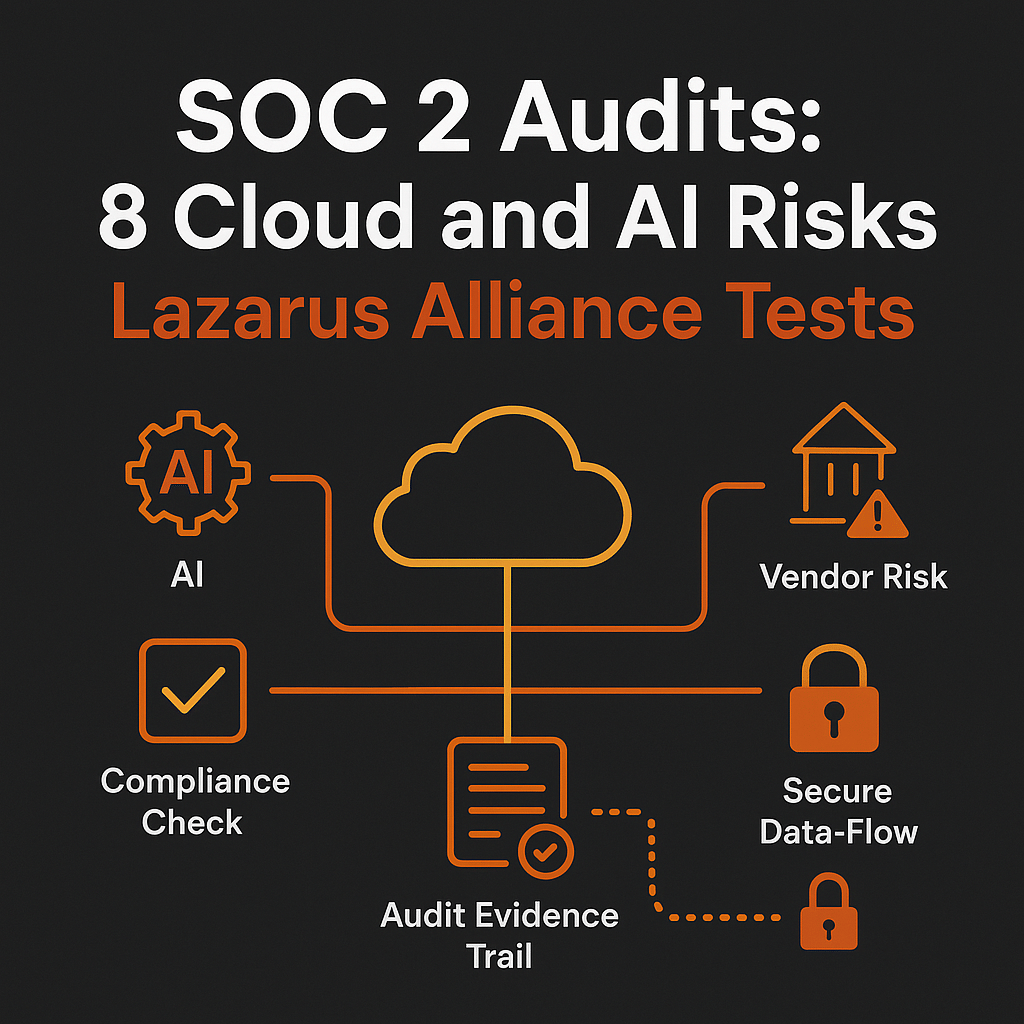
The most difficult SOC 2 audit findings in 2026 are rarely caused by a missing policy. They usually come from an inaccurate system boundary: a cloud service outside the diagram, an AI workflow nobody classified, a subservice organization omitted from the description, or monitoring evidence that exists but cannot be tied to the in-scope system. For organizations pursuing a SOC 2 audit, SOC 1 readiness, cloud compliance, AI governance, or broader cybersecurity audits, the strategic question is no longer simply, Do we have controls? It is, Can we prove the right controls operated over the right system, for the right period, with the right third-party dependencies disclosed?
SOC 2 Audit Scrutiny Has Shifted to System Boundaries
A SOC report is a customer assurance document, but auditors evaluate it as a system of facts. The AICPA describes SOC services as reports that help users understand controls at a service organization, including SOC 1 reporting for controls relevant to user entities’ internal control over financial reporting and SOC 2 reporting for controls relevant to trust services categories such as security, availability, processing integrity, confidentiality, and privacy AICPA & CIMA, SOC Suite of Services.
That distinction matters. A payroll platform, fintech processor, claims administrator, or managed infrastructure provider may need SOC 1 readiness when its controls affect customer financial reporting. The same organization may also need a SOC 2 audit when customers rely on the platform’s security, availability, confidentiality, processing integrity, or privacy controls. Lazarus Alliance supports organizations preparing for both SOC 1 and SOC 2 examinations through scoping, readiness, evidence review, and control validation Lazarus Alliance, SOC 1 & SOC 2 Audit Services.
The core audit challenge is that modern systems are not confined to one data center, one application, or one vendor. A typical SaaS environment may include cloud hosting, managed databases, CI/CD tooling, observability pipelines, support platforms, identity providers, AI copilots, payment processors, customer-managed integrations, and offshore support functions. If those components process, transmit, store, secure, or monitor in-scope data, they may belong in the SOC system description or in the subservice organization analysis.
Below are the eight cloud and AI risks Lazarus Alliance commonly tests when helping organizations prepare for SOC 2, SOC 1, and related compliance assessments.
1. Incomplete SOC 2 System Boundaries and Misstated Services
Audit risk: The report describes a product, but evidence shows the control environment actually depends on other systems, teams, datasets, integrations, or vendors.
Auditors expect the system description to align with how the service really operates. That means the boundary should address infrastructure, software, people, procedures, data flows, control responsibilities, and subservice organizations. If a company says its SOC 2 covers a customer portal but the portal relies on a separate analytics environment, unmanaged support tooling, or an AI-enabled ticket triage workflow, the boundary may be incomplete.
How Lazarus Alliance tests it:
- Trace customer commitments from contracts, security exhibits, and service descriptions into the SOC boundary.
- Review architecture diagrams, asset inventories, data-flow diagrams, identity integrations, and cloud accounts for omitted components.
- Compare production access paths with the system description to determine whether administrators, developers, support engineers, vendors, or service accounts are accurately represented.
- Validate whether SOC 1 and SOC 2 scopes should be separated, combined, or supported by complementary controls.
Common pitfall: Treating the SOC 2 boundary as a marketing definition of a product rather than an audit definition of the system used to deliver the service.
2. Cloud Compliance Drift in Infrastructure, Identity, and Configuration
Audit risk: Cloud controls are documented, but configurations drift during the Type 2 period.
Cloud compliance depends on operating evidence. NIST SP 800-53 control families are useful reference points because they define detailed expectations for access control, configuration management, system monitoring, incident response, contingency planning, and risk assessment NIST, SP 800-53 Rev. 5. For example, NIST SP 800-53 AC-2 addresses account management, CM-2 addresses baseline configuration, CM-6 addresses configuration settings, SI-4 addresses system monitoring, and RA-5 addresses vulnerability monitoring and scanning NIST, SP 800-53 Rev. 5.
FedRAMP’s current direction reinforces the same point. FedRAMP reported 92 new FedRAMP Certifications in FY2026, 538 FedRAMP Certified cloud service offerings, 760 new agency ATOs or ATUs, and a transition toward automated validation, machine-readable evidence, and continuous reporting under FedRAMP 20x FedRAMP PMO, From Foundation to Implementation. FedRAMP also stated that it will stop processing legacy Rev5 certification applications on June 11, 2027, and that its FY2027 goals include bringing all certification options into the FedRAMP 20x umbrella FedRAMP PMO, From Foundation to Implementation.
How Lazarus Alliance tests it:
- Sample cloud identity settings, privileged roles, break-glass accounts, and service principals.
- Review infrastructure-as-code repositories for peer review, approval, secrets handling, and deployment traceability.
- Compare cloud security posture findings with management’s remediation evidence.
- Validate that monitoring alerts map to in-scope services, not merely to the corporate network.
Implementation takeaway: Build an evidence pipeline that captures configuration snapshots, change approvals, vulnerability tickets, and remediation timestamps throughout the audit period.
3. AI Governance Gaps in Customer-Facing and Internal Workflows
Audit risk: AI is used inside the service organization, but it is not inventoried, risk-ranked, monitored, or disclosed where relevant.
AI governance is no longer an abstract policy issue. IBM identifies AI workload threats such as prompt injection, data poisoning, data leakage, model inversion, and shadow AI, and reports that roughly 21% of enterprise security incidents involve an AI model or application, with AI-related security incidents costing organizations an average of USD 5.33 million IBM, What Is AI Workload Security?. NIST’s AI Risk Management Framework organizes AI risk management around functions including Govern, Map, Measure, and Manage, making it a practical structure for AI control design and assessment NIST, AI Risk Management Framework.
For SOC 2, AI scrutiny often appears inside existing criteria rather than as a separate report category. If an AI assistant summarizes support tickets, accesses customer data, generates code, scores transactions, or assists incident response, auditors will ask how the organization controls access, data retention, change management, monitoring, vendor risk, and human review.
How Lazarus Alliance tests it:
- Create or validate an AI system inventory, including embedded vendor AI features and unsanctioned tools.
- Classify AI workflows by data sensitivity, customer impact, autonomy, and model exposure.
- Test controls over prompts, outputs, training data, retrieval-augmented generation stores, and model access.
- Evaluate whether human approval is required before AI-generated actions affect customers, financial processing, or regulated data.
Organizations formalizing AI governance can use structured risk workflows such as Continuum GRC’s AI Governance & Risk capabilities to document AI assets, assign owners, track risk treatment, and maintain evidence for compliance assessments Continuum GRC, AI Governance & Risk.
4. Third-Party Risk and Subservice Organization Blind Spots
Audit risk: Management relies on vendors but cannot show how those vendors are assessed, monitored, or reflected in the SOC report.
Third-party risk is a board-level issue because adversaries increasingly exploit supplier and technology dependencies. Verizon’s 2026 Data Breach Investigations Report analyzed more than 22,000 confirmed breaches and reported that third-party involvement reached 48% of breaches, while ransomware was involved in 48% of breaches Verizon, 2026 Data Breach Investigations Report. Verizon also reported that vulnerability exploitation was the initial access vector in 31% of breaches with known initial access Verizon, 2026 Data Breach Investigations Report.
In SOC 2, vendor risk intersects with complementary subservice organization controls. If a cloud provider, identity provider, payment processor, managed support platform, AI API, or data warehouse supports the in-scope system, management must determine whether the vendor is carved out, included, or addressed through complementary controls.
How Lazarus Alliance tests it:
- Map vendors to services, data types, regions, authentication paths, and operational dependencies.
- Review vendor due diligence, contracts, SOC reports, bridge letters, penetration-test summaries, and incident notifications.
- Confirm whether vendor exceptions are reviewed by risk owners and tracked to closure.
- Assess whether critical vendor failures are included in business continuity and incident response exercises.
Continuum GRC’s Third-Party & Vendor Risk capabilities can help organizations maintain vendor inventories, risk ratings, evidence, and remediation tracking in a form that supports audit readiness Continuum GRC, Third-Party & Vendor Risk.
5. Weak Identity Governance for Privileged, Non-Human, and Federated Access
Audit risk: Access reviews cover employees, but miss service accounts, API keys, federated identities, emergency accounts, and vendor administrators.
Identity is often the control plane for cloud, AI, and data access. NIST SP 800-53 AC-2 addresses account management, AC-3 addresses access enforcement, AC-5 addresses separation of duties, AC-6 addresses least privilege, and IA-2 addresses identification and authentication of organizational users NIST, SP 800-53 Rev. 5. For defense contractors, NIST SP 800-171 Rev. 3 includes access control, identification and authentication, audit and accountability, configuration management, incident response, and risk assessment requirements for protecting Controlled Unclassified Information in nonfederal systems NIST, SP 800-171 Rev. 3.
How Lazarus Alliance tests it:
- Reconcile HR rosters, identity providers, cloud IAM, privileged access tools, source-code platforms, and production databases.
- Sample terminated users, transferred users, emergency access grants, and vendor accounts.
- Inspect service-account ownership, rotation, scope, authentication method, and logging.
- Verify that access reviews are performed by owners who understand the business and technical meaning of each role.
Common misconception: Multifactor authentication alone is not identity governance. Auditors also test provisioning, approval, recertification, deprovisioning, segregation of duties, and privileged session traceability.
6. Continuous Monitoring Evidence That Cannot Support Type 2 Testing
Audit risk: Monitoring tools exist, but evidence is incomplete, overwritten, mis-scoped, or not reviewed.
SOC 2 Type 2 testing evaluates whether controls operated over a period, so point-in-time screenshots are usually weak evidence. Monitoring evidence should show what was monitored, when alerts occurred, who reviewed them, what decisions were made, and whether exceptions were remediated.
This is where organizations often learn that tool deployment is not the same as control operation. A SIEM may collect logs, but if critical cloud audit logs are excluded, retention is too short, or alerts are not tied to incident procedures, the monitoring control may fail. NIST SP 800-53 SI-4 addresses system monitoring, AU-6 addresses audit record review, and IR-4 addresses incident handling NIST, SP 800-53 Rev. 5.
How Lazarus Alliance tests it:
- Trace alerts from detection to triage, escalation, containment, and closure.
- Validate log sources for identity, cloud control plane, endpoint, database, application, and AI gateway activity.
- Review exception queues and unresolved alerts for aged risk.
- Test whether monitoring dashboards support audit sampling across the full period.
Continuum GRC’s 2026 Audit Readiness Benchmark Report examines audit readiness practices across organizations and is useful for leaders comparing evidence maturity, accountability, and compliance operating models Continuum GRC, 2026 Audit Readiness Benchmark Report.
7. Data Classification, Privacy, and Regulated Data Flow Errors
Audit risk: The organization cannot prove where regulated or confidential data flows, especially across analytics, AI, support, and backup environments.
Data-flow accuracy is essential for SOC 2 confidentiality and privacy categories, SOC 1 processing controls, HIPAA, PCI DSS, IRS 1075, CJIS, CMMC, and government cloud programs. PCI DSS v4.0.1 remains the current PCI standard in the PCI Security Standards Council document library, and payment environments require precise scoping of cardholder data environments, service providers, segmentation, and security controls PCI Security Standards Council, PCI DSS v4.0.1 Document Library. DFARS 252.204-7021 requires contractors to maintain the required CMMC status for applicable systems and to complete annual affirmations of continuous compliance in SPRS for each applicable CMMC UID eCFR, DFARS 252.204-7021.
How Lazarus Alliance tests it:
- Map data from ingestion through processing, storage, support access, analytics, AI use, backups, and deletion.
- Confirm whether sensitive data enters development, training, logging, or observability platforms.
- Review encryption, key management, retention, masking, and access restrictions by data class.
- Identify conflicts between SOC scope, PCI scope, HIPAA risk analysis, CMMC boundaries, and customer contractual commitments.
Lazarus Alliance routinely connects SOC readiness with multi-framework requirements, including PCI DSS, HIPAA, FedRAMP, GovRAMP, CMMC, NIST 800-53, NIST 800-171, IRS 1075, CJIS, C5, ISO 27001, and LADMF assessments.
8. Incident Response, Ransomware Resilience, and Recovery Evidence Gaps
Audit risk: Incident response plans exist, but exercises do not test realistic cloud, AI, vendor, and ransomware scenarios.
Ransomware resilience is now an audit concern because customers want assurance that a provider can detect, contain, communicate, and recover from disruptive events. Verizon’s 2026 DBIR reported ransomware involvement in 48% of breaches, making incident response and recovery evidence highly relevant to SOC 2 availability, confidentiality, and security testing Verizon, 2026 Data Breach Investigations Report.
How Lazarus Alliance tests it:
- Review tabletop exercises for cloud credential compromise, AI data leakage, vendor breach, ransomware, and destructive insider scenarios.
- Inspect incident tickets, severity classifications, communications, legal escalation, root-cause analysis, and corrective actions.
- Validate backup coverage, restoration tests, recovery time objectives, and recovery point objectives.
- Check whether lessons learned result in control changes, not just meeting notes.
Scenario: A SaaS provider uses an AI support assistant connected to customer tickets. During testing, the team discovers that support transcripts containing sensitive implementation details are retained in an analytics workspace outside the SOC boundary. The corrective action is not merely to update the diagram. The provider must classify the data, restrict access, assess the AI vendor, update retention rules, add monitoring, revise customer disclosures if needed, and include the workflow in future risk assessments.
A Lazarus Alliance Decision Matrix for SOC 2 and SOC 1 Readiness
Use this practical matrix before selecting a SOC report scope or entering Type 2 testing:
- If the service affects customer financial reporting: evaluate SOC 1 readiness and controls over transaction processing, reconciliations, change management, logical access, and data completeness.
- If customers rely on security, uptime, confidentiality, processing integrity, or privacy: evaluate SOC 2 readiness against the applicable trust services categories.
- If the system handles CUI: map the boundary to NIST SP 800-171 Rev. 3 and applicable CMMC obligations NIST, SP 800-171 Rev. 3.
- If the system supports federal cloud customers: align evidence architecture with FedRAMP 20x expectations for automation, continuous reporting, and machine-readable evidence FedRAMP PMO, From Foundation to Implementation.
- If AI touches customer data or operational decisions: create an AI inventory, classify use cases, test human oversight, and map governance to NIST AI RMF NIST, AI Risk Management Framework.
- If vendors operate critical controls: verify subservice organization treatment, complementary controls, vendor evidence, and incident notification obligations.
How to Prepare Evidence Before the Auditor Asks
Executive teams can reduce audit friction by treating evidence as an operating discipline rather than a scramble. Start with the system boundary, then build a control-to-evidence map. Each control should have an owner, frequency, population, evidence source, exception workflow, and retention rule. For technical controls, prefer system-generated evidence over manual attestations. For governance controls, retain meeting agendas, risk decisions, approvals, and follow-up actions.
The strongest SOC 2 audit programs integrate cybersecurity audits, compliance assessments, cloud compliance reviews, AI governance, and third-party risk management into a single evidence model. That approach reduces duplication across SOC 2, SOC 1, ISO 27001, PCI DSS, HIPAA, FedRAMP, GovRAMP, CMMC, CJIS, IRS 1075, C5, and LADMF readiness efforts. It also gives CISOs and compliance leaders a defensible view of risk before customers, regulators, or acquirers request proof.
Lazarus Alliance’s perspective is straightforward: a SOC report is only as credible as the boundary, evidence, and control operation behind it. Organizations that test cloud configuration, AI governance, identity, vendors, monitoring, data flows, and recovery before the audit period are better positioned to produce a clean, useful, and trusted report.
Sources and References
- AICPA & CIMA, SOC Suite of Services
- Lazarus Alliance, SOC 1 & SOC 2 Audit Services
- NIST, SP 800-53 Rev. 5
- FedRAMP PMO, From Foundation to Implementation
- IBM, What Is AI Workload Security?
- NIST, AI Risk Management Framework
- Continuum GRC, AI Governance & Risk
- Verizon, 2026 Data Breach Investigations Report
- Continuum GRC, Third-Party & Vendor Risk
- NIST, SP 800-171 Rev. 3
- Continuum GRC, 2026 Audit Readiness Benchmark Report
- PCI Security Standards Council, PCI DSS v4.0.1 Document Library
- eCFR, DFARS 252.204-7021
About Lazarus Alliance
To learn more about how Lazarus Alliance can help, contact us.
- FedRAMP
- GovRAMP
- NIST 800-53
- DFARS NIST 800-171
- CMMC
- SOC 1 & SOC 2
- C5
- HIPAA, HITECH, & Meaningful Use
- PCI DSS RoC & SAQ
- IRS 1075 & 4812
- CJIS
- LA DMF
- ISO 27001, ISO 27002, ISO 27005, ISO 27017, ISO 27018, ISO 27701, ISO 22301, ISO 17020, ISO 17021, ISO 17025, ISO 17065, ISO 9001, & ISO 90003
- And dozens more!
Related Posts