IT Pre-Acquisition Assessment Services | M&A Cybersecurity Due Diligence
Table of Contents
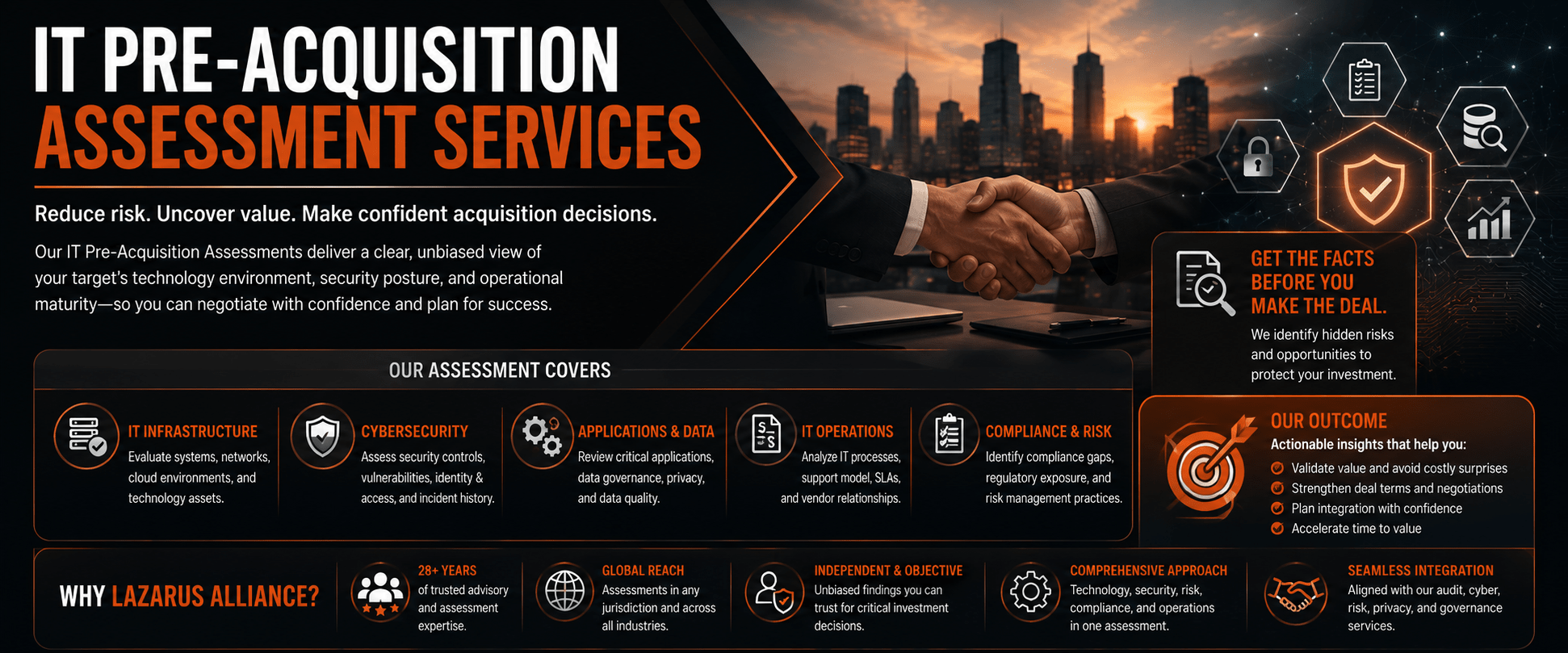
ToggleLazarus Alliance delivers structured, phased IT and cybersecurity due diligence for organizations undergoing mergers, acquisitions, divestitures, or private-equity transactions. Our Cybervisor® experts rapidly identify material IT, cybersecurity, data protection, and regulatory risks while minimizing disruption to the target company’s operations.
The assessment provides acquirers with clear, actionable intelligence in 4–8 weeks so they can protect deal value and ensure a smooth post-close transition.
Turn compliance requirements into a competitive advantage.
Call +1-888-896-7580 or schedule your free consultation today.
Why IT Pre-Acquisition Assessment Matters
Hidden IT and cybersecurity risks can erode deal value, create post-close liabilities, and complicate integration. A focused pre-acquisition assessment surfaces critical issues early, supports valuation adjustments and indemnification, and reduces surprises after closing.
Lazarus Alliance assessments are purpose-built for M&A timelines and work across industries including finance, healthcare, technology, manufacturing, professional services, and private-equity portfolio companies.
Key Challenges We Solve
| Challenge | Business Impact | How We Address It | |
|---|---|---|---|
| 🔍 | Hidden cybersecurity and IT risks | Deal value erosion and post-close liabilities | Rapid Wave 1 review of highest-risk items within 14 days |
| ⚖️ | Overwhelming the target company | Slow responses and incomplete data | Phased two-wave structure that respects operational capacity |
| 📜 | Regulatory and compliance gaps | Unexpected remediation costs or deal delays | Customizable coverage (FTC Safeguards, HIPAA, PCI DSS, ISO, CMMC, and more) |
| 🔄 | Incomplete transition visibility | Integration surprises and operational disruption | Dedicated focus on systems, contracts, credentials, and data preservation |
| 📊 | Lack of clear, actionable findings | Difficulty negotiating or planning remediation | Prioritized risk ratings, gap analysis, and concrete recommendations |
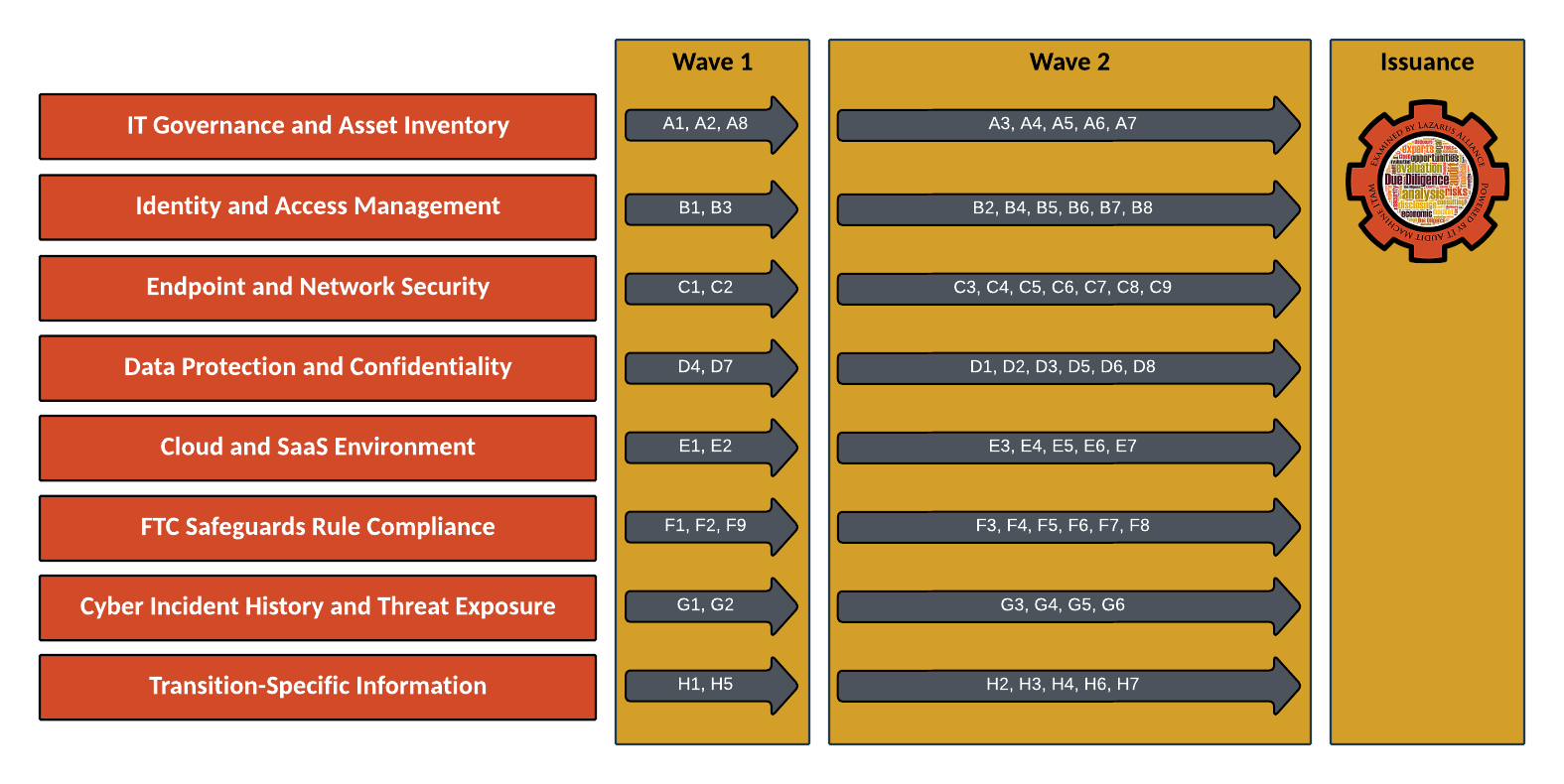
Assessment Scope – 8 Critical Sections
- IT Governance and Asset Inventory: Policies, MSP ownership, hardware/software inventories, business continuity/disaster recovery
- Identity and Access Management: User accounts, MFA, privileged access, password policies
- Endpoint and Network Security: EDR/AV, patching, firewalls, vulnerability scanning, network diagrams
- Data Protection and Confidentiality: Backups, encryption, data flows, storage locations
- Cloud and SaaS Environment: Microsoft 365 posture, DLP, external sharing, AI tools, SOC 2 reports
- Regulatory Compliance: Customizable review of applicable frameworks (FTC Safeguards Rule/GLBA, HIPAA, PCI DSS, ISO 27001, CMMC, SOC 2, and others)
- Cyber Incident History and Threat Exposure: Incident summary, cyber insurance, phishing tests, external attack surface
- Transition-Specific Information: System inventories, contract terms, data preservation, departing staff considerations
Our Phased Methodology
Wave 1 (Highest-Risk Items – Due in ~14 Days)
Approximately 18–20 priority items focused on the most material risks (MSP contract, MFA status, EDR coverage, backups, basic user accounts, incident history, cyber insurance, etc.). Results determine whether deeper investigation is warranted.
Wave 2 (Detailed Review – Issued After Wave 1)
Approximately 42–44 additional items covering detailed policies, scans, data-flow maps, admin reviews, and supporting evidence. Scope can be narrowed or expanded based on Wave 1 findings.
Submission Approach
Target companies (and their MSPs) upload evidence into a secure portal. Clear format guidance is provided. Missing items are noted as findings but are not penalized when confirmed in writing.

Typical Lazarus Alliance Audit Timeline
The CRL explicitly defines only the first milestone; the rest follows standard pre-acquisition due diligence logic (aligned with deal timing). Here is a realistic timeline based directly on the framework:
| Phase | Timing (from Kickoff) | Key Activities | Owner |
|---|---|---|---|
| Kickoff & CRL Issuance | Day 0 | Full Client Request List issued + Continuum GRC access | Lazarus Alliance and Deal Team |
| Wave 1 Collection | Days 1–14 | 18–20 highest-priority items (MSP contract, users, MFA, EDR, backups, etc.) | Target firm + MSP |
| Wave 1 Review & Wave 2 Issuance | Days 15–18 | Rapid review of Wave 1, red-flag identification, and tailored Wave 2 issued | Lazarus Alliance |
| Wave 2 Collection | Days 19–35 (≈2.5 weeks) | Remaining ~42 items (detailed policies, scans, SOC 2 reports, etc.) | Target firm + MSP |
| Full Analysis & Gap Assessment | Days 36–45 | Detailed risk mapping, FTC/GLBA review, and deal implications | Lazarus Alliance |
| Findings / Report Delivery | Days 46–56 (Week 7–8) | Final report delivered to the deal team | Lazarus Alliance and Deal Team |
Total typical duration: 4–8 weeks
- Fast-track (4–6 weeks): Possible with immediate MSP coordination and rapid Wave 2 turnaround.
- Standard (6–8 weeks): Recommended for most acquisitions to allow thorough review.
This compressed schedule front-loads the highest-risk items (still completed in the first two weeks) and keeps the entire engagement agile for tighter deal timelines. All documentation continues to be managed in the Continuum GRC portal.

Key Benefits
- Front-loaded visibility into the highest-risk items
- Low disruption to the target organization through the two-wave approach
- Comprehensive coverage of the issues that most frequently affect deals
- Protection of deal value through early identification of liabilities
- Clear data for valuation adjustments, indemnification, and post-close planning
- Regulatory flexibility across industries and frameworks
- Smooth transition support via system, contract, and data-preservation insights
Why Choose Lazarus Alliance
- 26+ years of experience performing thousands of assessments
- Veteran-Owned Small Business (VOSB) with deep assessor-side insight
- Cybervisor® experts who understand both technical risk and deal dynamics
- Proven methodology that balances thoroughness with M&A timelines
- Seamless integration with our Risk Management, Audit & Compliance, Privacy, Policies & Governance, and Penetration Testing services
- Independent, accredited firm focused on practical, actionable outcomes
Frequently Asked Questions
It is a structured, phased cybersecurity and IT due diligence review specifically designed for any organization undergoing M&A or private-equity transactions. Using a detailed Client Request List (CRL), it evaluates the target firm’s IT governance, security controls, data protection, regulatory compliance, and transition readiness across 8 key sections. The two-wave structure respects the operational capacity of a target organization. Wave 1 (18–20 items) delivers the highest-risk information within 14 days. Wave 2 (≈42 items) is issued only after Wave 1 review, so the scope can be adjusted based on findings, reducing unnecessary effort. The compressed timeline is 4–8 weeks from kickoff. Wave 1 is due in 14 days, Wave 2 collection takes ≈2.5 weeks, and the remaining time is used for analysis and final report delivery. Fast-track engagements can be completed in 4–6 weeks with strong MSP support. Simply upload a brief written confirmation (Word doc or email converted to PDF is fine). The absence of key documents is noted as an audit finding but is expected for many small firms and will not be penalized. Yes — we strongly recommend looping in your MSP at kickoff. Many Wave 1 exports (user accounts, MFA status, EDR coverage, patch reports) are most efficiently pulled directly from the MSP console. All documents, system exports, configuration records, and written confirmations are uploaded directly into the AI-powered Continuum GRC platform — Lazarus Alliance’s secure, enterprise-grade Governance, Risk, and Compliance system. Every submission is automatically protected with cryptographic hashing for immutable, tamper-proof evidence and a complete chain-of-custody. The platform’s intelligent evidence management engine automatically maps files to the corresponding audit steps, while built-in AI auditor tools perform real-time validation, gap detection, and compliance analysis. Progress is monitored through live dashboards with dynamic status tracking (NR, OS, PR, RC, NA, EX), automated alerts, and intelligent remediation recommendations — delivering a fully auditable, transparent, and highly efficient due diligence workflow. It provides immediate visibility into hidden risks, protects deal value through early identification of liabilities, ensures FTC Safeguards Rule / GLBA compliance, smooths post-acquisition transition, and gives the acquiring firm concrete data for valuation adjustments and remediation planning. Yes. Section F is dedicated to FTC Safeguards Rule (Gramm-Leach-Bliley Act) compliance, including the Written Information Security Program (WISP), Qualified Individual designation, risk assessment, training, and vendor oversight. A comprehensive final report with findings, risk ratings, gap analysis, prioritized recommendations, and transition considerations. The report is delivered to the deal team and can be used for negotiation, indemnification, or post-close remediation planning.
What is the Lazarus Alliance IT Pre-Acquisition Assessment?
Why is the assessment divided into Wave 1 and Wave 2?
How long does the full assessment take?
What if a requested document or policy does not exist?
Do we need to involve our Managed Service Provider (MSP)?
How are documents submitted and tracked?
What are the main benefits of this assessment?
Does the assessment cover regulatory compliance?
What deliverables will the acquiring firm receive?
Ready to Protect Deal Value and Reduce Post-Close Surprises?
Gain clear visibility into IT and cybersecurity risks before closing.
Our Lazarus Alliance Cybervisor™ teams have experience performing thousands of assessments for organizations providing services to clients around the world.