FedRAMP 20x & 3PAO Certification Services | Class A, B & C
Table of Contents
Toggle
The U.S. federal government, through the FedRAMP and the FedRAMP Program Management Office (PMO), developed the Federal Risk and Authorization Management Program (FedRAMP) in order to standardize and streamline the security assessment, authorization, and continuous monitoring of cloud service offerings used by federal agencies.
FedRAMP 20x is no longer a pilot concept. It is the live certification path for new Low and Moderate offerings.
- Class A pipeline opened August 3, 2026 (replaces FedRAMP Ready).
- Class B and Class C pipelines opened August 31, 2026 (updated Low / Li-SaaS and Moderate paths).
- Lazarus Alliance is accepting native 20x Class B and Class C intake now.
- Mandatory adoption of the Consolidated Rules for 2026 takes effect January 1, 2027, subject to the applicability and effective-date provisions of individual rules.
- FedRAMP will stop accepting new Rev5 certifications on June 11, 2027.
- FedRAMP will not issue program certifications for both 20x and Rev5 on the same offering. Choose one path.
Lazarus Alliance is an A2LA-accredited FedRAMP Third-Party Assessment Organization (3PAO). We assess traditional Rev5 packages and 20x Class A, B, and C packages built around Key Security Indicators (KSIs), machine-readable certification evidence, and continuous validation.
Current FedRAMP 20x Status — Updated September 2026
FedRAMP 20x is now operational for Class A, Class B and Class C Certifications. Class A applications opened August 3, 2026, followed by Class B and Class C on August 31. FedRAMP Ready is now legacy, while Rev5 remains available through limited transition paths. The Consolidated Rules for 2026 become mandatory January 1, 2027, and FedRAMP will stop accepting applications for new Rev5 Certifications on June 11, 2027.
-
Receive Our Diagnostic Proposal
The FedRAMP Rev. 5-to-20x Transition Diagnostic evaluates your current FedRAMP program and identifies the technical, evidence, automation, and operational changes needed for 20x. It delivers a practical, dated roadmap for moving from Rev. 5 documentation to continuous, machine-readable execution proof.
Use the form below to request this proposal.
-
Receive Our Implementation Proposal
The FedRAMP Rev. 5-to-20x Implementation Proposal turns the transition roadmap into operational capability by implementing evidence automation, KSI validation, JSON/schema integration, and continuous assurance processes needed for FedRAMP 20x readiness.
Use the form below to request this proposal.
-
Receive Our Assessment Proposal
The FedRAMP 20x Independent Assessment Proposal provides an objective evaluation of the cloud service offering through KSI verification and validation, technical evidence review, and SDR/JSON assessment to determine conformity with applicable FedRAMP 20x requirements.
Use the form below to request this proposal.
Federal Risk and Authorization Management Program (FedRAMP)
FedRAMP is the U.S. government-wide program that standardizes security assessment, authorization, and continuous monitoring for cloud products and services used by federal agencies.
Established in 2011 and written into law by the FedRAMP Authorization Act, the program still exists to eliminate duplicative testing: authorize once, reuse many times. What changed in 2025–2026 is how that authorization is earned.
The traditional Rev5 path is a narrative, control-by-control assessment against NIST SP 800-53 Rev. 5 baselines (Low, Moderate, High). FedRAMP 20x is the modernization program built under OMB Memorandum M-24-15. It replaces long static packages with:
- Certification classes instead of only Low / Moderate / High labels
- Key Security Indicators (KSIs) instead of hundreds of narrative control statements
- Machine-readable certification packages instead of Word SSPs and PDF binders
- Continuous, automated validation instead of periodic, document-centered validation
- Program certification issued by FedRAMP and reusable by agency authorizing officials
Lazarus Alliance still supports Rev5 through the published wind-down. For any new Low or Moderate offering that belongs on the Marketplace, 20x is the path we recommend opening first.
What FedRAMP 20x Changes
FedRAMP 20x was announced by GSA in March 2025, proven in public pilots through early 2026, and opened for production Class A, B, and C certifications in August 2026.
The design goal is simple: make it possible to automate most of the application and validation of FedRAMP security requirements, reuse commercial security investments, and keep authorization data current without a yearly documentation rebuild.
20x does not remove independent assessment. A FedRAMP-recognized 3PAO still analyzes, validates, and attests to the quality of the provider’s materials so FedRAMP can determine whether the security posture is acceptable for reuse.
What it does remove is the assumption that security is proven by paragraphs. Under 20x, encryption, account management, logging, vulnerability response, and boundary enforcement are demonstrated as current system state — configuration, telemetry, and repeatable tests — not as a story written for last year’s audit.
FedRAMP Certification Classes A–D
Investment and assurance scale with agency demand. Do not jump to Class C or wait for Class D unless the data, customers, and contract require it. Start at the defensible class and climb.
| Class | Legacy analog | What agencies can generally use it for | 20x bar | Pipeline status |
|---|---|---|---|---|
| A | FedRAMP Ready | Entry listing; pilots, configuration, testing, and many non-sensitive use cases | Six federal mandates, then 12 months after a federal customer to begin moving to Class B or higher | Opened August 3, 2026 |
| B | Low / Li-SaaS | Most Low objectives; some Moderate or High with agency compensating controls | 51 KSIs | Opened August 31, 2026 |
| C | Moderate | Most Low and Moderate objectives; some High with compensating controls | 56 KSIs plus tighter continuous validation | Opened August 31, 2026 |
| D | High | Most unclassified High-impact use cases | Later-phase High baseline | Pilot expected late 2026; formal option expected early 2027 |
Class A — Marketplace on-ramp
Class A is the new FedRAMP 20x Marketplace on-ramp following the transition of FedRAMP Ready to legacy status. It is built for cloud services with a mature commercial security program that need a federal listing without immediately carrying a full Low or Moderate operating burden.
Providers must address the Class A federal mandates, including FIPS-validated cryptography, multi-factor authentication aligned to NIST SP 800-63B, CAC/PIV support, DNSSEC, defined vulnerability-response timelines, and an authorization boundary and data-flow picture precise enough for independent verification. A complete Readiness Assessment Report or a strong SOC 2 Type II package can accelerate a Class A submission. It does not skip the KSI work required for Class B or C.
Once a federal customer is using the service, the provider has 12 months to begin the move to Class B or higher.
Class B — Updated Low / Li-SaaS
Class B consolidates the old Low and Li-SaaS tracks. It is the production 20x path for offerings whose residual risk is limited and whose agency use is typically bounded. Providers must meet 51 Key Security Indicators and maintain the ongoing reporting the class requires.
No dual Rev5 + 20x program certification is available on the same offering. If Class B is the right assurance level, build it as a native 20x package.
Class C — Updated Moderate
Class C is still the center of the federal cloud market. It is the production 20x path for enterprise services agencies will actually run. Providers must meet 56 Key Security Indicators, operate a tighter continuous-validation cadence (including three-day validation expectations at this class), and keep vulnerability, incident, and change data current in a form FedRAMP and agencies can consume.
If your buyers are asking for “FedRAMP Moderate,” Class C is the conversation you are in.
Class D — High, later phase
Class D is the High path. FedRAMP expects a late-2026 pilot and a formal option in early 2027. Until that pipeline opens, High-impact work remains on the established High / Rev5 and agency-authorization tracks. Lazarus Alliance continues to assess those packages and will take native Class D intake when the PMO opens it.
Which Path You Should Take: 20x vs. Rev5
| Phase | Activities | Duration | Deliverables |
|---|---|---|---|
| Phase 0 – Pre-Engagement & Decision | Consultation, Moderate/High baseline, agency sponsor or JAB path, authorization boundary, CSP responsibilities. | 1–2 weeks | Engagement agreement, roadmap, boundary diagram, baseline confirmation. |
| Phase 1 – Scoping & Readiness | System inventory, inheritance, initial gap against NIST SP 800-53 Rev. 5, FedRAMP tailoring, documentation review. | 2 weeks | Inventory, initial SSP outline, inheritance mapping, readiness gap report. |
| Phase 2 – Gap Assessment & Remediation Planning | Identify control gaps, documentation deficiencies, evidence requirements, and POA&M priorities. Remediation and implementation activities are performed by the CSP or a separately engaged implementation provider to preserve 3PAO independence. | 3–4 weeks | Gap report, draft SSP, initial POA&M, evidence roadmap. |
| Phase 3 – Evidence Collection & Testing | Implementation verification, automated + manual testing, penetration testing support, evidence repository. | 4–6 weeks | Evidence package, test results, updated POA&M, implementation statements. |
| Phase 4 – Reporting & Package | Final SSP, SAR, FedRAMP package assembly, agency or PMO submission support. | 2–3 weeks | Complete Rev5 package (SSP, SAR, POA&M) and 3PAO artifacts. |
| Phase 5 – Authorization & ConMon | Program certification coordination, agency reuse support, ConMon planning, automated reporting cadence, and ongoing certification maintenance. Where separately engaged, Continuum GRC can support evidence management, reporting, and continuous compliance operations. | 4 weeks initial, then ongoing | Marketplace support, ConMon plan, monthly dashboards. |
Hard dates that should drive the decision:
- January 1, 2027 — Mandatory adoption of the Consolidated Rules for 2026 takes effect, subject to the applicability and effective-date provisions of individual rules.
- June 11, 2027 — FedRAMP stops accepting new Rev5 certifications.
- Class D — later. Do not stall a Class B or C program waiting for High 20x.
FedRAMP Rev. 5-to-20x Transition Diagnostic
Organizations with an existing FedRAMP Rev. 5 program face a different challenge than cloud providers starting with FedRAMP 20x. The Lazarus Alliance FedRAMP Rev. 5-to-20x Transition Diagnostic evaluates the existing security program, evidence architecture, automation, KSI coverage, historical evidence and machine-readable data capabilities to determine what can be reused, what must change and when each transition activity should occur.
Our primary deliverables are:
- Rev. 5-to-20x transition analysis
- Dated transition roadmap
- Evidence and JSON schema gap analysis
- KSI historical evidence plan
- Rev. 5/20x dual-run operating model
- Assessor-ready 20x proof package
What Our FedRAMP Assessment Data Shows
Lazarus Alliance publishes original FedRAMP assessment research based on anonymized data from completed 3PAO assessments. Our 2026 FedRAMP Assessment Benchmark Report analyzed 38 completed FedRAMP Moderate and High assessment engagements performed between January 2025 and June 2026, providing empirical benchmarks for assessment duration, evidence requirements, authorization-boundary complexity, POA&M frequency and common assessment findings.
The data demonstrates why assessment readiness depends on more than documentation:
| Assessment Benchmark | Lazarus Alliance Research Finding |
|---|---|
| Median formal assessment duration | 42 business days from assessment kickoff through delivery of the draft Security Assessment Report |
| Additional evidence required | 95% of assessments required at least one additional evidence or clarification cycle |
| POA&M occurrence | 92% had at least one POA&M item, with a median of approximately six when present |
| Average evidence volume | Approximately 3,400 discrete artifacts, ranging from roughly 1,200 to 9,500 |
| Boundary complexity | 42% involved complex, multi-component environments |
| Average assessment scope | Approximately 85 system components and 210 assets |
These findings are based on completed Lazarus Alliance FedRAMP 3PAO assessment engagements and provide empirical benchmarks for organizations planning FedRAMP readiness, assessment, and transition activities.
The practical lesson is evidence quality, not evidence volume. Across the assessments studied, recurring deficiencies included implementation statements that did not match actual architecture, evidence lacking sufficient context, incomplete logging samples, outdated inventories and configuration baselines, weak inheritance evidence, and continuous-monitoring artifacts that did not demonstrate ongoing operational effectiveness.
What Lazarus Alliance Delivers
Lazarus Alliance provides independent FedRAMP transition diagnostic and 3PAO assessment services. When technical implementation, remediation, evidence automation, or GRC platform configuration is required, those activities can be separately scoped through Continuum GRC, preserving clear separation between implementation activities and independent assessment responsibilities.
20x services now open
- Class decision and path selection. 20x versus the limited Rev5 window. Class A versus B versus C, based on data types, federal customer intent, inheritance, and the actual residual risk — not a marketing label.
- Boundary and inheritance design. Cloud service offering (CSO) scoping, customer-responsibility matrix, and inheritance from FedRAMP-authorized IaaS, PaaS, and managed services.
- KSI and control mapping. The 51 or 56 indicators tied to implemented NIST SP 800-53 outcomes. Existing SOC 2, ISO 27001, CMMC, and Rev5 work is reused where it is real. Recycled narratives are not.
- Certification package build. SSP, assessment results, and POA&M in machine-readable form from the first working draft. The package is the system of record, not a conversion project at the end.
- Evidence and ConMon architecture. Automated collection, Class C validation cadence, vulnerability SLAs, FIPS-validated cryptography, MFA, operational logging, and a trust-center pattern agencies can actually consume.
- Independent 3PAO assessment. Testing, live demonstrations, validation of automated evidence, Security Assessment Report, submission support, Marketplace listing support, and continuous monitoring after authorization.
- Rev5 completion and transition. If you are already in a Rev5 package that still has a viable calendar, we finish it and map the CR26 / 20x conversion so you are not rebuilt from zero in 2027.
Related authorization work we keep in the same program
- DoD SRG IL4 / IL5 / IL6 overlays where the federal buyer is a defense mission, not a civilian Moderate workload.
- StateRAMP, TX-RAMP, GovRAMP, IRS 1075, CMMC, SOC 2, NIST 800-53 / FISMA reuse from the same control library and evidence store.
- Continuous monitoring operations after listing — monthly and event-driven reporting, vulnerability tracking, significant-change handling, and dashboard access for your team.
That speed claim was earned on disciplined Rev5 work. It applies to 20x only when the offering is automation-first and the evidence is coming from running systems. 20x is not a shortcut around engineering. It is a faster assessment of work you already operate.
Native 20x Intake Process
Native intake means the engagement starts in 20x shape. We do not write a Rev5 binder and “convert it later.”
Phase 0 — Decision and engagement (1–2 weeks)
Risk-free consultation. Confirm Class A, B, or C. Confirm 20x versus any remaining Rev5 exception. Define the authorization boundary, inheritance, federal customer hypothesis, and CSP versus customer responsibilities. Signed engagement, project roadmap, and baseline/class confirmation.
Phase 1 — Scoping and readiness (2 weeks)
System inventory, data types, KSI applicability, control inheritance, and a first-pass gap against the target class. Where implementation support is separately engaged, Continuum GRC may be configured as the working evidence and compliance management platform. Output: inventory, inheritance map, initial certification outline, and readiness gap report.
Phase 2 — Gap closure and evidence architecture (3–4 weeks)
Lazarus Alliance identifies KSI gaps, evidence deficiencies, validation requirements, and remediation priorities. Where implementation, policy-as-code development, technical remediation, evidence automation, or platform configuration is required, those activities are separately scoped and performed by Continuum GRC or the client's implementation team to preserve independence for the subsequent 3PAO assessment.
Phase 3 — Implementation verification and testing (4–6 weeks)
Independent verification of implemented KSIs, automated plus manual testing, penetration testing support where the class and boundary require it, live demonstrations, and an evidence repository that a FedRAMP reviewer can traverse. Output: test results, findings, updated POA&M, and assessable implementation statements.
Phase 4 — Package and submission (2–3 weeks)
Final certification package, Security Assessment Report, 3PAO attestation, and submission support to FedRAMP for program certification. Output: complete Class A, B, or C Certification package and Marketplace submission support.
Phase 5 — Authorization and continuous monitoring (4 weeks to stand up, then ongoing)
Program certification coordination, agency reuse support, ConMon planning, automated reporting cadence, and ongoing certification maintenance. Where separately engaged, Continuum GRC can support evidence management, reporting, and continuous compliance operations.
Assessment and authorization schedules vary by certification class, scope, evidence readiness, technical maturity and government review. Lazarus Alliance publishes historical FedRAMP assessment benchmarks from completed engagements; prospective schedules are developed after scoping and are estimates, not guarantees.
Fastest realistic calendars (prepared CSPs)
- Class A — weeks to a small number of months, depending on mandate readiness and existing SOC 2 / RAR quality
- Class B (updated Low) — commonly faster than legacy Low when KSIs are already instrumented
- Class C (updated Moderate) — still a serious engineering program; mature CSPs with aggressive 3PAO support are targeting the same compressed 5–9 month band we publish for disciplined Moderate work
- Legacy Rev5 Moderate / High — remains a 9–12 month (or longer) document-and-test cycle if you stay on that path
Unprepared offerings do not get those calendars. 20x punishes missing telemetry faster than Rev5 punished missing paragraphs.
Traditional Rev5 Assessment Timeline
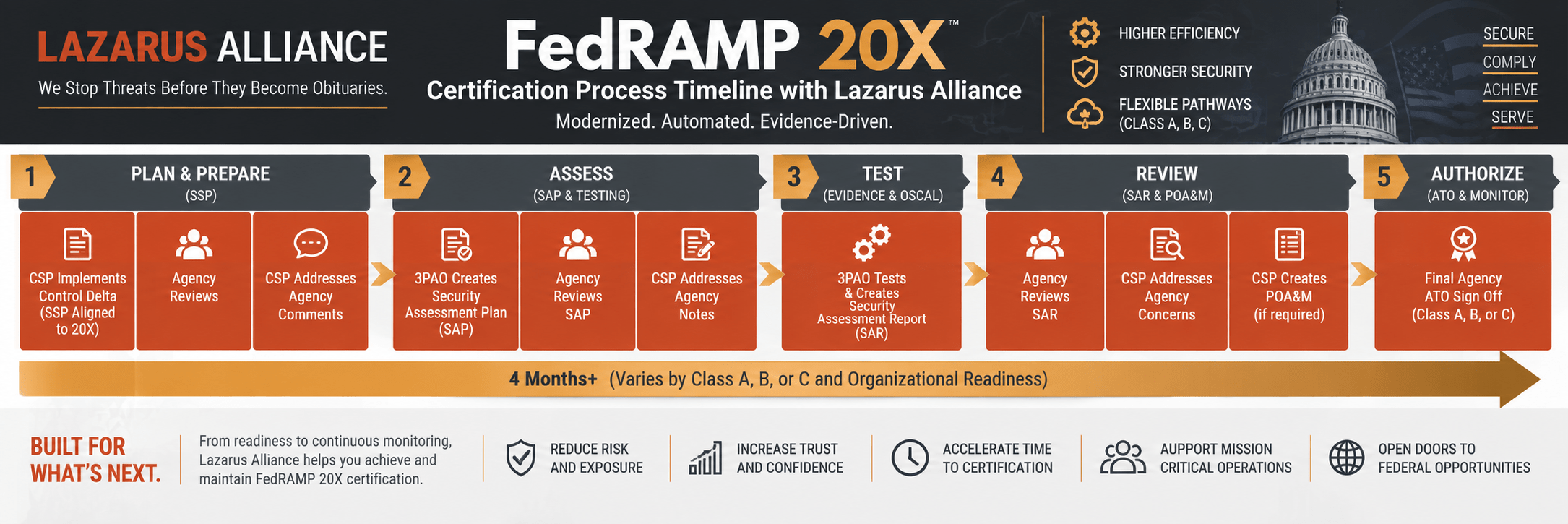
Lazarus Alliance still runs the structured Rev5 process for CSPs that are already mid-package or that fall into the limited transitional pipelines.
| Phase | Activities | Duration | Deliverables |
|---|---|---|---|
| Phase 0 – Pre-Engagement & Decision | Consultation, Moderate/High baseline, agency sponsor or FedRAMP PMO path, authorization boundary, CSP responsibilities. | 1–2 weeks | Engagement agreement, roadmap, boundary diagram, baseline confirmation. |
| Phase 1 – Scoping & Readiness | System inventory, inheritance, initial gap against NIST SP 800-53 Rev. 5, FedRAMP tailoring, documentation review. | 2 weeks | Inventory, initial SSP outline, inheritance mapping, readiness gap report. |
| Phase 2 – Gap Assessment & Remediation | Full control gap analysis, policy/procedure development, POA&M, evidence strategy using Cybervisor™ automation. | 3–4 weeks | Gap report, draft SSP, initial POA&M, evidence roadmap. |
| Phase 3 – Evidence Collection & Testing | Implementation verification, automated + manual testing, penetration testing support, evidence repository. | 4–6 weeks | Evidence package, test results, updated POA&M, implementation statements. |
| Phase 4 – Reporting & Package | Final SSP, SAR, FedRAMP package assembly, agency or PMO submission support. | 2–3 weeks | Complete Rev5 package (SSP, SAR, POA&M) and 3PAO artifacts. |
| Phase 5 – Authorization & ConMon | ATO coordination, ConMon setup, ongoing automation in Continuum GRC. | 4 weeks initial, then ongoing | Marketplace support, ConMon plan, monthly dashboards. |
Treat Rev5 as a closing window, not a preferred future state. New Rev5 submissions end June 11, 2027.
Treat Rev5 as a closing window, not a preferred future state. If you start a new Moderate program after August 2026 without a documented exception, you are choosing the slower path on purpose.
Current Marketplace designations you will still see
- FedRAMP Authorized (Agency ATO or 20x Program Certification): Reusable by other agencies with their own authorizing-official review.
- FedRAMP Ready / Legacy Ready: Being replaced by Class A. Ready listings are on a published wind-down.
- FedRAMP In Process: Actively working with a 3PAO and sponsor or PMO toward authorization.
- 20x Class A / B / C Certification: The new production labels for entry, Low, and Moderate assurance.

Why Cloud Providers Finish Faster with Lazarus Alliance
- A2LA-accredited 3PAO under ISO/IEC 17020, certification number 3822.01.
- Native 20x intake, not a Rev5 retrofit. Class selection, KSIs, FedRAMP Security Decision Record JSON Schema, and ConMon architecture are the engagement, not an afterthought.
- Continuum GRC / A.ITAM and AITAMBot. Scoping, evidence, scoring, and reporting live in a FedRAMP-authorized GRC platform. The same library supports FedRAMP, GovRAMP, NIST, CMMC, and SOC 2 reuse.
- Cybervisor™ assessors who have delivered thousands of assessments and know the difference between a control that exists in a policy and a control that exists in production.
- Fixed-scope commercial discipline. Clear boundary, clear class, clear deliverables. Scope creep is how FedRAMP programs die.
- Proactive Cyber Security®. Authorization is not a PDF event. It is an operating model you can keep after the Marketplace listing posts.
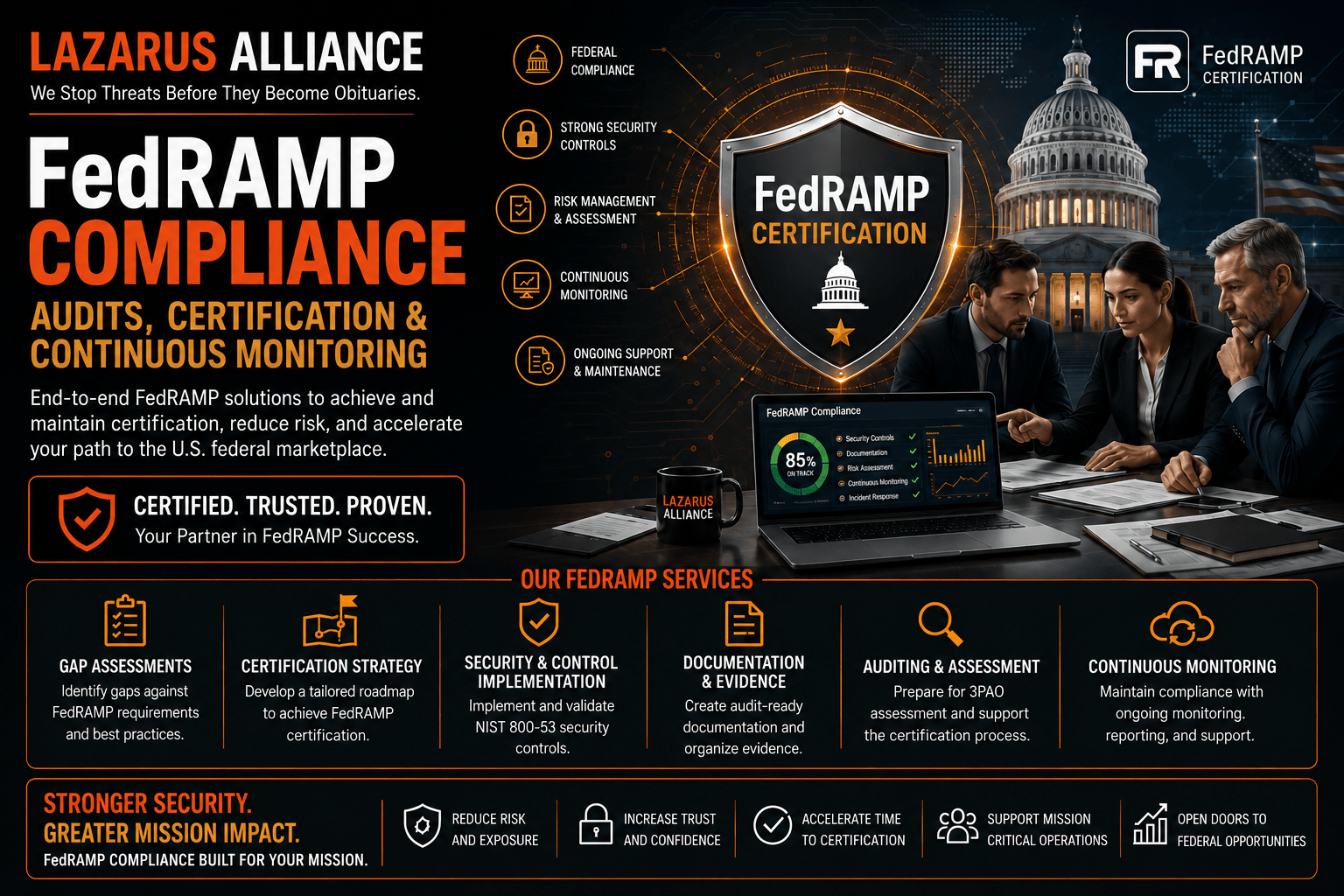
Lazarus Alliance provides FedRAMP, FISMA, and NIST audit, advisory, and assessment services for public, private, community, and hybrid cloud offerings — SaaS, PaaS, and IaaS.
At Lazarus Alliance, proactive isn’t just our trademark—it’s our promise to protect your future before threats even emerge. — Michael Peters, CEO & Founder
Frequently Asked Questions
What is FedRAMP?
FedRAMP (Federal Risk and Authorization Management Program) is a U.S. government program that standardizes security assessment, authorization, and continuous monitoring for cloud products and services. It enables cloud service providers (CSPs) to demonstrate compliance with FISMA and NIST requirements, allowing federal agencies to use cloud platforms confidently. There are two authorization paths: Agency and FedRAMP Marketplace.
What does Lazarus Alliance FedRAMP assessment research show?
Lazarus Alliance's 2026 FedRAMP Assessment Benchmark Report analyzed 38 completed FedRAMP Moderate and High assessments conducted between January 2025 and June 2026. The research found a median formal assessment duration of 42 business days, additional evidence requests in 95% of assessments, POA&M items in 92%, and an average of approximately 3,400 evidence artifacts per assessment. The findings demonstrate that evidence quality, boundary clarity, and operational implementation are major factors in FedRAMP assessment readiness.
What is FedRAMP 20x?
FedRAMP 20x is the program’s cloud-native modernization path. Instead of authorizing a service only against a long narrative NIST SP 800-53 baseline, 20x certifies offerings by class (A, B, C, and later D) against Key Security Indicators, machine-readable evidence, and ongoing validation. Class A, B, and C rules are finalized. The pipelines are open.
20x does not remove independent assessment.
FedRAMP's current Certification Package rules explicitly require the overall independent-assessment summary for Classes B, C and D.
How is 20x different from Rev5?
Rev5 asks you to describe every applicable 800-53 control and prove it in an annual-style package. 20x asks you to operate a defined set of measurable indicators and keep the proof current. You still need a 3PAO. You still need a real boundary, FIPS-validated crypto where required, identity discipline, logging, and vulnerability response. You do not need a thousand-page novel about those things.
Who is eligible for FedRAMP Certification?
Cloud service providers seeking FedRAMP Certification must select the appropriate certification class and path, meet the applicable FedRAMP requirements, establish the required certification package and evidence, and complete the applicable verification, validation, and independent assessment activities. Rev5 offerings continue to use NIST SP 800-53-based SSP and control-assessment requirements during the transition period.
What services does Lazarus Alliance provide for FedRAMP?
Lazarus Alliance offers a full suite of FedRAMP support, including:
- Native 20x Class A, B, and C intake and independent 3PAO assessment
- Rev5 readiness, gap analysis, and 3PAO assessment during the transition window
- Business justification and class-selection reviews (cost, timeline, inheritance, buyer fit)
- Boundary, KSI, and NIST SP 800-53 mapping
- Cybervisor™ assessments for Low, Moderate, High, and 20x classes
- Continuous monitoring operation in Continuum GRC
- Related overlays: DoD SRG, StateRAMP, CMMC, SOC 2, IRS 1075, FISMA / NIST
What are the benefits of working with Lazarus Alliance for FedRAMP?
Key benefits include a reduction in traditional assessment time through critical path methodology and advanced audit software, significant cost savings by avoiding scope creep and annual hikes, proactive threat prevention to maintain compliance, and expanded access to government markets with minimized risks. As an A2LA ISO/IEC 17020 accredited organization, they provide experienced Cybervisors™ for reliable, conflict-free partnerships.
How long does the FedRAMP authorization process take?
Prepared CSPs on a disciplined 3PAO program have historically finished faster than traditional 3PAO calendars, with authorizations in the 5–9 month band when the system is ready. Class A can be materially shorter. Class C is not a two-week badge. Uninstrumented environments take longer under 20x, not shorter, because missing telemetry is obvious.
How much does FedRAMP authorization cost?
Costs depend on the CSP's maturity, cloud type, and authorization path, but Lazarus Alliance drives down expenses through advanced audit software, experienced partnerships, and proactive approaches that prevent costly compliance threats. Their Business Justification Review evaluates total program costs, including assessments and monitoring, to inform decisions. Contact them at +1 (888) 896-7580 for a tailored estimate.
How can I get started with FedRAMP through Lazarus Alliance?
Start with a FedRAMP Readiness Assessment or Business Justification Review to gauge fit and roadmap. Reach out via phone (+1 (888) 896-7580) or their contact form for a consultation. They'll guide you through SSP preparation, gap analysis, 3PAO audits, and continuous monitoring to achieve ATO efficiently.
Do I still need an agency sponsor?
For many 20x Class A and Class B efforts, program certification does not wait on a sponsor the way classic agency ATO did. Agencies still decide whether their use of the service is acceptable. Class C enterprise use and any High / Class D work should be planned with real agency demand in mind. We will tell you if your class choice is running ahead of the buyers.
What are Key Security Indicators?
KSIs are the measurable, testable security outcomes FedRAMP 20x uses instead of a pure narrative control catalog. Class B requires 51. Class C requires 56. Each indicator must be addressed. Automated validation is expected for a large share of them. Evidence must be available in human-readable and machine-readable form.

Credentials You Can Count On
American Association for Laboratory Accreditation (A2LA) ISO/IEC 17020 accredited certification number 3822.01
Talk with one of our experts
Our Lazarus Alliance Cybervisor™ teams have experience performing thousands of assessments for organisations providing services to clients around the world.
We're here to answer any questions you may have.

Benefits of FedRAMP Certification
- Access to the U.S. federal cloud market. Once authorized or 20x-certified, civilian agencies can reuse the determination. Defense buyers still layer DoD SRG requirements where the mission requires it.
- Do-once, use-many-times reuse. Agencies issue their own ATO from the existing package instead of running a full independent assessment. That is what shortens federal sales cycles from 18–36 months to a single-digit-month review in the best cases.
- Public Marketplace listing. Federal buyers and integrators still start at fedramp.gov. Class A, B, and C certifications are the labels they will learn in FY2026–FY2027.
- Competitive differentiation. Most commercial SaaS never finishes this work. Authorization remains a sales asset, not a brochure claim.
- SLED and regulated-commercial pull-through. GovRAMP, TX-RAMP, healthcare, financial services, and critical-infrastructure buyers continue to treat FedRAMP as strong evidence of security discipline.
- Valuation and diligence. GovTech investors and acquirers treat a current FedRAMP authorization or 20x certification as a diligence checkbox and a valuation driver.
- Better engineering. KSIs and 800-53 both force account management, logging, encryption, vulnerability response, and boundary control that benefit every customer, not only federal ones.
- Improves overall security and engineering discipline: The rigorous NIST 800-53-based controls, continuous monitoring, and independent 3PAO assessment force mature security practices that benefit all customers, not just federal ones.
- Downstream framework reuse. A clean FedRAMP Moderate / Class C package still accelerates (GovRAMP, TX-RAMP, IRS 1075, CMMC IL4/IL5, HIPAA with a FedRAMP-aligned BAA, etc.).
- Sticky federal revenue. Multi-year agency adoption and expansion follow authorization more reliably than they follow a slide deck.
- A current operating model, not a binder. 20x makes that last point enforceable. Continuous validation is the product.
We want to be your partner and FedRAMP 3PAO compliance audit assessor of choice! For additional information, please call +1 (888) 896-7580.
Want to get a jump on receiving a quotation? Complete our questionnaire here: