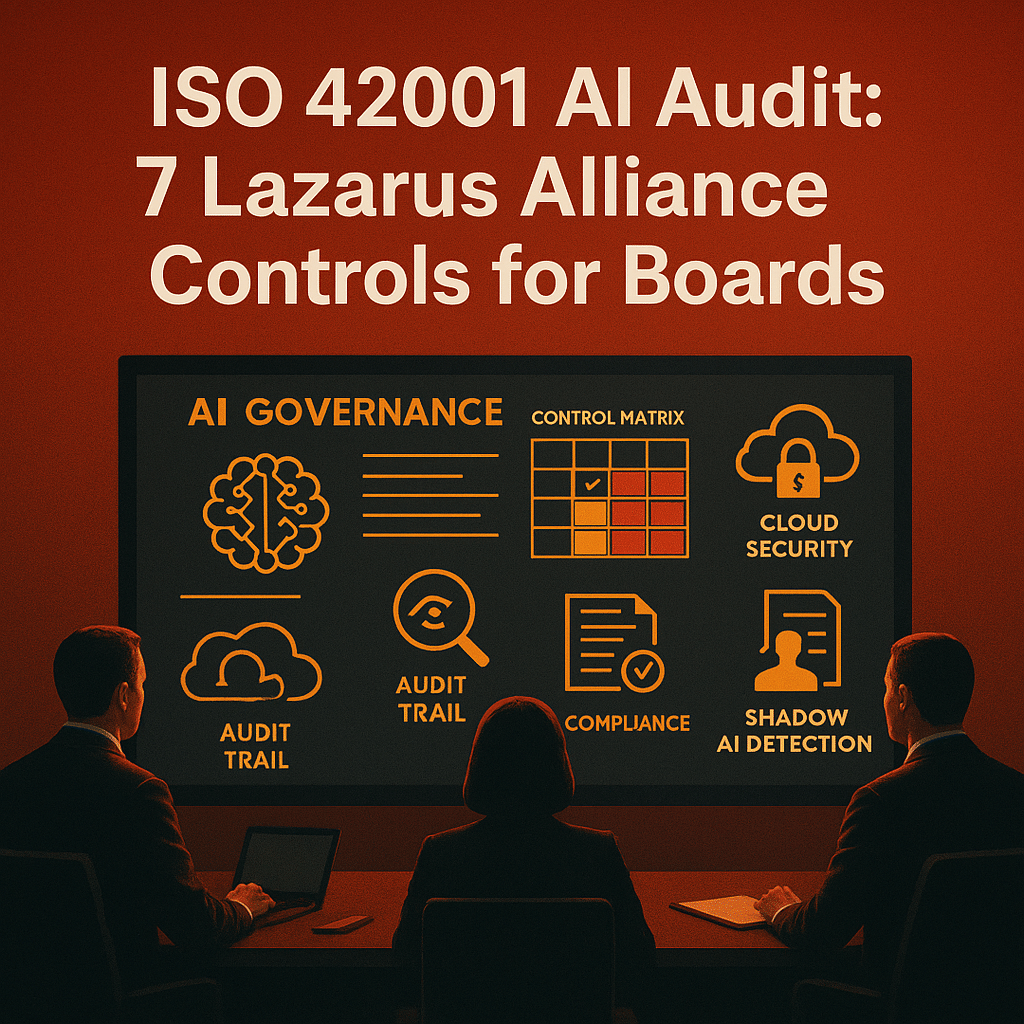
The contrarian truth about an ISO 42001 audit is that the hard part is not writing an AI policy; it is proving that the board can see, govern, and correct AI risk before a model, prompt, vendor, or data pipeline becomes an audit finding. ISO/IEC 42001 is listed by ISO’s artificial intelligence standards catalogue as an artificial intelligence management system standard, and the same ISO catalogue also identifies AI impact assessment and AI management system certification-body standards that are shaping assurance expectations for AI programs ISO/IEC JTC 1/SC 42, Artificial Intelligence Standards Catalogue.
For boards, that means AI governance must move from innovation theater to auditable control operation. The risk is not limited to enterprise generative AI tools approved by procurement. It includes shadow AI risk: employees pasting regulated data into unmanaged tools, developers embedding AI APIs without security review, business units using model outputs for decisions without validation, and vendors quietly adding AI functions to platforms already connected to sensitive data.
IBM reports that 20% of breached organizations experienced a security incident involving shadow AI, only 37% had policies to manage AI or detect shadow AI, and organizations with high shadow AI levels incurred USD 670,000 higher average breach costs than those with low or no shadow AI IBM, AI and Shadow AI Security Report. That is a board-level risk signal, not a technology footnote.
Lazarus Alliance’s perspective is straightforward: an ISO 42001 audit should be prepared like a cybersecurity audit, a compliance assessment, and an enterprise risk review at the same time. The seven controls below are designed for CISOs, compliance officers, general counsel, audit committees, and IT leaders who need AI risk management that survives assessor scrutiny and maps cleanly to GRC audit services across ISO, SOC 2, FedRAMP, CMMC, HIPAA, PCI DSS, CJIS, IRS 1075, C5, GovRAMP, and NIST-based programs.
ISO 42001 Audit Readiness Starts With Board Evidence, Not AI Enthusiasm
An ISO 42001 audit evaluates whether an organization has a functioning AI management system, not whether it has inspirational AI principles. In practice, assessors look for governance scope, accountable roles, risk criteria, operational controls, monitoring, evidence, corrective action, and management review. That aligns closely with NIST’s AI Risk Management Framework, which organizes AI risk activity around Govern, Map, Measure, and Manage functions NIST, AI Risk Management Framework.
Boards should therefore ask one central question: Can management prove where AI is used, what risks it creates, what controls apply, and whether those controls are operating? If the answer is no, the organization may have AI adoption, but it does not yet have AI governance.
Lazarus Alliance recommends treating AI governance as an extension of enterprise control architecture. The same evidence disciplines used in Lazarus Alliance ISO audits, NIST 800-53 and FISMA assessments, and SOC 1 and SOC 2 audit readiness should be applied to AI systems: define the control, assign an owner, collect evidence, test operation, record exceptions, and track remediation.
Control 1: Board AI Governance Charter and Risk Appetite
The first Lazarus Alliance control is a board-approved AI governance charter that defines scope, authority, escalation, and risk appetite. The charter should cover internally developed AI, third-party AI, embedded AI in SaaS platforms, AI-assisted software development, automated decision support, synthetic data, model tuning, prompt engineering, and AI use by contractors.
At minimum, the charter should identify the accountable executive, board oversight committee, AI risk council members, model owners, data owners, security owners, privacy owners, legal reviewers, and procurement stakeholders. It should also set thresholds for board escalation, such as use of regulated data, material customer impact, safety or employment decisions, cross-border data processing, model autonomy, or unresolved high-risk findings.
This control maps naturally to the Govern function in the NIST AI RMF and the Govern function in the NIST Cybersecurity Framework, which emphasizes organizational context, risk management strategy, roles, policy, oversight, and supply chain governance NIST, Cybersecurity Framework. For boards, the deliverable is not merely a policy. It is a board packet containing the AI inventory summary, top risks, exception trends, open corrective actions, supplier risk posture, and control test results.
Implementation evidence
- Board-approved AI governance charter and acceptable-use policy.
- RACI matrix for AI management system accountability.
- Quarterly AI risk dashboard with documented board or committee review.
- AI risk appetite statements linked to data sensitivity, model criticality, and regulatory exposure.
Control 2: Enterprise AI Inventory and Shadow AI Detection
You cannot audit what you cannot find. The second control is a continuously maintained AI inventory supported by shadow AI detection. The inventory should include approved AI platforms, AI-enabled SaaS functions, APIs, models, agents, training or tuning datasets, retrieval-augmented generation repositories, prompts used in controlled workflows, and vendors processing data through AI features.
Shadow AI detection requires multiple telemetry sources. Lazarus Alliance typically expects organizations to correlate identity provider logs, SSO application catalogs, CASB or secure web gateway logs, DNS requests, endpoint telemetry, browser extension inventories, source-code repositories, expense records, procurement intake, and DLP alerts. The objective is to identify unmanaged AI use patterns such as repeated uploads to consumer AI platforms, API keys in developer repositories, unapproved browser plugins, AI meeting transcription tools, or SaaS features enabled without a privacy and security review.
The board should not receive raw logs. It should receive decision-grade metrics: number of AI systems inventoried, percentage risk-rated, number of shadow AI events, exceptions by business unit, regulated-data exposure events, unresolved high-risk uses, and time to containment.
Example scenario
A healthcare business associate discovers that a product team uses an AI coding assistant and a customer-support team uses an AI summarization tool. The AI coding assistant is approved after code-retention settings, access controls, and secure development guardrails are validated. The summarization tool is suspended because transcripts may contain ePHI, and HHS OCR’s current HIPAA Security Rule modernization materials continue to emphasize risk analysis and stronger cybersecurity safeguards for electronic protected health information HHS OCR, HIPAA Security Rule NPRM. The audit-ready outcome is not a ban; it is documented discovery, risk evaluation, decision, and remediation.
Control 3: AI Risk Classification and Impact Assessment
The third control is a risk classification model that separates low-risk productivity use from high-impact AI. ISO’s AI standards catalogue lists AI system impact assessment work alongside AI management system standards, which reinforces the need for documented impact analysis in AI governance programs ISO/IEC JTC 1/SC 42, Artificial Intelligence Standards Catalogue.
A practical classification scheme should score each AI use case across at least eight dimensions: data sensitivity, decision impact, autonomy, user population, model opacity, external exposure, regulatory domain, and reversibility of harm. A chatbot that drafts internal marketing copy is different from an AI workflow that recommends credit actions, prioritizes patients, screens job candidates, analyzes criminal justice information, or summarizes controlled unclassified information.
Risk classification should drive required controls. Low-risk use may require training, logging, and acceptable-use rules. Moderate-risk use may require privacy review, vendor review, prompt restrictions, and output validation. High-risk use should require formal approval, model testing, human oversight, legal review, incident playbooks, ongoing monitoring, and board visibility.
Board decision matrix
- Green: No regulated data, no external decision impact, approved tool, logging enabled, standard user training complete.
- Yellow: Sensitive business data, customer-facing output, vendor AI feature, or limited operational reliance; requires risk owner approval and periodic testing.
- Red: Regulated data, material customer impact, employment or financial decision support, CUI, ePHI, CJI, payment data, or automated action; requires executive approval and board reporting.
Control 4: Data Protection, Identity, and AI Access Controls
The fourth control is the technical core of AI governance: protect data, restrict access, and preserve auditability. NIST SP 800-53 control AC-2 addresses account management, AC-6 addresses least privilege, IA-2 addresses identification and authentication, AU-2 addresses event logging, SC-28 addresses protection of information at rest, and SI-4 addresses system monitoring NIST, SP 800-53 Security and Privacy Controls. Those controls are not AI-specific, but they are essential for AI risk management.
AI systems create distinctive access-control challenges. Users may access a model through a chat interface, an API, an agent, a plugin, an embedded SaaS feature, or an automation workflow. Service accounts may retrieve data from knowledge bases. Developers may tune models with datasets copied from production. Agents may call downstream systems with privileges broader than the human user would have.
Lazarus Alliance recommends enforcing identity-aware AI controls: SSO and MFA for enterprise AI tools, role-based access to models and datasets, separate privileges for prompt creation and deployment, secrets management for API keys, DLP rules for prompts and uploads, encryption for stored prompts and outputs, retention limits, and logging that ties AI activity to user identity. For CUI environments, the stakes increase because eCFR CMMC acquisition rules require the applicable CMMC status at time of award and maintenance throughout contract performance eCFR, 48 CFR Part 204 Subpart 204.75.
Control 5: Model, Prompt, and Output Assurance Testing
The fifth control is assurance testing for the AI system itself. Traditional vulnerability scans do not answer whether a model leaks sensitive data, follows malicious instructions, hallucinates regulated advice, produces biased recommendations, or allows prompt injection through retrieved content. AI audit readiness requires model, prompt, retrieval, plugin, and output testing.
Testing should include prompt injection attempts, data exfiltration scenarios, toxic or prohibited output checks, jailbreak testing, retrieval poisoning tests, over-permissioned tool-call tests, and validation of human-in-the-loop gates. NIST SP 800-53 SA-11 addresses developer testing and evaluation, RA-5 addresses vulnerability monitoring and scanning, and SI-7 addresses software, firmware, and information integrity NIST, SP 800-53 Security and Privacy Controls.
This is also where SOC 2 expectations are moving. AICPA has proposed future Trust Services Criteria updates that include AI governance, model monitoring, prompt manipulation, data poisoning, transparency of AI-generated outputs, training data management, and automated decision-making risks AICPA & CIMA, Proposed SOC 2 Trust Services Criteria Update. Boards should view ISO 42001 readiness as a way to get ahead of AI assurance expectations in SOC reporting and vendor due diligence.
Control 6: AI Supplier, Vendor, and Embedded SaaS Oversight
The sixth control addresses the supply chain reality: many AI risks enter through vendors. A company may not build models, yet still rely on AI for customer support, HR screening, fraud detection, code generation, sales forecasting, contract review, or security monitoring. Supplier AI oversight should be part of third-party risk management, procurement, legal review, and periodic compliance assessment.
Required supplier evidence should include data-use terms, training and retention commitments, subprocessor disclosures, security certifications or audit reports, incident notification obligations, model update practices, data residency commitments, access-control descriptions, audit rights, and exit provisions. For regulated sectors, map the supplier review to the applicable framework: HIPAA business associate obligations, PCI DSS service-provider responsibilities, CJIS security addenda, IRS 1075 safeguard expectations, CMMC flow-down, FedRAMP authorization boundaries, GovRAMP state cloud assurance, or C5 cloud criteria.
Organizations that need multi-framework audit strategy can use Continuum GRC AI Governance & Risk to organize AI risks, control mappings, and evidence workflows, while Lazarus Alliance audit teams evaluate whether the control design and operating evidence are sufficient for the relevant assurance objective. Continuum GRC’s 2026 AI Governance Benchmark Report is also a useful resource for leaders benchmarking AI governance maturity without inventing a separate compliance universe.
Control 7: Continuous Evidence, Incident Response, and Board Reporting
The seventh control converts AI governance into an auditable operating model. A common misconception is that ISO 42001 readiness ends once policies, inventories, and risk assessments exist. In reality, assessors expect evidence that controls operate over time. That means ticket histories, review records, access recertifications, DLP alerts, model test results, supplier reviews, exception approvals, training records, incident exercises, and corrective-action closure.
Board reporting should focus on leading and lagging indicators. Leading indicators include percentage of AI systems risk-rated, percentage of high-risk AI systems tested, time to approve or reject AI use cases, number of unresolved vendor AI exceptions, and percentage of AI users trained. Lagging indicators include policy violations, shadow AI incidents, prompt-data leakage events, supplier incidents, model-output defects, and overdue remediation items.
Incident response must also be AI-specific. Playbooks should address prompt leakage, model credential compromise, retrieval poisoning, unauthorized model tuning, AI-generated phishing, automated decision errors, and vendor AI incidents. NIST CSF includes Detect, Respond, and Recover functions, which provide a clear organizing structure for AI incident monitoring, communications, analysis, mitigation, recovery, and improvement NIST, Cybersecurity Framework.
Common ISO 42001 Audit Pitfalls Boards Should Challenge
- Policy without telemetry: A policy that prohibits risky AI use is weak evidence unless the organization can detect violations.
- Inventory without ownership: Every AI system needs a business owner, technical owner, data owner, and control owner.
- Vendor review without AI clauses: Standard security questionnaires often miss training use, retention, model updates, prompt logging, and subprocessor AI functions.
- Security review without output validation: AI assurance must test behavior, not only infrastructure.
- Board reporting without decisions: Dashboards should support approvals, exceptions, budget decisions, and remediation accountability.
How Lazarus Alliance Connects AI Governance to GRC Audit Services
AI governance is now inseparable from cybersecurity audits and compliance assessments. A defense contractor must ask whether AI workflows touch CUI. A healthcare organization must ask whether prompts or transcripts contain ePHI. A payment processor must ask whether AI monitoring tools can see cardholder data and whether PCI DSS evidence remains accurate. A public-sector cloud provider must ask whether AI features affect FedRAMP, GovRAMP, CJIS, C5, or NIST 800-53 control boundaries.
Lazarus Alliance helps organizations move from fragmented AI policy to evidence-backed audit readiness. The method is practical: establish governance scope, discover AI use, classify risk, map controls, test operation, remediate gaps, and package evidence for auditors, regulators, customers, and boards. Where AI intersects broader audit obligations, Lazarus Alliance aligns AI controls with established programs such as FedRAMP assessments, SOC reporting, ISO audits, PCI DSS, HIPAA, DFARS NIST 800-171, CMMC, CJIS, IRS 1075, C5, GovRAMP, and LADMF.
The board mandate is clear: require management to prove AI control operation with the same rigor expected for cybersecurity, privacy, and financial reporting controls. The organizations that succeed in an ISO 42001 audit will not be those with the longest AI policy. They will be the organizations that can show a living AI management system: governed, inventoried, risk-rated, secured, tested, supplier-aware, and continuously evidenced.
Sources and References
- ISO/IEC JTC 1/SC 42, Artificial Intelligence Standards Catalogue
- NIST, AI Risk Management Framework
- NIST, Cybersecurity Framework
- NIST, SP 800-53 Security and Privacy Controls
- IBM, AI and Shadow AI Security Report
- HHS OCR, HIPAA Security Rule NPRM
- eCFR, 48 CFR Part 204 Subpart 204.75
- AICPA & CIMA, Proposed SOC 2 Trust Services Criteria Update
- Lazarus Alliance, ISO Audits
- Lazarus Alliance, NIST 800-53 and FISMA Audit Services
- Lazarus Alliance, SOC 1 and SOC 2 Audit Services
- Lazarus Alliance, FedRAMP Services
- Continuum GRC, AI Governance & Risk
- Continuum GRC, 2026 AI Governance Benchmark Report
About Lazarus Alliance
To learn more about how Lazarus Alliance can help, contact us.
- FedRAMP
- GovRAMP
- NIST 800-53
- DFARS NIST 800-171
- CMMC
- SOC 1 & SOC 2
- C5
- HIPAA, HITECH, & Meaningful Use
- PCI DSS RoC & SAQ
- IRS 1075 & 4812
- CJIS
- LA DMF
- ISO 27001, ISO 27002, ISO 27005, ISO 27017, ISO 27018, ISO 27701, ISO 22301, ISO 17020, ISO 17021, ISO 17025, ISO 17065, ISO 9001, & ISO 90003
- And dozens more!
Related Posts