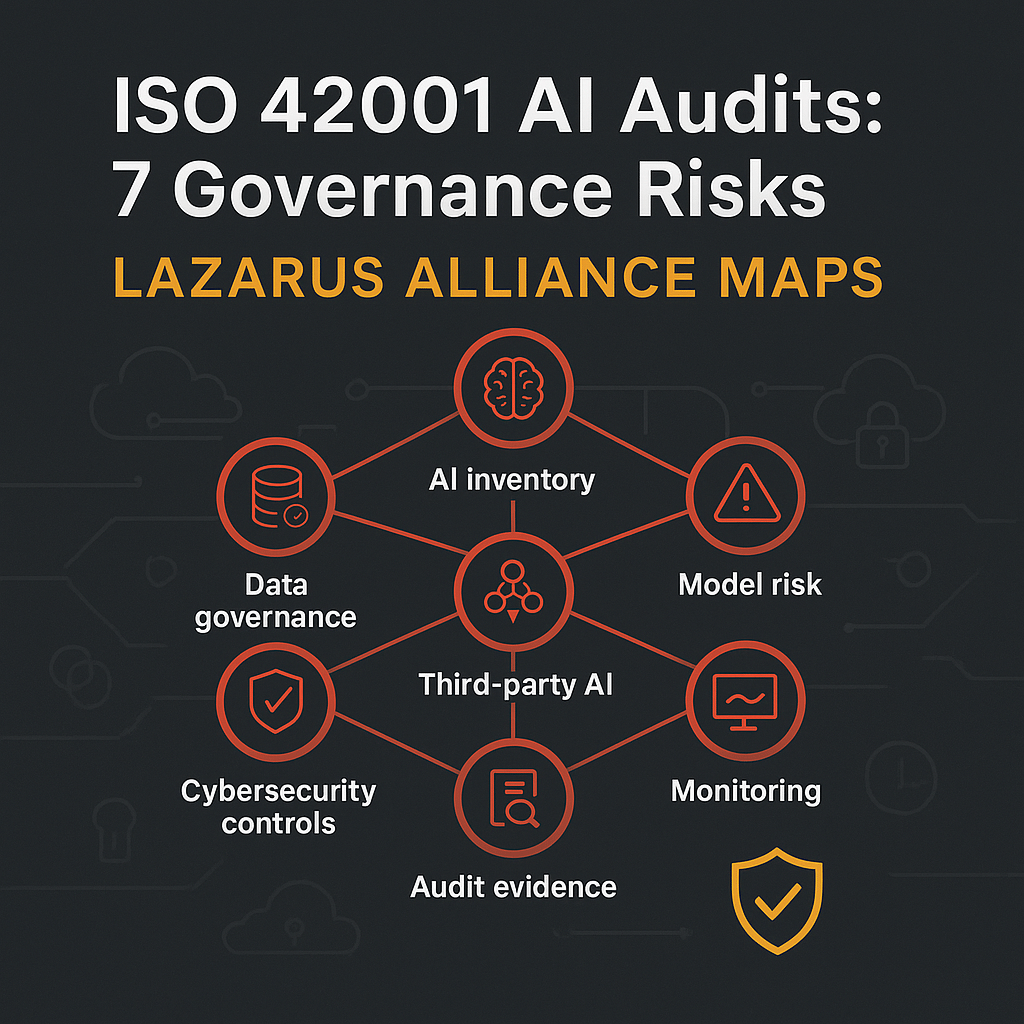
AI audit readiness is no longer a documentation exercise. The organizations that will pass an ISO 42001 AI governance audit with confidence are not the ones that merely publish an AI policy; they are the ones that can prove, with evidence, that AI risks are identified, assigned, tested, monitored, escalated, and improved through the same disciplined governance expected in mature cybersecurity audits and compliance assessments.
That distinction matters because ISO/IEC 42001 establishes requirements for an artificial intelligence management system, while the NIST AI Risk Management Framework organizes AI risk work around governance, mapping, measurement, and management activities ISO, ISO/IEC 42001 NIST, AI Risk Management Framework. In practice, an AI governance audit must connect board oversight, model risk, cybersecurity, privacy, third-party risk, incident response, and control evidence into one defensible assurance story.
Lazarus Alliance maps ISO 42001 audit readiness through the lens of enterprise assurance: what is in scope, what can fail, what evidence proves control operation, and where AI risk intersects with cybersecurity audits, SOC reporting, FedRAMP-style evidence discipline, HIPAA safeguards, PCI DSS obligations, CMMC and DFARS requirements, CJIS expectations, IRS 1075 controls, C5 cloud criteria, ISO 27001, and the LA DMF ecosystem. The result is not a generic AI checklist. It is a governance-risk map designed for CISOs, compliance officers, legal teams, product leaders, and audit committees that need assurance before customers, regulators, or examiners ask harder questions.
ISO 42001 AI Governance Audit: What Auditors Actually Need to See
An ISO 42001 AI governance audit evaluates whether an organization has implemented a management system for responsible AI, including policies, roles, risk processes, objectives, operational controls, performance evaluation, and continual improvement ISO, ISO/IEC 42001. The audit question is not simply whether the organization uses AI. The audit question is whether AI use is governed through a repeatable system that produces reliable evidence.
That evidence typically includes an AI system inventory, risk classification criteria, model lifecycle records, data governance artifacts, human oversight procedures, third-party AI assessments, vulnerability and misuse testing, change approvals, monitoring reports, incident response playbooks, exception logs, and management review outputs. This evidence pattern closely resembles mature cybersecurity audit programs because NIST SP 800-53 includes control families for access control, assessment and authorization, audit and accountability, configuration management, incident response, risk assessment, system and information integrity, and supply chain risk management NIST, SP 800-53 Rev. 5.
Lazarus Alliance approaches ISO 42001 readiness as an assurance problem: define the scope, identify AI assets, map risks to control objectives, validate the operating evidence, and test whether governance decisions are traceable. Organizations preparing for certification or customer due diligence can use Lazarus Alliance ISO audit services to align AI management-system readiness with broader ISO and cybersecurity audit expectations.
Risk 1: Undefined AI Inventory and Shadow AI
The first ISO 42001 governance risk is simple: leadership cannot govern AI systems it cannot see. Shadow AI appears when business units adopt generative AI tools, embedded SaaS AI features, developer copilots, machine-learning models, or vendor analytics without intake review, data classification, contractual assessment, or security approval.
A defensible AI inventory should identify the AI system owner, business purpose, model type, data inputs, training or fine-tuning sources, deployment environment, users, external interfaces, output consumers, human oversight points, vendors, and retirement criteria. The NIST AI RMF emphasizes organizational governance and contextual mapping as core activities for trustworthy AI risk management NIST, AI Risk Management Framework. In a cybersecurity audit context, this inventory should also connect to NIST SP 800-53 CM-8 inventory expectations, RA-3 risk assessment practices, and SR-3 supply chain controls NIST, SP 800-53 Rev. 5.
Audit-ready implementation: create an AI register that is integrated with asset management, vendor risk management, data classification, and change management. Require AI intake for every new model, AI-enabled SaaS feature, autonomous workflow, or high-impact decision-support use case. For each entry, require an accountable owner and a documented risk tier before production use.
Common pitfall: treating AI inventory as a spreadsheet owned by legal or innovation teams. Auditors will look for evidence that the inventory is operational: ticket workflows, review timestamps, risk approvals, vendor files, monitoring records, and periodic reconciliation with procurement, identity, cloud, and endpoint data.
Risk 2: Weak AI Risk Classification and Model Risk Accountability
The second governance risk is inadequate AI risk classification. Many organizations label systems as low, medium, or high risk without defining impact criteria. That creates inconsistent decisions and weak audit trails. ISO 42001 readiness requires management-system discipline, while the NIST AI RMF expects organizations to map AI context and manage identified risks through documented governance practices ISO, ISO/IEC 42001 NIST, AI Risk Management Framework.
A strong model risk taxonomy should consider safety impact, legal effect, financial exposure, privacy sensitivity, protected-class relevance, cybersecurity exposure, autonomy level, explainability needs, human review feasibility, dependency on third-party models, and the criticality of downstream decisions. For defense contractors, AI systems that handle Controlled Unclassified Information should also be mapped against NIST SP 800-171 requirements for access control, configuration management, incident response, risk assessment, security assessment, and system and information integrity NIST, SP 800-171 Rev. 3. DFARS 252.204-7021 requires applicable contractors to maintain the required CMMC status and complete an annual affirmation of continuous compliance in SPRS for covered systems eCFR, DFARS 252.204-7021.
Audit-ready implementation: define objective AI risk-tier criteria, assign a model risk owner, require independent review for high-risk systems, and document residual-risk acceptance. Use control gates for design approval, data readiness, security testing, human oversight, production release, and periodic recertification.
Lazarus Alliance perspective: model risk accountability should not sit solely with data science. It should be distributed across the system owner, security owner, privacy owner, vendor owner, and executive risk acceptor. That separation strengthens independence and reduces the chance that innovation pressure overrides assurance requirements.
Risk 3: Data Governance Failures in Training, Fine-Tuning, and Prompts
AI risk management fails quickly when data lineage, authorization, retention, and sensitivity are unclear. AI systems may ingest customer data, employee data, regulated data, source code, credentials, business secrets, payment data, protected health information, criminal justice information, tax information, or defense information. Each data class can trigger separate compliance obligations.
Healthcare organizations must align AI use with the HIPAA Security Rule safeguards for electronic protected health information in 45 CFR Part 164 Subpart C eCFR, HIPAA Security Rule. Payment environments must preserve cardholder-data scope discipline under PCI DSS v4.0.1 documentation and assessment requirements PCI Security Standards Council, PCI DSS v4.0.1 Document Library. Criminal justice environments should evaluate AI data access against FBI CJIS Security Policy resources FBI, CJIS Security Policy Resource Center. Agencies and contractors handling federal tax information must address IRS Publication 1075 safeguard expectations IRS, Publication 1075.
Audit-ready implementation: maintain data lineage for training, retrieval augmentation, prompt logging, fine-tuning, evaluation sets, and model outputs. Prohibit regulated or confidential data in public AI tools unless approved controls exist. Require data minimization, encryption, access control, retention rules, test-data segregation, and output handling instructions.
Scenario: a healthcare SaaS provider adds an AI summarization feature to support clinical workflow notes. An ISO 42001 audit would expect evidence that the feature has a business owner, ePHI data-flow map, HIPAA safeguard mapping, model access controls, prompt and output retention policy, human review criteria, vendor risk file, monitoring plan, and incident escalation path. Without that chain, the organization may have an impressive model but an immature AI management system.
Risk 4: Insufficient Human Oversight and Decision Accountability
Human oversight is often described as a policy statement, but auditors need operational proof. If an AI system recommends loan terms, triages security alerts, ranks job candidates, flags suspected fraud, drafts legal responses, or prioritizes patient outreach, the organization must define who reviews the output, when review is mandatory, what evidence is retained, and how overrides are monitored.
The NIST AI RMF Playbook provides practical prompts for organizations implementing governance, mapping, measurement, and management activities across AI risk scenarios NIST, AI RMF Playbook. For security-control alignment, NIST SP 800-53 AC-2 addresses account management, AU controls address audit and accountability, IR-4 addresses incident handling, and SI-4 addresses system monitoring NIST, SP 800-53 Rev. 5.
Audit-ready implementation: define human-in-the-loop, human-on-the-loop, and human-out-of-the-loop use cases. Establish authority thresholds, dual approvals for high-impact outputs, reviewer training, exception reporting, override analytics, and escalation requirements. Store review evidence in systems of record rather than informal chat threads.
Common pitfall: assuming that a user can ignore an AI output is the same as meaningful oversight. Effective oversight requires competence, time, authority, documented criteria, and the ability to stop or correct the AI-enabled process.
Risk 5: Third-Party AI and Supply Chain Blind Spots
Most enterprise AI systems depend on third parties: foundation model providers, cloud platforms, SaaS applications, data brokers, labeling providers, API gateways, monitoring tools, and managed service providers. ISO 42001 audit readiness therefore requires vendor AI risk management, not only internal model documentation.
NIST SP 800-53 supply chain controls, including SR-family controls, provide a useful structure for supplier governance, while ISO 27001 supports information-security management system alignment for broader security governance NIST, SP 800-53 Rev. 5 ISO, ISO/IEC 27001. Cloud service providers preparing for public-sector assurance can also use FedRAMP OSCAL concepts to make security and control evidence machine-readable and more reusable across assessments FedRAMP, OSCAL.
Audit-ready implementation: update vendor questionnaires to include AI-specific questions: model ownership, training-data use, customer-data retention, prompt logging, subcontractors, evaluation methods, security testing, isolation controls, incident notice, data residency, and deletion procedures. Require contract terms that address AI data use, confidentiality, breach notification, audit rights, change notification, and model deprecation.
Organizations that need integrated vendor evidence, AI governance workflows, and risk tracking can use Continuum GRC AI Governance and Risk to organize AI risk evidence across stakeholders and control frameworks.
Risk 6: Cybersecurity Weaknesses in AI Workloads and Model Pipelines
AI governance and cybersecurity are now inseparable. Model repositories, feature stores, vector databases, orchestration pipelines, inference APIs, prompt templates, secrets, plugins, agents, and monitoring telemetry all expand the attack surface. A model can be governed on paper and still fail operationally if the underlying pipeline is vulnerable.
An ISO 42001-aligned assurance review should evaluate identity and access management, privileged access, secure configuration, secrets management, logging, vulnerability management, API security, network segmentation, data-loss prevention, backup and recovery, and incident response. NIST SP 800-53 AC controls address access control, CM controls address configuration management, RA-5 addresses vulnerability monitoring and scanning, and SI controls address system and information integrity NIST, SP 800-53 Rev. 5.
Audit-ready implementation: include AI workloads in threat modeling, secure software development, vulnerability scans, penetration testing, cloud configuration reviews, logging strategy, and red-team exercises. Test model endpoints for authorization bypass, data leakage, prompt injection exposure, excessive agency, unsafe tool calls, and insecure retrieval paths. Evidence should include tickets, scan results, remediation records, access reviews, deployment approvals, and monitoring dashboards.
Where Lazarus Alliance Laboratories fits: technical assurance strengthens AI governance by validating whether implemented controls actually operate under adversarial conditions. Lazarus Alliance Laboratories supports technical testing that can complement governance assessments, cybersecurity audits, and control-validation programs.
Risk 7: No Continuous Monitoring, Incident Response, or Continual Improvement Loop
The seventh governance risk is treating ISO 42001 as a one-time certification project. AI systems drift. Data changes. Users discover new workflows. Vendors update models. Attackers adapt. Regulations and customer expectations evolve. A mature AI management system needs continuous monitoring and continual improvement, not annual policy refreshes.
ISO management-system assurance depends on performance evaluation and improvement mechanisms, while the NIST AI RMF includes measurement and management activities that support risk monitoring and treatment ISO, ISO/IEC 42001 NIST, AI Risk Management Framework. In cloud and regulated environments, continuous evidence practices are increasingly important because control performance must be demonstrable across time, not reconstructed after a request arrives.
Audit-ready implementation: define model performance indicators, risk indicators, fairness and quality checks where applicable, drift monitoring, security alerts, abuse monitoring, incident thresholds, user feedback channels, and management-review cadences. Build AI incident response into the enterprise incident response plan. Include playbooks for data leakage, harmful output, unauthorized model access, model rollback, vendor outage, hallucination in high-impact contexts, and suspected manipulation.
Evidence examples: monthly AI risk dashboard, model monitoring report, vendor change notice review, access recertification, incident tabletop record, corrective-action plan, management review minutes, and internal audit findings. Continuum GRC’s 2026 Audit Readiness Benchmark Report examines audit readiness challenges across organizations and can help leaders frame evidence maturity discussions without relying on last-minute artifact collection.
A Lazarus Alliance Decision Matrix for ISO 42001 AI Risk Management
Lazarus Alliance recommends a practical decision matrix that converts AI governance ambiguity into audit-ready action. For each AI system, assign a score for data sensitivity, decision impact, autonomy, external exposure, third-party dependency, model opacity, security exposure, and regulatory relevance. Then apply the highest applicable control path rather than averaging risk down.
- Tier 1: Minimal-risk productivity AI. Examples include approved internal drafting tools with no confidential data. Required evidence: acceptable-use policy, user training, tool approval, and data-handling restrictions.
- Tier 2: Business-process AI. Examples include customer-service routing, document classification, code assistance, or workflow automation. Required evidence: inventory entry, risk assessment, access controls, vendor assessment, monitoring, and change approval.
- Tier 3: Regulated or security-sensitive AI. Examples include AI touching ePHI, cardholder data, CUI, CJI, FTI, production security operations, or financial decision support. Required evidence: framework mapping, legal review, technical testing, human oversight, incident playbook, periodic recertification, and executive risk acceptance.
- Tier 4: High-impact autonomous or externally exposed AI. Examples include agentic systems with tool access, AI making or materially influencing consequential decisions, and public-facing models. Required evidence: independent validation, adversarial testing, enhanced monitoring, rollback plan, board-level reporting, and formal management review.
This tiering model supports multi-framework assurance. A defense contractor can align Tier 3 AI controls with DFARS and CMMC readiness through Lazarus Alliance CMMC services. A service organization can connect AI control evidence to SOC 1 and SOC 2 readiness through Lazarus Alliance SOC services. A public-sector cloud provider can align AI evidence with FedRAMP, GovRAMP, NIST 800-53, and OSCAL-oriented control discipline.
How to Prepare for an ISO 42001 AI Governance Audit
Preparation should begin with scoping. Define which entities, products, departments, cloud environments, vendors, and AI systems fall within the AI management system. Then build an evidence map that links ISO 42001 clauses and controls to AI risk management procedures, cybersecurity controls, privacy obligations, vendor oversight, and operational records.
Step 1: Establish AI governance authority. Appoint an executive sponsor, AI risk committee, system owners, model owners, security owners, privacy stakeholders, legal reviewers, and internal audit participants.
Step 2: Build the AI inventory. Reconcile procurement, SaaS, cloud, endpoint, developer, and business-process data to identify sanctioned and unsanctioned AI use.
Step 3: Classify risk. Use documented criteria and require elevated controls for regulated data, high-impact decisions, autonomous activity, and external exposure.
Step 4: Map controls. Crosswalk ISO 42001 to NIST AI RMF, NIST SP 800-53, ISO 27001, SOC 2, HIPAA, PCI DSS, CJIS, IRS 1075, CMMC, FedRAMP, GovRAMP, C5, and LA DMF where applicable.
Step 5: Validate operation. Test whether procedures are followed, approvals are retained, vendors are assessed, monitoring works, incidents are escalated, and corrective actions close.
Step 6: Conduct management review. Present AI risk posture, exceptions, incidents, metrics, supplier issues, audit findings, and improvement plans to leadership.
Step 7: Maintain continuous evidence. Use a GRC platform to retain artifacts, assign control owners, track issues, and support recurring compliance assessments. The Continuum GRC platform supports integrated governance, risk, and compliance workflows for organizations managing complex audit portfolios.
ISO 42001 Is an Assurance Signal, Not a Substitute for Cybersecurity
A strong ISO 42001 program can demonstrate structured AI governance, but it does not replace cybersecurity audits, privacy assessments, penetration testing, SOC reporting, PCI DSS validation, HIPAA security analysis, CMMC preparation, FedRAMP authorization work, CJIS assessment, IRS 1075 review, or ISO 27001 governance. Instead, ISO 42001 becomes more valuable when it is integrated with those assurance programs.
The strategic opportunity is to reuse evidence. AI inventory data can support vendor risk and asset management. Model security testing can support vulnerability management and secure development. Human oversight records can support accountability and quality management. Incident playbooks can support enterprise response readiness. Management-review minutes can support board reporting and risk governance.
For Lazarus Alliance clients, the goal is not to create a parallel AI compliance bureaucracy. The goal is to embed AI risk management into existing control systems so that ISO 42001 readiness strengthens overall cyber resilience, regulatory defensibility, and customer trust.
Sources and References
- ISO, ISO/IEC 42001, https://www.iso.org/standard/81230.html
- NIST, AI Risk Management Framework, https://www.nist.gov/itl/ai-risk-management-framework
- NIST, AI RMF Playbook, https://airc.nist.gov/AI_RMF_Knowledge_Base/Playbook
- NIST, SP 800-53 Rev. 5, https://csrc.nist.gov/pubs/sp/800/53/r5/upd1/final
- NIST, SP 800-171 Rev. 3, https://csrc.nist.gov/pubs/sp/800/171/r3/final
- eCFR, DFARS 252.204-7021, https://www.ecfr.gov/current/title-48/chapter-2/subchapter-H/part-252/subpart-252.2/section-252.204-7021
- eCFR, HIPAA Security Rule, https://www.ecfr.gov/current/title-45/subtitle-A/subchapter-C/part-164/subpart-C
- PCI Security Standards Council, PCI DSS v4.0.1 Document Library, https://www.pcisecuritystandards.org/document_library/?category=saqs&document=saq_d_merchant_4.0.1
- FBI, CJIS Security Policy Resource Center, https://le.fbi.gov/cjis-division/cjis-security-policy-resource-center
- IRS, Publication 1075, https://www.irs.gov/pub/irs-pdf/p1075.pdf
- ISO, ISO/IEC 27001, https://www.iso.org/standard/27001
- FedRAMP, OSCAL, https://www.fedramp.gov/oscal/
- Lazarus Alliance, ISO Audits, https://lazarusalliance.com/services/audit-compliance/iso-audits/
- Lazarus Alliance, CMMC, https://lazarusalliance.com/services/audit-compliance/cmmc/
- Lazarus Alliance, SOC 1 and SOC 2, https://lazarusalliance.com/services/audit-compliance/soc/
- Lazarus Alliance, Lazarus Alliance Laboratories, https://lazarusalliance.com/lazarus-alliance-laboratories/
- Continuum GRC, AI Governance and Risk, https://continuumgrc.com/ai-governance-risks/
- Continuum GRC, 2026 Audit Readiness Benchmark Report, https://continuumgrc.com/2026-audit-readiness-benchmark-report/
- Continuum GRC, Platform, https://continuumgrc.com/
About Lazarus Alliance
To learn more about how Lazarus Alliance can help, contact us.
- FedRAMP
- GovRAMP
- NIST 800-53
- DFARS NIST 800-171
- CMMC
- SOC 1 & SOC 2
- C5
- HIPAA, HITECH, & Meaningful Use
- PCI DSS RoC & SAQ
- IRS 1075 & 4812
- CJIS
- LA DMF
- ISO 27001, ISO 27002, ISO 27005, ISO 27017, ISO 27018, ISO 27701, ISO 22301, ISO 17020, ISO 17021, ISO 17025, ISO 17065, ISO 9001, & ISO 90003
- And dozens more!
Related Posts