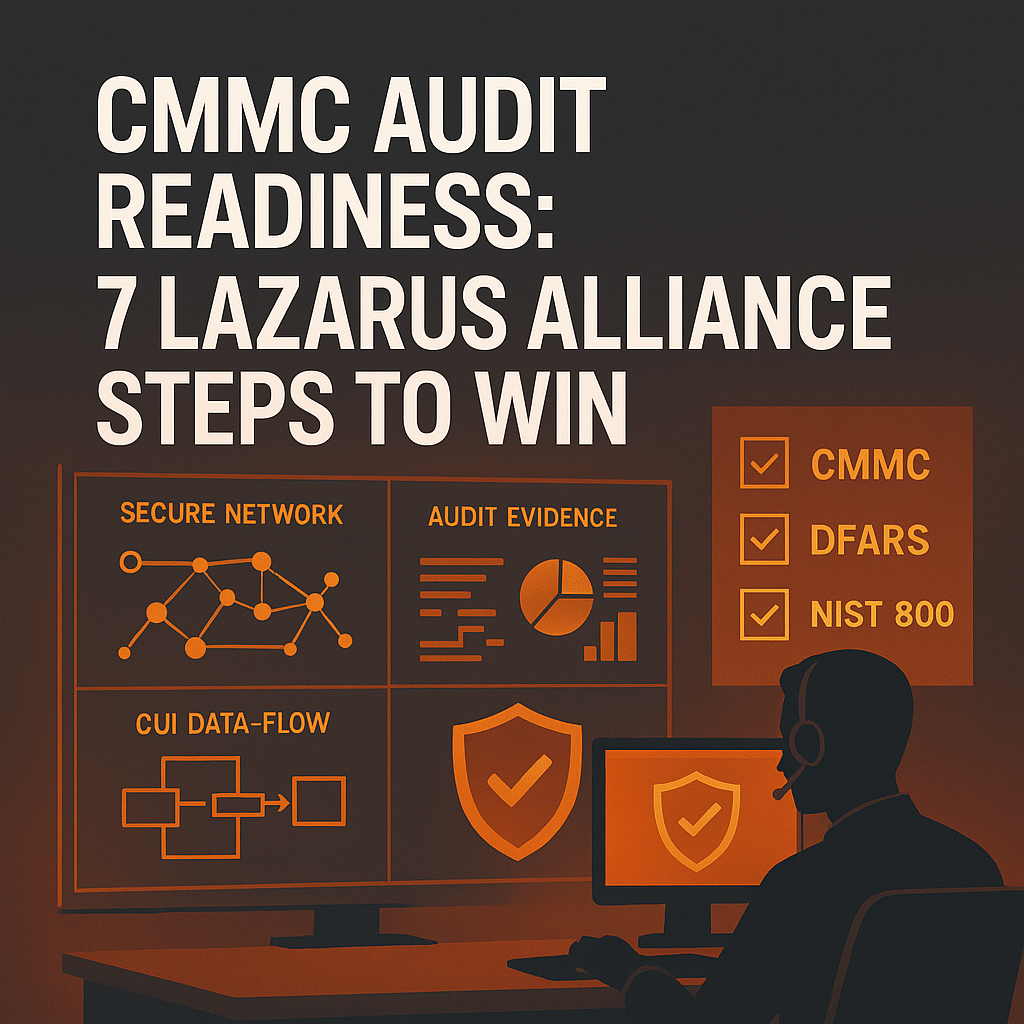
CMMC audit readiness is no longer a paperwork sprint at the end of a capture cycle. For defense contractors, the practical question is now whether cybersecurity evidence is strong enough to protect contract eligibility, survive assessor scrutiny, and support subcontractor flow-down without creating operational drag. The strongest programs treat CMMC and DFARS compliance as a revenue assurance discipline: scope the environment, prove NIST 800-171 implementation, close risk, and maintain audit-ready evidence continuously.
CMMC Audit Readiness Is Now a Contract Eligibility Issue
The current CMMC rule structure makes one point clear: cybersecurity readiness has moved from aspirational maturity to acquisition gating. The eCFR text for 48 CFR Part 204 Subpart 204.75 states that contractors must achieve the required CMMC status at time of award and maintain that status during contract performance. The companion applicability language in 32 CFR 170.3 applies CMMC requirements to contractors and subcontractors that process, store, or transmit Federal Contract Information or Controlled Unclassified Information.
That changes the CISO and compliance officer mandate. A CMMC audit is not just a control checklist; it is a business continuity and contract eligibility exercise. A prime contractor that cannot prove cyber compliance may lose award timing. A subcontractor that cannot support flow-down obligations may be removed from the supplier base. A cloud or managed service provider touching CUI may become part of the assessment boundary unless the architecture cleanly prevents CUI exposure.
Lazarus Alliance cybersecurity audits approach this problem from the auditor’s point of view: define the defensible boundary, validate implementation against the contractual baseline, test evidence quality, and help leadership understand residual risk before the formal assessment window. Lazarus Alliance’s CMMC audit and compliance services and DFARS NIST 800-171 audit services are designed for organizations that need readiness decisions grounded in evidence rather than optimistic self-attestation.
Step 1: Translate Contract Language Into a Defensible CMMC Audit Scope
The first Lazarus Alliance step is to convert contract language into a technical assessment boundary. This begins by identifying whether the organization handles FCI, CUI, or both, then tracing where that information is created, received, processed, stored, transmitted, backed up, monitored, and destroyed. CMMC applicability is tied to the handling of FCI and CUI under 32 CFR 170.3, so scope errors can become eligibility errors.
A defensible scope should include users, endpoints, identity providers, network segments, cloud services, backup platforms, security tools, development environments, administrative workstations, and external service providers that can access CUI. The common misconception is that CMMC applies only to a file server or document repository. In practice, a privileged administrator, SIEM platform, ticketing tool, email gateway, or remote support vendor may enter scope if it can access CUI systems or CUI metadata.
Implementation takeaway: build a CUI data-flow diagram with three views: business process, system architecture, and trust boundary. Every data store and transmission path should have an owner, control set, evidence source, and assessment rationale.
Step 2: Build the NIST 800-171 Evidence Baseline Before the Assessment
CMMC Level 2 readiness depends on whether the organization can demonstrate implementation of the NIST SP 800-171 security requirements for protecting CUI in nonfederal systems. NIST SP 800-171 Revision 2 contains 110 security requirements organized across 14 control families, as published by NIST, Protecting Controlled Unclassified Information in Nonfederal Systems and Organizations. NIST SP 800-171 Revision 3 is also final and is important for transition planning, but contractors should not lose sight of the contractual baseline referenced in active obligations, as described by NIST SP 800-171 Revision 3.
The baseline must include a System Security Plan, control narratives, diagrams, policies, procedures, technical configuration exports, screenshots, tickets, logs, training records, vulnerability records, incident response artifacts, vendor records, and management approvals. NIST SP 800-171A provides assessment procedures with determine, examine, interview, and test methods for evaluating requirement implementation, according to NIST SP 800-171A, Assessing Security Requirements for Controlled Unclassified Information.
Example: for access control, a contractor should not rely on a policy that says access is reviewed. The evidence package should include identity group exports, role definitions, recent access review records, removal tickets, privileged access approvals, and interview-ready explanations of how joiner, mover, and leaver events are controlled.
Step 3: Validate DFARS Compliance, SPRS Scoring, and Assessment Integrity
DFARS compliance is the bridge between contract clauses and technical readiness. DFARS 252.204-7012 requires contractors to provide adequate security for covered contractor information systems and report cyber incidents rapidly, including the clause’s incident reporting timeline, as stated in DFARS 252.204-7012. DFARS 252.204-7019 requires contractors to have a current NIST SP 800-171 DoD Assessment score in SPRS when applicable, according to DFARS 252.204-7019. DFARS 252.204-7020 addresses access to systems, facilities, and personnel necessary for the government to conduct or verify assessments, as stated in DFARS 252.204-7020.
A common pitfall is treating the SPRS score as a sales document instead of a risk representation. The score should be traceable to the SSP, POA&M, control implementation evidence, and executive risk acceptance. If the organization changes architecture, migrates CUI to a new enclave, implements a new identity provider, or outsources security operations, the score and evidence set should be reviewed.
Implementation takeaway: maintain a score workbook with requirement-by-requirement rationale, evidence links, assessor notes, control ownership, remediation status, and signoff by the control owner and executive risk owner.
Step 4: Close POA&M Items With Risk-Based Engineering, Not Cosmetic Documentation
Plan of Action and Milestones items must be treated as engineering work, not document debt. The strongest POA&M program ranks gaps by contract impact, CUI exposure, exploitability, dependency, and assessor visibility. High-risk issues typically include weak multifactor enforcement, unmanaged privileged accounts, incomplete audit logging, lack of endpoint coverage, missing vulnerability remediation governance, incomplete media protection, insufficient configuration baselines, and weak incident response evidence.
NIST SP 800-171 requirements cover families such as access control, awareness and training, audit and accountability, configuration management, identification and authentication, incident response, media protection, risk assessment, security assessment, system and communications protection, and system and information integrity, according to NIST SP 800-171 Revision 2. For organizations also operating federal, state, healthcare, payment, or criminal justice workloads, mapping those same controls to NIST 800-53, FedRAMP, GovRAMP, SOC 1, SOC 2, CJIS, PCI DSS, HIPAA, IRS 1075, C5, LA DMF, and ISO 27001 can reduce duplicate evidence requests.
Example: a vulnerability management gap should not be closed by uploading a scanning policy. A credible closure package includes authenticated scan configuration, asset coverage evidence, scan results, risk rating criteria, remediation tickets, exception approvals, retest evidence, and metrics showing aging by severity.
Step 5: Create an Evidence Factory for CMMC, DFARS, and GRC Audit Services
The fifth Lazarus Alliance step is to operationalize evidence. Audit readiness fails when evidence lives in personal folders, screenshots are stale, and control owners cannot explain how a control operates. An evidence factory defines what evidence is collected, who owns it, how often it refreshes, how it is quality-reviewed, and which frameworks reuse it.
NIST Cybersecurity Framework 2.0 organizes outcomes around Govern, Identify, Protect, Detect, Respond, and Recover, according to NIST, Cybersecurity Framework. That structure is useful for executive reporting because it connects control performance to enterprise risk management. Continuum GRC’s 2026 Audit Readiness Benchmark Report examines audit readiness challenges across organizations, and Continuum GRC’s IT and Cybersecurity Risk Management capabilities support risk and evidence workflows for organizations managing multiple frameworks.
Implementation takeaway: create an evidence catalog with fields for control ID, framework mappings, evidence type, source system, refresh frequency, control owner, approver, retention period, and assessor notes. Treat missing or unreviewed evidence as a risk event.
Step 6: Prove Supplier Flow-Down and Third-Party Risk Management
CMMC readiness extends beyond the contractor’s four walls. The CMMC applicability rule addresses flow-down to subcontractors that process, store, or transmit FCI or CUI, as reflected in 32 CFR 170.3. The acquisition rule also ties required CMMC status to award and ongoing performance, according to 48 CFR Part 204 Subpart 204.75.
Supplier readiness should include contract clause review, CUI handling questionnaires, subcontractor CMMC status tracking, incident notification terms, cloud responsibility matrices, encryption expectations, access control validation, and termination procedures. Prime contractors should also understand whether subcontractors rely on external service providers, because nested suppliers can create unplanned CUI exposure.
Decision matrix: if a supplier receives CUI, require CUI flow-down, assessment status evidence, incident notification commitments, and technical control validation. If a supplier only receives FCI, validate FCI handling and basic safeguarding expectations. If a supplier never receives FCI or CUI but has privileged system access, treat the relationship as a third-party access risk and document compensating controls.
Step 7: Run a Mock CMMC Audit With Executive-Level Risk Decisions
The final step is a mock audit that feels like the real event. It should include document review, system walkthroughs, control owner interviews, technical sampling, evidence challenge sessions, enclave validation, and leadership readouts. NIST SP 800-171A’s assessment methods of examine, interview, and test provide a practical structure for this rehearsal, according to NIST SP 800-171A.
Lazarus Alliance recommends that leadership participate directly in the final readiness readout. Executives should understand which requirements are fully implemented, which risks remain, which POA&M items affect eligibility, which suppliers create uncertainty, and which evidence gaps could delay award. A CMMC audit is not passed by the compliance team alone; it is passed by an operating model that can prove cybersecurity control performance under questioning.
Mock audit checklist:
- Confirm CUI boundary, data flows, and enclave assumptions.
- Test requirement narratives against live system configuration.
- Interview control owners and administrators, not just policy authors.
- Validate that evidence is current, complete, attributable, and repeatable.
- Review DFARS clause obligations, SPRS score support, and POA&M status.
- Challenge subcontractor flow-down and supplier evidence.
- Deliver an executive risk register with remediation owners and dates.
Common CMMC Audit Pitfalls Lazarus Alliance Sees in Readiness Reviews
Mis-scoped enclaves: contractors sometimes build a CUI enclave but leave identity administration, backups, logging, email, or remote support outside the boundary even though those services can affect CUI confidentiality.
Policy-only compliance: assessors expect implemented controls. A policy that promises logging is weaker than log source coverage, alert rules, retention settings, review records, and incident escalation evidence.
Unowned POA&Ms: remediation without executive ownership often stalls. Each POA&M item should have a business owner, technical owner, funding path, acceptance criteria, and retest plan.
Supplier blind spots: subcontractor and service provider dependencies often surface late. Flow-down tracking should begin during capture, not after award.
Framework silos: defense contractors frequently maintain separate evidence for CMMC, SOC 2, ISO 27001, FedRAMP, GovRAMP, HIPAA, CJIS, PCI DSS, IRS 1075, and C5. A unified control library mapped to NIST outcomes reduces audit fatigue and strengthens governance.
A Practical CMMC Audit Readiness Model for Defense Contractors
For CISOs, compliance officers, and IT directors, the most effective readiness model is simple: contract scope drives CUI scope; CUI scope drives control scope; control scope drives evidence; evidence drives eligibility. The organization should be able to answer five questions at any time:
- What contracts and clauses create the obligation?
- Where does FCI or CUI live, move, and persist?
- Which NIST 800-171 requirements are implemented and how can we prove it?
- Which risks could affect award, performance, or supplier acceptance?
- Can our control owners demonstrate the program under interview and test conditions?
Lazarus Alliance’s position is that CMMC audit readiness should not be reduced to a last-minute documentation scramble. The winning approach is disciplined, evidence-backed, risk-informed, and reusable across the broader GRC audit services landscape. When CMMC, DFARS compliance, NIST 800-171 assessment, risk management, and compliance assessment activities are integrated, contractors gain more than audit readiness; they gain a defensible cybersecurity operating model that supports growth in regulated markets.
Sources and References
- eCFR, 48 CFR Part 204 Subpart 204.75 — Cybersecurity Maturity Model Certification
- eCFR, 32 CFR 170.3 — Applicability
- NIST, SP 800-171 Revision 2 — Protecting Controlled Unclassified Information in Nonfederal Systems and Organizations
- NIST, SP 800-171 Revision 3 — Protecting Controlled Unclassified Information in Nonfederal Systems and Organizations
- NIST, SP 800-171A — Assessing Security Requirements for Controlled Unclassified Information
- Acquisition.gov, DFARS 252.204-7012 — Safeguarding Covered Defense Information and Cyber Incident Reporting
- Acquisition.gov, DFARS 252.204-7019 — Notice of NIST SP 800-171 DoD Assessment Requirements
- Acquisition.gov, DFARS 252.204-7020 — NIST SP 800-171 DoD Assessment Requirements
- NIST, Cybersecurity Framework
- Lazarus Alliance, CMMC Audit and Compliance Services
- Lazarus Alliance, DFARS NIST 800-171 Audit Services
- Continuum GRC, 2026 Audit Readiness Benchmark Report
- Continuum GRC, IT and Cybersecurity Risk Management
About Lazarus Alliance
To learn more about how Lazarus Alliance can help, contact us.
- FedRAMP
- GovRAMP
- NIST 800-53
- DFARS NIST 800-171
- CMMC
- SOC 1 & SOC 2
- C5
- HIPAA, HITECH, & Meaningful Use
- PCI DSS RoC & SAQ
- IRS 1075 & 4812
- CJIS
- LA DMF
- ISO 27001, ISO 27002, ISO 27005, ISO 27017, ISO 27018, ISO 27701, ISO 22301, ISO 17020, ISO 17021, ISO 17025, ISO 17065, ISO 9001, & ISO 90003
- And dozens more!
Related Posts