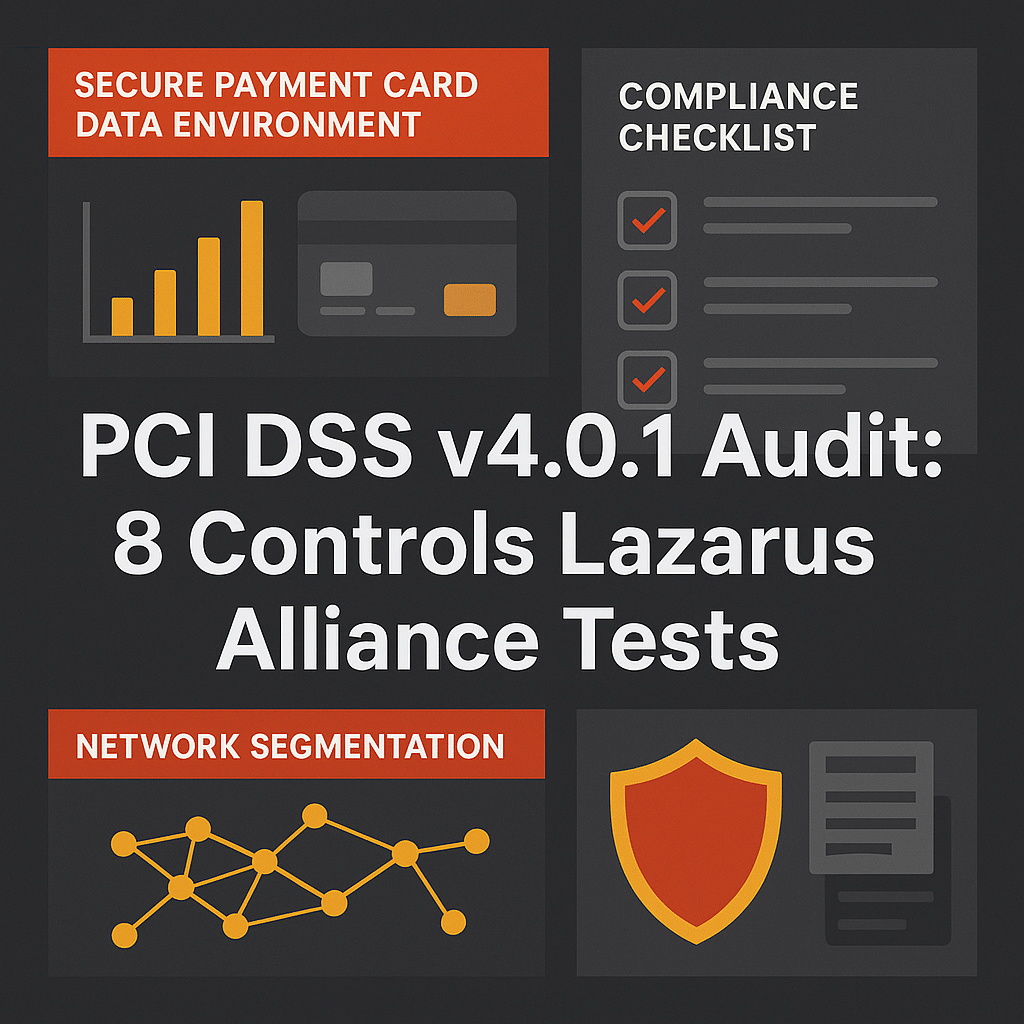
The hard part of a PCI DSS v4.0.1 audit is not knowing what the standard says. The hard part is proving, with defensible evidence, that payment security controls operate consistently across people, platforms, code, vendors, and change windows. Many organizations still prepare for a PCI DSS v4.0.1 audit as if it were a documentation exercise. Lazarus Alliance takes the opposite view: assessor-ready payment security compliance is an evidence engineering discipline.
That distinction matters because PCI DSS v4.0.1 validation depends on scope accuracy, repeatable evidence collection, and control operation. A merchant completing a PCI SAQ, a service provider preparing a PCI ROC, and a hybrid enterprise operating e-commerce, call-center, cloud, and third-party payment workflows all face the same core question: can an assessor trace cardholder data, confirm the in-scope environment, test the stated controls, and reconcile evidence to the requirement language in the PCI Security Standards Council, PCI DSS v4.0.1?
This article explains eight control domains Lazarus Alliance tests during PCI DSS v4.0.1 validation, how evidence is collected, what assessors expect, and how mature organizations turn PCI into a reusable GRC audit services foundation for SOC 1, SOC 2, ISO 27001, HIPAA, CJIS, FedRAMP, CMMC, DFARS NIST 800-171, IRS 1075, C5, GovRAMP, and LA DMF readiness.
PCI DSS v4.0.1 Audit Readiness Starts With Scope, Not Screenshots
A PCI DSS v4.0.1 audit begins with a scope determination: where cardholder data is stored, processed, transmitted, or could be impacted by connected systems. PCI DSS v4.0.1 defines the cardholder data environment, or CDE, as the people, processes, and technologies that store, process, or transmit cardholder data or sensitive authentication data, plus connected-to or security-impacting system components PCI Security Standards Council, PCI DSS v4.0.1.
Lazarus Alliance tests scope before testing controls. If scope is wrong, every downstream artifact is suspect: firewall exports, vulnerability scans, MFA screenshots, key inventories, access reviews, and third-party service provider attestations. In practice, a scoping walkthrough includes payment-channel interviews, data-flow diagrams, network segmentation review, system inventory sampling, cloud account validation, e-commerce script discovery, and evidence that tokenization or redirect designs actually reduce exposure.
Assessor-ready takeaway: Build a CDE evidence package that includes data-flow diagrams, network diagrams, asset inventories, payment-channel narratives, segmentation rationale, and named control owners. Continuum GRC’s 2026 Audit Readiness Benchmark Report examines audit readiness as an operational discipline, which aligns with the Lazarus Alliance approach: evidence must be mapped to controls before the assessor asks for it.
8 PCI DSS v4.0.1 Controls Lazarus Alliance Tests
1. Network Security, Segmentation, and CDE Boundary Control
PCI DSS v4.0.1 Requirement 1 addresses network security controls, including configuration standards, traffic restrictions, and protection of system components from untrusted networks PCI Security Standards Council, PCI DSS v4.0.1. Lazarus Alliance tests whether network security controls enforce the documented CDE boundary rather than merely appearing in a diagram.
Evidence usually includes firewall and cloud security group exports, rule-base reviews, network diagrams, segmentation penetration-test results, router and ACL configurations, change tickets, and rule recertification records. In cloud environments, the equivalent evidence may include virtual private cloud routing tables, security groups, network ACLs, private endpoint policies, load balancer listener configurations, and identity-based access paths that could bypass network segmentation.
Common gap: Organizations often document a segmented CDE but allow administrative paths from enterprise identity platforms, jump hosts, monitoring tools, backup networks, or CI/CD systems. If those systems can impact CDE security, they may become in-scope under PCI DSS v4.0.1 scoping principles PCI Security Standards Council, PCI DSS v4.0.1.
2. Account Data Protection, Encryption, and Key Management
PCI DSS v4.0.1 Requirement 3 covers protection of stored account data, while Requirement 4 covers protection of cardholder data during transmission over open, public networks PCI Security Standards Council, PCI DSS v4.0.1. Lazarus Alliance tests whether account data exists where the organization says it exists, whether sensitive authentication data is prohibited after authorization where applicable, and whether cryptographic controls are governed across the full key lifecycle.
Technical evidence includes database discovery scans, data-loss prevention findings, tokenization design documents, storage encryption settings, TLS configuration reports, certificate inventories, key custodianship records, key rotation evidence, hardware security module policies, and access logs for key-management systems. For payment security compliance, key management is rarely just a cryptography question. It is also an access-control, change-management, and incident-response question.
Scenario: An e-commerce company claims it stores only tokens. During evidence review, application logs reveal truncated PAN values in exception traces. Lazarus Alliance would test logging configurations, data-masking functions, retention policies, and developer access to logs, because the presence of account data in observability tooling can expand scope and invalidate assumptions.
3. Vulnerability Management, Authenticated Scanning, and Penetration Testing
PCI DSS v4.0.1 Requirement 11 includes security testing activities such as vulnerability scanning, external scanning, penetration testing, and detection of unauthorized changes to payment pages PCI Security Standards Council, PCI DSS v4.0.1. Lazarus Alliance tests whether vulnerability management is risk-based, authenticated where required, reconciled to asset scope, and connected to remediation governance.
Evidence includes internal scan reports, external ASV scan attestations, scan scope reconciliation, authenticated credential validation, exception approvals, remediation tickets, retest results, penetration-test reports, segmentation-test results, and vulnerability aging metrics. The key audit issue is traceability. An assessor should be able to pick a critical vulnerability, follow it from discovery to risk ranking to remediation to retest, and verify that no in-scope assets were omitted.
Expert pitfall: A passed external scan does not prove internal vulnerability management. External ASV scanning and internal authenticated scanning answer different audit questions. Lazarus Alliance therefore tests scan coverage, scan depth, credential success, excluded hosts, compensating controls, and whether risk acceptance follows PCI DSS v4.0.1 governance expectations PCI Security Standards Council, PCI DSS v4.0.1.
4. Secure Configuration, Patch Governance, and Change Control
PCI DSS v4.0.1 Requirement 2 covers secure configurations, while Requirement 6 covers secure development, vulnerability remediation, and change-management controls for systems and software PCI Security Standards Council, PCI DSS v4.0.1. Lazarus Alliance tests whether configuration baselines are approved, implemented, monitored, and enforced across servers, containers, network devices, databases, endpoints, and cloud services.
Assessment evidence includes hardening standards, golden images, configuration compliance reports, infrastructure-as-code repositories, change tickets, emergency change records, patch deployment metrics, vulnerability-to-patch mapping, code-review evidence, software bill of materials where used, and deployment approvals. When organizations use DevOps pipelines, Lazarus Alliance evaluates whether security tests occur before deployment and whether production changes can be traced to authorized commits and approved release records.
This control area maps well to NIST SP 800-53 because CM-2 addresses baseline configuration, CM-3 addresses configuration change control, SI-2 addresses flaw remediation, and SA-11 addresses developer testing and evaluation NIST, Security and Privacy Controls for Information Systems and Organizations. Cross-mapping reduces duplicate audit work when PCI evidence is reused for FedRAMP, GovRAMP, CJIS, ISO 27001, SOC 2, and CMMC readiness.
5. Identity, Least Privilege, MFA, and Access Reviews
PCI DSS v4.0.1 Requirement 7 covers restricting access by business need to know, and Requirement 8 covers identifying users and authenticating access to system components PCI Security Standards Council, PCI DSS v4.0.1. Lazarus Alliance tests whether access controls are role-based, approved, monitored, reviewed, and promptly removed when users change roles or leave.
Evidence includes identity provider configurations, MFA enforcement policies, privileged-access management logs, role matrices, joiner-mover-leaver tickets, access-review signoffs, service-account inventories, shared-account exceptions, break-glass procedures, and failed-login monitoring. Lazarus Alliance also tests whether administrative access to cloud consoles, hypervisors, firewalls, payment applications, databases, CI/CD tools, and logging platforms is included in the access-control population.
Assessor-ready metric: For each privileged group, maintain a population of users, the system of record for approval, last review evidence, MFA status, and current employment or contractor status. NIST SP 800-53 AC-2 addresses account management, AC-3 addresses access enforcement, AC-6 addresses least privilege, and IA-2 addresses identification and authentication NIST, Security and Privacy Controls for Information Systems and Organizations.
6. Payment-Page Script Security and E-Commerce Integrity
PCI DSS v4.0.1 specifically addresses payment-page script management and change detection through requirements such as 6.4.3 and 11.6.1 PCI Security Standards Council, PCI DSS v4.0.1. Lazarus Alliance tests whether browser-executed scripts on payment pages are inventoried, justified, authorized, integrity-monitored, and reviewed.
Evidence includes script inventories, business justifications, owner assignments, content security policy configurations, subresource integrity where implemented, tag-manager governance, change-detection alerts, alert triage records, vendor approvals, and incident-response playbooks for payment-page tampering. The assessment must include first-party code, third-party analytics scripts, chat widgets, fraud tools, A/B testing scripts, consent banners, and tag containers if they execute in the payment flow.
Common misconception: Redirecting payment capture to a hosted payment page does not automatically remove e-commerce script obligations if the merchant page can affect the consumer browser session or payment flow. Lazarus Alliance tests the actual browser path, not only architecture diagrams.
7. Logging, Detection, Incident Response, and Evidence Retention
PCI DSS v4.0.1 Requirement 10 addresses logging and monitoring, and Requirement 12 includes incident-response expectations PCI Security Standards Council, PCI DSS v4.0.1. Lazarus Alliance tests whether security events from in-scope systems are generated, protected, reviewed, correlated, and retained in a way that supports investigation and compliance validation.
Evidence includes log source inventories, SIEM ingestion reports, log retention settings, time synchronization configurations, alert rules, daily review records where applicable, incident tickets, tabletop exercises, forensic readiness procedures, and examples of event triage. Logging evidence must prove more than tool ownership. The assessor wants to see that logs exist for relevant system components, that privileged activity is visible, that log integrity is protected, and that alerts lead to documented analysis.
This domain also supports broader governance. The NIST Cybersecurity Framework describes core functions for governing, identifying, protecting, detecting, responding, and recovering from cybersecurity risk NIST, Cybersecurity Framework. PCI logging evidence can therefore become reusable support for SOC 2 security criteria, ISO 27001 monitoring controls, CJIS audit preparation, and HIPAA security operations.
8. Third-Party Service Provider Oversight and Shared Responsibility
PCI DSS v4.0.1 Requirement 12.8 addresses management of service providers with which cardholder data is shared or that could affect the security of cardholder data, and Requirement 12.9 addresses service-provider acknowledgment of responsibility where applicable PCI Security Standards Council, PCI DSS v4.0.1. Lazarus Alliance tests whether third-party risk management is connected to actual payment flows and shared security responsibilities.
Evidence includes service-provider inventories, contracts, responsibility matrices, PCI attestations, SOC reports, segmentation responsibilities, incident-notification clauses, data-processing maps, annual review records, and risk exceptions. For cloud and SaaS dependencies, the key question is not whether the provider has a report. The key question is which PCI responsibilities remain with the merchant or service provider being assessed.
Continuum GRC’s Third-Party and Vendor Risk resource reflects the same operational reality: vendor assurance must connect contracts, evidence, control ownership, and monitoring. Lazarus Alliance applies that principle in PCI DSS audits by reconciling payment data flows to third-party commitments and validating that responsibility boundaries are documented and tested.
PCI ROC vs. PCI SAQ: What Evidence Changes?
A PCI ROC is a formal report on compliance used for organizations that require an onsite or full assessment, while a PCI SAQ is a self-assessment questionnaire used by eligible entities under PCI SSC validation programs PCI Security Standards Council, Document Library. The evidence burden differs, but the control logic does not. A SAQ response still needs defensible evidence, and a ROC demands assessor-tested proof across the in-scope environment.
For a ROC, Lazarus Alliance emphasizes population completeness, sampling methodology, control-owner interviews, technical configuration review, independent observation, and evidence retention. For a SAQ, Lazarus Alliance emphasizes truthful eligibility analysis, documentation alignment, control testing, and remediation before attestation. In both cases, payment security compliance fails when assertions are not supported by records.
Decision matrix:
- If cardholder data is stored: prioritize data discovery, encryption, retention, key management, and access reviews.
- If payment capture is browser-based: prioritize script inventories, change detection, CSP governance, and third-party tag control.
- If cloud services are in scope: prioritize shared-responsibility mapping, IAM, logging, network controls, and evidence exports.
- If vendors touch the CDE: prioritize contracts, attestations, responsibility matrices, and incident-notification procedures.
- If segmentation reduces scope: prioritize segmentation test evidence, rule reviews, administrative path analysis, and asset reconciliation.
Lazarus Alliance Compliance Assessments: Evidence That Reuses Across Frameworks
PCI DSS v4.0.1 audit evidence should not live in a silo. The same control families often support SOC 1, SOC 2, ISO audits, HIPAA audits, CJIS reviews, CMMC readiness, DFARS NIST 800-171 assessments, FedRAMP and GovRAMP preparation, IRS 1075 audits, C5 assessments, and LA DMF obligations. Lazarus Alliance provides PCI DSS audit services alongside broader audit and compliance programs, allowing organizations to harmonize control testing, evidence requests, remediation, and executive reporting.
The practical benefit is control reuse. For example, PCI access reviews can support SOC 2 logical access testing; PCI vulnerability management can support ISO 27001 and NIST-based risk treatment; PCI incident-response records can support HIPAA security operations and CJIS readiness; and PCI vendor oversight can support enterprise third-party risk management. AICPA describes SOC 2 reporting as assurance over controls relevant to trust services criteria such as security, availability, processing integrity, confidentiality, and privacy AICPA and CIMA, SOC 2.
For organizations managing multiple frameworks, Lazarus Alliance recommends an evidence-control matrix with five fields: requirement citation, control owner, system population, evidence artifact, and testing procedure. This prevents the most common audit failure pattern: strong technology controls paired with weak evidence governance.
A Practical PCI DSS v4.0.1 Evidence Collection Checklist
- Define scope: maintain current CDE diagrams, data flows, inventories, payment channels, and third-party dependencies.
- Prove control operation: collect tickets, logs, approvals, scan results, review signoffs, configuration exports, and exception records.
- Validate populations: reconcile assets, users, vendors, scripts, certificates, keys, and scan targets before sampling.
- Test technical reality: observe configurations directly, not only through policy documents or screenshots.
- Close remediation loops: link findings to corrective actions, retest evidence, risk acceptance, and executive oversight.
- Prepare narratives: write concise explanations for scope, segmentation, encryption, MFA, vulnerability management, incident response, and shared responsibility.
- Retain reusable evidence: map PCI artifacts to SOC 2, NIST 800-53, ISO 27001, HIPAA, CJIS, FedRAMP, CMMC, and vendor-risk requirements.
Final Perspective: Payment Security Compliance Is Continuous Assurance
The best PCI DSS v4.0.1 audit outcomes occur when compliance teams stop chasing artifacts and start engineering evidence. Lazarus Alliance tests whether payment security controls are designed correctly, implemented consistently, monitored continuously, and supported by records an assessor can rely on. That is the difference between a stressful evidence scramble and an assessor-ready compliance program.
For CISOs, compliance officers, and IT directors, the message is simple: treat PCI DSS v4.0.1 validation as a control-verification program. If your organization can prove scope, account-data protection, segmentation, vulnerability management, secure configuration, identity governance, payment-page integrity, logging, incident response, and third-party oversight, you are not merely preparing for an audit. You are improving payment security resilience across the enterprise.
Sources and References
- PCI Security Standards Council, PCI DSS v4.0.1
- PCI Security Standards Council, Document Library
- NIST, Security and Privacy Controls for Information Systems and Organizations
- NIST, Cybersecurity Framework
- AICPA and CIMA, SOC 2
- Lazarus Alliance, PCI DSS Audit Services
- Continuum GRC, 2026 Audit Readiness Benchmark Report
- Continuum GRC, Third-Party and Vendor Risk
About Lazarus Alliance
To learn more about how Lazarus Alliance can help, contact us.
- FedRAMP
- GovRAMP
- NIST 800-53
- DFARS NIST 800-171
- CMMC
- SOC 1 & SOC 2
- C5
- HIPAA, HITECH, & Meaningful Use
- PCI DSS RoC & SAQ
- IRS 1075 & 4812
- CJIS
- LA DMF
- ISO 27001, ISO 27002, ISO 27005, ISO 27017, ISO 27018, ISO 27701, ISO 22301, ISO 17020, ISO 17021, ISO 17025, ISO 17065, ISO 9001, & ISO 90003
- And dozens more!
Related Posts