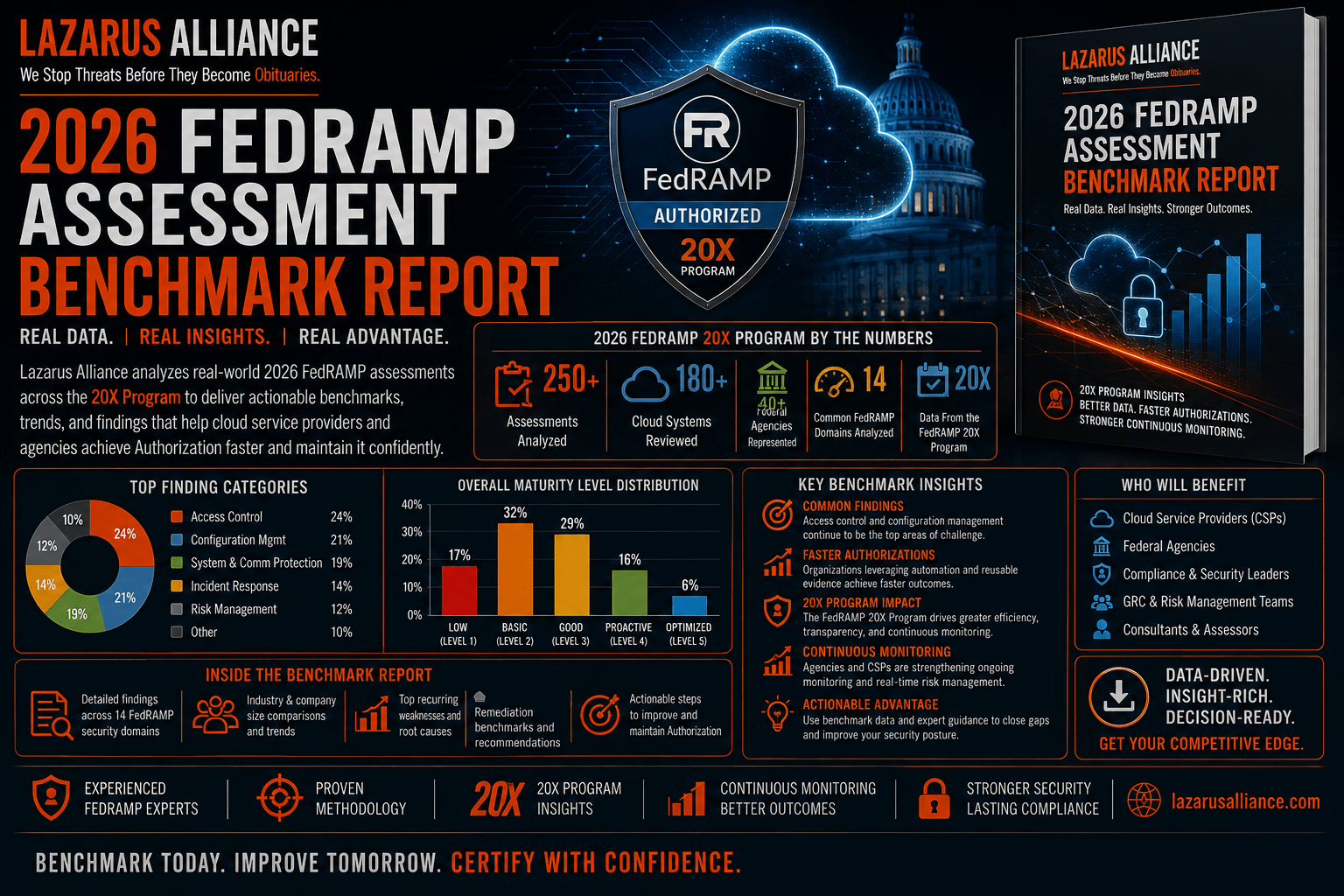
2026 FedRAMP Assessment
Benchmark Report
Table of Contents
ToggleAggregate Anonymized Insights from Lazarus Alliance
FedRAMP 3PAO Assessments
Reporting Period: January 2025 – June 2026 • Published August 2026 • Version 1.0
Assessments
Duration
(35 of 38)
Evidence (36 of 38)
Lazarus Alliance, Inc.
A2LA-Accredited FedRAMP 3PAO
Authorized CMMC C3PAO (CPN 10251) • PCI DSS QSA • Veteran-Owned Small Business
Title: 2026 FedRAMP Assessment Benchmark Report
Version: 1.0 (August 2026)
Dataset: N = 38 completed FedRAMP Moderate and High authorization assessments (including significant change and continuous monitoring support packages where full assessment procedures were applied) performed by Lazarus Alliance as an A2LA-accredited FedRAMP 3PAO between January 2025 and June 2026. All data anonymized.
Publisher: Lazarus Alliance, Inc., Scottsdale, Arizona
License: © 2026 Lazarus Alliance, Inc. All rights reserved. Aggregate statistics may be cited with attribution.
1. Purpose & Methodology
This benchmark report aggregates anonymized findings from N = 38 FedRAMP assessment engagements performed by Lazarus Alliance as an A2LA-accredited FedRAMP Third-Party Assessment Organization (3PAO) between January 2025 and June 2026. Organizational identifiers, system names, agency sponsors, and proprietary details have been removed. Figures represent observed patterns and are intended to provide Cloud Service Providers (CSPs), agencies, and partners with realistic expectations for scope, duration, evidence quality, and common control gaps.
Scope of Data: Completed FedRAMP Moderate and High assessments (initial authorizations, significant change assessments, and full-procedure continuous monitoring support packages). Readiness-only or documentation reviews without testing are excluded. Percentages use N = 38 unless otherwise noted.
Disclaimer: These benchmarks are observational and do not constitute guarantees of future performance, authorization outcomes, or timelines. Individual results vary significantly based on system complexity, inheritance, FedRAMP package maturity, assessment scope, and applicable FedRAMP or agency review processes. Lazarus Alliance maintains strict independence and impartiality under ISO/IEC 17020 and FedRAMP 3PAO requirements.
2. Executive Summary – Key Benchmarks
| Metric | Observed Value | Denominator / Notes |
|---|---|---|
| Sample size | N = 38 | Completed FedRAMP 3PAO assessments |
| Average authorization boundary size | ~85 system components / ~210 assets | Wide range by service model |
| Median formal assessment duration | 42 business days | Kickoff to draft SAR / Security Assessment Report |
| Assessments with ≥1 POA&M | 92% (35 of 38) | Median ~6 items when present |
| Percentage requiring additional evidence | 95% (36 of 38) | At least one clarification / evidence request cycle |
| Single-system / tightly bounded vs. complex multi-component | 58% / 42% | N = 38 |
| Average evidence volume | ~3,400 discrete artifacts | Range approximately 1,200 – 9,500 |
POA&M Presence (N = 38)
Additional Evidence Required
3. Average Scope Size
Authorization boundary size is a primary driver of assessment effort:
- Average in-scope system components / services: ~85
- Average assets (instances, containers, network devices, endpoints in boundary): ~210
- Smallest observed boundary: focused SaaS service with limited supporting infrastructure
- Largest observed boundaries: multi-service platforms with extensive inheritance and customer-configurable elements
CSPs that maintained clear, current System Security Plans (SSPs), accurate data-flow diagrams, and well-documented control inheritance consistently experienced more efficient testing and fewer boundary-related findings.
4. Median Assessment Duration
Formal assessment duration is measured from assessment kickoff (accepted evidence package / readiness to test) through delivery of the draft Security Assessment Report.
- Median formal assessment duration: 42 business days
- 25th percentile: ~28 business days (mature packages, tighter boundaries)
- 75th percentile: ~58 business days
- Longer engagements typically involved complex multi-component systems, heavy inheritance validation, or significant mid-assessment evidence remediation
Note: Agency or JAB review cycles, package iteration after 3PAO delivery, and continuous monitoring cadence are outside this formal assessment duration metric.
5. Common Failed Objectives
The following NIST SP 800-53 control areas most frequently generated residual findings (partially implemented or not satisfied) across the N = 38 assessments:
| Rank | Control Family / Examples | Primary Issue Observed |
|---|---|---|
| 1 | AU (Audit & Accountability) — AU-2, AU-3, AU-6, AU-12 | Incomplete event coverage, review cadence, or log protection |
| 2 | CM (Configuration Management) — CM-2, CM-3, CM-6, CM-8 | Baselines not maintained; change control gaps; incomplete inventories |
| 3 | AC (Access Control) — AC-2, AC-3, AC-6, AC-17 | Account management, least privilege, remote access evidence gaps |
| 4 | IA (Identification & Authentication) — IA-2, IA-5, IA-8 | MFA coverage, authenticator management, federation evidence |
| 5 | SI (System & Information Integrity) — SI-2, SI-3, SI-4 | Flaw remediation timelines; monitoring coverage |
| 6 | CA (Assessment, Authorization, Monitoring) — CA-2, CA-5, CA-7 | POA&M quality; continuous monitoring evidence |
| 7 | SC (System & Communications Protection) — SC-7, SC-8, SC-13 | Boundary protection; encryption implementation evidence |
Controls related to supply chain risk (SR), contingency planning testing (CP), and personnel security also appeared frequently among residual findings, particularly for CSPs with rapid growth or complex subservice organizations.
6. Evidence Deficiencies
Evidence quality — not volume alone — determined assessment efficiency. Common deficiencies:
- SSP and control implementation statements that were generic or not aligned to the actual architecture
- Screenshots and exports without context (missing system identifiers, timestamps, or configuration paths)
- Incomplete or non-representative log samples
- Missing or outdated configuration baselines and inventories
- Inheritance claims lacking current customer responsibility matrices, shared responsibility documentation, or subservice organization evidence
- POA&M entries that were vague, lacked milestones, or did not map cleanly to residual risk
- Continuous monitoring artifacts that did not demonstrate ongoing operational effectiveness
CSPs using structured evidence repositories mapped to 800-53 controls and maintaining living SSPs required fewer clarification cycles.
7. POA&M Frequency
- 92% (35 of 38) of assessments resulted in at least one POA&M item
- Median number of POA&M items when present: ~6
- Most common categories: audit logging, configuration management, access control, vulnerability remediation, and continuous monitoring evidence
In FedRAMP, POA&Ms are an expected and normal part of the authorization process. Well-formed POA&Ms with clear milestones, residual risk statements, and remediation owners are treated as manageable; poorly defined or open-ended POA&Ms create friction in agency / JAB review.
8. Authorization Boundary Complexity
Analogous to “enclave vs. enterprise” scoping in other frameworks, FedRAMP assessments varied by boundary complexity:
- 58% (22 of 38) — single-system or tightly bounded service with limited external dependencies
- 42% (16 of 38) — complex multi-component, multi-service, or heavily inherited architectures
Tighter, well-documented boundaries correlated with shorter formal assessment durations, lower evidence volume, and fewer residual findings related to external interfaces and inheritance. Complex boundaries more frequently generated findings in boundary protection, external system services, and shared responsibility clarity.
9. Average Evidence Volume & Additional Evidence Requests
- Average discrete artifacts submitted: ~3,400 (policies, procedures, SSP excerpts, diagrams, configurations, logs, scan results, tickets, training records, etc.)
- Observed range: approximately 1,200 to 9,500 artifacts
- 95% (36 of 38) required at least one round of additional evidence after initial package review
- Most frequent additional requests: expanded log samples, baseline details, MFA / access path proof, inheritance documentation, and continuous monitoring records
Volume alone was a weak predictor of success. Practice-mapped, contextualized, and current evidence moved assessments faster than large undifferentiated document dumps.
10. Most Misunderstood Requirements
- Continuous monitoring (CA-7 and related) — treating assessment as a point-in-time event rather than demonstrating ongoing operational effectiveness
- Control inheritance and shared responsibility — incomplete or outdated customer responsibility matrices; unsupported claims about what the CSP vs. customer vs. subservice organization provides
- Configuration baselines (CM-2 / CM-6) — presenting generic hardening guides as maintained, version-controlled baselines for the actual production environment
- Audit record content and review (AU-3 / AU-6) — logging some events without ensuring required content, protection, retention, and documented review
- Authenticator management and MFA (IA-2 / IA-5) — incomplete coverage across privileged, remote, and federated access paths
- POA&M quality (CA-5) — vague milestones, missing residual risk, or lack of clear ownership
- Boundary and data-flow accuracy — SSP diagrams that do not match the implemented architecture or external connections
11. Key Insights for CSPs
- 1. Keep the SSP and boundary living documents. Out-of-date architecture descriptions create immediate friction.
- 2. Map evidence to 800-53 controls before kickoff. Assessors spend less time requesting clarification when artifacts are already control-tagged.
- 3. Prioritize AU, CM, AC, and IA. These families accounted for a disproportionate share of residual findings.
- 4. Treat continuous monitoring as first-class evidence, not an afterthought.
- 5. Expect POA&Ms and prepare high-quality ones. 92% of assessments had at least one item.
- 6. Validate inheritance early. Unsupported or stale shared-responsibility claims are a recurring source of delay.
12. Authors, Reviewers & How to Cite
Lead Author
Michael D. Peters, CEO & Founder, Lazarus Alliance, Inc.
A2LA-accredited FedRAMP 3PAO leadership; Authorized CMMC C3PAO; PCI DSS QSA firm principal; Delaware CPA firm. 26+ years in proactive cybersecurity, audit, and compliance.
Technical Review
FedRAMP Assessment Team, Lazarus Alliance (3PAO delivery and quality assurance under ISO/IEC 17020 and FedRAMP requirements).
How to Cite This Report
Peters, M. D. (2026). 2026 FedRAMP Assessment Benchmark Report: Aggregate Anonymized Insights from Lazarus Alliance FedRAMP 3PAO Assessments (Version 1.0). Lazarus Alliance, Inc. https://lazarusalliance.com
Recommended short citation: Lazarus Alliance (2026). 2026 FedRAMP Assessment Benchmark Report (N=38).
13. About & Contact
Lazarus Alliance is an A2LA-accredited FedRAMP Third-Party Assessment Organization (3PAO), an authorized CMMC C3PAO (CPN 10251), a PCI DSS Qualified Security Assessor (QSA), and a veteran-owned small business headquartered in Scottsdale, Arizona. Since 2000 the firm has specialized in proactive cybersecurity, audit, and compliance services across FedRAMP, CMMC, SOC 2, NIST, ISO, and related frameworks.
Lazarus Alliance, Inc.
27743 N. 70th Street, Suite 100, Scottsdale, AZ 85266
1-888-896-7580 • [email protected]
https://lazarusalliance.com
© 2026 Lazarus Alliance, Inc. All rights reserved. Proactive Cybersecurity®, Cybervisor®, and IT Audit Machine® are trademarks of Lazarus Alliance or its affiliates. Aggregate data is anonymized; individual assessment outcomes remain confidential.
Scottsdale, Arizona • 1-888-896-7580 • lazarusalliance.com
Additional Analysis
- How Long Does a FedRAMP Assessment Take?
- 7 Most Common FedRAMP Assessment Findings
- How Much Evidence Does a FedRAMP Assessment Require?
- FedRAMP Authorization Boundary Complexity
- 7 Most Misunderstood FedRAMP Requirements Observed in Assessments
- FedRAMP POA&M Benchmarks
Talk with one of our experts
Our Lazarus Alliance Cybervisor™ teams have experience performing thousands of assessments for organizations providing services to clients around the world.
We're here to answer any questions you may have.