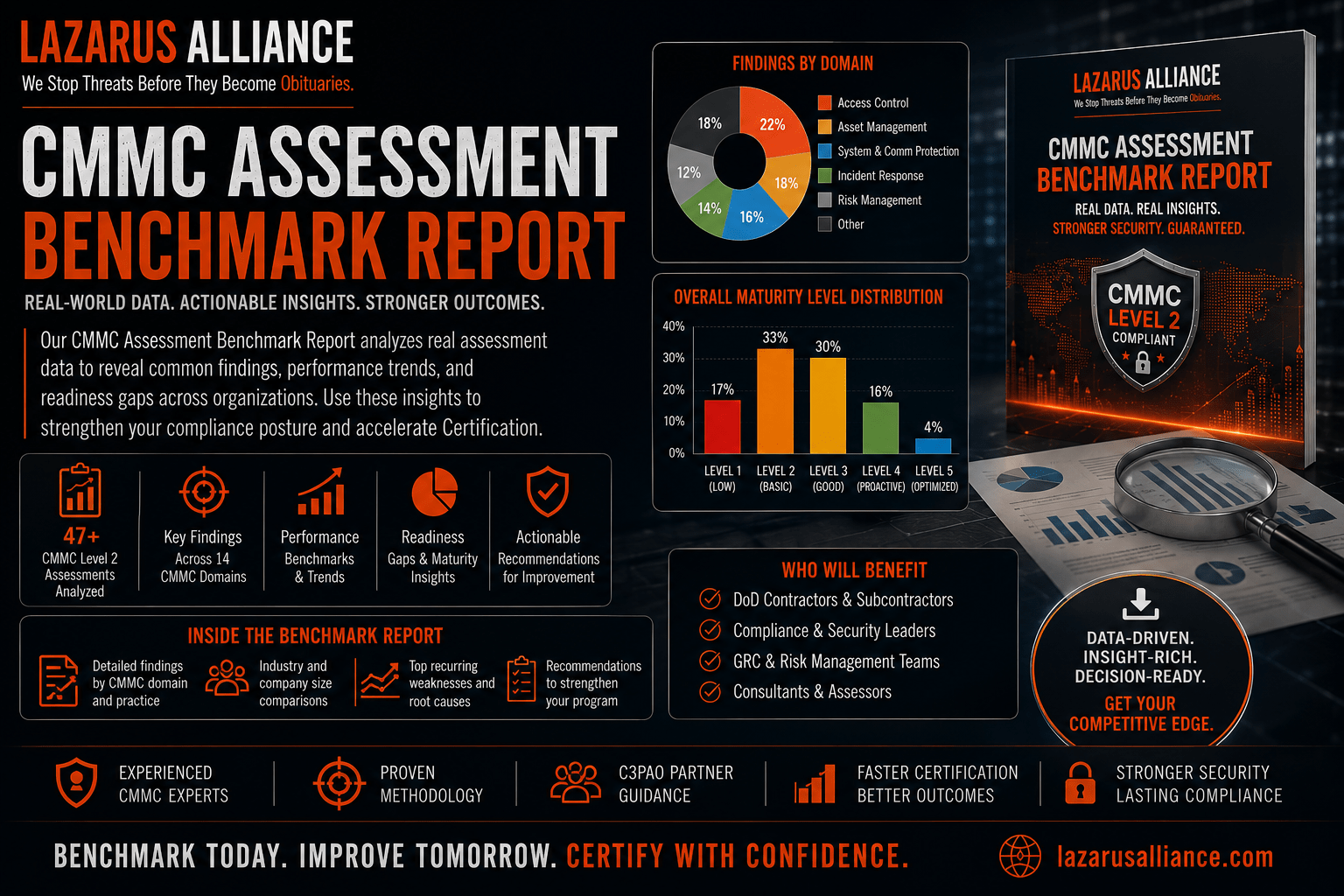
2026 CMMC Assessment
Benchmark Report
Table of Contents
ToggleAggregate Anonymized Insights from Lazarus Alliance
CMMC Level 2 C3PAO Assessments
Reporting Period: January 2025 – June 2026 • Published August 2026 • Version 1.1
Assessments
Duration
(35 of 47)
Evidence (42 of 47)
Lazarus Alliance, Inc.
Authorized CMMC C3PAO (CPN 10251)
A2LA-Accredited FedRAMP 3PAO • PCI DSS QSA • Veteran-Owned Small Business
On 13 July 2026 the Department of War announced the immediate suspension of CMMC Phase II requirements (originally scheduled to take effect 10 November 2026) and established a CMMC Reform Task Force for a 60-day review. Phase I self-assessment requirements remain in effect. DFARS 252.204-7012 obligations are unchanged.
Primary sources:
• Official release: war.gov – Forging the Arsenal of Freedom (13 Jul 2026)
• Implementing memorandum (26-P-1023): dodcio.defense.gov – Implementing Suspension of CMMC Phase II (PDF)
• Program page: dodcio.defense.gov/CMMC
This benchmark remains relevant for organizations pursuing voluntary C3PAO assessments, prime-driven requirements, and continuous improvement against NIST SP 800-171.
Title: 2026 CMMC Assessment Benchmark Report
Version: 1.1 (August 2026)
Dataset: N = 47 completed formal CMMC Level 2 C3PAO assessments conducted by Lazarus Alliance between January 2025 and June 2026. All data anonymized; organizational identifiers removed.
Publisher: Lazarus Alliance, Inc., Scottsdale, Arizona
License: © 2026 Lazarus Alliance, Inc. All rights reserved. Aggregate statistics may be cited with attribution.
1. Purpose & Methodology
This benchmark report aggregates anonymized findings from N = 47 formal CMMC Level 2 certification assessments performed by Lazarus Alliance as an authorized Cyber AB C3PAO (CPN 10251) between January 2025 and June 2026. All organizational identifiers, system names, contract numbers, and proprietary details have been removed. Figures represent observed patterns across the assessment population and are intended to provide defense industrial base (DIB) organizations with realistic expectations for scope, duration, evidence quality, and common control gaps.
Scope of Data: Completed Level 2 assessments only (self-assessment / SPRS data and readiness engagements are excluded). Both enclave and enterprise boundary assessments are included. Percentages use the full N = 47 as denominator unless otherwise noted. Numbers are rounded for clarity and confidentiality.
Disclaimer: These benchmarks are observational and do not constitute guarantees of future performance, certification outcomes, or timelines. Individual results vary significantly based on preparation quality, environment complexity, inheritance, and assessor findings. Lazarus Alliance maintains strict independence and impartiality under ISO/IEC 17020 and Cyber AB requirements.
2. Executive Summary – Key Benchmarks
Across the aggregated assessment population (N = 47), organizations that entered formal assessment with mature documentation, complete logging, and verified multifactor authentication experienced materially shorter cycles and fewer residual findings.
| Metric | Observed Value | Denominator / Notes |
|---|---|---|
| Sample size (completed Level 2 assessments) | N = 47 | Full formal C3PAO assessments only |
| Average scope size (in-scope systems / assets) | ~68 systems / ~155 endpoints | N = 47; range 12–410 systems |
| Median formal assessment duration | 17 business days | N = 47; kickoff to draft SAR |
| Assessments resulting in ≥1 POA&M item | 74% (35 of 47) | Median 3 items when present |
| Percentage requiring additional evidence | 89% (42 of 47) | At least one clarification round |
| Enclave vs. Enterprise boundary | 66% Enclave (31) / 34% Enterprise (16) | N = 47 |
| Average evidence volume submitted | ~1,920 discrete artifacts | N = 47; range ~650–5,800 |
Embeddable Charts (N = 47)
Boundary Type Distribution
POA&M Presence
Additional Evidence Required
Assessment Duration Distribution (approx.)
Most Frequent Residual Findings (Rank Order)
3. Average Scope Size
Scope size remains the primary driver of assessment effort and cost (N = 47):
- Average in-scope systems/assets: approximately 68
- Average endpoints: ~155
- Median user population within the assessment boundary: ~95 users
- Smallest observed scope: 12 systems (tightly defined CUI enclave)
- Largest observed scope: 410+ systems (full enterprise boundary with multiple locations)
Organizations that successfully limited scope through well-documented enclaves, network segmentation, and clear CUI data-flow diagrams consistently experienced shorter assessment windows and fewer findings related to residual enterprise systems.
4. Median Assessment Duration
Formal assessment duration is measured from assessment kickoff (evidence package acceptance) through delivery of the draft Security Assessment Report (SAR). Readiness / gap-analysis periods are excluded (N = 47).
- Median formal assessment duration: 17 business days
- 25th percentile: 11 business days
- 75th percentile: 26 business days
- Outliers exceeding 35 business days typically involved multi-site enterprise boundaries or significant evidence remediation mid-assessment
Organizations that leveraged automated evidence collection (including Continuum GRC / IT Audit Machine® workflows) and completed pre-assessment evidence mapping generally fell into the lower quartile of duration.
5. Common Failed Objectives
The following practices most frequently generated findings (partial implementation or not met) across the N = 47 Level 2 assessments:
| Rank | Practice | Domain | Primary Issue Observed |
|---|---|---|---|
| 1 | IA.L2-3.5.3 | Identification & Authentication | Multifactor authentication incomplete for privileged or remote access paths |
| 2 | AU.L2-3.3.1 / 3.3.2 | Audit & Accountability | Incomplete or non-centralized audit logging; retention or review deficiencies |
| 3 | CM.L2-3.4.1 / 3.4.2 | Configuration Management | Missing or outdated baselines; configuration change control gaps |
| 4 | AC.L2-3.1.1 / 3.1.2 | Access Control | Account management / least privilege not fully enforced or evidenced |
| 5 | SI.L2-3.14.1 / 3.14.2 | System & Information Integrity | Flaw remediation / vulnerability scanning cadence or coverage incomplete |
| 6 | SC.L2-3.13.1 / 3.13.5 | System & Communications Protection | Boundary protection / external system connections insufficiently controlled |
| 7 | MP.L2-3.8.1 / 3.8.3 | Media Protection | Media sanitization / CUI media handling procedures lacking evidence |
6. Evidence Deficiencies
Evidence quality—not merely volume—determined assessment efficiency. Common deficiencies observed across the dataset:
- Screenshots without context or timestamps
- Policy statements without operational evidence
- Incomplete log samples
- Missing configuration baselines
- Inheritance claims without supporting SSP or customer responsibility matrix
- Outdated or generic templates
- Lack of sampling methodology documentation for larger environments
7. POA&M Frequency
Plans of Action and Milestones remain a normal outcome for many first-time Level 2 assessments (N = 47):
- 74% (35 of 47) of assessments resulted in at least one POA&M item
- Median number of POA&M items when present: 3
- Most common categories: multifactor authentication gaps, logging completeness, vulnerability management cadence, and media protection procedures
8. Enclave vs. Enterprise Environments
- 66% (31 of 47) used a defined CUI enclave
- 34% (16 of 47) assessed a full enterprise or multi-site boundary
Enclave assessments showed lower average duration, lower evidence volume, and fewer residual findings related to residual enterprise systems.
9. Average Evidence Volume & Additional Evidence Requests
- Average discrete artifacts submitted: ~1,920 (N = 47; range ~650–5,800)
- 89% (42 of 47) required at least one round of additional evidence after initial package review
10. Most Misunderstood Requirements
- IA.L2-3.5.3 (Multifactor Authentication) – Scope of privileged accounts and remote access paths frequently under-interpreted.
- AU.L2-3.3.1 / 3.3.2 – Confusion between what must be logged versus what is retained and reviewed.
- CM.L2-3.4.1 – Belief that a generic hardening checklist equals a maintained baseline.
- AC.L2-3.1.12 / 3.1.20 – Underestimation of external system connection controls.
- SC.L2-3.13.11 (FIPS-validated cryptography) – Misapplication or incomplete module validation evidence.
- CA.L2-3.12.2 and continuous monitoring – Treating assessment as purely point-in-time.
- Inheritance / shared responsibility – Unsupported claims without CRM or SSP excerpts.
11. Key Insights for Organizations Seeking Certification
- 1. Define and defend the boundary early.
- 2. Treat evidence as a living system (timestamped, practice-mapped, context-rich).
- 3. Prioritize MFA, logging, and baselines.
- 4. Perform a realistic internal mock assessment.
- 5. Accept that limited POA&Ms are common — focus on rapid, documented remediation.
- 6. Leverage automation where it maintains continuous evidence and control status.
12. Authors, Reviewers & How to Cite
Lead Author
Michael D. Peters, CEO & Founder, Lazarus Alliance, Inc.
Authorized CMMC C3PAO leadership; A2LA-accredited FedRAMP 3PAO; PCI DSS QSA firm principal; Delaware CPA firm. 26+ years in proactive cybersecurity, audit, and compliance.
Technical Review
Senior Cybervisor® Assessment Team, Lazarus Alliance (CMMC Level 2 assessment delivery and quality assurance under ISO/IEC 17020).
How to Cite This Report
Peters, M. D. (2026). 2026 CMMC Assessment Benchmark Report: Aggregate Anonymized Insights from Lazarus Alliance CMMC Level 2 C3PAO Assessments (Version 1.1). Lazarus Alliance, Inc. https://lazarusalliance.com
Recommended short citation: Lazarus Alliance (2026). 2026 CMMC Assessment Benchmark Report (N=47).
Supporting data file: 2026_CMMC_Benchmark_Aggregate_Data.csv (released with this report).
13. About & Contact
Lazarus Alliance is an authorized CMMC Third-Party Assessment Organization (C3PAO, CPN 10251), an A2LA-accredited FedRAMP 3PAO, a PCI DSS Qualified Security Assessor (QSA), and a veteran-owned small business headquartered in Scottsdale, Arizona. Since 2000 the firm has specialized in proactive cybersecurity, audit, and compliance services.
Lazarus Alliance, Inc.
27743 N. 70th Street, Suite 100, Scottsdale, AZ 85266
1-888-896-7580 • [email protected]
https://lazarusalliance.com
© 2026 Lazarus Alliance, Inc. All rights reserved. Proactive Cybersecurity®, Cybervisor®, and IT Audit Machine® are trademarks of Lazarus Alliance or its affiliates. Aggregate data is anonymized; individual assessment outcomes remain confidential. Brand colors follow the official Lazarus Alliance Style Guide. Charts generated with Chart.js.
Scottsdale, Arizona • 1-888-896-7580 • lazarusalliance.com
Additional Analysis
- How Long Does a CMMC Level 2 Assessment Take?
- 7 Most Common CMMC Level 2 Assessment Findings
- How Much Evidence Does a CMMC Assessment Require?
- How Common Are CMMC POA&Ms?
- CMMC Enclave vs Enterprise: What 47 Assessments Show
About Lazarus Alliance
To learn more about how Lazarus Alliance can help, contact us.
-
- FedRAMP
- GovRAMP
- NIST 800-53
- DFARS NIST 800-171
- CMMC
- SOC 1 & SOC 2
- C5
- HIPAA, HITECH, & Meaningful Use
- PCI DSS RoC & SAQ
- IRS 1075 & 4812
- CJIS
- LA DMF
- ISO 27001, ISO 27002, ISO 27005, ISO 27017, ISO 27018, ISO 27701, ISO 22301, ISO 17020, ISO 17021, ISO 17025, ISO 17065, ISO 9001, & ISO 90003
- And dozens more!