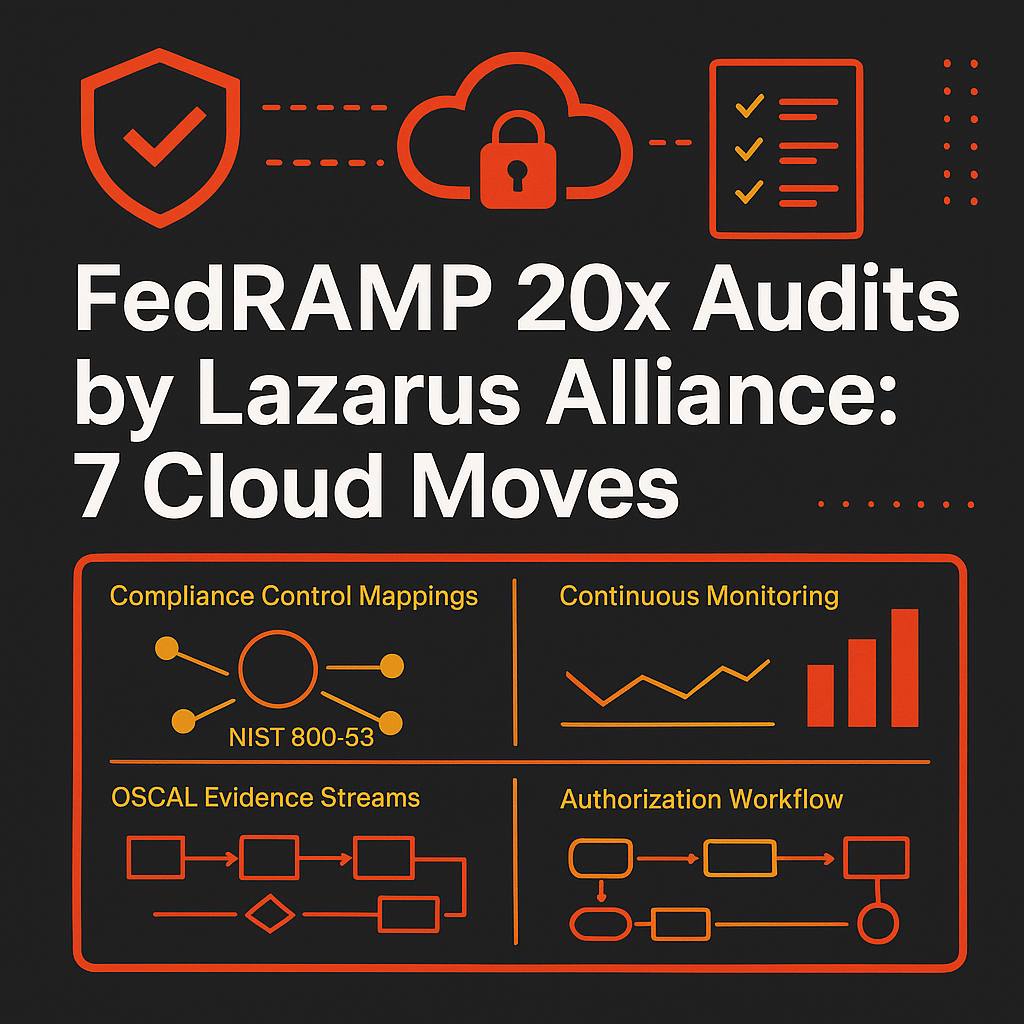
FedRAMP 20x is not merely a faster authorization path; it is a different evidence economy. The organizations that benefit most will not be the ones with the thickest System Security Plan. They will be the cloud service providers that can continuously prove control performance through structured, reusable, machine-readable evidence aligned to NIST 800-53, OSCAL, and real operational telemetry.
For federal cloud buyers, the shift is equally important. FedRAMP reported 92 new FedRAMP Certifications in FY2026, including 66 Rev5 and 26 FedRAMP 20x Certifications, and stated that the marketplace reached 538 FedRAMP Certified cloud service offerings; FedRAMP also said it will stop processing Legacy FedRAMP Rev5 Certification applications on June 11, 2027, according to FedRAMP, “Scaling a Better Path to Cloud Security”. That means the practical question for CISOs, compliance leaders, and cloud engineering teams is no longer “How do we assemble a package?” It is “How do we operate an assurance pipeline?”
Lazarus Alliance approaches FedRAMP 20x audits as a continuous cloud assurance program: control architecture, evidence automation, technical validation, governance, and assessor-ready traceability. The following seven cloud moves translate FedRAMP 20x into an actionable operating model for providers pursuing federal authorization, agencies evaluating cloud risk, and enterprises seeking NIST 800-53-grade assurance.
FedRAMP 20x Audits Start with Continuous Cloud Assurance
FedRAMP 20x changes the center of gravity from static documentation to continuously supportable evidence. Traditional cloud security audit activity often treats assessment as a project: collect documents, remediate gaps, respond to assessor questions, and repeat the scramble during continuous monitoring. FedRAMP 20x requires a more durable model in which policies, control implementations, cloud-native logs, vulnerability data, configuration baselines, identity evidence, and change records remain audit-ready throughout the authorization lifecycle.
This direction is consistent with federal risk management expectations. NIST SP 800-37 describes the Risk Management Framework as an ongoing process for categorizing systems, selecting controls, implementing controls, assessing controls, authorizing systems, and monitoring controls, according to NIST SP 800-37 Rev. 2. FedRAMP 20x takes that continuous philosophy and applies it to cloud authorization velocity.
Practical audit implication: cloud teams must be able to show not only that a control was designed correctly, but that the control is operating now. For example, NIST SP 800-53 AC-2 requires account management, AU-6 addresses audit record review and analysis, CA-7 addresses continuous monitoring, RA-5 addresses vulnerability monitoring and scanning, SI-2 addresses flaw remediation, and CM-6 addresses configuration settings, according to NIST SP 800-53 Rev. 5. A FedRAMP 20x-ready program should be able to connect each of those controls to current evidence, not just narrative assertions.
Move 1: Build a NIST 800-53 Control Backbone Before Tooling
The first FedRAMP 20x cloud move is architectural: define the control backbone before buying or configuring more tools. NIST 800-53 should function as the common control language across FedRAMP, FISMA, GovRAMP, CJIS, IRS 1075, CMMC-adjacent environments, SOC 2 mappings, ISO 27001 alignment, HIPAA security programs, and payment environments.
A strong control backbone includes three layers:
- Control intent: the authoritative requirement, such as AC-2 for account management, CM-8 for system component inventory, IR-6 for incident reporting, SA-9 for external system services, and SR-3 for supply chain controls, as defined in NIST SP 800-53 Rev. 5.
- Implementation statement: the cloud-specific design, including identity provider settings, privileged access workflows, logging architecture, encryption boundaries, vulnerability scanning scope, and tenant isolation assumptions.
- Evidence object: the artifact or telemetry that proves the implementation is operating, such as access review exports, SIEM alerts, configuration snapshots, scan results, change tickets, incident exercises, and third-party attestations.
This is where Lazarus Alliance cybersecurity audits emphasize traceability. The goal is not to create a spreadsheet of frameworks; it is to build a control-to-evidence graph that can survive assessor scrutiny. Lazarus Alliance’s FedRAMP audit and compliance services and NIST 800-53 and FISMA audit services help organizations rationalize control inheritance, customer-responsibility matrices, cloud shared-responsibility assumptions, and evidence expectations before assessment pressure peaks.
Move 2: Convert Documents into OSCAL Evidence
FedRAMP 20x rewards machine-readable assurance. OSCAL, the Open Security Controls Assessment Language, is a NIST project that provides standardized, machine-readable formats for security control catalogs, profiles, component definitions, system security plans, assessment plans, assessment results, and plans of action and milestones, according to NIST, Open Security Controls Assessment Language.
For audit leaders, OSCAL evidence is not simply a file format. It is a discipline. Each evidence object should have an owner, source system, collection method, timestamp, scope boundary, retention rule, control mapping, and validation status. A vulnerability scan export, for example, is weak evidence if it does not show authenticated coverage, asset completeness, exception handling, remediation ownership, and aging. A strong OSCAL-aligned evidence object can show that the scan supports RA-5, that remediation tickets support SI-2, and that risk acceptance decisions tie to the organization’s authorization boundary.
Implementation example: a SaaS provider pursuing FedRAMP 20x can model its SSP elements in OSCAL, connect identity evidence from its identity provider to AC-2 and IA-family controls, connect cloud configuration posture data to CM-6 and CM-8, and connect SIEM detections to AU-6 and IR-family controls. When assessors request evidence, the provider can produce a current, structured record rather than manually rebuilding the story from screenshots.
Move 3: Instrument Continuous Monitoring as an Audit Product
Continuous monitoring is often treated as a security operations activity that happens near the SOC, while audit teams collect evidence separately. FedRAMP 20x makes that separation risky. FedRAMP publishes continuous monitoring resources and templates for cloud service providers, according to FedRAMP Documents and Templates. The lesson for cloud providers is clear: monitoring outputs must be usable by security engineers, authorizing officials, assessors, and agency customers.
A FedRAMP 20x continuous monitoring program should define minimum evidence streams for:
- Vulnerability management: authenticated scanning, container image scanning, dependency risk, remediation service-level objectives, accepted-risk approvals, and recurring weakness trends mapped to RA-5 and SI-2.
- Configuration management: baseline drift, infrastructure-as-code changes, privileged configuration edits, encryption settings, logging settings, and unauthorized service exposure mapped to CM-2, CM-3, CM-6, and CM-8.
- Identity and access: joiner-mover-leaver events, privileged role assignments, service accounts, federation trust changes, access reviews, and MFA exceptions mapped to AC-2, AC-5, AC-6, IA-2, and IA-5.
- Logging and detection: log source coverage, time synchronization, alert triage, escalation, incident correlation, and retention mapped to AU-2, AU-6, AU-8, AU-12, IR-4, and IR-5.
The audit-ready version of continuous monitoring answers four questions: What changed? Who approved it? What control did it affect? What evidence proves the risk was handled?
Move 4: Treat Cloud Boundary Management as a Board-Level Risk
FedRAMP failures often begin with boundary ambiguity. A cloud service offering may rely on multiple infrastructure providers, managed services, identity platforms, content delivery networks, code repositories, support portals, analytics tools, and ticketing systems. If the boundary is unclear, control inheritance becomes unreliable, evidence gaps multiply, and customer agencies lose confidence.
NIST 800-53 SA-9 addresses external system services, and SR-family controls address supply chain risk management, according to NIST SP 800-53 Rev. 5. In practice, this means a FedRAMP 20x audit should test whether every external service supporting the cloud offering has a defined security role, contractual obligation, evidence source, incident notification path, and continuity expectation.
Common pitfall: organizations often document the production cloud boundary but omit administrative support systems that can affect confidentiality, integrity, or availability. Examples include remote support tooling, CI/CD orchestration, secrets management, customer success platforms containing regulated data, and engineering analytics tools that store operational metadata. Under a continuous assurance model, these dependencies should be either inside the boundary, explicitly inherited, or formally excluded with defensible rationale.
Continuum GRC’s 2026 Compliance Framework Complexity Report examines how organizations manage overlapping compliance obligations, making it a useful resource for leaders trying to rationalize FedRAMP, GovRAMP, SOC 2, ISO 27001, HIPAA, PCI DSS, CJIS, and DFARS NIST 800-171 obligations without duplicating evidence programs.
Move 5: Design Evidence Once for FedRAMP, GovRAMP, SOC 2, CJIS, PCI DSS, HIPAA, CMMC, C5, IRS 1075, and LADMF
The most mature organizations do not run separate evidence factories for every framework. They normalize evidence around control objectives and then map outward. FedRAMP and GovRAMP both rely heavily on NIST 800-53-style assurance. CJIS programs emphasize identity, encryption, access control, audit logging, incident response, and agency oversight, as reflected in the FBI CJIS Security Policy Resource Center. HIPAA-regulated entities must implement administrative, physical, and technical safeguards, and HHS identifies risk analysis and risk management as central to Security Rule compliance, according to HHS Security Rule Guidance Material.
Payment environments must align with PCI DSS requirements maintained by the PCI Security Standards Council, according to the PCI SSC Document Library. Defense contractors handling controlled unclassified information must understand NIST SP 800-171 requirements, according to NIST SP 800-171 Rev. 3, and CMMC program information is maintained by the DoD Chief Information Officer CMMC resource page. Federal tax information programs should account for IRS safeguard expectations described by the IRS Safeguards Program. Limited Access Death Master File users should maintain access control and audit discipline consistent with NTIS certification expectations, according to the NTIS Limited Access Death Master File program.
Decision matrix:
- If evidence proves identity governance, map it first to AC and IA controls, then reuse for FedRAMP, GovRAMP, CJIS, HIPAA, PCI DSS, SOC 2, ISO 27001, and CMMC-adjacent programs.
- If evidence proves vulnerability remediation, map it to RA-5 and SI-2, then reuse for FedRAMP continuous monitoring, PCI DSS, HIPAA risk management, SOC 2 security criteria, and ISO vulnerability management expectations.
- If evidence proves third-party oversight, map it to SA-9 and SR controls, then reuse for FedRAMP, GovRAMP, SOC 2 vendor management, HIPAA business associate oversight, and financial-services due diligence.
- If evidence proves encryption and key management, map it to SC-family controls, then reuse for FedRAMP, CJIS, PCI DSS, HIPAA, IRS 1075, and LADMF access environments.
Lazarus Alliance supports this multi-framework strategy through specialized programs including GovRAMP audit services, CJIS audit services, and FedRAMP-aligned cloud security audit planning.
Move 6: Run Technical Validation Before the Formal Cloud Security Audit
FedRAMP 20x does not eliminate the need for technical testing. It raises the cost of weak technical evidence. Before a formal audit event, organizations should conduct pre-assessment validation across attack surface, identity, logging, encryption, vulnerability management, incident response, and configuration drift.
A practical technical walkthrough should include:
- Identity attack path review: enumerate privileged roles, emergency accounts, federation trust policies, stale users, service principals, API tokens, and workload identities.
- Control-plane logging test: prove that administrative actions are logged, protected, time-synchronized, retained, reviewed, and correlated with incident workflows.
- Boundary penetration analysis: confirm that internet-exposed assets, management interfaces, APIs, storage buckets, and support tools match the authorized boundary.
- Infrastructure-as-code assurance: test whether policy-as-code prevents noncompliant deployment of public storage, weak encryption, missing logs, overly permissive security groups, and untagged assets.
- Remediation sampling: select closed vulnerabilities and confirm that the fix was deployed, verified, documented, and linked to risk acceptance where applicable.
This is where audit and engineering must work together. A screenshot of a security group is not durable evidence. A version-controlled baseline, automated drift detection, ticketed approval, and current cloud configuration export create a stronger evidence chain.
Move 7: Govern FedRAMP 20x as an Operating Model, Not a Deadline
The final move is governance. FedRAMP 20x readiness requires executive sponsorship, risk ownership, engineering participation, legal and procurement alignment, and evidence accountability. A strong governance model defines who owns each control, who owns each evidence source, who approves exceptions, who validates remediation, and who communicates material changes to customers and authorizing stakeholders.
Use the following FedRAMP 20x operating cadence:
- Weekly: review critical vulnerabilities, configuration drift, privileged access changes, and production incidents.
- Monthly: validate evidence freshness, control exceptions, POA&M status, access review progress, and third-party risk changes.
- Quarterly: conduct executive risk review, tabletop exercise follow-up, boundary confirmation, continuous monitoring trend analysis, and customer-facing assurance updates.
- Before major releases: assess architecture changes, data flow changes, new external services, logging impact, encryption impact, privacy implications, and inherited control assumptions.
Continuum GRC’s 2026 Audit Readiness Benchmark Report examines audit readiness practices across organizations, while the Continuum GRC platform supports integrated risk, audit, and compliance workflows for organizations seeking continuous evidence management and cross-framework governance.
What FedRAMP 20x Means for Agency Buyers and Cloud Providers
For cloud providers, FedRAMP 20x creates an opportunity to reduce sales friction with federal agencies by proving that assurance is embedded in operations. For agency buyers, it creates an opportunity to evaluate risk based on live control performance rather than static document volume. For boards and executives, it reframes compliance as a measurable cloud trust function.
The providers that move fastest will be those that can answer assessor questions with evidence that is current, scoped, complete, and mapped. They will know which controls are inherited, which are shared, which are customer-responsibility items, and which are fully provider-owned. They will be able to explain why each dependency is inside or outside the boundary. They will demonstrate that continuous monitoring is not a compliance ritual but a management system.
Lazarus Alliance’s expert perspective is straightforward: FedRAMP 20x readiness should begin before the formal audit. Build the NIST 800-53 backbone, convert documents into OSCAL-ready evidence, instrument continuous monitoring, clarify the cloud boundary, reuse evidence across frameworks, validate technical controls, and govern the program as a continuous assurance function. That is how a FedRAMP 20x transition becomes more than a faster application path; it becomes a stronger cloud security operating model.
Sources and References
- FedRAMP, “Scaling a Better Path to Cloud Security”
- FedRAMP, Documents and Templates
- NIST, SP 800-37 Rev. 2, Risk Management Framework
- NIST, SP 800-53 Rev. 5, Security and Privacy Controls
- NIST, Open Security Controls Assessment Language
- NIST, SP 800-171 Rev. 3
- DoD Chief Information Officer, CMMC Program
- FBI, CJIS Security Policy Resource Center
- HHS, Security Rule Guidance Material
- PCI Security Standards Council, PCI DSS Document Library
- IRS, Safeguards Program
- NTIS, Limited Access Death Master File Program
- Lazarus Alliance, FedRAMP Audit and Compliance Services
- Lazarus Alliance, NIST 800-53 and FISMA Audit Services
- Lazarus Alliance, GovRAMP Audit Services
- Lazarus Alliance, CJIS Audit Services
- Continuum GRC, 2026 Compliance Framework Complexity Report
- Continuum GRC, 2026 Audit Readiness Benchmark Report
- Continuum GRC Platform
About Lazarus Alliance
To learn more about how Lazarus Alliance can help, contact us.
- FedRAMP
- GovRAMP
- NIST 800-53
- DFARS NIST 800-171
- CMMC
- SOC 1 & SOC 2
- C5
- HIPAA, HITECH, & Meaningful Use
- PCI DSS RoC & SAQ
- IRS 1075 & 4812
- CJIS
- LA DMF
- ISO 27001, ISO 27002, ISO 27005, ISO 27017, ISO 27018, ISO 27701, ISO 22301, ISO 17020, ISO 17021, ISO 17025, ISO 17065, ISO 9001, & ISO 90003
- And dozens more!
Related Posts