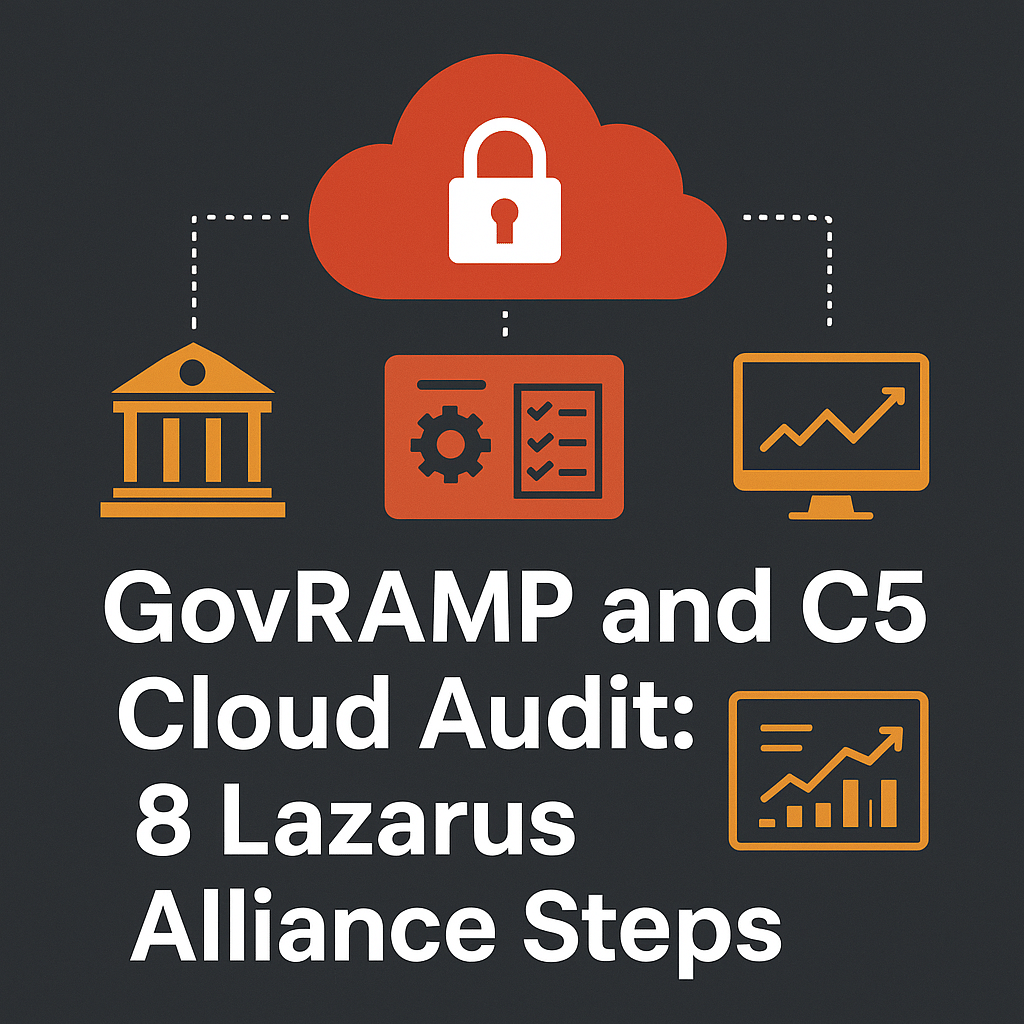
Public-sector cloud assurance is no longer a single certification project. It is an evidence operating model. A cloud service provider that sells to agencies, education, defense-adjacent buyers, healthcare programs, justice organizations, or European regulated entities may need to satisfy GovRAMP, BSI C5, FedRAMP, NIST 800-53, SOC 2, ISO 27001, HIPAA, PCI DSS, CJIS, IRS 1075, DFARS NIST 800-171, CMMC, and customer-specific procurement clauses with the same underlying control environment. The strategic mistake is treating each framework as a separate audit. The efficient approach is to build one defensible control architecture, one evidence fabric, and one continuous monitoring cadence that can be expressed in the language of each assurance regime.
That is the operating premise behind Lazarus Alliance’s eight-step method for GovRAMP and BSI C5 cloud audit readiness. The objective is not merely to pass an assessment. The objective is to make cloud compliance durable, repeatable, machine-readable where possible, and useful to executive decision-makers.
GovRAMP, BSI C5, FedRAMP, and NIST 800-53: What Public-Sector Cloud Buyers Really Want
GovRAMP supports state, local, education, and public-sector procurement use cases by organizing cloud assurance around independent security review, authorization status, and ongoing monitoring, as described by GovRAMP. FedRAMP supports U.S. federal cloud authorization and is increasingly aligned with continuous, technology-enabled assurance through FedRAMP 20x. BSI C5, Germany’s Cloud Computing Compliance Criteria Catalogue, provides a criteria-based attestation model for cloud services and is maintained by Germany’s Federal Office for Information Security, the BSI C5 program.
These programs have different stakeholders, report formats, and assessor expectations, but they share a common center of gravity: well-governed implementation of security controls. NIST SP 800-53 is especially important because it provides a comprehensive control catalog covering access control, audit and accountability, configuration management, contingency planning, incident response, risk assessment, system and communications protection, system integrity, supply chain risk management, and other domains, according to NIST SP 800-53 Rev. 5. FedRAMP baselines are also rooted in NIST 800-53 and documented through the official FedRAMP documents library.
The practical implication for CISOs is straightforward: if your cloud compliance audit program cannot explain system boundaries, control inheritance, shared responsibility, evidence ownership, vulnerability remediation, incident response, and continuous monitoring, it will struggle across every public-sector assurance path.
Step 1: Define the Public-Sector Cloud Boundary Before You Map Controls
The first Lazarus Alliance step is boundary discipline. Many cloud compliance audit failures begin before testing starts because the provider cannot clearly explain what is inside the assessment boundary. The boundary should identify production services, management planes, CI/CD tooling, support systems, identity providers, logging pipelines, backup environments, data stores, third-party dependencies, and administrative access paths.
For FedRAMP and GovRAMP, boundary definition must support authorization packages, customer responsibility matrices, interconnection descriptions, inherited controls, and continuous monitoring. For BSI C5, the boundary must support a criteria-based attestation that makes sense to customers reviewing the report. For SOC 2, the same boundary should align to the system description requirements used in SOC examinations covering security, availability, confidentiality, processing integrity, and privacy, as explained by AICPA SOC 2 description criteria.
Implementation takeaway: create a boundary register with each component’s function, owner, hosting location, data classification, authentication method, logging source, backup approach, and customer impact. Then map every component to the frameworks it supports. A SaaS platform that hosts state agency records, federal customer data, cardholder data, and ePHI cannot rely on a single narrative. It needs a boundary model that can support GovRAMP, FedRAMP, PCI DSS, HIPAA, and C5 without contradiction.
Step 2: Build a NIST 800-53 Control Spine for GovRAMP and FedRAMP
The second step is to build a control spine using NIST 800-53. A control spine is a normalized control structure that lets the organization implement once and report many times. For example, NIST 800-53 AC-2 addresses account management, AC-6 addresses least privilege, AU-6 addresses audit record review and analysis, CA-7 addresses continuous monitoring, CM-6 addresses configuration settings, IR-4 addresses incident handling, RA-5 addresses vulnerability monitoring and scanning, and SI-2 addresses flaw remediation, according to NIST SP 800-53 Rev. 5.
The control spine should not be a spreadsheet-only exercise. It should connect policies, technical configurations, tickets, scanner outputs, identity logs, change records, training records, incident exercises, vendor reviews, and risk decisions. This is where organizations move from audit readiness theater to operational assurance. Lazarus Alliance’s NIST 800-53 and FISMA audit services help organizations evaluate whether controls are not only documented but implemented, operating, and evidenced at the level expected by public-sector assessors.
Common pitfall: mapping control titles instead of control intent. AC-2 is not satisfied by having an access policy. Assessors expect evidence of joiner, mover, and leaver workflows; privileged account approvals; periodic access reviews; disabled accounts; service account governance; and exceptions. RA-5 is not satisfied by a scanner subscription. It requires defined scope, authenticated scanning where appropriate, risk ranking, remediation tracking, rescans, and management visibility.
Step 3: Map BSI C5 Without Treating It Like an ISO Certificate
BSI C5 is often misunderstood by U.S.-based cloud providers. It is not simply ISO 27001 with a German label. BSI C5 is a cloud criteria catalogue intended to support transparency and assurance for cloud customers, and BSI describes it as a criteria catalogue for cloud computing compliance on its official C5 information page. C5 reporting is attestation-oriented, so evidence must support how controls are designed and, for operating effectiveness engagements, how they performed over the review period.
The Lazarus Alliance method maps C5 criteria to the NIST 800-53 spine, ISO 27001 controls, SOC 2 trust services criteria, and customer contractual commitments. For example, identity governance can be expressed as NIST AC controls, SOC 2 logical access criteria, ISO access-control objectives, and C5 access-management expectations. The key is to maintain traceability from the C5 criterion to actual technical proof: identity provider exports, role definitions, access review approvals, privileged session logs, and terminated-user samples.
Lazarus Alliance’s C5 audit services are designed for cloud providers that need to demonstrate credible assurance to German, EU, multinational, and regulated customers while avoiding duplicated evidence collection.
Step 4: Engineer Continuous Monitoring Instead of Chasing Monthly Evidence
Public-sector cloud assurance increasingly depends on continuous monitoring. FedRAMP 20x emphasizes modernization and technology-enabled assurance through its official FedRAMP 20x initiative. NIST 800-53 CA-7 addresses continuous monitoring, while RA-5, SI-2, CM-6, AU-6, and IR-4 provide the operational substance behind vulnerability management, configuration control, audit review, remediation, and incident handling, according to NIST SP 800-53.
A mature continuous monitoring program includes:
- Asset truth: daily reconciliation of cloud assets, containers, virtual machines, databases, identities, and exposed services.
- Vulnerability operations: authenticated scanning, container image scanning, software composition analysis, remediation SLAs, and documented risk acceptance.
- Configuration drift detection: baseline enforcement for encryption, logging, network exposure, backup, and privileged access.
- Audit log coverage: centralized logs for identity, administrator actions, API calls, security tools, data access, and network events.
- Incident readiness: runbooks, tabletop exercises, escalation paths, forensics retention, and customer notification logic.
Continuous monitoring should produce evidence by design. Instead of asking engineers for screenshots before an audit, the organization should maintain dashboards and exports that show control performance over time. The NIST OSCAL project is especially relevant because it provides machine-readable formats for security control information, assessment plans, assessment results, and system security plans.
Step 5: Harmonize GovRAMP, FedRAMP, C5, SOC 2, ISO, PCI DSS, HIPAA, CJIS, IRS 1075, CMMC, and DFARS
Multi-framework compliance is not about forcing every framework into a single checklist. It is about identifying which controls are common, which are stricter in one regime, and which are unique. For example, PCI DSS focuses heavily on cardholder data environments and payment security requirements, and the PCI Security Standards Council maintains the official PCI DSS document library. HIPAA requires administrative, physical, and technical safeguards for electronic protected health information, as described by the HHS HIPAA Security Rule guidance. CJIS requirements apply to criminal justice information environments, and the FBI maintains the CJIS Security Policy Resource Center. CMMC is managed through the Department of Defense’s official CMMC program, and NIST SP 800-171 governs protection of controlled unclassified information in nonfederal systems, according to NIST SP 800-171 Rev. 3.
A practical mapping model uses four categories:
- Common core controls: identity management, logging, incident response, configuration management, vulnerability management, vendor risk, encryption, change management, and backup.
- Public-sector overlays: authorization boundaries, continuous monitoring, POA&M discipline, agency reporting, and shared responsibility matrices.
- Data-specific overlays: cardholder data, ePHI, CUI, criminal justice information, tax information, privacy data, and defense contract information.
- Geography and customer overlays: German public-sector expectations, EU procurement requirements, state agency clauses, education requirements, and local government procurement language.
Continuum GRC’s Compliance Framework Complexity Report examines the operational challenge of overlapping compliance obligations. For organizations seeking a centralized evidence model, the Continuum GRC platform supports risk, compliance, and audit evidence management in a FedRAMP-authorized environment.
Step 6: Create an Evidence Factory That Assessors Can Test
An evidence factory is a repeatable system for producing complete, current, and testable evidence. It includes defined evidence owners, collection frequency, approval workflow, retention rules, naming conventions, and linkage to controls. In a GovRAMP or FedRAMP context, it should support system security plans, implementation statements, risk decisions, POA&Ms, continuous monitoring submissions, and assessment artifacts. In a C5 context, it should support the auditor’s ability to evaluate control design and operating effectiveness.
For example, consider vulnerability management. A weak evidence package includes a scanner screenshot and a policy. A strong evidence package includes asset inventory scope, scanner configuration, authenticated scan proof, raw scan results, risk ratings, remediation tickets, exception approvals, rescan evidence, patch deployment records, executive metrics, and linkage to RA-5 and SI-2. If the environment processes cardholder data, the same package may support PCI DSS. If it hosts ePHI, it may support HIPAA risk management. If it supports criminal justice workloads, it may support CJIS.
Assessor expectation: evidence must prove operation, not aspiration. Policies state intent. Tickets, logs, configurations, meeting records, approvals, and system-generated exports prove execution.
Step 7: Validate Shared Responsibility and Third-Party Risk
Cloud assurance fails when shared responsibility is vague. A public-sector customer wants to know which controls the provider performs, which controls the customer performs, which are inherited from an underlying cloud platform, and which require joint action. The shared responsibility matrix should be specific at the control level, not generic at the domain level.
For example, encryption may require the cloud platform to provide cryptographic services, the SaaS provider to configure encryption correctly, the customer to manage tenant settings, and a key management vendor to meet contractual obligations. Logging may require infrastructure logs, application logs, identity logs, customer-accessible audit logs, retention controls, and monitoring workflows. Vendor risk must connect supplier contracts, security reviews, data flow diagrams, service criticality, incident notification clauses, and ongoing monitoring.
This step is especially important for organizations subject to DFARS NIST 800-171, CMMC, HIPAA business associate obligations, PCI service provider dependencies, CJIS supplier requirements, and IRS 1075-style safeguarding expectations. A provider that cannot explain inherited controls creates procurement friction even if its internal controls are strong.
Step 8: Run a Mock Assessment, Executive Readout, and Remediation Sprint
The final Lazarus Alliance step is a full mock assessment. This is not a casual readiness checklist. It should include document review, control interviews, technical sampling, evidence testing, boundary walkthroughs, vulnerability management review, incident-response tabletop analysis, access-control sampling, change-management sampling, backup and recovery validation, third-party risk review, and executive risk acceptance analysis.
A realistic scenario: a SaaS provider seeks GovRAMP authorization for state education customers, FedRAMP readiness for federal pipeline expansion, and C5 attestation for German public-sector procurement. The mock assessment discovers three issues. First, privileged access reviews occur quarterly, but service accounts are excluded. Second, vulnerability remediation tickets do not consistently include rescan evidence. Third, the customer responsibility matrix states that customers own logging, but the platform retains key audit events centrally. None of these findings necessarily means the program is immature, but each creates audit risk. The remediation sprint assigns owners, revises control language, updates technical workflows, and produces testable evidence before formal assessment.
Lazarus Alliance’s FedRAMP services and GovRAMP services support this readiness-to-assessment lifecycle by helping organizations identify gaps, rationalize evidence, and prepare for public-sector cloud scrutiny.
Decision Matrix: Which Assurance Path Should Come First?
- Federal agency demand: prioritize FedRAMP readiness, NIST 800-53 control maturity, OSCAL strategy, and continuous monitoring.
- State, local, and education demand: prioritize GovRAMP boundary definition, control implementation, vulnerability management, and public-sector evidence packaging.
- German or EU regulated demand: prioritize BSI C5 mapping, attestation evidence, ISO alignment, supplier transparency, and data-location narratives.
- Defense contractor demand: prioritize NIST 800-171, CMMC, DFARS flow-down, CUI boundary definition, and subcontractor assurance.
- Healthcare or payment demand: prioritize HIPAA Security Rule safeguards, PCI DSS scoping, encryption, access control, logging, and incident response.
The most efficient providers do not wait for a customer questionnaire to reveal gaps. They build an assurance roadmap that anticipates procurement scrutiny and converts control maturity into market access.
Conclusion: Public-Sector Cloud Compliance Is an Operating Discipline
GovRAMP and BSI C5 are not isolated checkboxes. They are signals that cloud buyers expect independent assurance, transparent control operation, and continuous evidence. FedRAMP modernization, NIST 800-53 control depth, OSCAL-enabled evidence, SOC 2 customer assurance, ISO governance, PCI DSS data protection, HIPAA safeguards, CJIS requirements, IRS 1075 expectations, CMMC obligations, and DFARS NIST 800-171 all point in the same direction: organizations must run compliance as a continuously monitored security program.
Lazarus Alliance’s eight-step approach helps cloud providers establish a durable public-sector cloud assurance model: define the boundary, build the NIST control spine, map C5 correctly, engineer continuous monitoring, harmonize frameworks, operationalize evidence, validate shared responsibility, and test the program before assessors do. That is how a cloud compliance audit becomes more than a report. It becomes a competitive advantage.
Sources and References
- GovRAMP, Official Program Website, https://govramp.org/
- FedRAMP, FedRAMP 20x, https://www.fedramp.gov/20x/
- FedRAMP, Documents Library, https://www.fedramp.gov/documents/
- NIST, SP 800-53 Rev. 5 Security and Privacy Controls, https://csrc.nist.gov/pubs/sp/800/53/r5/upd1/final
- NIST, Open Security Controls Assessment Language, https://pages.nist.gov/OSCAL/
- BSI, Cloud Computing Compliance Criteria Catalogue C5, https://www.bsi.bund.de/EN/Themen/Unternehmen-und-Organisationen/Informationen-und-Empfehlungen/Cloud-Computing/Kriterienkatalog-C5/kriterienkatalog-c5_node.html
- AICPA & CIMA, SOC 2 Description Criteria, https://www.aicpa-cima.com/resources/article/get-description-criteria-for-your-organizations-soc-2-r-report
- PCI Security Standards Council, Document Library, https://www.pcisecuritystandards.org/document_library
- HHS, HIPAA Security Rule, https://www.hhs.gov/hipaa/for-professionals/security/index.html
- FBI, CJIS Security Policy Resource Center, https://le.fbi.gov/cjis-division/cjis-security-policy-resource-center
- DoD CIO, Cybersecurity Maturity Model Certification, https://dodcio.defense.gov/CMMC/
- NIST, SP 800-171 Rev. 3 Protecting Controlled Unclassified Information, https://csrc.nist.gov/pubs/sp/800/171/r3/final
- Lazarus Alliance, NIST 800-53 and FISMA Audit Services, https://lazarusalliance.com/fisma-nist-audit/
- Lazarus Alliance, C5 Audit Services, https://lazarusalliance.com/services/audit-compliance/c5/
- Lazarus Alliance, FedRAMP Services, https://lazarusalliance.com/services/audit-compliance/fedramp/
- Lazarus Alliance, GovRAMP Services, https://lazarusalliance.com/services/audit-compliance/stateramp/
- Continuum GRC, Compliance Framework Complexity Report, https://continuumgrc.com/2026-compliance-framework-complexity-report/
- Continuum GRC, Platform Overview, https://continuumgrc.com/
About Lazarus Alliance
To learn more about how Lazarus Alliance can help, contact us.
- FedRAMP
- GovRAMP
- NIST 800-53
- DFARS NIST 800-171
- CMMC
- SOC 1 & SOC 2
- C5
- HIPAA, HITECH, & Meaningful Use
- PCI DSS RoC & SAQ
- IRS 1075 & 4812
- CJIS
- LA DMF
- ISO 27001, ISO 27002, ISO 27005, ISO 27017, ISO 27018, ISO 27701, ISO 22301, ISO 17020, ISO 17021, ISO 17025, ISO 17065, ISO 9001, & ISO 90003
- And dozens more!
Related Posts