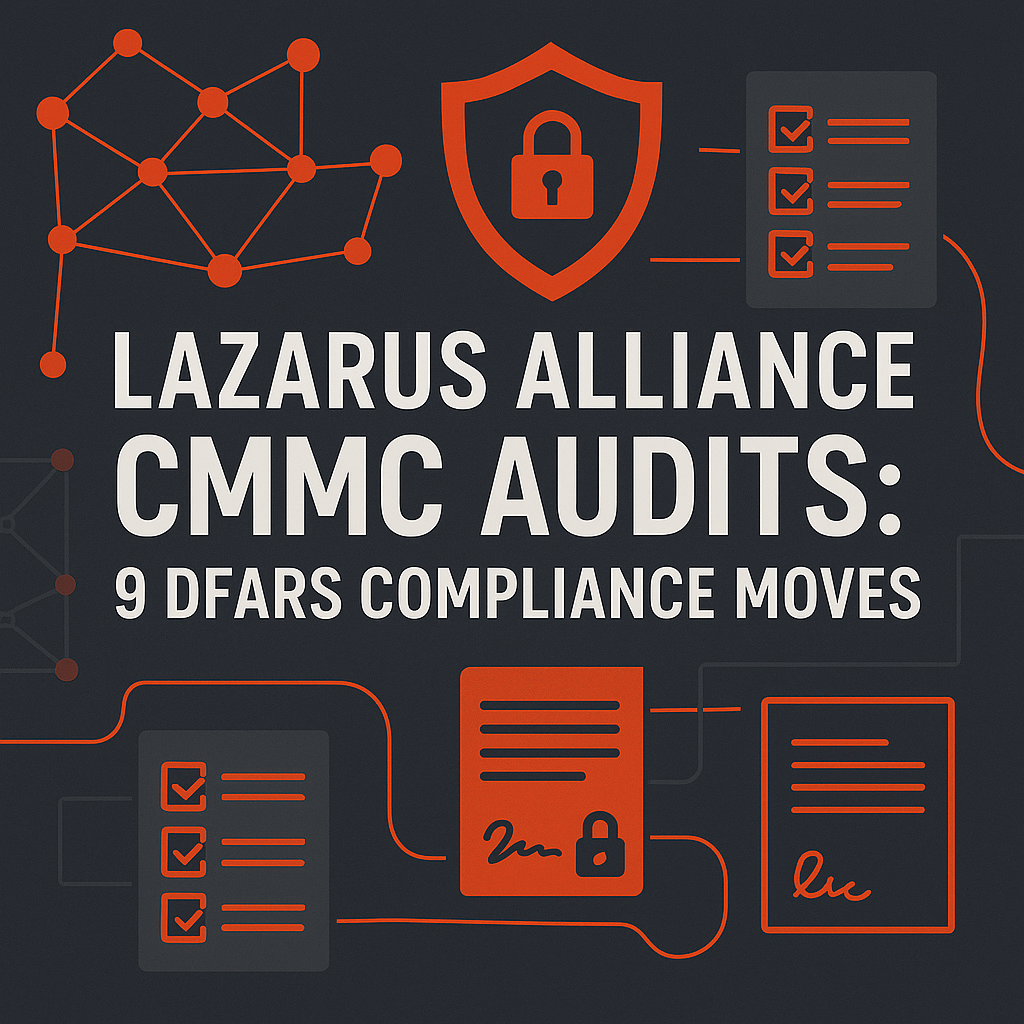
The contrarian truth about CMMC audits is this: most Defense Industrial Base organizations do not fail because they lack cybersecurity tools. They fail because the contract, the CUI boundary, the NIST 800-171 evidence record, the supplier flow-down, and the executive affirmation story do not agree with one another. CMMC is becoming less of a paperwork milestone and more of a contract-enforcement readiness test.
For prime contractors, subcontractors, managed service providers, engineering firms, manufacturers, SaaS providers, and cloud platforms supporting defense work, DFARS compliance now demands a defensible operating model for NIST 800-171 implementation and CUI protection. The CMMC Program rule in 32 CFR Part 170 establishes a phased approach for adding CMMC requirements to solicitations and contracts, and it states that requirements apply to subcontractors that process, store, or transmit FCI or CUI in performance of the subcontract eCFR, 32 CFR Part 170.
Below are nine practical moves Lazarus Alliance recommends for organizations preparing for CMMC audits, DFARS compliance assessments, and contract enforcement scrutiny.
CMMC audits are now about enforceable contract truth
CMMC audits are not merely maturity interviews. They test whether the organization can prove that contract clauses, system boundaries, security controls, cloud services, subcontractor obligations, incident reporting workflows, and senior-level affirmations are all aligned. CMMC verifies the implementation of safeguards associated with FAR 52.204-21, NIST SP 800-171, and NIST SP 800-172 as applicable eCFR, 32 CFR Part 170. FAR 52.204-21 defines basic safeguarding requirements for covered contractor information systems handling Federal Contract Information, including access control, media protection, and system integrity expectations Acquisition.gov, FAR 52.204-21.
DFARS 252.204-7012 requires contractors to provide adequate security for covered defense information, rapidly report cyber incidents, and submit malicious software when discovered and isolated in connection with a reported incident Acquisition.gov, DFARS 252.204-7012. DFARS 252.204-7019 and 252.204-7020 address NIST SP 800-171 DoD assessment requirements and the submission or availability of assessment information for contracting purposes Acquisition.gov, DFARS 252.204-7019 Acquisition.gov, DFARS 252.204-7020.
Lazarus Alliance approaches CMMC readiness as an evidence engineering problem: define the governed data set, identify every system and supplier touching it, map controls to accountable owners, test implementation, and preserve assessment-grade evidence. For organizations that need independent readiness and assessment support, Lazarus Alliance provides dedicated CMMC audit and compliance services and DFARS NIST 800-171 audit services.
Move 1: Build a contract-to-CUI traceability map
The first DFARS compliance move is to identify exactly which contracts, subcontracts, statements of work, attachments, drawings, technical data packages, support tickets, repositories, and collaboration spaces introduce FCI or CUI into the environment. The National Archives maintains the CUI Registry as the authoritative government-wide resource for CUI categories and markings National Archives, Controlled Unclassified Information.
Audit-ready implementation: create a traceability matrix with columns for contract number, clause, CUI category, data owner, system location, business process, external service provider, retention requirement, and downstream recipient. If a propulsion component drawing is received under a defense subcontract, the matrix should show whether the file resides in PLM, email, endpoint caches, backup repositories, ticketing systems, and supplier portals.
Common pitfall: limiting scope to the primary file server while ignoring email, engineering workstations, CI/CD artifacts, managed detection tools, and cloud backups. Assessors look for the actual path of CUI, not the intended path.
Move 2: Define the CMMC assessment boundary before buying more tools
NIST SP 800-171 is organized around security requirements for protecting CUI in nonfederal systems and organizations NIST CSRC, SP 800-171 Rev. 2. A strong boundary decision often reduces complexity more effectively than another security product. Segmenting CUI into a controlled enclave can simplify access control, logging, configuration management, vulnerability remediation, and evidence collection.
Decision matrix:
- Enterprise-wide boundary: appropriate when CUI is pervasive across engineering, operations, finance, and support. Higher evidence burden, lower risk of accidental exclusion.
- CUI enclave: appropriate when CUI workflows can be centralized. Lower scope, stronger technical isolation, but requires disciplined transfer controls.
- Cloud-native boundary: appropriate when CUI is processed in approved SaaS, IaaS, or PaaS environments. Requires contractual and technical verification of the provider role.
- Hybrid boundary: common for manufacturers and engineering firms. Requires careful mapping across identity, endpoints, file transfer, backup, and supplier access.
When cloud services are involved, DFARS 252.204-7012 includes requirements for cloud service provider use in connection with covered defense information Acquisition.gov, DFARS 252.204-7012. Organizations should also watch federal cloud assurance trends because FedRAMP is moving toward reusable certification artifacts and class-based terminology through FedRAMP 20x FedRAMP, Memo to Milestone: FedRAMP Grants the First Full FedRAMP 20x Class C Certification.
Move 3: Convert NIST 800-171 into testable evidence packages
NIST SP 800-171 Rev. 2 contains 110 security requirements across 14 requirement families for protecting CUI NIST CSRC, SP 800-171 Rev. 2. CMMC audits require more than policy language. Each requirement needs implementation evidence, operating evidence, and interview consistency.
For example, Access Control requirement 3.1.1 requires limiting system access to authorized users, processes acting on behalf of authorized users, and devices NIST CSRC, SP 800-171 Rev. 2. Assessment-grade evidence may include identity provider groups, role-to-system mappings, privileged access reviews, joiner-mover-leaver tickets, conditional access policies, endpoint enrollment records, and samples showing disabled accounts after termination.
Configuration Management requirement 3.4.1 requires establishing and maintaining baseline configurations and inventories for organizational systems NIST CSRC, SP 800-171 Rev. 2. Evidence should include golden images, hardened build standards, asset inventory exports, unauthorized software alerts, configuration drift reports, and change approvals.
Lazarus Alliance audit practice: treat each control as a claim that must survive document review, technical inspection, sampling, and interviews. If the system security plan says multifactor authentication is enforced for remote access, the assessor should be able to see the identity policy, test account behavior, exception list, and approval trail.
Move 4: Reconcile SSP, POA&M, SPRS, and executive affirmation
The System Security Plan should describe the system boundary, operational environment, interconnections, implemented requirements, roles, and supporting procedures. NIST SP 800-171 requires organizations to develop, document, and periodically update system security plans that describe system boundaries, operating environments, security requirement implementation, and relationships with other systems NIST CSRC, SP 800-171 Rev. 2.
DFARS 252.204-7019 requires offerors to have a current NIST SP 800-171 DoD Assessment posted in the Supplier Performance Risk System or to provide assessment information for posting when required by the solicitation Acquisition.gov, DFARS 252.204-7019. DFARS 252.204-7020 requires contractors to provide the government access to facilities, systems, and personnel necessary for DoD to conduct or renew a higher-level assessment when required Acquisition.gov, DFARS 252.204-7020.
Readiness test: pick ten NIST 800-171 requirements and compare the SSP statement, POA&M status, evidence repository, technical implementation, and leadership reporting. If any source tells a different story, fix the governance process before the formal audit.
Move 5: Engineer DFARS incident reporting before an incident
DFARS 252.204-7012 requires rapid reporting of cyber incidents within 72 hours of discovery Acquisition.gov, DFARS 252.204-7012. The same clause requires contractors to preserve and protect images of affected systems and relevant monitoring data for at least 90 days from the submission of a cyber incident report Acquisition.gov, DFARS 252.204-7012.
An audit-ready incident process includes legal notification triggers, DoD reporting credentials, chain-of-custody templates, forensic imaging procedures, log retention settings, containment playbooks, supplier notification steps, and communications approvals. Technical teams should test whether endpoint telemetry, DNS logs, cloud audit logs, identity logs, EDR alerts, and firewall records can reconstruct access to CUI during the reporting window.
Scenario: an engineer clicks a phishing link from a managed workstation used to access CUI drawings. The organization should know who declares the incident, who determines whether covered defense information was affected, how images are preserved, where relevant logs are exported, and how the prime contractor is notified. Waiting to answer these questions during an event is a contract risk.
Move 6: Verify cloud, SaaS, MSP, and MSSP responsibilities
Many CMMC failures emerge from unclear shared responsibility. A SaaS provider may secure the application platform, while the contractor remains responsible for identity governance, conditional access, retention, external sharing, data classification, and user activity review. A managed service provider may administer systems that store CUI, meaning privileged access, logging, personnel screening, and subcontractor flow-down become part of the compliance picture.
NIST SP 800-53 Rev. 5 provides a broad control catalog used across federal and commercial assurance programs, including access control, audit and accountability, configuration management, incident response, risk assessment, and supply chain risk management control families NIST CSRC, SP 800-53 Rev. 5. Lazarus Alliance often uses this control-spine thinking to rationalize overlapping requirements across CMMC, FedRAMP, GovRAMP, CJIS, PCI DSS, HIPAA, IRS 1075, C5, ISO 27001, SOC 1, SOC 2, and LA DMF programs. Organizations pursuing broader federal control alignment can also review Lazarus Alliance NIST 800-53 and FISMA audit services.
Action: obtain provider responsibility matrices, security addenda, incident support commitments, subcontractor disclosures, encryption details, log export options, and evidence of independent assurance. Then map each NIST 800-171 requirement to the contractor, provider, or shared responsibility owner.
Move 7: Harden identity, privilege, and remote administration
Access control is one of the fastest ways to distinguish a paper program from an implemented program. NIST SP 800-171 includes requirements for limiting access, controlling remote access sessions, using multifactor authentication for local and network access to privileged accounts and for network access to non-privileged accounts, and applying least privilege principles NIST CSRC, SP 800-171 Rev. 2.
Strong implementation includes phishing-resistant authentication where feasible, separate administrator accounts, privileged access workstations, conditional access based on device posture, just-in-time elevation, break-glass controls, quarterly access reviews, and automated deprovisioning. Remote monitoring and management tools should be treated as high-risk administrative pathways because compromise of those tools can affect multiple systems inside the CUI boundary.
Evidence examples: identity policy exports, MFA enforcement screenshots, privileged group membership history, access review attestations, administrator session logs, disabled legacy authentication reports, and tickets showing removal of access after role changes.
Move 8: Enforce supplier flow-down with evidence, not email
The CMMC Program rule states that CMMC requirements apply to subcontractors that process, store, or transmit FCI or CUI in performance of the subcontract eCFR, 32 CFR Part 170. DFARS 252.204-7012 also includes flow-down language for subcontracts involving covered defense information or operationally critical support Acquisition.gov, DFARS 252.204-7012.
A defensible supplier program should classify vendors by CUI exposure, require contract clauses before data transfer, validate assessment status where applicable, review incident reporting obligations, and monitor changes in hosting, support, and subcontracting. For high-risk suppliers, request evidence tied to specific NIST 800-171 requirements rather than accepting broad compliance statements.
Case example: a machine shop sends CUI drawings to a heat-treatment subcontractor through a consumer file-sharing link. Even if the prime contractor has a strong enclave, uncontrolled downstream transfer can break the CUI protection chain. The corrective action is not only a new file-transfer tool; it is a supplier onboarding, contract, training, and evidence process.
Move 9: Operate continuous compliance, not annual scramble
NIST CSF 2.0 organizes cybersecurity outcomes around Govern, Identify, Protect, Detect, Respond, and Recover functions, giving executives a governance vocabulary for cyber risk oversight NIST, Cybersecurity Framework. CMMC and DFARS readiness should use the same logic: leadership governs risk, process owners maintain controls, technical teams produce evidence, and compliance teams verify that the story remains current.
Continuum GRC’s 2026 Audit Readiness Benchmark Report examines audit readiness practices across organizations and is useful for teams benchmarking evidence discipline, ownership, and compliance operations. For organizations managing multiple frameworks, a unified GRC system can reduce duplicate evidence requests, connect controls to risks, and maintain current assessment artifacts.
Operating cadence:
- Monthly: review open POA&M items, high-risk vulnerabilities, new CUI repositories, privileged access changes, and supplier changes.
- Quarterly: test incident reporting workflow, sample evidence for high-risk controls, validate cloud responsibility matrices, and brief executives on contract exposure.
- Before proposal submission: confirm contract clauses, assessment status, CMMC level expectations, supplier dependencies, and whether the represented security posture matches current evidence.
Lazarus Alliance CMMC audit readiness checklist
- Contract alignment: identify every DFARS, FAR, CMMC, CUI, and flow-down obligation before scoping the audit.
- Data discovery: map CUI across endpoints, cloud platforms, collaboration tools, email, backups, development environments, and suppliers.
- Boundary decision: choose enterprise, enclave, cloud-native, or hybrid scope and document the rationale.
- Control evidence: maintain evidence packages for each NIST 800-171 requirement, including policy, procedure, configuration, ticket, log, and sample records.
- Incident readiness: test the 72-hour DFARS reporting process and 90-day preservation requirement before a real event occurs.
- Supplier assurance: verify subcontractor obligations and CUI handling evidence before transferring covered data.
- Executive governance: ensure leadership assertions, SPRS-related information, SSP statements, and POA&M status are consistent.
Final perspective: readiness is a contract performance capability
The organizations best prepared for CMMC audits are not simply those with the most tools. They are the organizations that can demonstrate a controlled operating model for CUI protection, prove that NIST 800-171 safeguards are implemented, show that DFARS incident and flow-down obligations are operational, and maintain evidence that withstands assessor scrutiny.
Lazarus Alliance helps defense contractors, cloud providers, SaaS companies, manufacturers, healthcare organizations, financial services firms, and government-sector suppliers build audit-ready compliance programs across CMMC, DFARS, NIST 800-171, NIST 800-53, FedRAMP, GovRAMP, CJIS, PCI DSS, HIPAA, IRS 1075, SOC 1, SOC 2, C5, ISO 27001, and LA DMF. The strategic goal is not merely passing an assessment. It is protecting contract eligibility, mission trust, and the CUI entrusted to the organization.
Sources and References
- eCFR, 32 CFR Part 170 — Cybersecurity Maturity Model Certification Program
- Acquisition.gov, FAR 52.204-21 — Basic Safeguarding of Covered Contractor Information Systems
- Acquisition.gov, DFARS 252.204-7012 — Safeguarding Covered Defense Information and Cyber Incident Reporting
- Acquisition.gov, DFARS 252.204-7019 — Notice of NIST SP 800-171 DoD Assessment Requirements
- Acquisition.gov, DFARS 252.204-7020 — NIST SP 800-171 DoD Assessment Requirements
- National Archives, Controlled Unclassified Information
- NIST CSRC, SP 800-171 Rev. 2 — Protecting Controlled Unclassified Information in Nonfederal Systems and Organizations
- NIST CSRC, SP 800-53 Rev. 5 — Security and Privacy Controls for Information Systems and Organizations
- NIST, Cybersecurity Framework
- FedRAMP, Memo to Milestone: FedRAMP Grants the First Full FedRAMP 20x Class C Certification
- Lazarus Alliance, CMMC Audit and Compliance Services
- Lazarus Alliance, DFARS NIST 800-171 Audit Services
- Lazarus Alliance, FISMA and NIST Audit Services
- Continuum GRC, 2026 Audit Readiness Benchmark Report
About Lazarus Alliance
To learn more about how Lazarus Alliance can help, contact us.
- FedRAMP
- GovRAMP
- NIST 800-53
- DFARS NIST 800-171
- CMMC
- SOC 1 & SOC 2
- C5
- HIPAA, HITECH, & Meaningful Use
- PCI DSS RoC & SAQ
- IRS 1075 & 4812
- CJIS
- LA DMF
- ISO 27001, ISO 27002, ISO 27005, ISO 27017, ISO 27018, ISO 27701, ISO 22301, ISO 17020, ISO 17021, ISO 17025, ISO 17065, ISO 9001, & ISO 90003
- And dozens more!
What Should a Cyber Security Policy Include? - Lazarus Alliance, Inc.
[…] them at all! This “ad hoc” approach to enterprise cybersecurity has become such a problem among defense subcontractors that the DoD is developing a new compliance framework to address […]