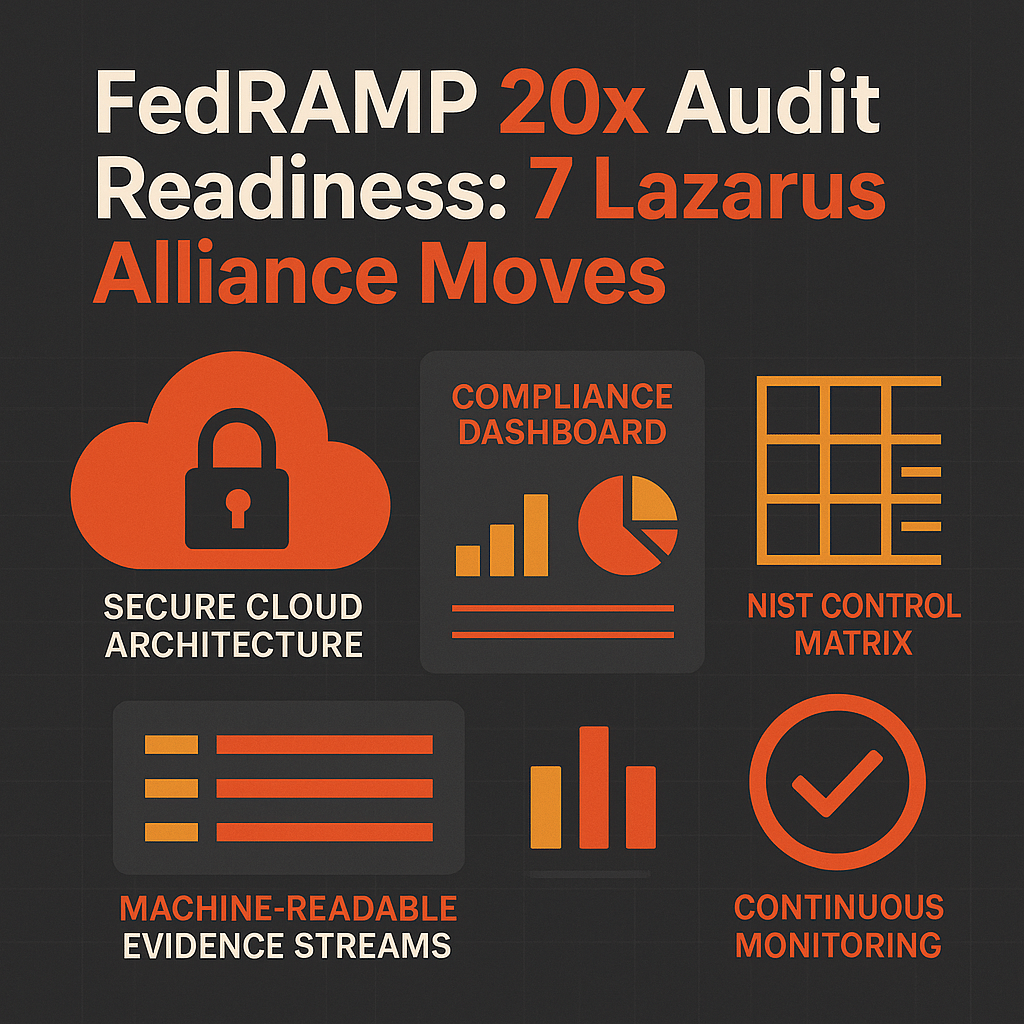
FedRAMP 20x is not just a faster authorization lane; it is a different assurance operating model. The organizations most likely to succeed will not be the ones with the longest policy binders. They will be the cloud service providers that can prove, continuously and repeatably, that controls are implemented, monitored, tested, remediated, and traceable to NIST 800-53 expectations.
For CISOs, compliance leaders, cloud architects, and product executives, the practical question is no longer whether the system has documentation. The question is whether the system can produce trustworthy, machine-readable, assessor-ready evidence on demand.
FedRAMP 20x Changes the Definition of Audit Readiness
FedRAMP 20x is the federal cloud modernization initiative focused on improving how cloud services demonstrate security assurance, with public program activity maintained by the FedRAMP Program Management Office at FedRAMP, FedRAMP 20x. The direction is clear: compliance evidence must become more current, more automated, and more technically verifiable.
Traditional FedRAMP readiness often centers on static artifacts: the System Security Plan, policies, procedures, diagrams, inventories, scan reports, Plans of Action and Milestones, and control narratives. Those artifacts remain important, but FedRAMP 20x raises the bar for continuous cloud assurance. Evidence must increasingly be available as data, not just prose.
NIST has already established the technical foundation for this shift through the Open Security Controls Assessment Language, which provides machine-readable formats for control catalogs, profiles, component definitions, assessment plans, assessment results, and plans of action, according to NIST, Open Security Controls Assessment Language. In plain terms, OSCAL enables compliance information to be exchanged and validated in structured form rather than buried in documents.
This is why Lazarus Alliance approaches FedRAMP 20x audit readiness as an evidence engineering problem, not merely a documentation project. A FedRAMP-ready cloud environment must connect NIST 800-53 controls, cloud configuration, vulnerability management, identity governance, logging, incident response, third-party dependencies, and remediation workflows into a defensible assurance system. Lazarus Alliance supports this model through its FedRAMP audit and compliance services and its NIST 800-53 and FISMA assessment services.
Move 1: Build a FedRAMP 20x Evidence Architecture Before the Audit Starts
The first Lazarus Alliance move is to define the evidence architecture before control testing begins. Evidence architecture answers four questions: what proves the control, where the proof comes from, how often it refreshes, and who owns the remediation when the proof fails.
For example, NIST 800-53 AC-2 addresses account management expectations, including account lifecycle and role management, as defined in NIST SP 800-53 Revision 5, Security and Privacy Controls for Information Systems and Organizations. Under a static readiness model, an organization may provide an access control policy and a sample user review. Under a FedRAMP 20x-ready model, the organization should be able to produce current identity provider exports, privileged account listings, joiner-mover-leaver tickets, group membership evidence, service account ownership records, and exception approvals in a repeatable format.
A strong evidence architecture includes:
- Authoritative sources: identity provider, cloud configuration service, ticketing platform, endpoint management, vulnerability scanner, SIEM, CI/CD pipeline, and GRC repository.
- Evidence freshness rules: daily for high-risk configuration and vulnerability data, monthly for access reviews where required by policy, and event-driven for incidents or material system changes.
- Control-to-evidence mapping: each NIST 800-53 control and enhancement maps to one or more evidence objects, not a vague folder location.
- Exception governance: every control deviation has a risk decision, expiration date, owner, compensating control, and POA&M linkage.
The common pitfall is collecting evidence after the assessor asks for it. That creates a scramble, increases inconsistency, and often exposes weak ownership. FedRAMP 20x readiness requires evidence pipelines that operate before the audit calendar begins.
Move 2: Translate NIST 800-53 Into Testable Control Assertions
The second move is to decompose NIST 800-53 into testable assertions. NIST 800-53 is a control catalog, but audit execution requires evidence criteria. NIST SP 800-53A defines assessment procedures and uses assessment methods such as examine, interview, and test, according to NIST SP 800-53A Revision 5, Assessing Security and Privacy Controls in Information Systems and Organizations.
Consider NIST 800-53 RA-5 for vulnerability monitoring and scanning. A weak control narrative says the organization scans systems regularly. A testable assertion says authenticated vulnerability scans run against all in-scope assets, scan coverage is reconciled against the asset inventory, critical findings are assigned remediation tickets, false positives require approval, and remediation is validated by rescan. Each part can be examined, interviewed, and tested.
Another example is AU-6 for audit record review, analysis, and reporting. A FedRAMP 20x-ready assertion should identify which logs are generated, where they are centralized, which detections operate against them, how alerts are triaged, how escalations are documented, and how monitoring effectiveness is reviewed.
Lazarus Alliance typically structures NIST 800-53 readiness around three layers:
- Design adequacy: the policy, standard, architecture, and procedure are sufficient for the control objective.
- Implementation evidence: the system configuration and operational process match the design.
- Operating effectiveness: the control operated consistently across the assessment period and exceptions were handled appropriately.
This approach also strengthens adjacent compliance assessments. SOC 2 uses the Trust Services Criteria for security, availability, processing integrity, confidentiality, and privacy, according to AICPA & CIMA, SOC 2 Description Criteria. Many FedRAMP evidence objects can support SOC 2, ISO 27001, HIPAA, PCI DSS, CJIS, IRS 1075, CMMC, DFARS NIST 800-171, GovRAMP, C5, and LA DMF when the evidence is tagged and governed correctly.
Move 3: Make Continuous Monitoring a Control System, Not a Monthly Ritual
The third move is to mature continuous monitoring from a reporting ritual into a control system. NIST SP 800-137 describes information security continuous monitoring as maintaining ongoing awareness of information security, vulnerabilities, and threats to support risk management decisions, according to NIST SP 800-137, Information Security Continuous Monitoring. FedRAMP also maintains continuous monitoring guidance for cloud service providers through FedRAMP, CSP Continuous Monitoring Strategy Guide.
FedRAMP 20x readiness requires continuous monitoring signals that management can trust. That means vulnerability data must be reconciled to asset inventory. Configuration findings must be tied to approved baselines. Security alerts must have triage evidence. POA&M entries must reflect true remediation status. Penetration testing, incident response exercises, change management, and contingency testing must produce evidence that can be reused across compliance assessments.
A practical continuous monitoring dashboard should answer:
- Which assets are in the FedRAMP boundary, and which assets changed since the last reporting cycle?
- Which privileged accounts exist, and which have not been reviewed?
- Which high-risk vulnerabilities remain open beyond policy-defined remediation expectations?
- Which configuration deviations lack an approved exception?
- Which POA&M items are overdue, blocked, or awaiting validation?
- Which third-party services support inherited or shared controls?
The misconception is that continuous monitoring is only a compliance upload. In a modern FedRAMP 20x program, continuous monitoring is the operating rhythm of assurance. If engineering teams do not use the same signals the compliance team submits, the organization is maintaining two realities. Assessors can usually detect that split quickly.
Move 4: Use OSCAL and Machine-Readable Evidence Without Losing Auditor Judgment
The fourth move is to adopt machine-readable evidence while preserving professional audit judgment. OSCAL can standardize how information moves between control catalogs, system security plans, assessment plans, assessment results, and POA&Ms, according to NIST, OSCAL. But OSCAL is not a substitute for control implementation, risk analysis, or assessor scrutiny.
Organizations should avoid treating OSCAL conversion as a formatting exercise. The deeper value comes from evidence normalization. For instance, a cloud configuration finding should reference the system component, control objective, risk severity, exception status, remediation owner, ticket number, and validation result. A vulnerability record should include asset criticality, exploitability context, remediation due date, compensating controls, and rescan outcome.
A useful FedRAMP 20x evidence object contains:
- Control reference: such as AC-2, CM-2, RA-5, AU-6, IR-4, CP-4, SA-9, or SI-2.
- System component: cloud account, cluster, database, identity platform, network segment, application, or managed service.
- Evidence source: API query, ticket, scan report, configuration snapshot, log export, attestation, or test result.
- Timestamp and period: when the evidence was generated and what operating period it supports.
- Owner and approver: accountable personnel for implementation and exception decisions.
- Validation result: pass, fail, partial, not applicable, or accepted risk with justification.
Continuum GRC supports this kind of evidence-driven compliance operating model through its FedRAMP-authorized GRC platform and A.ITAM AI auditor capabilities, described at Continuum GRC. Continuum GRC also examines audit readiness challenges in its 2026 Audit Readiness Benchmark Report.
Move 5: Align FedRAMP 20x With NIST 800-53, CMMC, PCI DSS, HIPAA, CJIS, IRS 1075, C5, and SOC 2
The fifth move is to build a common control evidence model across frameworks. Cloud providers rarely face only one compliance obligation. A SaaS provider may need FedRAMP for federal customers, GovRAMP for public-sector buyers, SOC 2 for enterprise procurement, PCI DSS for payment workflows, HIPAA for healthcare customers, CJIS for criminal justice data, IRS 1075 for federal tax information, CMMC and DFARS NIST 800-171 for defense contracts, C5 for regulated cloud markets, ISO 27001 for global customers, and LA DMF for defensive maturity.
NIST SP 800-171 Revision 3 defines requirements for protecting Controlled Unclassified Information in nonfederal systems and organizations, according to NIST SP 800-171 Revision 3. The Department of Defense maintains CMMC program information through DoD CIO, Cybersecurity Maturity Model Certification. PCI DSS requirements are maintained by the PCI Security Standards Council in the official document library at PCI SSC, PCI DSS Document Library. HIPAA Security Rule administrative, physical, and technical safeguard requirements are maintained in eCFR, HIPAA Security Rule. CJIS Security Policy resources are maintained by the FBI at FBI, CJIS Security Policy Resource Center. IRS Publication 1075 requirements are published by the IRS at IRS, Publication 1075.
The right answer is not to maintain separate evidence factories for every framework. The right answer is a control inheritance and evidence reuse strategy. For example, identity governance evidence can support FedRAMP AC controls, SOC 2 security criteria, HIPAA access control expectations, PCI DSS identity requirements, and CMMC access control practices when scope and system boundaries are clearly documented.
Lazarus Alliance helps organizations connect these domains through services including SOC 1 and SOC 2 audit services, DFARS NIST 800-171 audit services, and PCI DSS audit services.
Move 6: Validate Shared Responsibility and Control Inheritance
The sixth move is to prove shared responsibility. FedRAMP readiness often fails when teams cannot explain which controls are inherited from the cloud platform, which controls are implemented by the SaaS provider, which controls are shared, and which controls remain the customer responsibility.
NIST SP 800-37 describes the Risk Management Framework steps for preparing, categorizing, selecting, implementing, assessing, authorizing, and monitoring systems, according to NIST SP 800-37 Revision 2, Risk Management Framework. That lifecycle perspective matters because inherited controls must still be understood, documented, and monitored. A provider cannot simply point to a hyperscaler authorization and assume the control is closed.
For example, encryption at rest may be partially inherited from the infrastructure provider, but key management configuration, key rotation policy, access to keys, application-level encryption decisions, and customer data segregation may remain provider responsibilities. Similarly, physical security may be inherited from a data center provider, while media handling procedures for exported logs or backups may still require internal controls.
A FedRAMP 20x shared-responsibility matrix should include:
- Control and enhancement identifier.
- Responsible party: provider, customer, platform provider, managed service provider, or shared.
- Inherited evidence source and refresh cadence.
- Provider implementation evidence.
- Customer configuration dependency.
- Assessment method and validation owner.
- Residual risk and exception status.
The pitfall is assuming inheritance equals assurance. Inheritance is a claim until it is supported by boundary diagrams, contracts, customer responsibility matrices, service configuration evidence, and monitoring records.
Move 7: Run a FedRAMP 20x Mock Assessment With Red-Team Discipline
The seventh move is to conduct a mock assessment that behaves like a serious assessor engagement. That means sampling real evidence, testing cloud configuration, interviewing control owners, challenging assumptions, validating POA&M integrity, reviewing incident records, and tracing tickets from detection to closure.
A rigorous mock assessment should include at least four workstreams:
- Governance and documentation review: SSP, policies, procedures, roles, risk register, inventory, data flows, boundary diagrams, and customer responsibility matrix.
- Technical validation: identity and access management, encryption, network segmentation, vulnerability management, logging, change control, secure configuration, backup, recovery, and incident response.
- Evidence pipeline testing: source system extracts, API-generated evidence, OSCAL readiness, ticket traceability, POA&M linkage, and exception approval.
- Executive risk review: unresolved risks, authorization strategy, agency sponsor expectations, remediation budget, and go-no-go decision.
One useful scenario is a SaaS provider preparing for FedRAMP 20x while also supporting healthcare and defense customers. The identity team must prove privileged access reviews. The DevOps team must prove change approvals and configuration baselines. The security operations team must prove alert triage and incident escalation. The compliance team must prove that the same evidence supports NIST 800-53, SOC 2, HIPAA, and NIST 800-171 obligations without conflicting scope statements. The mock assessment should expose broken handoffs before an official review does.
Lazarus Alliance often recommends a final readiness checkpoint that assigns each control a status of ready, ready with monitored risk, remediation required, or not supportable. Controls in the remediation required category need owners, funding, technical action plans, validation criteria, and executive visibility.
FedRAMP 20x Audit Readiness Checklist for CISOs and Compliance Leaders
Use this decision matrix to determine whether your organization is moving toward FedRAMP 20x readiness or merely updating documentation.
- Boundary clarity: every system component, data flow, external service, and management plane is in or out of scope with documented rationale.
- Control traceability: each NIST 800-53 requirement maps to implementation evidence, operating evidence, owner, and assessor test method.
- Machine-readable readiness: evidence can be exported or structured for automation, not only stored as narrative documents.
- Continuous monitoring: vulnerability, configuration, identity, logging, incident, and POA&M signals refresh on a defined cadence.
- Shared responsibility: inherited, shared, provider, and customer controls are documented and validated.
- Multi-framework reuse: FedRAMP evidence is tagged for SOC 2, ISO 27001, CMMC, DFARS NIST 800-171, PCI DSS, HIPAA, CJIS, IRS 1075, GovRAMP, C5, and LA DMF where applicable.
- Remediation discipline: failed controls create tracked corrective actions with due dates, evidence requirements, and validation results.
- Executive governance: leadership reviews risk, readiness, exceptions, and authorization strategy before the formal assessment begins.
The Lazarus Alliance Perspective: Assurance Must Become Operational
FedRAMP 20x rewards organizations that make assurance part of engineering and operations. The winning model is not more paperwork. It is a control environment where cloud configuration, risk decisions, security telemetry, audit evidence, and executive governance reinforce each other.
For organizations pursuing federal cloud opportunities, the time to prepare is before the evidence request arrives. Build the architecture. Normalize the evidence. Validate NIST 800-53 implementation. Test shared responsibility. Reuse evidence across frameworks. Run the mock assessment with discipline.
That is how FedRAMP 20x audit readiness becomes more than a compliance milestone. It becomes a continuous cloud assurance capability that supports cybersecurity audits, compliance assessments, continuous monitoring, and trusted public-sector growth.
Sources and References
- FedRAMP, FedRAMP 20x, https://www.fedramp.gov/20x/
- NIST, Open Security Controls Assessment Language, https://csrc.nist.gov/projects/open-security-controls-assessment-language
- NIST SP 800-53 Revision 5, Security and Privacy Controls for Information Systems and Organizations, https://csrc.nist.gov/pubs/sp/800/53/r5/upd1/final
- NIST SP 800-53A Revision 5, Assessing Security and Privacy Controls in Information Systems and Organizations, https://csrc.nist.gov/pubs/sp/800/53/a/r5/final
- NIST SP 800-137, Information Security Continuous Monitoring, https://csrc.nist.gov/pubs/sp/800/137/final
- FedRAMP, CSP Continuous Monitoring Strategy Guide, https://www.fedramp.gov/assets/resources/documents/CSP_Continuous_Monitoring_Strategy_Guide.pdf
- AICPA & CIMA, SOC 2 Description Criteria, https://www.aicpa-cima.com/resources/article/get-description-criteria-for-your-organizations-soc-2-r-report
- NIST SP 800-171 Revision 3, Protecting Controlled Unclassified Information in Nonfederal Systems and Organizations, https://csrc.nist.gov/pubs/sp/800/171/r3/final
- DoD CIO, Cybersecurity Maturity Model Certification, https://dodcio.defense.gov/CMMC/
- PCI Security Standards Council, PCI DSS Document Library, https://www.pcisecuritystandards.org/document_library?category=pcidss&document=pci_dss
- eCFR, HIPAA Security Rule, https://www.ecfr.gov/current/title-45/subtitle-A/subchapter-C/part-164/subpart-C
- FBI, CJIS Security Policy Resource Center, https://le.fbi.gov/cjis-division/cjis-security-policy-resource-center
- IRS, Publication 1075, https://www.irs.gov/privacy-disclosure/publication-1075
- NIST SP 800-37 Revision 2, Risk Management Framework for Information Systems and Organizations, https://csrc.nist.gov/pubs/sp/800/37/r2/final
- Lazarus Alliance, FedRAMP Audit and Compliance Services, https://lazarusalliance.com/services/audit-compliance/fedramp/
- Lazarus Alliance, FISMA and NIST Audit Services, https://lazarusalliance.com/fisma-nist-audit/
- Lazarus Alliance, SOC 1 and SOC 2 Audit Services, https://lazarusalliance.com/services/audit-compliance/soc/
- Lazarus Alliance, DFARS NIST 800-171 Audit Services, https://lazarusalliance.com/dfars-nist-audit/
- Lazarus Alliance, PCI DSS Audit Services, https://lazarusalliance.com/services/audit-compliance/pci-dss-audit/
- Continuum GRC, FedRAMP-Authorized GRC Platform, https://continuumgrc.com/
- Continuum GRC, 2026 Audit Readiness Benchmark Report, https://continuumgrc.com/2026-audit-readiness-benchmark-report/
About Lazarus Alliance
To learn more about how Lazarus Alliance can help, contact us.
- FedRAMP
- GovRAMP
- NIST 800-53
- DFARS NIST 800-171
- CMMC
- SOC 1 & SOC 2
- C5
- HIPAA, HITECH, & Meaningful Use
- PCI DSS RoC & SAQ
- IRS 1075 & 4812
- CJIS
- LA DMF
- ISO 27001, ISO 27002, ISO 27005, ISO 27017, ISO 27018, ISO 27701, ISO 22301, ISO 17020, ISO 17021, ISO 17025, ISO 17065, ISO 9001, & ISO 90003
- And dozens more!
Related Posts