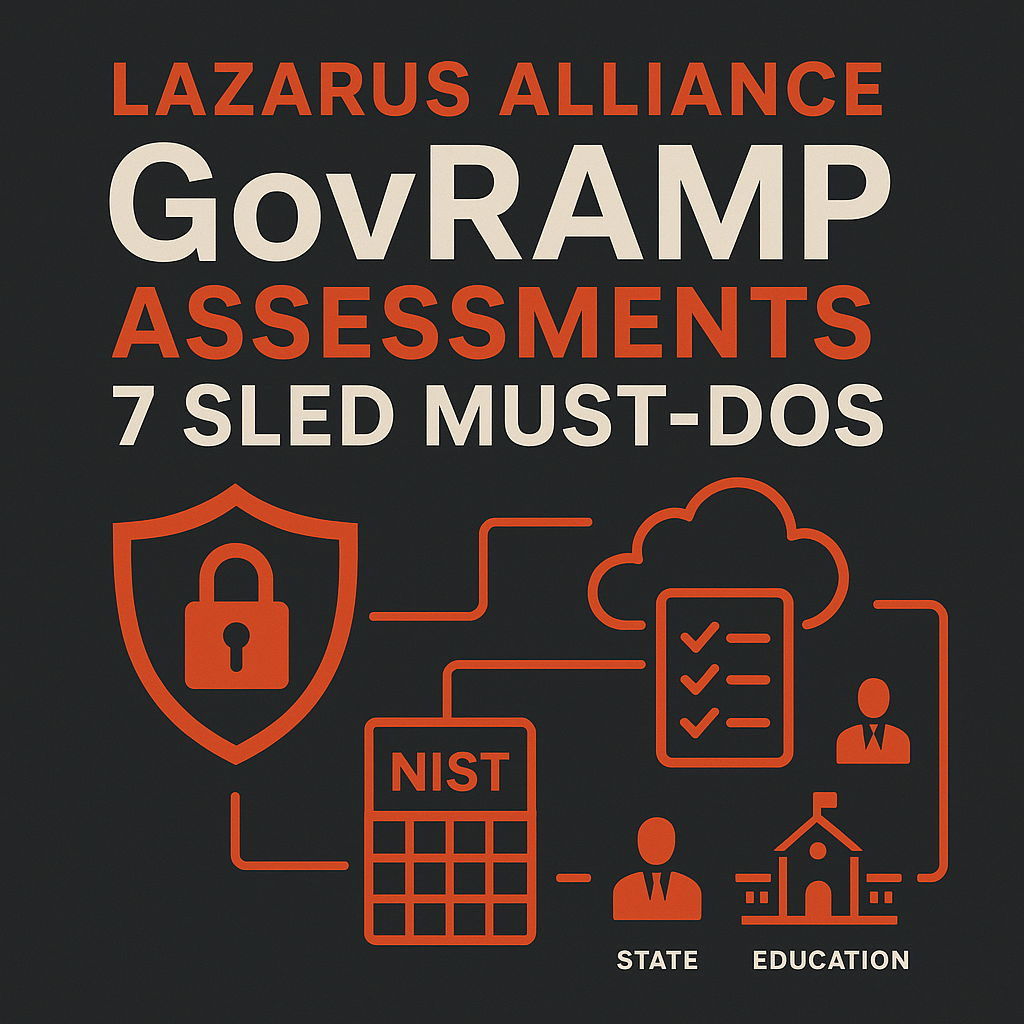
Contrarian view: GovRAMP is not just another badge for cloud vendors. For SLED buyers, it is becoming procurement infrastructure: a way to replace one-off questionnaires with reusable, NIST 800-53-based security assurance that can survive contract review, cyber insurance scrutiny, incident response, and public accountability. The organizations that win in this environment will not treat GovRAMP or StateRAMP as a paperwork exercise; they will engineer auditable cloud operations from architecture through continuous monitoring.
GovRAMP and StateRAMP Adoption: Why SLED Cloud Procurement Is Changing
State, local, education, tribal, territorial, and public-sector organizations are under pressure to buy cloud services faster while proving that vendors can protect sensitive public data. GovRAMP describes its mission as providing a standardized approach for cloud security verification for government and public-sector use cases, and that standardization matters because many SLED agencies lack the time or staff to perform deep technical reviews of every cloud provider independently GovRAMP, Program Information.
The practical shift is already visible in procurement. North Carolina began requiring new executive-branch contracts with a cloud component to include GovRAMP-aligned risk-assessment provisions on April 1, 2026, with full compliance for covered contracts beginning April 1, 2027; Nevada also put a cloud security mandate into effect on July 1, 2026 Route Fifty, States Risk Rebuilding Cloud Compliance Maze. Texas operates TX-RAMP as its own cloud risk and authorization program, including a reciprocity process for eligible cloud offerings Texas Department of Information Resources, TX-RAMP.
This is why Lazarus Alliance approaches GovRAMP assessments as both a cybersecurity assessment and a procurement-readiness engagement. The goal is not simply to map controls. The goal is to make the cloud service defensible to a state CISO, a county procurement office, an education technology review board, a law-enforcement data owner, and an independent assessor. Lazarus Alliance provides GovRAMP assessment services for organizations that need structured readiness, assessment, remediation support, and evidence aligned to SLED cloud expectations Lazarus Alliance, GovRAMP Assessment Services.
What Is GovRAMP Compliance?
GovRAMP compliance is the process of demonstrating that a cloud service provider has implemented and can sustain a security control environment appropriate for public-sector cloud workloads. In practice, GovRAMP and StateRAMP programs rely heavily on NIST SP 800-53 control concepts, independent assessment, documented system boundaries, vulnerability management, continuous monitoring, and a plan of action and milestones for unresolved risks. NIST SP 800-53 is the catalog of security and privacy controls used across federal and public-sector risk management programs, while NIST SP 800-53A provides assessment procedures for determining whether those controls are implemented, operating as intended, and producing the desired outcome NIST, SP 800-53 Security and Privacy Controls NIST, SP 800-53A Assessment Procedures.
That distinction is critical. Many cloud vendors can produce policies. Fewer can produce current evidence that the policy is implemented in production, monitored continuously, and tied to accountable owners. A GovRAMP-ready organization can show how AC-2 account management, AC-17 remote access, AU-2 event logging, CM-2 baseline configurations, CM-6 configuration settings, RA-5 vulnerability monitoring, SA-9 external system services, SC-13 cryptographic protection, SI-2 flaw remediation, and IR-4 incident handling operate within the actual cloud boundary NIST, SP 800-53 Control Catalog.
Lazarus Alliance GovRAMP Assessments: 7 SLED Compliance Must-Dos
1. Decide Whether GovRAMP, StateRAMP, TX-RAMP, or FedRAMP Reciprocity Fits the Deal
The first must-do is strategic: do not begin evidence collection until the procurement pathway is clear. A cloud provider selling to a state agency may face GovRAMP expectations, a Texas buyer may require TX-RAMP, and a federal-adjacent public-sector buyer may ask whether the service is listed in the FedRAMP Marketplace FedRAMP, Marketplace. These pathways overlap, but they are not identical. Procurement teams should identify the contracting entity, data sensitivity, hosting model, tenant model, external service dependencies, and whether existing authorizations can support reciprocity.
Implementation step: Build a procurement decision record for each SLED opportunity. Include the target authorization program, expected security category, data types, buyer-specific clauses, required assessment artifacts, and deadlines. If Texas is in scope, determine whether the offering can use TX-RAMP reciprocity or needs a direct TX-RAMP package Texas Department of Information Resources, TX-RAMP. If a FedRAMP authorization is part of the strategy, compare the authorized federal boundary against the SLED product boundary before assuming the evidence is reusable.
2. Define the Cloud Boundary Before You Map NIST 800-53 Assessment Controls
The most common GovRAMP readiness failure is a vague boundary. A system security plan cannot be credible if it cannot answer where the cloud service begins and ends. The NIST Risk Management Framework emphasizes categorizing the system, selecting controls, implementing controls, assessing controls, authorizing the system, and monitoring the system over time NIST, Risk Management Framework. For SLED cloud procurement, that means defining production, staging, management plane, customer support tools, identity providers, CI/CD pipelines, logging platforms, backup environments, and subservice organizations.
Example: A public safety SaaS provider may host application workloads in a commercial cloud, use a third-party identity provider for single sign-on, store audit logs in a managed analytics platform, and route support tickets through a customer service application. If law-enforcement data is involved, the cloud boundary must identify where criminal justice information could be viewed, stored, transmitted, logged, exported, or supported. The FBI CJIS Security Policy Resource Center provides the authoritative policy source for CJIS security expectations used by law-enforcement-connected environments FBI, CJIS Security Policy Resource Center.
Implementation step: Produce boundary diagrams that show users, administrators, APIs, data stores, encryption points, audit log flows, backup paths, administrative access, and external services. Then create a data inventory that tags regulated data such as CJIS, protected health information, payment data, federal tax information, education records, controlled unclassified information, and agency confidential data.
3. Engineer the Control Set Instead of Writing Around It
GovRAMP and StateRAMP assessments reward operational proof, not policy prose. NIST SP 800-53 AC-2 requires account management controls, but assessors will look for account lifecycle procedures, approval evidence, privileged account review, deprovisioning records, and technical enforcement in identity systems NIST, SP 800-53 AC-2. RA-5 requires vulnerability monitoring and scanning, but credible evidence includes authenticated scan configurations, scan frequency, coverage reports, exception handling, remediation tickets, and risk acceptance approvals NIST, SP 800-53 RA-5. CM-6 requires configuration settings, which means hardened baselines must be implemented, monitored, and corrected when drift occurs NIST, SP 800-53 CM-6.
Lazarus Alliance perspective: The fastest path to GovRAMP readiness is not to start with a spreadsheet. Start with control engineering workshops. For each inherited, shared, and customer-responsible control, determine the system component, control owner, automated enforcement point, evidence source, test method, and monitoring frequency. Lazarus Alliance supports NIST 800-53 and FISMA assessment activities for organizations that need control validation, audit readiness, and independent assessment expertise Lazarus Alliance, FISMA and NIST Audit Services.
Implementation step: Build a control implementation matrix with five columns: control requirement, implementation statement, system component, evidence artifact, and assessor test procedure. If a control cannot be tied to a system component or evidence source, it is not ready for assessment.
4. Build Assessor-Grade Evidence Before the Assessment Window Opens
GovRAMP assessments often stall because evidence is assembled after the fact. NIST SP 800-53A assessment procedures are designed to examine, interview, and test controls, so evidence must support all three methods where applicable NIST, SP 800-53A Assessment Procedures. A policy alone may support examination, but it rarely proves operating effectiveness. An assessor will expect configuration screenshots, ticket histories, log samples, change records, scan outputs, access review results, incident exercises, backup restoration evidence, and management approvals.
Evidence quality checklist:
- Current: Evidence should reflect the active production environment, not an obsolete architecture.
- Traceable: Each artifact should map to a control, procedure, system component, date, and owner.
- Complete: Evidence should show population, sampling method, exceptions, and remediation when relevant.
- Repeatable: The team should be able to regenerate evidence on demand for continuous monitoring.
- Protected: Evidence repositories should apply access control, retention rules, and integrity protections.
Continuum GRC’s 2026 Audit Readiness Benchmark Report examines how organizations prepare for audits, manage evidence, and coordinate compliance operations across frameworks; it is a useful resource for leaders evaluating whether their evidence program is mature enough for multi-framework assessments Continuum GRC, 2026 Audit Readiness Benchmark Report.
5. Treat Continuous Monitoring as a Procurement Requirement
FedRAMP’s direction is a signal for the broader government cloud market. FedRAMP reported FY26 results that included 92 new FedRAMP Certifications, 66 Rev5 certifications, 26 FedRAMP 20x certifications, 538 FedRAMP Certified cloud service offerings, 71 Initial Implementation listings, and 760 new agency ATOs or ATUs; FedRAMP also stated that it will stop processing legacy Rev5 certification applications on June 11, 2027 FedRAMP, From Foundation to Implementation. SLED buyers are watching this evolution because it reinforces evidence-driven authorization, continuous assurance, and structured security data.
For GovRAMP and StateRAMP readiness, continuous monitoring should include vulnerability scanning, configuration compliance, endpoint coverage, logging, alert triage, incident response metrics, encryption status, backup success, access review completion, and POA&M aging. The POA&M should not be a static list. It should be a risk-managed remediation system with owners, due dates, severity, compensating controls, verification steps, and executive visibility.
Implementation step: Establish a monthly security evidence package. At minimum, include vulnerability summary, high-risk findings, remediation status, configuration drift report, privileged access changes, incident summary, audit log review results, backup restoration evidence, and POA&M updates. This package becomes the backbone for SLED compliance discussions and reduces scramble during reassessment.
6. Map GovRAMP Once, Reuse It Across CJIS, PCI DSS, HIPAA, IRS 1075, SOC 2, CMMC, C5, ISO 27001, and LADMF
SLED cloud procurement rarely involves only one framework. A county justice application may need CJIS alignment. A health department platform may involve HIPAA Security Rule safeguards, for which HHS describes administrative, physical, and technical safeguards for electronic protected health information HHS OCR, HIPAA Security Rule. A tax-related system may involve IRS Publication 1075 safeguard expectations for federal tax information IRS, Safeguards Program. A payment function may need PCI DSS controls from the PCI Security Standards Council PCI Security Standards Council, Standards. A defense-related SLED supplier may also need CMMC or DFARS NIST SP 800-171 alignment, and NIST SP 800-171 provides requirements for protecting controlled unclassified information in nonfederal systems NIST, SP 800-171.
The key is to avoid parallel compliance programs that create duplicate evidence requests. NIST 800-53 controls can be mapped to SOC 1, SOC 2, CJIS, PCI DSS, FedRAMP, CMMC, DFARS NIST 800-171, C5, GovRAMP, LADMF, ISO 27001, HIPAA, and IRS 1075 requirements. Not every control maps perfectly, but a unified control framework reduces audit fatigue and improves consistency.
Lazarus Alliance supports CJIS assessment and compliance services for organizations working with criminal justice information and law-enforcement technology environments Lazarus Alliance, CJIS Services. For organizations with federal cloud ambitions, Lazarus Alliance also provides FedRAMP services that can help align federal and SLED cloud assurance strategies Lazarus Alliance, FedRAMP Services.
Implementation step: Create a crosswalk that identifies common controls, framework-specific overlays, unique evidence artifacts, and assessor-specific expectations. For example, access control evidence may support GovRAMP, SOC 2, CJIS, HIPAA, and ISO 27001, while CJIS-specific personnel screening or agency agreement requirements may need separate evidence.
7. Put Vendor Risk and Contract Language Under Assessment Discipline
Cloud procurement fails when the prime vendor ignores its own supply chain. NIST SP 800-53 SA-9 addresses external system services, including the need to define and monitor security requirements for services provided by external providers NIST, SP 800-53 SA-9. For GovRAMP readiness, this means subservice organizations, managed service providers, cloud infrastructure providers, identity platforms, support tools, monitoring providers, and outsourced development functions must be covered by risk management, contracts, evidence review, and incident notification obligations.
Procurement clause checklist:
- Security control obligations aligned to GovRAMP or the applicable SLED program.
- Right to request security evidence, assessment reports, and remediation status.
- Incident notification timelines and escalation contacts.
- Data location, encryption, retention, deletion, and return requirements.
- Subprocessor approval and change notification requirements.
- Vulnerability remediation service levels and exception process.
- Audit cooperation obligations for assessors and public-sector buyers.
Continuum GRC provides third-party and vendor risk management resources for organizations that need to centralize vendor inventories, evidence, and risk decisions across compliance programs Continuum GRC, Third-Party and Vendor Risk. For GovRAMP, vendor risk is not a back-office function; it is part of the assessment story.
GovRAMP Decision Matrix for SLED Cloud Leaders
Use this decision matrix before committing to a cloud procurement or assessment timeline:
- If the buyer is a state executive agency: confirm whether GovRAMP, a state-specific cloud security program, or contract-specific security clauses apply.
- If the buyer is in Texas: evaluate TX-RAMP requirements and reciprocity options through the Texas DIR program Texas Department of Information Resources, TX-RAMP.
- If law-enforcement data is in scope: include CJIS controls, agency agreements, personnel security, encryption, MFA, logging, and incident reporting expectations from the CJIS policy source FBI, CJIS Security Policy Resource Center.
- If healthcare data is in scope: include HIPAA Security Rule administrative, physical, and technical safeguards HHS OCR, HIPAA Security Rule.
- If federal tax information is in scope: include IRS safeguard expectations and evidence controls IRS, Safeguards Program.
- If federal expansion is planned: design the GovRAMP boundary and evidence model so it can support FedRAMP strategy without rework.
Common GovRAMP Assessment Gaps Lazarus Alliance Sees
Several gaps appear repeatedly in SLED compliance assessments. First, cloud providers overclaim inheritance from their infrastructure provider without documenting shared responsibility. Second, evidence repositories contain screenshots without dates, owners, or system context. Third, vulnerability management programs scan production but miss containers, serverless functions, network devices, or ephemeral assets. Fourth, access reviews focus on business users while ignoring administrators, break-glass accounts, service accounts, API keys, and CI/CD roles. Fifth, POA&Ms are treated as audit artifacts rather than remediation management tools.
The fix is disciplined operating cadence. Hold monthly control owner meetings. Review high-risk vulnerabilities and POA&M aging. Reconcile asset inventory against cloud accounts and deployment pipelines. Validate that logging covers authentication, administrative actions, data access, configuration changes, security alerts, and incident response. Test incident response with SLED-specific scenarios, such as a public records exposure, a CJIS access violation, a ransomware event affecting a county service, or unauthorized privileged access to an education platform.
How to Start a GovRAMP Assessment Program
Begin with a readiness assessment, not a full assessment. A readiness engagement identifies boundary gaps, missing policies, weak technical controls, evidence defects, and procurement blockers before they become formal findings. The output should include a prioritized remediation roadmap, control ownership model, evidence plan, POA&M structure, and assessment schedule.
A practical 90-day launch plan includes: define the system boundary; inventory data and external services; select the target GovRAMP or StateRAMP pathway; map NIST 800-53 controls; collect sample evidence; test vulnerability and configuration management; review identity and privileged access; validate incident response; create procurement-ready security documentation; and schedule independent assessment activities. The organizations that complete these steps early enter SLED procurements with credible answers instead of aspirational commitments.
GovRAMP adoption is not simply a compliance trend. It is a signal that public-sector cloud buyers want repeatable trust. Lazarus Alliance helps cloud providers and public-sector organizations turn that expectation into a defensible assessment program: scoped correctly, engineered technically, supported by evidence, and ready for procurement scrutiny.
Sources and References
- GovRAMP, Program Information, https://www.govramp.org/
- Route Fifty, States Risk Rebuilding Cloud Compliance Maze, https://www.route-fifty.com/cybersecurity/2026/10/states-risk-rebuilding-cloud-compliance-maze/416298/?oref=rf-homepage-river
- Texas Department of Information Resources, TX-RAMP, https://dir.texas.gov/texas-risk-and-authorization-management-program-tx-ramp
- FedRAMP, Marketplace, https://marketplace.fedramp.gov/
- FedRAMP, From Foundation to Implementation, https://www.fedramp.gov/2026-10-08-from-foundation-to-implementation/
- NIST, Risk Management Framework, https://csrc.nist.gov/projects/risk-management/about-rmf
- NIST, SP 800-53 Security and Privacy Controls, https://csrc.nist.gov/pubs/sp/800/53/r5/upd1/final
- NIST, SP 800-53A Assessment Procedures, https://csrc.nist.gov/pubs/sp/800/53/a/r5/final
- NIST, SP 800-171 Protecting Controlled Unclassified Information, https://csrc.nist.gov/pubs/sp/800/171/r3/final
- FBI, CJIS Security Policy Resource Center, https://le.fbi.gov/cjis-division/cjis-security-policy-resource-center
- HHS OCR, HIPAA Security Rule, https://www.hhs.gov/hipaa/for-professionals/security/index.html
- IRS, Safeguards Program, https://www.irs.gov/privacy-disclosure/safeguards-program
- PCI Security Standards Council, Standards, https://www.pcisecuritystandards.org/standards/
- Lazarus Alliance, GovRAMP Assessment Services, https://lazarusalliance.com/services/audit-compliance/stateramp/
- Lazarus Alliance, FISMA and NIST Audit Services, https://lazarusalliance.com/fisma-nist-audit/
- Lazarus Alliance, CJIS Services, https://lazarusalliance.com/criminal-justice-information-services-cjis/
- Lazarus Alliance, FedRAMP Services, https://lazarusalliance.com/services/audit-compliance/fedramp/
- Continuum GRC, 2026 Audit Readiness Benchmark Report, https://continuumgrc.com/2026-audit-readiness-benchmark-report/
- Continuum GRC, Third-Party and Vendor Risk, https://continuumgrc.com/third-party-vendor-risk/
About Lazarus Alliance
To learn more about how Lazarus Alliance can help, contact us.
- FedRAMP
- GovRAMP
- NIST 800-53
- DFARS NIST 800-171
- CMMC
- SOC 1 & SOC 2
- C5
- HIPAA, HITECH, & Meaningful Use
- PCI DSS RoC & SAQ
- IRS 1075 & 4812
- CJIS
- LA DMF
- ISO 27001, ISO 27002, ISO 27005, ISO 27017, ISO 27018, ISO 27701, ISO 22301, ISO 17020, ISO 17021, ISO 17025, ISO 17065, ISO 9001, & ISO 90003
- And dozens more!
Related Posts