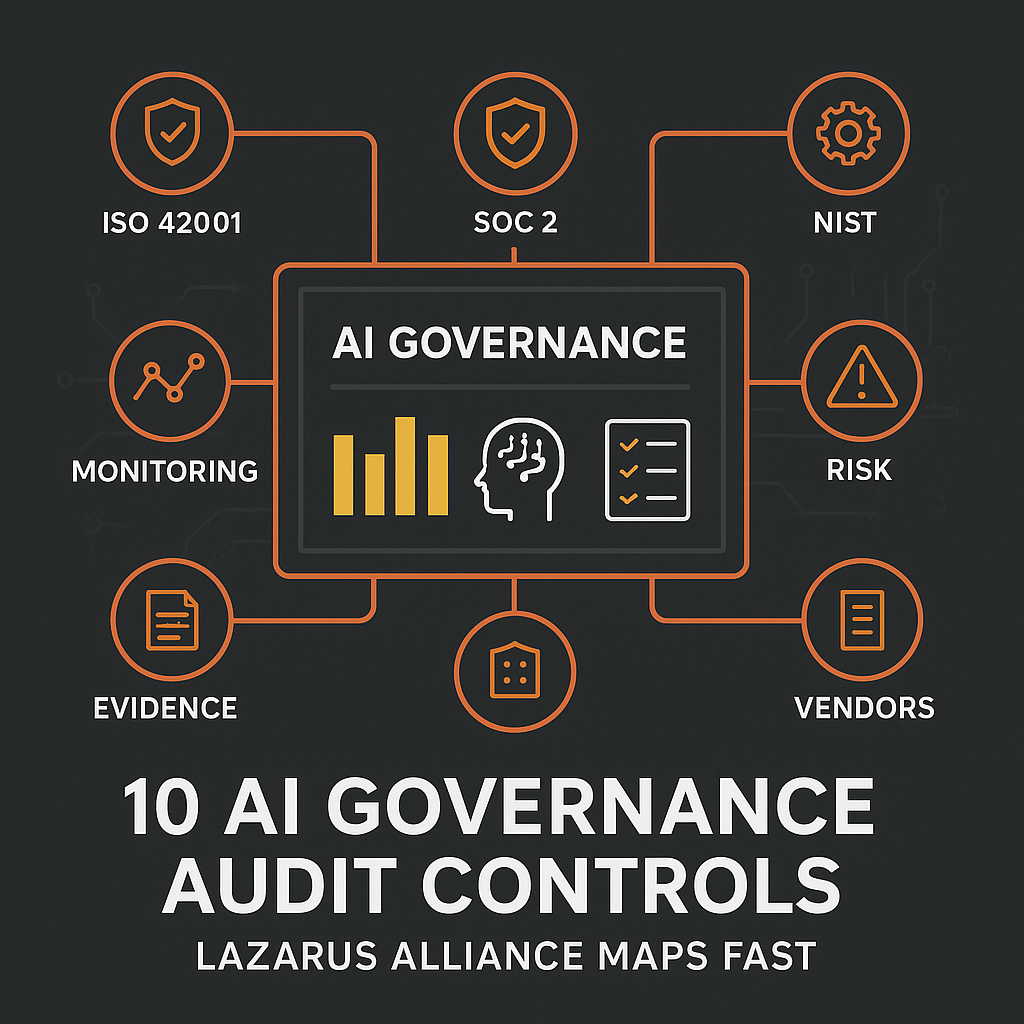
Contrarian audit view: AI governance does not fail first at the model layer. It usually fails at the evidence layer. Boards ask whether the enterprise has safe, accountable AI; auditors ask whether the organization can prove inventory, ownership, data lineage, risk treatment, monitoring, supplier oversight, incident response, and management review across every material AI use case. That is why an effective AI governance audit must map ISO IEC 42001, SOC 2 AI controls, and NIST AI governance into one testable evidence model—not three parallel compliance projects.
For CISOs, compliance officers, product leaders, and IT directors, the practical question is not “Which AI framework should we pick?” The better question is: “Which ten controls will satisfy the largest number of AI assurance expectations, reduce vendor due diligence friction, and create defensible evidence for compliance assessments?” Lazarus Alliance approaches AI governance audit work through that lens: establish the management system, identify AI assets, evaluate risk, connect controls to business processes, and preserve evidence in a format an assessor can test.
Why AI Governance Audit Programs Are Converging Now
AI assurance is converging because ISO IEC 42001, SOC 2, and NIST all expect organizations to govern AI through accountable roles, risk-based controls, documented processes, monitoring, and continual improvement. ISO describes ISO/IEC 42001 as a standard for organizations establishing, implementing, maintaining, and continually improving an artificial intelligence management system, according to ISO, ISO/IEC 42001. AFNOR also emphasizes that ISO/IEC 42001 certification and legal compliance with AI-specific regulation are not the same assurance outcome, a key point for organizations using ISO IEC 42001 as a management-system baseline while preparing for sector or jurisdiction-specific obligations, according to AFNOR, AI Standards and Compliance Procedures.
SOC 2 is moving in the same direction. The AICPA SOC 2 Working Group is seeking public comment on proposed 2027 Trust Services Criteria and Description Criteria, with AI-related topics including AI governance, model monitoring, prompt manipulation, data poisoning, transparency of AI-generated outputs, training data management, and automated decision-making, according to AICPA-CIMA, SOC Suite of Services and CPA Practice Advisor, AICPA Proposed SOC 2 Update. Public comments are open through Jan. 15, 2027, and the proposed criteria would be effective for engagements beginning on or after Dec. 31, 2027, with early adoption permitted, according to CPA Practice Advisor, AICPA Proposed SOC 2 Update.
NIST provides the risk vocabulary. The NIST AI Risk Management Framework organizes trustworthy AI around governance, mapping, measurement, and management activities, according to NIST, AI Risk Management Framework. NIST CSF 2.0 also elevates governance as a core cybersecurity function, and NIST describes CSF 2.0 functions as Govern, Identify, Protect, Detect, Respond, and Recover, according to NIST CSRC, Governing and Managing ICT Risk Programs Draft.
The Lazarus Alliance AI Governance Audit Mapping Method
Lazarus Alliance maps AI governance controls into an assessor-ready control universe: one requirement, one owner, one evidence type, one test procedure, and one set of linked obligations. This matters because a single AI workflow can implicate ISO IEC 42001, SOC 2 AI controls, NIST 800-53, ISO 27001, HIPAA, PCI DSS, FedRAMP, GovRAMP, CJIS, CMMC, DFARS NIST 800-171, IRS 1075, C5, and LADMF depending on sector, data type, and customer commitments.
Organizations that already maintain multi-framework programs can accelerate mapping by reusing mature audit patterns. For example, access governance for AI systems often traces to NIST SP 800-53 AC-2 account management and AC-6 least privilege, according to NIST, SP 800-53 Rev. 5. Security assessment and authorization practices trace to CA controls in the same catalog, according to NIST, SP 800-53 Rev. 5. Organizations pursuing federal or public-sector assurance can align these patterns with Lazarus Alliance NIST 800-53 and FISMA audit services, while service organizations can map AI evidence into Lazarus Alliance SOC 1 and SOC 2 audit services.
10 AI Governance Audit Controls Lazarus Alliance Maps Fast
1. AI System Inventory and Classification
Control objective: Maintain a current inventory of AI systems, models, datasets, automated decision workflows, embedded vendor AI capabilities, and user-facing AI features.
Framework mapping: ISO IEC 42001 expects an AI management system that can be maintained and improved, according to ISO, ISO/IEC 42001. NIST AI RMF uses the Map function to establish context and understand AI system risks, according to NIST, AI Risk Management Framework. SOC 2 scoping requires a service organization to describe the system being examined and the boundaries relevant to the Trust Services Criteria, according to AICPA-CIMA, SOC Suite of Services.
Evidence auditors expect: AI asset register, business owner, technical owner, model type, deployment environment, data categories, criticality, vendor dependency, customer impact, and control inheritance notes. A common gap is allowing teams to use AI-enabled SaaS features without updating the vendor inventory or data-flow diagram. For regulated environments, classification should identify whether the AI system touches protected health information, cardholder data, criminal justice information, controlled unclassified information, federal tax information, or LADMF data.
2. AI Accountability, Governance Charter, and RACI
Control objective: Define who approves AI use, who owns risk, who monitors performance, who can accept residual risk, and who reports AI risk to leadership.
Framework mapping: NIST CSF 2.0 places governance alongside Identify, Protect, Detect, Respond, and Recover as an organizing function for cyber risk, according to NIST CSRC, Governing and Managing ICT Risk Programs Draft. NIST SP 800-53 PM controls address organization-level information security program management, according to NIST, SP 800-53 Rev. 5.
Implementation detail: Lazarus Alliance typically looks for an AI governance charter that names the executive sponsor, AI risk committee, model owners, privacy representative, security representative, legal reviewer, procurement owner, and incident commander. The RACI should distinguish approval of a model from approval of the business process using the model. A fraud-detection model may be technically acceptable yet still require legal review if it materially affects consumers or employees.
3. AI Risk Assessment and Impact Analysis
Control objective: Perform risk assessments before deployment and at defined triggers, including material model change, data-source change, new user population, new jurisdiction, new vendor, or incident.
Framework mapping: The NIST AI RMF Manage function supports prioritizing, responding to, and monitoring identified risks, according to NIST, AI Risk Management Framework. NIST SP 800-53 RA-3 addresses risk assessment, RA-5 addresses vulnerability monitoring and scanning, and RA-7 addresses risk response, according to NIST, SP 800-53 Rev. 5.
What good looks like: The AI risk assessment should evaluate confidentiality, integrity, availability, privacy, safety, bias, explainability, security abuse cases, prompt injection, data poisoning, model inversion, output misuse, and dependency concentration. Verizon’s 2026 DBIR found that 31% of breaches began with vulnerability exploitation, 48% involved ransomware, 48% involved a third party, and 62% involved the human element, according to Verizon, 2026 Data Breach Investigations Report. Those breach patterns should directly influence AI risk scoring because AI systems amplify software, third-party, and human-process risk.
4. Data Governance, Training Data Controls, and Lineage
Control objective: Govern AI data from acquisition through retention, including lawful use, data minimization, quality controls, provenance, labeling, segregation, and deletion.
Framework mapping: NIST SP 800-53 PT controls address personally identifiable information processing and transparency, while MP controls address media protection and SC controls address system and communications protection, according to NIST, SP 800-53 Rev. 5. PCI DSS v4.0.1 is the current PCI DSS version and is provided by the PCI Security Standards Council for organizations protecting account data, according to PCI Security Standards Council, PCI DSS Document Library.
Audit walkthrough: In a healthcare AI triage scenario, the assessor should be able to trace where protected data enters the pipeline, how it is tokenized or de-identified, who can access the training set, whether synthetic data is used, where embeddings are stored, and whether output logs contain regulated data. For HIPAA environments, the current Security Rule remains enforceable, and regulated entities continue to be expected to maintain risk analysis and safeguards, according to Center for Internet Security, Healthcare Cybersecurity Regulatory Expectations.
5. Human Oversight and Automated Decision Controls
Control objective: Define when humans must review AI outputs, override decisions, document exceptions, and notify affected stakeholders.
Framework mapping: The proposed 2027 SOC 2 updates address automated decision-making and transparency of AI-generated outputs, according to CPA Practice Advisor, AICPA Proposed SOC 2 Update. NIST AI RMF identifies trustworthy AI characteristics and governance practices that help organizations manage AI risks, according to NIST, AI Risk Management Framework.
Practical test: Select samples of AI-assisted decisions and verify whether the human reviewer had sufficient context, authority, training, and time to challenge the output. If the reviewer rubber-stamps model recommendations, the organization has a procedural control, not an effective control. Auditors should also inspect escalation records for false positives, false negatives, customer complaints, and override trends.
6. Model Security, Prompt Manipulation, and Abuse-Case Testing
Control objective: Test AI systems for adversarial behavior, prompt injection, data exfiltration through outputs, unsafe tool invocation, insecure plugins, and model supply-chain compromise.
Framework mapping: The proposed SOC 2 AI topics include prompt manipulation and data poisoning, according to CPA Practice Advisor, AICPA Proposed SOC 2 Update. NIST SP 800-53 SI controls cover system and information integrity, including flaw remediation and malicious code protection, according to NIST, SP 800-53 Rev. 5.
Implementation detail: Security teams should create AI-specific test cases: “ignore previous instructions,” “summarize restricted document,” “call external tool with hidden parameter,” “retrieve unrelated tenant content,” and “produce credential-like output from logs.” Evidence should include test plans, results, remediation tickets, retest outcomes, and risk acceptance decisions.
7. AI Vendor Due Diligence and Contractual Controls
Control objective: Validate supplier AI capabilities, data use, subcontractors, security posture, model update practices, incident notification, audit rights, and termination assistance.
Framework mapping: NIST SP 800-53 SR controls address supply chain risk management, including supplier assessments and provenance considerations, according to NIST, SP 800-53 Rev. 5. Vendor risk is not theoretical; Verizon’s 2026 DBIR reported that 48% of breaches involved a third party, according to Verizon, 2026 Data Breach Investigations Report.
Due diligence checklist: Require model-card or system-card documentation when available, data retention terms, training-use restrictions, subprocessor list, penetration testing summary, SOC report mapping, breach notification commitments, customer data deletion evidence, and change-notification clauses for material model updates. Continuum GRC’s AI governance and risk capabilities support structured AI control inventories, risk workflows, and evidence organization for this kind of supplier review, according to Continuum GRC, AI Governance and Risk.
8. Logging, Monitoring, and Model Performance Management
Control objective: Monitor AI systems for security events, performance drift, data drift, anomalous output, abuse patterns, service degradation, and unauthorized access.
Framework mapping: NIST SP 800-53 AU controls address audit and accountability, CA-7 addresses continuous monitoring, and SI controls address integrity monitoring, according to NIST, SP 800-53 Rev. 5. FedRAMP reported that its 20x approach emphasizes reduced assessment burden, improved evidence quality, machine-readable packages, and reuse of external security frameworks, according to FedRAMP, Memo to Milestone.
Audit evidence: Logs should show who used the model, what data class was involved, which version responded, what tool calls were executed, whether restricted content was blocked, and whether alerts were reviewed. For government cloud environments, evidence quality is increasingly important because FedRAMP reported that CR26 was published in June 2026, the 20x pipeline opened in August 2026, FY26 produced 92 new FedRAMP certifications, and Legacy FedRAMP Rev5 certification applications stop being processed on June 11, 2027, according to FedRAMP, Memo to Milestone. Lazarus Alliance supports this type of control validation through Lazarus Alliance FedRAMP services.
9. AI Incident Response, Redress, and Communications
Control objective: Extend the incident response program to AI-specific events, including harmful output, privacy leakage, model compromise, poisoning, unauthorized training, and unsafe automated actions.
Framework mapping: NIST SP 800-53 IR controls address incident response planning, handling, reporting, and testing, according to NIST, SP 800-53 Rev. 5. NIST CSF 2.0 includes Respond and Recover functions alongside Govern, Identify, Protect, and Detect, according to NIST CSRC, Governing and Managing ICT Risk Programs Draft.
Scenario: A customer-support chatbot exposes another customer’s confidential support history through retrieval-augmented generation. A mature AI incident process immediately disables the retrieval connector, preserves prompts and outputs, identifies affected records, notifies legal and privacy teams, opens vendor support tickets, performs root-cause analysis, updates guardrails, and retests retrieval filters before restoration. The audit question is whether those steps are documented, trained, exercised, and evidenced.
10. Management Review, Internal Audit, and Continuous Improvement
Control objective: Ensure leadership receives AI risk reporting, approves remediation priorities, reviews metrics, and drives continual improvement.
Framework mapping: ISO/IEC 42001 is built as a management-system standard for establishing, maintaining, and improving AI governance, according to ISO, ISO/IEC 42001. NIST SP 800-53 CA controls address assessment, authorization, and monitoring practices, according to NIST, SP 800-53 Rev. 5.
Metrics to report: AI systems inventoried, high-risk AI systems approved, overdue AI risk treatments, unreviewed vendor AI features, unresolved model findings, prompt-abuse test pass rate, data-retention exceptions, incidents by severity, and human-override rates. Continuum GRC’s 2026 AI Governance Benchmark Report is a useful resource for organizations evaluating AI governance maturity and audit readiness practices, according to Continuum GRC, 2026 AI Governance Benchmark Report.
Cross-Framework AI Control Mapping Matrix
- Inventory: ISO IEC 42001 AI management system scope; NIST AI RMF Map; SOC 2 system description.
- Risk assessment: NIST AI RMF Map, Measure, Manage; NIST SP 800-53 RA controls; ISO IEC 42001 risk treatment.
- Access control: NIST SP 800-53 AC-2 account management and AC-6 least privilege, according to NIST, SP 800-53 Rev. 5; SOC 2 logical access criteria.
- Supplier governance: NIST SP 800-53 SR controls; SOC 2 vendor management; AI vendor due diligence.
- Monitoring: NIST SP 800-53 AU, CA-7, and SI controls, according to NIST, SP 800-53 Rev. 5; SOC 2 monitoring criteria; ISO IEC 42001 performance evaluation.
- Incident response: NIST SP 800-53 IR controls; SOC 2 incident communication; AI-specific escalation and redress.
Sector-Specific AI Governance Audit Considerations
Defense contractors: AI tools used for engineering, proposal development, log analysis, or code generation can create controlled unclassified information exposure if access, retention, and vendor training terms are not governed. DFARS 252.204-7019 requires offerors subject to NIST SP 800-171 to have a current assessment not more than three years old unless the solicitation specifies a shorter period, and summary-level scores must be posted in SPRS for covered contractor information systems relevant to the offer, according to Acquisition.gov, DFARS 252.204-7019. CMMC is implemented through a four-phase approach under 32 CFR Part 170, according to eCFR, 32 CFR Part 170.
Law enforcement and justice: AI summarization, RAG search, transcription, and evidence review must be scoped against CJIS obligations. The FBI CJIS Security Policy is at version 6.1 dated June 2026, does not mandate a specific vendor, cloud provider, FedRAMP authorization level, or deployment model, and compliance is assessed by the applicable state CJIS Systems Agency rather than a central body, according to AWS Public Sector Blog, CJIS RAG Architecture Discussion. Lazarus Alliance supports CJIS scoping and control review through Lazarus Alliance CJIS services.
Healthcare and financial services: AI governance must integrate privacy, security, retention, and vendor oversight. PCI DSS v4.0.1 is available from the PCI Security Standards Council as the current payment security standard, according to PCI Security Standards Council, PCI DSS Document Library. Healthcare entities continue to operate under enforceable HIPAA Security Rule expectations, according to Center for Internet Security, Healthcare Cybersecurity Regulatory Expectations.
Restricted government datasets: AI workflows that touch LADMF data need careful scoping. eCFR 15 CFR Part 1110 implements the certification program for access to the Death Master File, and 15 CFR 1110.101 requires a written attestation from an Accredited Conformity Assessment Body based on a review or assessment conducted no more than three years before submission, according to eCFR, 15 CFR Part 1110 and eCFR, 15 CFR 1110.101.
Common AI Governance Audit Pitfalls
- Confusing certification with legal compliance: ISO IEC 42001 certification can support an AI management system, but AFNOR cautions that it is not the same as legal compliance with AI regulation, according to AFNOR, AI Standards and Compliance Procedures.
- Auditing only internally built models: Many material AI risks come from embedded vendor AI, SaaS copilots, cloud AI services, and subcontractor tools.
- Missing retrieval-layer risk: RAG architecture can expose restricted documents even when the base model is not trained on them.
- Overreliance on policy: An AI acceptable-use policy is not enough without inventory, risk assessments, logging, approval workflows, and tested incident response.
- Weak evidence retention: If control owners cannot show dated approvals, test results, remediation records, and monitoring outputs, the control will be difficult to defend.
Fast-Start AI Governance Audit Checklist
- Build an AI inventory covering internal models, third-party AI, embedded product AI, and employee productivity AI.
- Classify each AI use case by data sensitivity, decision impact, external exposure, vendor dependency, and regulatory scope.
- Perform an AI risk assessment aligned to NIST AI RMF Map, Measure, Manage, and Govern functions, according to NIST, AI Risk Management Framework.
- Map reusable controls to ISO IEC 42001, SOC 2, NIST 800-53, ISO 27001, HIPAA, PCI DSS, FedRAMP, GovRAMP, CMMC, CJIS, IRS 1075, C5, and LADMF where applicable.
- Create evidence packets for the ten controls above, including owner, frequency, sample population, test procedure, and remediation workflow.
- Run tabletop exercises for AI incidents, including privacy leakage, prompt injection, rogue automation, and vendor model change.
- Review vendor contracts for training restrictions, data retention, audit rights, incident notice, subprocessors, and model update notification.
How Lazarus Alliance Helps Map AI Governance Controls Faster
Lazarus Alliance helps organizations convert AI governance from policy ambition into audit-ready evidence. The core advantage is multi-framework fluency: the same AI risk assessment can support ISO IEC 42001 readiness, SOC 2 AI controls, NIST AI governance, FedRAMP or GovRAMP evidence planning, CJIS architecture review, CMMC scoping, HIPAA safeguard review, PCI DSS data-flow analysis, and LADMF attestation preparation where the environment requires it.
The practical deliverable is not a binder of generic AI policies. It is a mapped control set with owners, procedures, evidence, test plans, gaps, remediation priorities, and executive reporting. That is the difference between saying AI is governed and proving it under audit.
Sources and References
- ISO, ISO/IEC 42001
- AFNOR, AI Standards and Compliance Procedures
- AICPA-CIMA, SOC Suite of Services
- CPA Practice Advisor, AICPA Proposed SOC 2 Update
- NIST, AI Risk Management Framework
- NIST CSRC, Governing and Managing ICT Risk Programs Draft
- NIST, SP 800-53 Rev. 5
- Verizon, 2026 Data Breach Investigations Report
- PCI Security Standards Council, PCI DSS Document Library
- Center for Internet Security, Healthcare Cybersecurity Regulatory Expectations
- FedRAMP, Memo to Milestone
- Acquisition.gov, DFARS 252.204-7019
- eCFR, 32 CFR Part 170
- AWS Public Sector Blog, CJIS RAG Architecture Discussion
- eCFR, 15 CFR Part 1110
- eCFR, 15 CFR 1110.101
- Lazarus Alliance, NIST 800-53 and FISMA Audit Services
- Lazarus Alliance, SOC 1 and SOC 2 Audit Services
- Continuum GRC, AI Governance and Risk
- Lazarus Alliance, FedRAMP Services
- Lazarus Alliance, CJIS Services
- Continuum GRC, 2026 AI Governance Benchmark Report
About Lazarus Alliance
To learn more about how Lazarus Alliance can help, contact us.
- FedRAMP
- GovRAMP
- NIST 800-53
- DFARS NIST 800-171
- CMMC
- SOC 1 & SOC 2
- C5
- HIPAA, HITECH, & Meaningful Use
- PCI DSS RoC & SAQ
- IRS 1075 & 4812
- CJIS
- LA DMF
- ISO 27001, ISO 27002, ISO 27005, ISO 27017, ISO 27018, ISO 27701, ISO 22301, ISO 17020, ISO 17021, ISO 17025, ISO 17065, ISO 9001, & ISO 90003
- And dozens more!
Related Posts