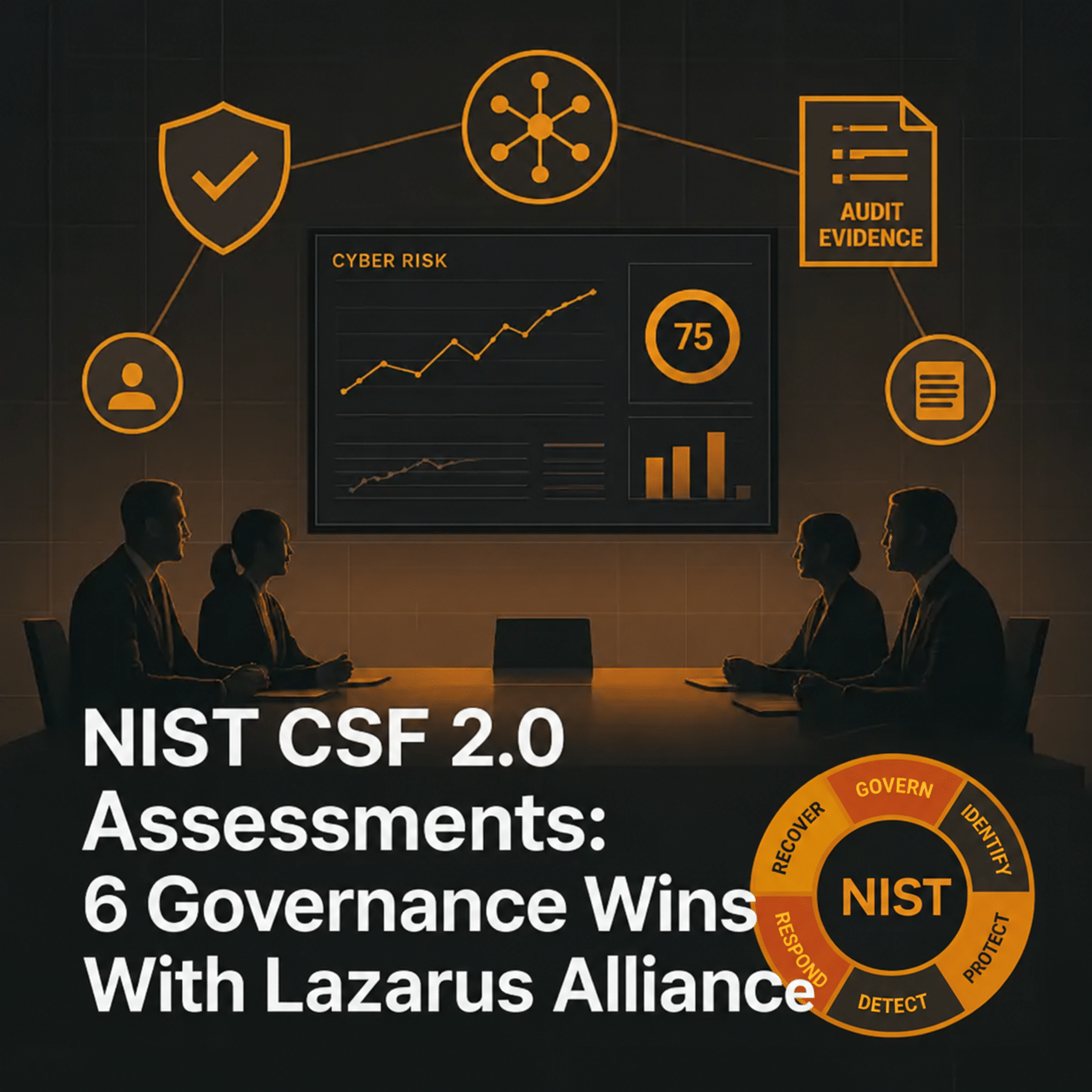
Enterprise cybersecurity leaders do not need another framework poster. They need a defensible way to prove that cyber risk is governed, funded, tested, reported, and improved. That is the practical value of a NIST CSF 2.0 assessment when it is performed as a governance-driven GRC assessment rather than a checklist exercise.
NIST CSF 2.0 organizes cybersecurity outcomes around six Functions: Govern, Identify, Protect, Detect, Respond, and Recover, with Govern positioned to establish cybersecurity risk management strategy, expectations, policy, oversight, roles, and supply-chain direction, according to NIST, The NIST Cybersecurity Framework 2.0. For boards, CISOs, general counsel, audit committees, and enterprise risk leaders, that shift matters: cybersecurity maturity is no longer just a technical control score; it is evidence that leadership can make risk-informed decisions.
NIST CSF 2.0 Assessment Governance: Why Govern Changes the Conversation
The most important NIST CSF 2.0 assessment question is not whether a firewall rule exists. It is whether leadership knows why the rule exists, what risk it treats, who owns it, how exceptions are approved, which business process depends on it, and what evidence proves it operates. NIST CSF 2.0 defines the Govern Function across organizational context, risk management strategy, roles and responsibilities, policy, oversight, and cybersecurity supply-chain risk management, as documented by NIST, The NIST Cybersecurity Framework 2.0.
That makes the framework especially useful for organizations that must explain cyber risk to nontechnical stakeholders. NIST also states that the CSF is voluntary guidance and not a certification program, which means an assessment should produce a risk-based maturity view, not a pass-fail certificate, according to NIST, Cybersecurity Framework FAQs.
Lazarus Alliance treats NIST CSF 2.0 as an executive control plane. The assessment connects board risk oversight to the evidence layer underneath: asset inventories, identity controls, vulnerability remediation, cloud configuration, supplier risk, incident response, backup recovery, privacy safeguards, and audit artifacts. This is where cybersecurity governance becomes measurable.
The Lazarus Alliance Method: A Governance-First GRC Assessment
A mature NIST CSF 2.0 assessment should produce three outputs that boards can use: a current profile, a target profile, and a prioritized action plan. NIST describes CSF Profiles as a mechanism for describing current or desired cybersecurity outcomes and aligning them with business requirements and risk tolerance, according to NIST, The NIST Cybersecurity Framework 2.0.
Lazarus Alliance extends that concept through a governance evidence model:
- Mandate: confirm who has authority for risk acceptance, budget approval, policy exceptions, and supplier onboarding.
- Materiality: map cyber events to operational disruption, legal exposure, revenue impact, patient safety, contractual penalties, or mission failure.
- Mechanism: test whether controls are implemented, monitored, and evidenced.
- Measurement: define KRIs, KPIs, control metrics, and reporting thresholds.
- Management action: convert gaps into remediation, risk transfer, compensating controls, or accepted risk.
For organizations pursuing multiple audits, the assessment also becomes a control rationalization exercise. Lazarus Alliance supports cross-framework programs spanning NIST 800-53 and FISMA audit services, DFARS NIST 800-171 audit services, SOC 1 and SOC 2 audit services, and PCI DSS audit services. The goal is not to duplicate evidence for every framework; it is to build one defensible control narrative.
Governance Win 1: Board Risk Oversight Becomes Evidence-Based
Boards often receive cyber dashboards that show vulnerability counts, phishing rates, or training completion. Those metrics help, but they are insufficient when directors need to understand enterprise risk. NIST CSF 2.0 helps translate technical exposure into governance questions: Which business services are critical? What risk appetite has leadership approved? Which cyber scenarios exceed tolerance? Which risks have no accountable owner?
In practice, Lazarus Alliance assesses whether board risk oversight includes documented cyber risk appetite, escalation thresholds, management reporting cadence, exception approval, and linkage to enterprise risk management. NIST SP 800-53 Rev. 5 control PM-9 addresses risk management strategy, and RA-3 addresses risk assessment activities, providing a deeper control reference for organizations that need auditable risk governance beneath CSF outcomes, according to NIST, Security and Privacy Controls for Information Systems and Organizations.
Example: A healthcare system may report endpoint coverage to the board, but a governance-driven assessment asks whether ransomware loss scenarios are tied to emergency operations, ePHI availability, downtime procedures, recovery point objectives, and business associate dependencies. HIPAA requires covered entities and business associates to conduct an accurate and thorough risk analysis of potential risks and vulnerabilities to electronic protected health information under 45 CFR 164.308(a)(1)(ii)(A), according to eCFR, 45 CFR 164.308. That requirement becomes more defensible when cyber risk reporting is tied to operational impact and governance decisions.
Governance Win 2: Cybersecurity Maturity Is Measured Against Business Outcomes
A NIST CSF 2.0 maturity assessment should not score every subcategory equally. A SaaS company serving federal customers, a defense supplier handling controlled unclassified information, a payment processor, and a county justice agency have different risk drivers. NIST CSF 2.0 supports tailoring through profiles and implementation tiers, according to NIST, The NIST Cybersecurity Framework 2.0.
Lazarus Alliance uses a weighted maturity model that evaluates four dimensions:
- Design maturity: the control is defined, approved, and aligned to policy.
- Implementation maturity: the control exists in systems, processes, and contracts.
- Operating maturity: the control produces repeatable evidence over time.
- Governance maturity: leadership reviews results, funds remediation, and accepts residual risk when appropriate.
This prevents a common pitfall: treating documentation as maturity. A policy stating that privileged access is reviewed quarterly does not prove that accounts are reviewed, exceptions are resolved, or terminated users are removed. NIST SP 800-53 Rev. 5 AC-2 addresses account management, including account creation, enabling, modification, disabling, and removal, according to NIST, Security and Privacy Controls for Information Systems and Organizations.
For defense contractors, the same evidence discipline applies to NIST SP 800-171 Rev. 3 requirements for protecting controlled unclassified information in nonfederal systems, according to NIST, Protecting Controlled Unclassified Information in Nonfederal Systems and Organizations. DFARS 252.204-7021 requires applicable contractors to maintain the required CMMC status for systems that process, store, or transmit FCI or CUI, complete annual affirmations of continuous compliance in SPRS, and flow down applicable requirements to subcontractors, according to eCFR, 48 CFR 252.204-7021.
Governance Win 3: Compliance Assessments Become Reusable, Not Repetitive
Most enterprises are not assessed against one framework. A single environment may support SOC 2 customer assurance, ISO/IEC 27001 governance, PCI DSS payment processing, HIPAA safeguards, CMMC readiness, CJIS access, IRS 1075 data handling, FedRAMP cloud expectations, and internal enterprise risk reporting. ISO describes ISO/IEC 27001 as a standard for information security management systems, according to ISO, ISO/IEC 27001 Information Security Management Systems.
The governance opportunity is control inheritance. A well-designed NIST CSF 2.0 GRC assessment maps one control to many obligations. Identity governance, for example, can support NIST CSF Protect outcomes, NIST 800-53 AC controls, SOC 2 common criteria, PCI DSS access-control expectations, HIPAA access management, and CMMC access-control practices. PCI SSC lists PCI DSS v4.0.1 documentation in its official document library, according to PCI Security Standards Council, PCI DSS v4.0.1 Document Library.
Assessment walkthrough: During a multi-framework assessment, Lazarus Alliance may request the identity policy, privileged access inventory, sample joiner-mover-leaver tickets, MFA enforcement evidence, cloud IAM exports, quarterly access review records, exception approvals, and terminated-user validation. The assessor then evaluates the same evidence against CSF governance expectations, NIST 800-53 AC-2, SOC 2 logical access criteria, PCI DSS access scope, and contractual obligations. This lowers audit fatigue while increasing consistency.
Continuum GRC’s Compliance Framework Complexity Report examines how organizations manage overlapping compliance obligations. Lazarus Alliance uses that same practical insight in assessment planning: normalize evidence once, then map it intelligently.
Governance Win 4: Supplier and Third-Party Risk Moves Into the Boardroom
NIST CSF 2.0 places cybersecurity supply-chain risk management inside Govern, making vendor risk an executive governance issue rather than a procurement afterthought, according to NIST, The NIST Cybersecurity Framework 2.0. That is essential because third-party dependency is now a material cyber exposure. Verizon’s DBIR reports that its dataset analyzed more than 22,000 confirmed breaches, vulnerability exploitation represented 31% of breaches with known initial access, ransomware was involved in 48% of breaches, and third-party involvement reached 48% of breaches, according to Verizon, Data Breach Investigations Report.
A governance-driven assessment examines the complete third-party lifecycle:
- risk tiering before contract execution;
- security addenda and audit-right language;
- data-flow and subprocessor mapping;
- cloud shared-responsibility boundaries;
- ongoing control monitoring;
- incident notification and evidence-retention obligations;
- offboarding and data destruction validation.
NIST SP 800-53 Rev. 5 includes supply-chain risk management controls in the SR family, including controls that address supply-chain risk management plans and supplier-related requirements, according to NIST, Security and Privacy Controls for Information Systems and Organizations. For organizations with government or regulated data, Lazarus Alliance can align third-party assessments to CJIS audit services, IRS 1075 audit services, and FedRAMP audit services where appropriate.
Continuum GRC’s Third-Party and Vendor Risk capabilities support the operational side of this governance model by helping teams organize supplier risk records, evidence, and oversight workflows.
Governance Win 5: Cloud, AI, and Automation Are Assessed as Control Systems
Boards are asking whether cloud and AI create unmanaged risk. A NIST CSF 2.0 assessment gives leadership a structure for answering that question with evidence. For cloud service providers serving federal agencies, FedRAMP reports a shift toward automated validation, machine-readable evidence, Key Security Indicators, continuous reporting, and full alignment of certification options under the FedRAMP 20x umbrella, according to FedRAMP, From Foundation to Implementation. The same FedRAMP update reports 538 certified cloud service offerings and 760 new agency ATOs or ATUs, according to FedRAMP, From Foundation to Implementation.
The lesson for enterprise risk leaders is clear: evidence is becoming continuous. A cloud governance assessment should review configuration baselines, identity federation, logging coverage, vulnerability SLAs, encryption boundaries, inherited controls, tenant isolation, backup recoverability, and change-control automation. A policy-only review is no longer enough.
AI governance deserves the same discipline. IBM reports that roughly 21% of enterprise security incidents involve an AI model or application and that AI-related security incidents cost organizations an average of USD 5.33 million, while identifying threats such as prompt injection, data poisoning, data leakage, model inversion, and shadow AI, according to IBM, AI Workload Security. NIST CSF 2.0 can be used to govern AI risk by requiring asset inventory, model ownership, data classification, access controls, monitoring, incident handling, vendor review, and policy exceptions.
Continuum GRC’s AI Governance and Risk capabilities align with this direction by helping organizations structure AI risk inventories and governance workflows. ISO also identifies ISO/IEC 42001 as an AI management system standard, according to ISO, ISO/IEC 42001 Artificial Intelligence Management System.
Governance Win 6: Remediation Becomes a Funded Risk Treatment Plan
The final governance win is the most practical: a NIST CSF 2.0 assessment turns findings into management decisions. Weak assessments end with a spreadsheet of gaps. Strong assessments produce a risk treatment plan that prioritizes by business impact, exploitability, compliance exposure, control dependency, and implementation effort.
Lazarus Alliance typically separates findings into five remediation lanes:
- Immediate risk reduction: exposed critical vulnerabilities, unprotected administrator accounts, missing backups, broken logging, or expired certificates.
- Audit readiness: missing evidence, incomplete scope boundaries, outdated policies, unapproved exceptions, and weak control narratives.
- Governance decisions: risk appetite gaps, ownership disputes, unsupported legacy systems, and unfunded remediation.
- Architecture modernization: segmentation, zero trust access, centralized logging, secrets management, and secure cloud landing zones.
- Continuous assurance: automated evidence collection, control monitoring, KRI reporting, and recurring management review.
This approach is especially powerful for organizations preparing for SOC 2 Type 2, PCI DSS validation, CMMC assessment, HIPAA risk analysis, CJIS readiness, FedRAMP readiness, GovRAMP, C5, LADMF, or ISO certification activities. It also gives executive sponsors a defensible basis for budget requests. The question changes from what does security want to buy to which enterprise risks remain above tolerance without this investment.
Common NIST CSF 2.0 Assessment Pitfalls
- Using CSF 2.0 as a control checklist: CSF outcomes should be mapped to controls and evidence, but the framework is designed for risk management outcomes, according to NIST, The NIST Cybersecurity Framework 2.0.
- Ignoring governance evidence: Minutes, risk registers, exception approvals, supplier reviews, and funding decisions are evidence, not administrative clutter.
- Scoring maturity without weighting risk: A low maturity score in an internet-facing identity control may matter more than a documentation gap in a low-risk internal process.
- Failing to reconcile frameworks: If SOC 2, PCI DSS, CMMC, HIPAA, and ISO teams maintain separate evidence sets, the organization will create inconsistent control stories.
- Leaving the board out of remediation: High residual risk without governance escalation becomes a leadership failure, not just a security backlog.
Decision Matrix: When Should You Schedule a NIST CSF 2.0 GRC Assessment?
Schedule a governance-driven NIST CSF 2.0 assessment when any of the following conditions exist:
- the board wants cyber risk reported in enterprise risk language;
- the organization is preparing for SOC 2, PCI DSS, CMMC, FedRAMP, HIPAA, CJIS, ISO, IRS 1075, or C5 review;
- cloud migration has outpaced governance and evidence collection;
- supplier risk is materially increasing;
- AI tools, shadow AI, or vendor AI features are entering business workflows;
- risk acceptance decisions are informal or undocumented;
- audit teams repeatedly request the same evidence from different business units;
- executives need a prioritized cybersecurity maturity roadmap.
Lazarus Alliance brings the assessor mindset needed to make NIST CSF 2.0 operational. The assessment is not just a maturity score. It is a practical governance artifact that helps leaders align cybersecurity governance, compliance assessments, risk management, technical control validation, and board risk oversight into one defensible program.
Bottom Line: Governance Is the New Cybersecurity Maturity Multiplier
NIST CSF 2.0 gives enterprise risk leaders a common language for cyber governance. Lazarus Alliance turns that language into evidence, findings, risk decisions, and remediation plans. The six governance wins are clear: better board oversight, business-aligned maturity, reusable compliance evidence, stronger third-party risk management, cloud and AI control discipline, and funded remediation.
For organizations under pressure from customers, regulators, insurers, boards, and mission owners, that is the real value of a NIST CSF 2.0 assessment. It proves not only that controls exist, but that cybersecurity is governed.
Sources and References
- NIST, The NIST Cybersecurity Framework 2.0
- NIST, Cybersecurity Framework FAQs
- NIST, Security and Privacy Controls for Information Systems and Organizations
- NIST, Protecting Controlled Unclassified Information in Nonfederal Systems and Organizations
- eCFR, 48 CFR 252.204-7021
- eCFR, 45 CFR 164.308
- PCI Security Standards Council, PCI DSS v4.0.1 Document Library
- ISO, ISO/IEC 27001 Information Security Management Systems
- ISO, ISO/IEC 42001 Artificial Intelligence Management System
- Verizon, Data Breach Investigations Report
- IBM, AI Workload Security
- FedRAMP, From Foundation to Implementation
- Lazarus Alliance, NIST 800-53 and FISMA Audit Services
- Lazarus Alliance, DFARS NIST 800-171 Audit Services
- Lazarus Alliance, SOC 1 and SOC 2 Audit Services
- Lazarus Alliance, PCI DSS Audit Services
- Lazarus Alliance, CJIS Audit Services
- Lazarus Alliance, IRS 1075 Audit Services
- Lazarus Alliance, FedRAMP Audit Services
- Continuum GRC, Compliance Framework Complexity Report
- Continuum GRC, Third-Party and Vendor Risk
- Continuum GRC, AI Governance and Risk
About Lazarus Alliance
To learn more about how Lazarus Alliance can help, contact us.
- FedRAMP
- GovRAMP
- NIST 800-53
- DFARS NIST 800-171
- CMMC
- SOC 1 & SOC 2
- C5
- HIPAA, HITECH, & Meaningful Use
- PCI DSS RoC & SAQ
- IRS 1075 & 4812
- CJIS
- LA DMF
- ISO 27001, ISO 27002, ISO 27005, ISO 27017, ISO 27018, ISO 27701, ISO 22301, ISO 17020, ISO 17021, ISO 17025, ISO 17065, ISO 9001, & ISO 90003
- And dozens more!
Related Posts