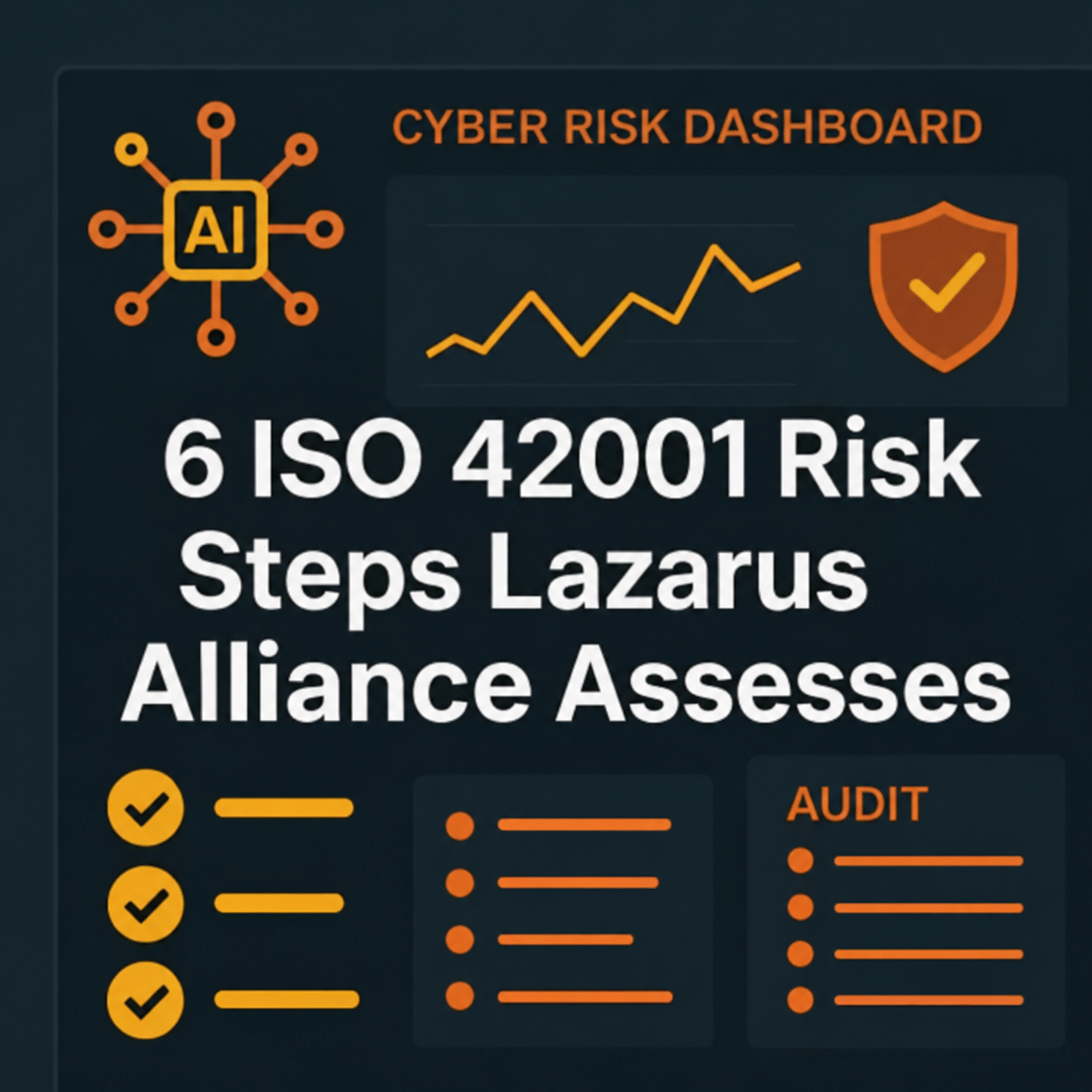
AI governance is no longer a policy exercise separated from enterprise security. For organizations preparing for ISO 42001 readiness, the central audit question is practical: can leadership prove that AI risks are identified, evaluated, treated, monitored, and governed with the same discipline expected in mature cybersecurity, privacy, and compliance programs? ISO 42001 defines requirements for an artificial intelligence management system, while ISO/IEC 23894 provides guidance for AI risk management, and both standards require evidence that governance decisions are repeatable rather than ad hoc ISO, ISO/IEC 42001 ISO, ISO/IEC 23894.
The contrarian view from Lazarus Alliance is that ISO 42001 readiness should not begin with an AI policy template. It should begin with an evidence-grade risk assessment that connects AI use cases to business objectives, regulated data, control inheritance, third-party dependencies, monitoring telemetry, and executive accountability. That is the difference between an AI governance program that reads well and one that survives a compliance assessment, GRC audit, or board-level risk review.
ISO 42001 Risk Assessment Readiness Starts With Evidence, Not Declarations
ISO 42001 establishes a management-system model for organizations that provide, develop, or use AI systems, and that management-system approach means assessors expect defined scope, accountable roles, risk processes, control objectives, documented decisions, and measurable improvement ISO, ISO/IEC 42001. NIST describes AI risk management as a structured discipline for mapping, measuring, managing, and governing AI risks, which aligns closely with the kind of audit trail Lazarus Alliance expects when evaluating AI governance maturity NIST, AI Risk Management Framework.
For CISOs, compliance officers, and IT directors, ISO 42001 readiness should be integrated into existing control ecosystems rather than operated as a standalone AI committee. AI systems often process data covered by security, privacy, government, healthcare, payment, or defense obligations; therefore, AI governance should map to frameworks such as NIST 800-53, SOC 2, PCI DSS, HIPAA, CJIS, IRS 1075, FedRAMP, GovRAMP, CMMC, DFARS NIST 800-171, C5, LA DMF, and ISO 27001 where applicable NIST, SP 800-53 Rev. 5 AICPA, SOC 2 Description Criteria PCI Security Standards Council, Document Library.
Lazarus Alliance assesses ISO 42001 readiness through six risk steps designed to produce assessor-ready evidence. The methodology connects AI system inventory, risk taxonomy, impact scoring, control selection, validation, and continuous monitoring so leadership can explain not only what AI systems exist, but why specific risk decisions are reasonable.
Step 1: Define the ISO 42001 AI Governance Scope and Accountability Model
The first ISO 42001 risk step is to define the AI management system boundary. Scope should identify business units, AI-enabled products, internal AI tools, models, data stores, cloud services, vendors, users, decision points, and excluded systems with justification. ISO 42001 requires organizations to establish an AI management system, and the scope of that system is foundational to determining which risks, controls, and records are relevant ISO, ISO/IEC 42001.
Lazarus Alliance looks for governance artifacts that show actual authority. A mature package includes an AI governance charter, risk acceptance criteria, model ownership assignments, privacy and security representation, escalation paths, and documented linkage to enterprise risk management. NIST SP 800-53 control PM-9 addresses risk management strategy, PM-11 addresses mission and business process definition, and PM-30 addresses supply chain risk management strategy, each of which can support AI governance when AI systems affect enterprise operations or regulated environments NIST, SP 800-53 Rev. 5.
Example: a healthcare organization using an AI-enabled triage assistant should not scope the system as merely a software tool. The ISO 42001 scope should include model inputs, protected health information handling, user override capability, audit logs, clinical workflow dependencies, vendor support access, and incident escalation. HIPAA requires covered entities and business associates to protect electronic protected health information through administrative, physical, and technical safeguards, which means AI governance evidence must connect to security rule obligations when health data is involved HHS, HIPAA Security Rule.
Assessor-ready evidence:
- AI management system scope statement with inclusions, exclusions, and rationale.
- AI governance committee charter and decision authority matrix.
- AI system owner, data owner, model owner, and risk owner assignments.
- Crosswalk to enterprise risk, cybersecurity, privacy, and vendor-risk programs.
Step 2: Build a Complete AI System and Data Inventory for Risk Assessment
The second ISO 42001 risk step is inventory. You cannot assess AI risk if the organization cannot identify where AI is embedded, who uses it, what data it consumes, what decisions it influences, and which third parties support it. NIST’s AI RMF emphasizes the need to map AI context, including system purpose, intended use, stakeholders, and risk sources NIST, AI RMF Playbook.
Lazarus Alliance expects the inventory to go beyond model names. A usable AI inventory includes system purpose, model type, training or configuration data, production data categories, regulated data indicators, human-in-the-loop controls, deployment environment, APIs, prompts or prompt templates, output consumers, logging coverage, and upstream/downstream dependencies. For organizations already operating under ISO 27001, the AI inventory should connect to information assets and security controls because ISO 27001 specifies requirements for an information security management system ISO, ISO/IEC 27001.
Common pitfall: organizations often inventory only externally visible AI products and miss internal AI use, such as customer-support summarization, code-generation assistants, HR screening tools, procurement analytics, security operations copilots, and employee use of public AI services. That gap becomes material when regulated information, intellectual property, or government data enters unsanctioned tools.
Defense contractor scenario: a contractor supporting a federal program uses an AI code assistant inside a development environment. The ISO 42001 inventory should identify whether controlled unclassified information could appear in prompts, code comments, telemetry, or vendor logs. NIST SP 800-171 Rev. 3 provides requirements for protecting controlled unclassified information in nonfederal systems, including access control, audit and accountability, configuration management, identification and authentication, incident response, and system and communications protection families NIST, SP 800-171 Rev. 3. Lazarus Alliance’s DFARS NIST 800-171 audit services help organizations align controlled-information protection with audit readiness when AI use touches defense workflows Lazarus Alliance, DFARS NIST 800-171 Audit Services.
Assessor-ready evidence:
- AI system register with owner, purpose, users, environment, and vendor details.
- Data-flow diagrams showing inputs, processing, outputs, storage, and retention.
- Regulated data mapping for PHI, cardholder data, CUI, tax information, criminal justice information, and customer confidential data.
- Shadow-AI discovery process using procurement, endpoint, SSO, CASB, DLP, and expense-review signals.
Step 3: Classify AI Risks Using Impact, Likelihood, and Control Context
The third ISO 42001 risk step is risk classification. ISO/IEC 23894 provides AI risk management guidance, while NIST’s AI RMF describes functions for governing, mapping, measuring, and managing AI risks ISO, ISO/IEC 23894 NIST, AI Risk Management Framework. Lazarus Alliance evaluates whether the organization has a repeatable method for scoring risks and whether scoring criteria reflect business impact rather than technical novelty.
A practical AI risk taxonomy should include confidentiality, integrity, availability, privacy, safety, fairness, transparency, explainability, misuse, model drift, data poisoning, prompt injection, insecure plugin access, hallucination, unauthorized decision automation, vendor concentration, and legal or contractual exposure. Each category should be tied to measurable criteria. For example, integrity impact should consider whether an AI output can initiate financial transactions, change access permissions, alter clinical routing, modify production code, or influence eligibility decisions.
Lazarus Alliance uses a decision matrix that separates inherent AI risk from residual AI risk. Inherent risk scores the AI use case before controls. Residual risk scores the use case after governance, technical, and operational controls are implemented. This distinction matters because ISO 42001 readiness depends on whether leadership can justify risk treatment decisions, not whether every AI system is low risk.
Risk scoring matrix:
- Critical: AI can materially affect regulated decisions, safety, financial integrity, government obligations, or sensitive data exposure.
- High: AI influences security operations, privileged workflows, customer obligations, or regulated data handling with human review.
- Moderate: AI supports internal productivity or analytics with limited sensitive data and compensating controls.
- Low: AI performs narrow administrative tasks with non-sensitive data and limited operational reliance.
Assessor-ready evidence:
- Approved AI risk taxonomy and scoring rubric.
- Risk register showing inherent risk, existing controls, residual risk, owner, treatment, and due date.
- Documented risk acceptance signed by accountable leadership.
- Evidence that risk scoring is refreshed after material model, data, vendor, or workflow changes.
Step 4: Map ISO 42001 AI Governance Controls to Cybersecurity and Compliance Frameworks
The fourth ISO 42001 risk step is control mapping. AI governance fails when it creates a parallel compliance universe disconnected from established control libraries. Lazarus Alliance maps AI risk treatments to existing security, privacy, and operational controls so evidence can support multiple assessments, including ISO audits, SOC 1, SOC 2, FedRAMP, GovRAMP, PCI DSS, HIPAA, CJIS, IRS 1075, CMMC, C5, LA DMF, and NIST-based reviews Lazarus Alliance, ISO Audit Services.
For access governance, NIST SP 800-53 AC-2 addresses account management, AC-3 addresses access enforcement, and IA-2 addresses identification and authentication NIST, SP 800-53 Rev. 5. For auditability, AU-2 addresses event logging, AU-6 addresses audit record review, and AU-12 addresses audit record generation NIST, SP 800-53 Rev. 5. For secure development, NIST SP 800-218 defines secure software development practices that are relevant when AI models, prompts, integrations, or ML pipelines are built or modified by the organization NIST, SP 800-218 Secure Software Development Framework.
In payment environments, PCI DSS requirements address protection of account data, secure configuration, access restriction, logging, vulnerability management, and security testing, all of which become relevant when AI systems can access cardholder data environments or operational telemetry PCI Security Standards Council, PCI DSS Document Library. In criminal justice environments, the FBI CJIS Security Policy Resource Center provides the authoritative policy source for criminal justice information security expectations FBI, CJIS Security Policy Resource Center. For tax information, the IRS Safeguards Program governs protection of federal tax information IRS, Safeguards Program.
Control mapping example: an AI assistant embedded in a security operations center should map to access control, logging, privileged activity review, incident response, configuration management, data loss prevention, vendor access, and model-output validation. If the same environment supports federal workloads, FedRAMP control baselines and continuous monitoring artifacts should be considered as part of the shared evidence strategy FedRAMP, Documents and Templates. Lazarus Alliance’s FedRAMP assessment services support organizations that must align cloud security evidence with federal assurance expectations Lazarus Alliance, FedRAMP Services.
Assessor-ready evidence:
- AI risk-to-control crosswalk mapped to ISO 42001 and applicable external frameworks.
- Control narratives identifying preventive, detective, corrective, and compensating controls.
- Sample evidence for identity, logging, change management, data protection, vendor management, and incident response.
- Traceability from AI risk register entries to implemented control evidence.
Step 5: Validate AI Controls With Testing, Monitoring, and GRC Audit Evidence
The fifth ISO 42001 risk step is validation. A control is not audit-ready because a policy says it exists; it is audit-ready when evidence shows that the control is designed, implemented, and operating. Lazarus Alliance assesses whether AI governance controls can produce reliable evidence over the assessment period, including tickets, approvals, logs, risk reviews, exception records, testing results, incident records, training attestations, and vendor assurance documents.
AI control testing should include both conventional cybersecurity testing and AI-specific validation. Conventional testing covers identity reviews, privileged access checks, vulnerability management, endpoint controls, secure configuration, data retention, encryption, logging, and incident response. AI-specific testing covers prompt-injection resistance, output validation, prohibited-data leakage, model drift monitoring, bias evaluation where relevant, human override effectiveness, fallback procedures, and misuse monitoring. NIST’s AI RMF Playbook provides implementation-oriented questions and actions that can support governance, mapping, measuring, and managing activities NIST, AI RMF Playbook.
Continuum GRC’s 2026 Audit Readiness Benchmark Report examines audit readiness across 275 organizations, and Lazarus Alliance uses that type of readiness lens to help clients identify whether evidence collection is centralized, repeatable, and defensible before the assessor requests samples Continuum GRC, 2026 Audit Readiness Benchmark Report. Continuum GRC’s AI Governance & Risk capabilities are also relevant where organizations need structured AI risk workflows, evidence management, and governance visibility across business units Continuum GRC, AI Governance & Risk.
Testing walkthrough: for a customer-support AI assistant, Lazarus Alliance would select a sample of production interactions, verify whether sensitive-data filters operated, review access logs for administrator accounts, test whether prompts can extract restricted data, confirm that model-output disclaimers match approved use, validate retention settings, and inspect whether exceptions were escalated. If the assistant integrates with CRM, ticketing, or payment systems, the assessment expands to API scopes, token management, least privilege, and downstream audit trails.
Assessor-ready evidence:
- AI control test plan with population, sample method, test steps, and expected evidence.
- Red-team or misuse-testing results for high-risk AI systems.
- Monitoring dashboards for model performance, security events, and policy exceptions.
- Corrective action plans with owners, deadlines, validation results, and closure evidence.
Step 6: Establish Continuous AI Governance, Risk Treatment, and Executive Reporting
The sixth ISO 42001 risk step is continuous governance. ISO management systems require ongoing operation, performance evaluation, and improvement, which means AI governance cannot end after the initial compliance assessment ISO, ISO/IEC 42001. Lazarus Alliance assesses whether leadership receives risk information in a form that supports decisions: risk trends, open exceptions, high-risk AI use cases, overdue remediation, vendor-risk changes, incidents, and residual-risk acceptances.
Continuous AI governance should define trigger events for reassessment. Triggers include new AI use cases, material model updates, new data categories, vendor changes, regulatory obligations, control failures, incidents, drift indicators, major workflow changes, or expansion into regulated environments. For cloud and government environments, continuous monitoring is already familiar through FedRAMP documentation and templates, and the same operating discipline can strengthen ISO 42001 readiness FedRAMP, Documents and Templates.
Executive reporting should avoid vanity metrics. Useful AI governance metrics include percentage of AI systems with assigned owners, high-risk AI systems with completed risk assessments, overdue AI risk treatments, number of approved versus unapproved AI tools, percentage of critical AI vendors reviewed, time to close AI control findings, number of AI incidents or policy exceptions, and percentage of AI systems with tested rollback or human override procedures. These metrics become more powerful when linked to enterprise risk appetite and control performance.
Common misconception: many organizations believe ISO 42001 readiness is primarily about responsible-AI principles. Principles matter, but assessors also need evidence of operational control. If a company states that AI decisions are explainable, it should be able to produce design records, user notices, model documentation, validation results, reviewer procedures, or monitoring evidence that supports that claim.
Assessor-ready evidence:
- AI governance dashboard and recurring leadership review minutes.
- Risk treatment plan with aging, status, control owner, and validation results.
- AI incident response playbook integrated with enterprise incident response.
- Management review records showing decisions, resource allocation, and improvement actions.
How Lazarus Alliance Connects ISO 42001 to Broader Compliance Assessment Priorities
AI systems rarely respect compliance boundaries. A single AI workflow may involve cloud security obligations, privacy obligations, contractual obligations, export or defense restrictions, software development controls, vendor assurance, and operational resilience. Lazarus Alliance’s approach to ISO 42001 readiness is therefore deliberately cross-framework: one evidence strategy should support multiple assurance demands whenever control intent overlaps.
For SOC 2, AI governance evidence often supports security, availability, confidentiality, processing integrity, or privacy criteria depending on the service commitment and system description AICPA, SOC 2 Description Criteria. For CMMC and defense contractors, AI governance must account for CUI protection and the Department of Defense CMMC program context DoD CIO, Cybersecurity Maturity Model Certification. For cloud providers serving Germany’s regulated market, BSI’s C5 criteria provide cloud security assurance expectations that can intersect with AI-enabled cloud services BSI, Cloud Computing Compliance Criteria Catalogue.
The strategic value of a Lazarus Alliance ISO 42001 readiness assessment is that it identifies where AI governance can inherit mature controls and where AI creates new risk that existing controls do not address. In practice, that means distinguishing between ordinary access control and AI-specific authorization, ordinary logging and AI decision traceability, ordinary vendor risk and model-supply-chain risk, ordinary change management and model-behavior change, ordinary incident response and AI misuse response.
Executive Checklist: ISO 42001 Risk Assessment Readiness
- Scope: Have you documented which AI systems, business units, data flows, vendors, and environments are inside the ISO 42001 management-system boundary?
- Inventory: Can you identify every approved AI system and detect unapproved AI use through technical, procurement, and process controls?
- Risk scoring: Do you separate inherent and residual AI risk, and can executives explain why high-risk AI uses are accepted, treated, transferred, or avoided?
- Control mapping: Are AI risks mapped to ISO 42001, NIST, SOC 2, ISO 27001, PCI DSS, HIPAA, CJIS, IRS 1075, CMMC, FedRAMP, GovRAMP, C5, and other applicable frameworks?
- Validation: Can you produce evidence that AI controls operate effectively, including logs, approvals, test results, monitoring records, and exception handling?
- Continuous governance: Are AI risks reviewed after changes, incidents, vendor updates, and new use cases, with board- or executive-level visibility?
Conclusion: ISO 42001 Readiness Is an AI Governance Stress Test
ISO 42001 readiness is not a paperwork milestone. It is a stress test of whether an organization can govern AI with discipline, traceability, and accountability. Lazarus Alliance assesses six risk steps: scope, inventory, classification, control mapping, validation, and continuous governance. Together, these steps transform AI governance from aspirational language into auditable evidence.
Organizations that start with evidence-grade risk assessment are better positioned for ISO 42001, GRC audit readiness, multi-framework compliance, and executive oversight. The goal is not to slow AI adoption. The goal is to make AI adoption defensible, secure, measurable, and aligned with the organization’s risk appetite.
Sources and References
- ISO, ISO/IEC 42001
- ISO, ISO/IEC 23894
- NIST, AI Risk Management Framework
- NIST, AI RMF Playbook
- NIST, SP 800-53 Rev. 5
- NIST, SP 800-171 Rev. 3
- NIST, SP 800-218 Secure Software Development Framework
- ISO, ISO/IEC 27001
- AICPA, SOC 2 Description Criteria
- PCI Security Standards Council, Document Library
- HHS, HIPAA Security Rule
- FBI, CJIS Security Policy Resource Center
- IRS, Safeguards Program
- FedRAMP, Documents and Templates
- DoD CIO, Cybersecurity Maturity Model Certification
- BSI, Cloud Computing Compliance Criteria Catalogue
- Lazarus Alliance, DFARS NIST 800-171 Audit Services
- Lazarus Alliance, ISO Audit Services
- Lazarus Alliance, FedRAMP Services
- Continuum GRC, 2026 Audit Readiness Benchmark Report
- Continuum GRC, AI Governance & Risk
About Lazarus Alliance
To learn more about how Lazarus Alliance can help, contact us.
- FedRAMP
- GovRAMP
- NIST 800-53
- DFARS NIST 800-171
- CMMC
- SOC 1 & SOC 2
- C5
- HIPAA, HITECH, & Meaningful Use
- PCI DSS RoC & SAQ
- IRS 1075 & 4812
- CJIS
- LA DMF
- ISO 27001, ISO 27002, ISO 27005, ISO 27017, ISO 27018, ISO 27701, ISO 22301, ISO 17020, ISO 17021, ISO 17025, ISO 17065, ISO 9001, & ISO 90003
- And dozens more!
Related Posts