The most important SOC 2 AI governance lesson for 2026 is counterintuitive: waiting for the proposed criteria to become mandatory is itself an audit risk. The AICPA SOC 2 Working Group is seeking public comment on proposed 2027 SOC 2 Trust Services Criteria and Description Criteria, with comments open through Jan. 15, 2027 and an expected effective date for engagements beginning on or after Dec. 31, 2027 if approved, with early adoption permitted AICPA & CIMA, SOC Suite of Services. The proposed modernization addresses AI governance, model monitoring, prompt manipulation, data poisoning, AI-output transparency, training data management, and automated decision-making CPA Practice Advisor, AICPA Proposes SOC 2 Trust Services Criteria Update.
For service organizations, that means SOC readiness can no longer treat artificial intelligence as a side project owned only by product teams. AI now affects the system description, control environment, risk assessment, change management, third-party risk, privacy, incident response, and monitoring evidence that auditors evaluate in a SOC 2 audit. Lazarus Alliance validates these controls now because customers, boards, underwriters, and regulators are already asking for AI assurance before the proposed criteria become effective.
SOC 2 AI Governance Is Becoming a Trust Services Criteria Modernization Issue
SOC 2 reports address controls at a service organization relevant to one or more Trust Services categories, including security, availability, processing integrity, confidentiality, and privacy AICPA & CIMA, SOC Suite of Services. AI changes each of those categories. A generative AI support assistant can affect confidentiality if it exposes customer data in prompts. A machine-learning fraud model can affect processing integrity if drift changes outcomes. An AI-enabled DevOps tool can affect security if it writes vulnerable code or grants excessive permissions.
The Lazarus Alliance position is practical: do not build a separate AI binder that auditors cannot tie to operating controls. Instead, integrate AI governance controls into the same evidence fabric used for SOC 2, ISO 27001, FedRAMP, GovRAMP, PCI DSS, CJIS, HIPAA, CMMC, DFARS NIST 800-171, IRS 1075, C5, and LADMF compliance assessments. Lazarus Alliance supports SOC 1 and SOC 2 readiness, testing, and reporting alignment through its SOC 1 and SOC 2 audit services, and Continuum GRC’s AI governance resources help organizations organize AI risk, control ownership, and evidence workflows Continuum GRC, AI Governance & Risk.
The external pressure is broader than SOC 2. NIST’s current ICT risk management draft aligns enterprise technology risk with the NIST Cybersecurity Framework 2.0 functions Govern, Identify, Protect, Detect, Respond, and Recover, and NIST opened comments through Dec. 7, 2026 NIST CSRC, SP 800-221 Rev. 1 Initial Public Draft. FedRAMP 20x is also pushing cloud assurance toward reduced assessment burden, higher evidence quality, machine-readable packages, and reuse of external security frameworks FedRAMP, Memo to Milestone. SOC 2 AI readiness should follow the same pattern: reusable evidence, clear ownership, and testable controls.
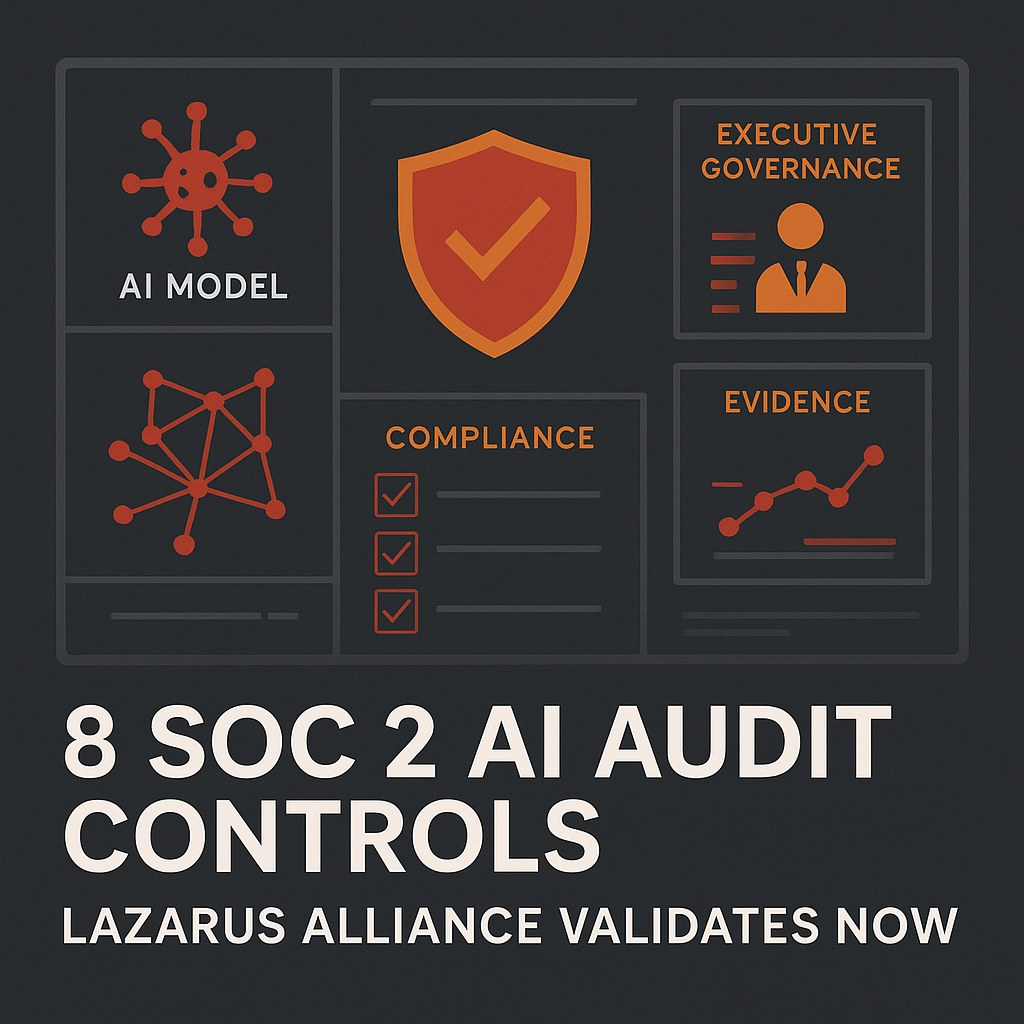
8 SOC 2 AI Audit Controls Lazarus Alliance Validates Now
1. AI System Inventory, System Description, and Control Ownership
Audit question: Can management identify every AI capability that is in scope for the SOC 2 system and explain how it supports services, customers, data flows, and Trust Services Criteria?
The first AI governance control is an inventory that distinguishes embedded AI features, internal AI tools, externally hosted models, retrieval-augmented generation pipelines, automated decision engines, and AI-enabled security tools. In SOC 2 readiness, Lazarus Alliance validates whether the inventory ties to the system description, architecture diagrams, data classifications, subprocessors, access paths, and risk owners.
Implementation detail matters. A strong inventory should include the model or service name, business purpose, data categories processed, user groups, hosting environment, vendor dependency, criticality, human reviewer role, logging source, output consumers, and decommissioning status. NIST AI RMF describes AI risk management through Govern, Map, Measure, and Manage functions, which provides a useful structure for documenting accountability and risk context NIST, AI Risk Management Framework.
Common pitfall: teams list only customer-facing AI products and omit internal copilots used by engineering, support, sales, or security operations. That gap can undermine confidentiality, privacy, and change-management assertions during a SOC 2 audit.
2. AI Risk Assessment Mapped to Trust Services Criteria
Audit question: Has management assessed AI risks in a way that maps to SOC 2 control objectives and enterprise risk decisions?
Lazarus Alliance validates that AI risk assessments are not generic questionnaires. A useful SOC readiness assessment evaluates threats such as prompt injection, training data leakage, model inversion, data poisoning, excessive agency, insecure plugin use, biased automated outcomes, inappropriate retention, dependency failure, and unauthorized model changes. Each risk should map to control activities, monitoring procedures, and residual-risk acceptance.
This approach aligns with broader governance expectations. NIST SP 800-100 Rev. 1, currently in draft, structures executive cybersecurity leadership around CSF 2.0 concepts such as governance, risk management, awareness and training, incident response, configuration management, and continuous monitoring, with comments open from Oct. 12, 2026 to Dec. 4, 2026 NIST, Draft SP 800-100 Revision 1 Information Security Handbook. The same governance logic applies to AI in SOC 2: management must demonstrate that risk decisions are intentional, approved, and monitored.
Evidence Lazarus Alliance expects: AI risk register, risk-rating methodology, Trust Services Criteria mapping, approvals, exception records, compensating controls, and remediation plans. Continuum GRC’s 2026 AI Governance Benchmark Report is a useful resource for organizations comparing AI governance program maturity across organizations Continuum GRC, 2026 AI Governance Benchmark Report.
3. Training Data, Retrieval Data, and Sensitive Data Governance
Audit question: Are the data sets used by AI systems authorized, classified, minimized, protected, and traceable?
AI governance controls should separate three data categories: training data, retrieval data, and prompt or interaction data. Training data may be curated for model development. Retrieval data may include indexed customer documents or knowledge bases. Prompt data may include user-submitted content, secrets, regulated data, or confidential business context. SOC 2 evidence should prove that management knows which data category is involved and what safeguards apply.
For regulated environments, the same AI data discipline supports other audits. HIPAA technical and administrative safeguards apply to electronic protected health information under the Security Rule eCFR, 45 CFR Part 164 Subpart C. DFARS 252.204-7019 requires applicable offerors to have a current NIST SP 800-171 assessment not more than three years old unless a solicitation specifies a shorter period, with summary scores posted in SPRS for covered contractor information systems relevant to the offer Acquisition.gov, DFARS 252.204-7019. LADMF access requires certification under 15 CFR Part 1110, and 15 CFR 1110.101 requires a written attestation from an Accredited Conformity Assessment Body based on a review or assessment conducted no more than three years before submission eCFR, 15 CFR 1110.101.
Implementation steps: classify AI-accessible data, prohibit secrets in prompts, tokenize or redact sensitive fields, document retention rules, restrict indexing jobs, log retrieval activity, and test whether role-based access applies equally to AI-mediated access.
4. Prompt, Input, Output, and Abuse-Case Security Controls
Audit question: Can the organization prevent, detect, and respond to malicious or unauthorized AI interactions?
Prompt manipulation and data poisoning are explicitly part of the proposed SOC 2 modernization discussion CPA Practice Advisor, AICPA Proposes SOC 2 Trust Services Criteria Update. In practical audits, Lazarus Alliance looks for abuse-case testing: prompt injection attempts, jailbreak scenarios, malicious file ingestion, adversarial retrieval content, unauthorized tool invocation, and attempts to elicit confidential data.
Security teams should treat AI interaction layers as application attack surfaces. Controls include input validation, content filtering, output encoding, source attribution, retrieval allowlists, tool permission boundaries, session isolation, rate limiting, secrets detection, and red-team test cases. Where AI connects to code repositories, ticketing systems, cloud consoles, or customer records, tool execution should require explicit authorization and should be logged.
Auditor-ready evidence: AI abuse-case test plans, test results, remediation tickets, secure design reviews, model or prompt version history, security sign-off, and production monitoring alerts. The best evidence shows repeatability, not a one-time demonstration.
5. AI Model Change Management and Release Validation
Audit question: Are AI model, prompt, policy, retrieval, and tool changes approved, tested, segregated, and reversible?
AI change management is broader than traditional software deployment. A material AI change may be a new model version, a system prompt update, a modified embedding pipeline, a new retrieval corpus, a vendor model replacement, a fine-tuning data change, or a new autonomous tool permission. Lazarus Alliance validates whether organizations define what constitutes a material AI change and whether those changes follow documented approval workflows.
Control design should require pre-release risk review, test coverage for security and expected behavior, privacy review where sensitive data is processed, rollback procedures, release notes, and post-deployment monitoring. NIST SP 800-53 CM-3 addresses configuration change control, while NIST SP 800-53 SI-4 addresses system monitoring, both of which are relevant when AI behavior changes can alter system risk NIST, SP 800-53 CM-3 Configuration Change Control NIST, SP 800-53 SI-4 System Monitoring.
Example: a SaaS provider adds retrieval-augmented generation to customer support. A weak process only approves the application code. A strong process approves the retrieval index source, customer-data filtering, prompt template, model endpoint, output disclaimer, access roles, monitoring thresholds, and rollback plan.
6. Human Oversight, Automated Decisioning, and AI Output Transparency
Audit question: Do users and customers know when AI is involved, and are high-impact decisions subject to appropriate human oversight?
The proposed SOC 2 update highlights transparency of AI-generated outputs and automated decision-making CPA Practice Advisor, AICPA Proposes SOC 2 Trust Services Criteria Update. For SOC 2, transparency is not marketing language; it is a control. Organizations need defined points where human review is mandatory, where AI recommendations may be accepted automatically, and where AI is prohibited.
Lazarus Alliance validates policies for human-in-the-loop review, user notifications, customer disclosures, override procedures, exception tracking, complaint handling, and quality sampling. The control should be risk-tiered. A grammar suggestion tool may need lightweight review. A fraud, hiring, credit, healthcare, or access-approval model may need formal decision governance, documented review criteria, and periodic fairness or accuracy assessment.
Common misconception: adding a disclaimer that output may be inaccurate does not replace control design. Auditors will look for operational evidence that users are trained, reviewers are assigned, exceptions are resolved, and management monitors output quality.
7. AI Logging, Monitoring, Drift Detection, and Incident Response
Audit question: Can the organization reconstruct AI activity, detect unsafe behavior, and respond to AI-related incidents?
AI systems generate audit-relevant events: prompts, outputs, retrieval sources, model versions, tool calls, policy blocks, administrator changes, fine-tuning jobs, failed authorization attempts, and escalations. Lazarus Alliance validates whether logs are complete enough to support investigations while also protecting sensitive prompt content.
Monitoring should cover performance drift, security events, data leakage indicators, toxicity or policy-violation rates, hallucination trends, unauthorized data access, vendor outages, and anomalous tool execution. Incident response playbooks should explicitly address AI events such as sensitive prompt exposure, poisoned retrieval content, compromised model credentials, unsafe automated action, or unauthorized model substitution.
Why this matters: Verizon’s 2026 Data Breach Investigations Report analyzed 31,861 security incidents and 22,625 confirmed data breaches; the report found that 31% of breaches began with vulnerability exploitation, 48% involved ransomware, 48% involved a third party, 62% involved the human element, and the median full remediation time for KEV vulnerabilities was 43 days Verizon, 2026 Data Breach Investigations Report. AI expands those same exposure paths if logging and response are incomplete.
Evidence to retain: log schemas, sample logs, alert rules, incident tickets, tabletop exercises, drift reports, vendor status records, and root-cause analyses.
8. AI Vendor Risk Management and Subservice Organization Evidence
Audit question: Does vendor risk management cover AI providers, model platforms, data processors, embedded AI features, and downstream subprocessors?
Vendor risk management is now central to SOC 2 AI governance. AI vendors can host models, process prompts, retain interaction data, train on customer content, provide embeddings, moderate outputs, or execute tools inside customer environments. Lazarus Alliance validates that vendor due diligence includes AI-specific security, privacy, availability, incident response, data use, retention, subprocessors, model-change notification, and audit-right evidence.
Third-party AI risk should also align with multi-framework obligations. The CMMC rule describes a four-phase implementation approach for defense contractors under 32 CFR Part 170 eCFR, 32 CFR Part 170. PCI DSS v4.0.1 is a limited revision intended to address stakeholder feedback and questions after PCI DSS v4.0 was published PCI Security Standards Council, PCI DSS. GovRAMP opened public comment on RFC GR-2601 for a proposed FedRAMP 20x Delta Assessment to align FedRAMP 20x and GovRAMP security verification requirements, with comments open through Dec. 4, 2026 at 5 p.m. ET GovRAMP, Proposed 20x Delta Assessment. For CJIS, the FBI CJIS Security Policy v6.1 does not mandate a specific cloud provider, FedRAMP level, or deployment model, and compliance is assessed through the applicable state CJIS Systems Agency AWS Public Sector Blog, CJIS RAG Architecture and Policy v6.1.
Lazarus Alliance helps organizations harmonize these expectations through services such as DFARS NIST 800-171 audit support, PCI DSS assessments, and CJIS assessments. The practical objective is to avoid asking the same AI vendor question in ten different formats while still preserving framework-specific evidence.
A Lazarus Alliance SOC Readiness Decision Matrix for AI Controls
Use this decision matrix before the formal SOC 2 audit window opens:
- If AI processes customer confidential data: require data-flow diagrams, encryption evidence, retention rules, access reviews, prompt logging controls, and vendor data-use restrictions.
- If AI produces customer-visible output: require output transparency, quality monitoring, complaint handling, reviewer workflows, and customer disclosure language.
- If AI triggers actions: require tool permission boundaries, segregation of duties, approval thresholds, rollback procedures, and incident response runbooks.
- If AI supports regulated workloads: map evidence to HIPAA, PCI DSS, CJIS, DFARS NIST 800-171, CMMC, IRS 1075, FedRAMP, GovRAMP, C5, ISO 27001, or LADMF requirements as applicable.
- If AI depends on a vendor: collect contracts, SOC reports if available, security documentation, subprocessor lists, model-change notices, incident SLAs, and data-retention commitments.
What CISOs and Compliance Leaders Should Do Next
First, update the SOC 2 system description to identify AI services, dependencies, data flows, and user responsibilities. Second, perform an AI governance control gap assessment before the audit period begins. Third, integrate AI evidence into existing SOC readiness repositories rather than building isolated evidence folders. Fourth, test AI abuse cases, change workflows, and incident response playbooks before customer questionnaires arrive.
The organizations that will move fastest are the ones that treat SOC 2 AI governance as a modernization of trustworthy operations, not as an add-on. Lazarus Alliance validates the control design, operating evidence, and cross-framework mappings that help organizations answer customer due diligence questions with confidence.
Sources and References
- AICPA & CIMA, SOC Suite of Services
- CPA Practice Advisor, AICPA Proposes Update of SOC 2 Trust Services Criteria
- Lazarus Alliance, SOC 1 and SOC 2 Audit Services
- Continuum GRC, AI Governance & Risk
- NIST CSRC, SP 800-221 Rev. 1 Initial Public Draft
- FedRAMP, Memo to Milestone
- NIST, AI Risk Management Framework
- NIST, Draft SP 800-100 Revision 1 Information Security Handbook
- Continuum GRC, 2026 AI Governance Benchmark Report
- eCFR, 45 CFR Part 164 Subpart C
- Acquisition.gov, DFARS 252.204-7019
- eCFR, 15 CFR 1110.101
- NIST, SP 800-53 CM-3 Configuration Change Control
- NIST, SP 800-53 SI-4 System Monitoring
- Verizon, 2026 Data Breach Investigations Report
- eCFR, 32 CFR Part 170
- PCI Security Standards Council, PCI DSS
- GovRAMP, Proposed 20x Delta Assessment
- AWS Public Sector Blog, Building a RAG Architecture to Support CJIS Compliance
- Lazarus Alliance, DFARS NIST 800-171 Audit Support
- Lazarus Alliance, PCI DSS Assessments
- Lazarus Alliance, CJIS Assessments
About Lazarus Alliance
To learn more about how Lazarus Alliance can help, contact us.
- FedRAMP
- GovRAMP
- NIST 800-53
- DFARS NIST 800-171
- CMMC
- SOC 1 & SOC 2
- C5
- HIPAA, HITECH, & Meaningful Use
- PCI DSS RoC & SAQ
- IRS 1075 & 4812
- CJIS
- LA DMF
- ISO 27001, ISO 27002, ISO 27005, ISO 27017, ISO 27018, ISO 27701, ISO 22301, ISO 17020, ISO 17021, ISO 17025, ISO 17065, ISO 9001, & ISO 90003
- And dozens more!
Related Posts