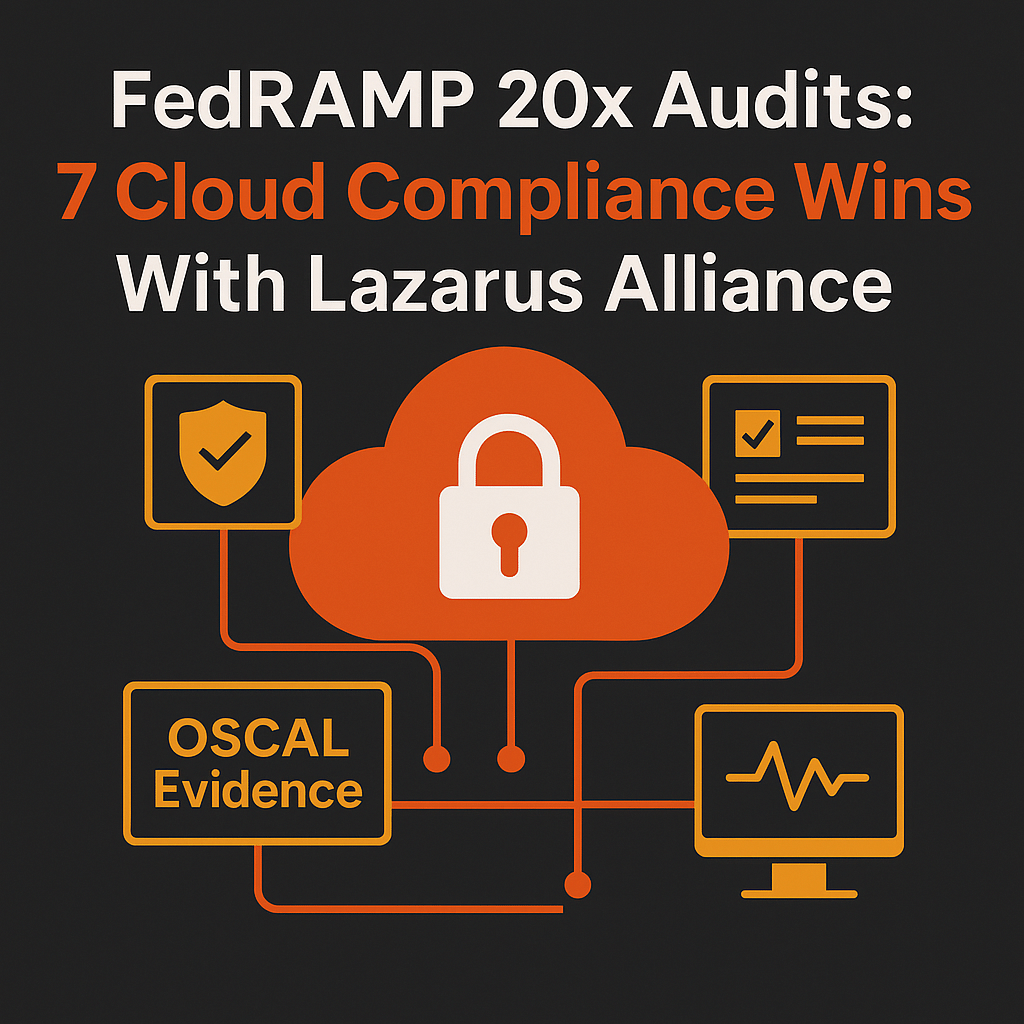
FedRAMP 20x Is Not a Shortcut; It Is an Auditability Upgrade
FedRAMP 20x changes the center of gravity for federal cloud authorization. The winning cloud service providers will not be the ones with the largest static documentation package. They will be the ones that can prove, continuously and in machine-readable form, that their cloud compliance controls are designed correctly, operating effectively, and mapped to customer risk.
According to the FedRAMP PMO, the program issued 92 new FedRAMP Certifications in FY2026, including 66 Rev5 and 26 FedRAMP 20x Certifications; FedRAMP also reported 538 FedRAMP Certified cloud service offerings, 71 service offerings on the new Initial Implementation listing, and 760 new agency ATOs or ATUs FedRAMP PMO, From Foundation to Implementation. FedRAMP has also stated that it will stop processing legacy FedRAMP Rev5 certification applications on June 11, 2027 and that FY2027 goals include bringing 100% coverage of FedRAMP certification options into the FedRAMP 20x umbrella FedRAMP PMO, FedRAMP.gov.
That creates a practical board-level question: can your cloud environment survive continuous validation, or is your audit evidence still assembled manually during a deadline scramble? Lazarus Alliance helps cloud providers, SaaS companies, government contractors, and regulated enterprises answer that question through FedRAMP readiness, NIST 800-53 control assessment, evidence validation, risk management, and compliance assessments aligned to real assessor expectations Lazarus Alliance, FedRAMP Services.
What Is FedRAMP 20x Continuous Cloud Assurance?
FedRAMP 20x is the program’s move toward automated, continuous cloud assurance. In practical audit terms, it emphasizes repeatable validation, Key Security Indicators, machine-readable evidence, inherited control clarity, and ongoing monitoring instead of a one-time document-heavy review. The FedRAMP community’s Class D cloud-hosted pilot requirements show the direction of travel: authorization classes, automation expectations, and evidence structures are becoming more explicit FedRAMP Community, RFC-0036 FedRAMP 20x Class D Cloud-Hosted Pilot Requirements.
OSCAL evidence is central to this shift. NIST describes OSCAL as the Open Security Controls Assessment Language, a machine-readable format for representing control catalogs, system security plans, assessment plans, assessment results, and plans of action and milestones NIST, Open Security Controls Assessment Language. For CISOs and compliance officers, OSCAL is not just a file format. It is an operating model for keeping the SSP, control implementation statements, diagrams, inventories, test results, and remediation data synchronized.
Expert perspective: FedRAMP 20x does not eliminate audit judgment. It changes where judgment is applied. Assessors will spend less time chasing PDFs and more time determining whether automation is trustworthy, whether evidence is complete, whether inherited controls are justified, and whether risk decisions are defensible.
7 Cloud Compliance Wins With Lazarus Alliance
1. Turn OSCAL Evidence Into an Audit-Ready System of Record
The first FedRAMP 20x win is replacing spreadsheet-based evidence collection with a structured evidence architecture. NIST OSCAL supports machine-readable system security plans, assessment plans, assessment results, and POA&M artifacts NIST, OSCAL Project. That means a control such as access account management can be linked to identity-provider configuration, privileged-access reviews, ticket evidence, HR termination feeds, and cloud IAM logs.
NIST SP 800-53 AC-2 addresses account management, including account authorization, monitoring, disabling, and removal expectations NIST, SP 800-53 Rev. 5. In a FedRAMP 20x-ready program, AC-2 evidence should not be a policy plus a screenshot. It should include authoritative user sources, automated deprovisioning workflow evidence, privileged account recertification results, exception approvals, and log-based confirmation that disabled accounts cannot authenticate.
- Implementation step: Build an OSCAL evidence map that connects each control to system components, data owners, evidence sources, refresh frequency, and control owner attestations.
- Common pitfall: Treating OSCAL as a document-conversion project rather than a control-evidence engineering project.
Lazarus Alliance reviews whether the evidence architecture supports assessor testing, continuous monitoring, and cross-framework reuse across FedRAMP, NIST 800-53, SOC 2, ISO 27001, CMMC, PCI DSS, HIPAA, CJIS, IRS 1075, C5, GovRAMP, and LADMF.
2. Make Continuous Monitoring Measurable, Not Aspirational
FedRAMP 20x readiness depends on proving that continuous monitoring is operating, not merely documented. NIST SP 800-53 CA-7 addresses continuous monitoring, including ongoing assessment of control effectiveness and security posture NIST, SP 800-53 Rev. 5. SI-4 addresses system monitoring, including detection of attacks, indicators of compromise, and unauthorized activity NIST, SP 800-53 Rev. 5.
A mature continuous monitoring program includes defined Key Security Indicators such as vulnerability age, encryption coverage, endpoint telemetry health, privileged access exceptions, failed MFA events, audit-log ingestion rates, unresolved high-risk configuration drift, and incident-response SLA performance. These indicators should have thresholds, owners, escalation paths, and evidence retention rules.
Consider a SaaS provider running a moderate-impact multi-tenant platform. A conventional readiness effort might collect monthly vulnerability scans and quarterly access reviews. A FedRAMP 20x-ready model instead validates daily cloud configuration drift, near-real-time vulnerability ingestion, ticket-based remediation proof, automated SSP impact tagging, and risk acceptance approvals for unresolved findings.
- Implementation step: Define KSI thresholds for each security domain, then test whether alerts create tickets, tickets drive remediation, and remediation evidence updates the compliance record.
- Common pitfall: Measuring activity volume rather than control effectiveness. Ten dashboards do not equal assurance if no one owns exceptions.
3. Reduce Assessment Friction With Control Inheritance Clarity
Cloud compliance fails when inherited controls are vague. FedRAMP packages must make clear which controls are implemented by the cloud service provider, which are inherited from the underlying infrastructure, which are customer responsibilities, and which are shared. NIST SP 800-53 SA-9 addresses external system services and requires organizations to manage controls for services provided by external parties NIST, SP 800-53 Rev. 5.
Inheritance analysis should be technical. For example, if a SaaS provider inherits physical security from an IaaS provider, that inheritance may be valid only for the data center layer. The SaaS provider still owns tenant isolation, identity federation, application logging, vulnerability remediation, encryption configuration, backup validation, incident notification, and secure software delivery. In assessor interviews, vague phrases such as “covered by AWS” or “handled by the platform” often create avoidable findings.
- Implementation step: Create a shared-responsibility matrix at the control-objective level, not merely at the service-category level.
- Common pitfall: Assuming inherited controls automatically satisfy agency customer requirements without validating scope, region, service configuration, and evidence availability.
Lazarus Alliance NIST 800-53 and FISMA audit services help organizations validate control ownership, documentation precision, and assessor-ready implementation statements before a formal review begins Lazarus Alliance, FISMA and NIST Audit Services.
4. Use One Evidence Model Across FedRAMP, CMMC, SOC 2, PCI DSS, HIPAA, CJIS, IRS 1075, C5, GovRAMP, and ISO 27001
The fourth win is avoiding framework-by-framework duplication. FedRAMP 20x cloud compliance evidence can become the anchor for multiple audits when control mappings are engineered carefully. For defense contractors, DFARS 252.204-7021 requires contractors to have and maintain the required CMMC status for applicable systems and requires annual affirmation of continuous compliance in SPRS for each applicable CMMC UID eCFR, DFARS 252.204-7021. NIST SP 800-171 Rev. 3 defines security requirements for protecting Controlled Unclassified Information in nonfederal systems NIST, SP 800-171 Rev. 3.
Payment environments add another layer. PCI DSS v4.0.1 documentation remains available through the PCI Security Standards Council, and audit readiness commonly depends on segmentation, vulnerability management, MFA, logging, service-provider oversight, and payment-page security evidence PCI Security Standards Council, PCI DSS v4.0.1 Documents. Healthcare environments must account for HIPAA Security Rule administrative, physical, and technical safeguards under 45 CFR Part 164 Subpart C eCFR, HIPAA Security Rule. Criminal justice data requires CJIS Security Policy alignment through the FBI CJIS Security Policy Resource Center FBI, CJIS Security Policy Resource Center. Federal tax information programs must address IRS Publication 1075 safeguards IRS, Publication 1075.
- Implementation step: Establish a common control library that maps each evidence object to all applicable obligations, including FedRAMP, SOC 2 Trust Services Criteria, CMMC, HIPAA, PCI DSS, CJIS, IRS 1075, GovRAMP, C5, LADMF, and ISO 27001.
- Common pitfall: Copying one control statement into every framework without tailoring test procedures, scope, sampling, and evidence retention.
5. Strengthen Risk Management Before the Assessor Finds the Risk
FedRAMP 20x rewards organizations that can show active risk management. NIST SP 800-53 RA-5 addresses vulnerability monitoring and scanning, while PM-9 addresses risk management strategy NIST, SP 800-53 Rev. 5. A defensible program links technical findings to risk decisions: exploitability, asset criticality, data sensitivity, exposure, compensating controls, remediation deadlines, and executive acceptance.
External threat data reinforces why this matters. Verizon’s 2026 Data Breach Investigations Report analyzed more than 22,000 confirmed breaches; it reported vulnerability exploitation as the initial access vector in 31% of breaches with known initial access, ransomware involvement in 48% of breaches, and third-party involvement in 48% of breaches Verizon, 2026 Data Breach Investigations Report.
For a cloud provider, that means vulnerability management cannot end with a scanner export. Lazarus Alliance looks for asset-scanner coverage reconciliation, authenticated scan quality, container image scanning, infrastructure-as-code testing, dependency risk, runtime exposure, compensating control evidence, and timely POA&M updates.
- Implementation step: Build a risk register that automatically associates vulnerabilities with affected services, FedRAMP controls, customer impact, remediation tickets, and POA&M entries.
- Common pitfall: Treating all high-severity findings equally while ignoring internet exposure, exploit maturity, tenant data concentration, and business-critical dependencies.
6. Prove Governance, Not Just Technical Configuration
Audit failures often originate in governance gaps. NIST Cybersecurity Framework 2.0 organizes cybersecurity outcomes around Govern, Identify, Protect, Detect, Respond, and Recover, and NIST states that the framework is voluntary guidance for managing cybersecurity risk NIST, Cybersecurity Framework. The practical implication is clear: boards and executives need risk appetite, accountability, supplier-risk oversight, policy direction, and measurable reporting.
In FedRAMP 20x readiness, governance evidence includes control-owner appointment records, risk committee minutes, policy exception decisions, supplier reviews, incident tabletop results, audit committee reporting, remediation governance, and change-control approvals. NIST SP 800-53 IR-6 addresses incident reporting, AU-6 addresses audit record review, and CM-6 addresses configuration settings NIST, SP 800-53 Rev. 5.
Continuum GRC’s 2026 Audit Readiness Benchmark Report examines audit readiness as an operational discipline, and Lazarus Alliance uses this same operating philosophy when helping organizations move from episodic compliance to continuous control assurance Continuum GRC, 2026 Audit Readiness Benchmark Report.
- Implementation step: Create an executive control dashboard that reports KSI status, accepted risk, overdue remediation, third-party exceptions, incident trends, and audit evidence completeness.
- Common pitfall: Presenting governance as policy ownership only. Assessors expect proof that governance changes operational outcomes.
7. Automate Readiness Without Automating Bad Assumptions
Automation is essential, but unvalidated automation creates false confidence. A FedRAMP 20x audit should test whether automation is complete, accurate, authorized, and resilient. Evidence pipelines should be version-controlled, access-controlled, monitored, and reconciled against authoritative sources.
Continuum GRC is a FedRAMP-authorized GRC platform with the A.ITAM AI auditor, supporting risk management, compliance operations, and evidence workflows for organizations that need scalable control assurance Continuum GRC, GRC Platform. The important point is not that automation replaces auditors. It is that automation gives auditors stronger, fresher, and more traceable evidence when implemented correctly.
AI-related systems add urgency. IBM reports that roughly 21% of enterprise security incidents involve an AI model or application and that AI-related security incidents cost organizations an average of USD 5.33 million IBM, AI Workload Security. For cloud providers using AI in customer support, DevSecOps, detection engineering, or GRC workflows, evidence should address data leakage controls, model access, prompt-injection defenses, vendor AI risk, logging, human review, and incident response.
- Implementation step: Validate automation outputs through sampling, source-system reconciliation, permission review, and exception testing before relying on them in an assessment.
- Common pitfall: Assuming a tool-generated artifact is audit evidence. Evidence must still prove the control objective for the defined system boundary.
A Practical FedRAMP 20x Readiness Decision Matrix
Use this decision matrix before committing to a FedRAMP 20x path:
- System boundary: Are all services, APIs, management planes, CI/CD systems, data stores, and support tools included or explicitly excluded with justification?
- Evidence freshness: Can high-risk evidence refresh continuously or on a defined cadence tied to control criticality?
- OSCAL maturity: Are SSP, assessment, POA&M, inventory, and implementation statements structured for machine-readable exchange?
- Control inheritance: Are inherited, shared, provider-owned, and customer-owned controls documented at the control-objective level?
- Monitoring quality: Are KSIs actionable, threshold-based, owned, and tied to remediation workflows?
- Risk governance: Are exceptions approved by accountable leaders, time-bound, and supported by compensating control evidence?
- Cross-framework leverage: Can the same evidence support FedRAMP, NIST 800-53, SOC 2, CMMC, PCI DSS, HIPAA, CJIS, IRS 1075, C5, GovRAMP, LADMF, and ISO 27001 without uncontrolled duplication?
If the answer to any of these questions is uncertain, a readiness assessment is the safest next step. Lazarus Alliance combines cybersecurity audits, compliance assessments, technical testing, risk management review, evidence validation, and executive advisory support to help organizations prepare before an assessor, agency sponsor, customer, or regulator asks harder questions.
How Lazarus Alliance Helps You Win Under FedRAMP 20x
Lazarus Alliance brings an assessor-minded approach to FedRAMP 20x readiness. Our methodology starts with scoping and data-flow validation, then moves into control mapping, inherited-control analysis, OSCAL evidence design, continuous monitoring validation, vulnerability and configuration review, risk register assessment, POA&M quality review, and executive readiness reporting.
For organizations pursuing multiple audits, Lazarus Alliance also supports SOC 1 and SOC 2 readiness and reporting alignment, helping teams rationalize control evidence and reduce redundant audit requests Lazarus Alliance, SOC 1 and SOC 2 Services. The result is not just a cleaner FedRAMP package. It is a more defensible cloud compliance operating model.
Bottom line: FedRAMP 20x favors organizations that can prove security continuously. The seven wins are OSCAL-ready evidence, measurable continuous monitoring, precise inheritance, multi-framework leverage, mature risk management, executive governance, and trustworthy automation. Together, they turn compliance from a project into a cloud assurance capability.
Sources and References
- FedRAMP PMO, From Foundation to Implementation: Scaling a Better Path to Cloud Security
- FedRAMP PMO, FedRAMP.gov
- FedRAMP Community, RFC-0036 FedRAMP 20x Class D Cloud-Hosted Pilot Requirements
- NIST, Open Security Controls Assessment Language
- NIST, Security and Privacy Controls for Information Systems and Organizations, SP 800-53 Rev. 5
- NIST, Protecting Controlled Unclassified Information in Nonfederal Systems and Organizations, SP 800-171 Rev. 3
- eCFR, DFARS 252.204-7021 Contractor Compliance With the Cybersecurity Maturity Model Certification Level Requirements
- PCI Security Standards Council, PCI DSS v4.0.1 Documents
- eCFR, HIPAA Security Rule, 45 CFR Part 164 Subpart C
- FBI, CJIS Security Policy Resource Center
- IRS, Publication 1075
- NIST, Cybersecurity Framework
- Verizon, 2026 Data Breach Investigations Report
- IBM, AI Workload Security
- Lazarus Alliance, FedRAMP Services
- Lazarus Alliance, FISMA and NIST Audit Services
- Lazarus Alliance, SOC 1 and SOC 2 Services
- Continuum GRC, 2026 Audit Readiness Benchmark Report
- Continuum GRC, GRC Platform
About Lazarus Alliance
To learn more about how Lazarus Alliance can help, contact us.
- FedRAMP
- GovRAMP
- NIST 800-53
- DFARS NIST 800-171
- CMMC
- SOC 1 & SOC 2
- C5
- HIPAA, HITECH, & Meaningful Use
- PCI DSS RoC & SAQ
- IRS 1075 & 4812
- CJIS
- LA DMF
- ISO 27001, ISO 27002, ISO 27005, ISO 27017, ISO 27018, ISO 27701, ISO 22301, ISO 17020, ISO 17021, ISO 17025, ISO 17065, ISO 9001, & ISO 90003
- And dozens more!
Related Posts