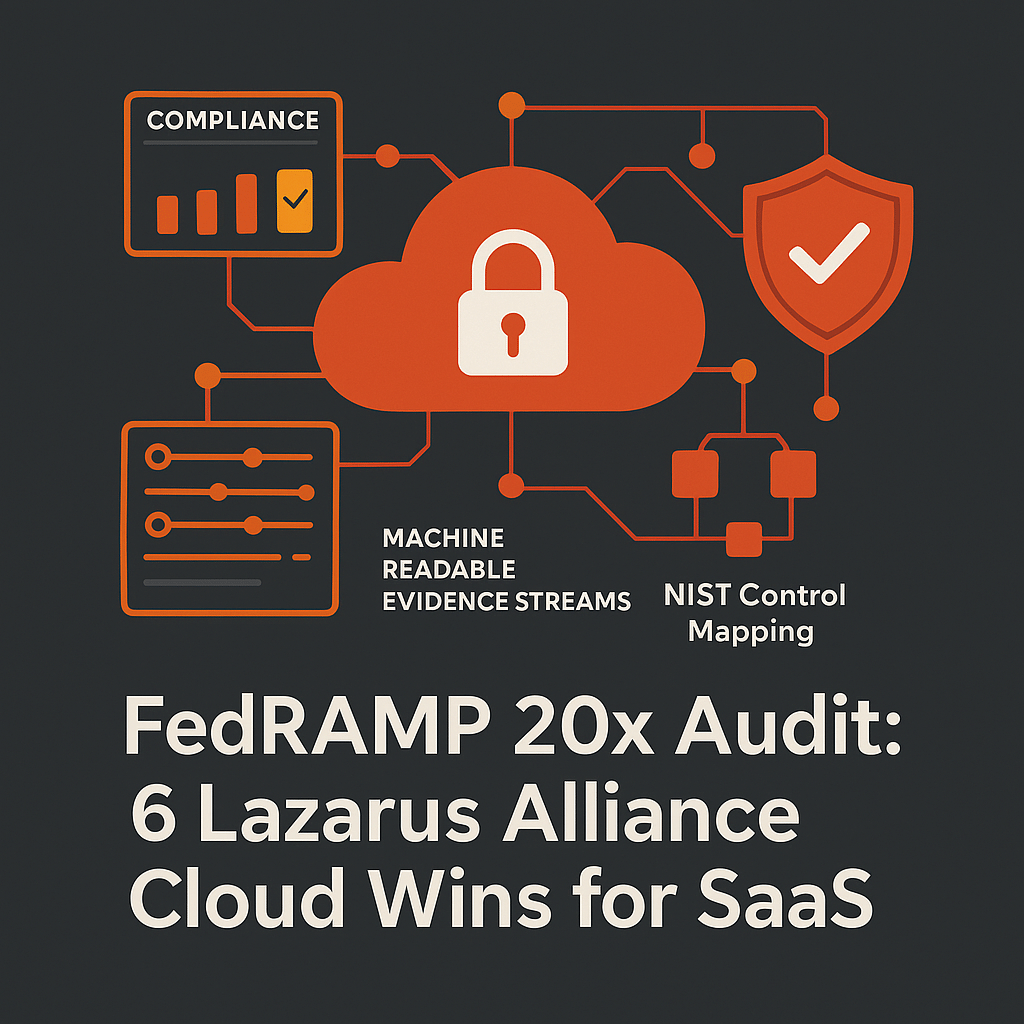
FedRAMP 20x is not simply a faster audit lane; it is a forcing function for evidence engineering. SaaS providers that treat it as a document-submission exercise will recreate the same bottlenecks with newer labels. Providers that redesign control ownership, telemetry, and machine-readable evidence around NIST 800-53 will be better positioned for federal cloud authorization, GovRAMP, SOC 2, CMMC, CJIS, PCI DSS, HIPAA, IRS 1075, ISO 27001, C5, and LA DMF evidence reuse.
According to the FedRAMP PMO, FedRAMP 20x was launched to modernize cloud authorization after OMB’s modernization direction, reduce assessment burden, remove agency sponsorship barriers, encourage automation, and transition toward machine-readable interactions; FedRAMP also reported that 26 companies received limited pilot certifications and announced the first full FedRAMP 20x Class C Certification in 2026 FedRAMP PMO, Memo to Milestone. For SaaS executives, the practical takeaway is clear: authorization strategy now depends as much on data architecture and evidence pipelines as on policy binders.
FedRAMP 20x Strategy Starts with Evidence Architecture
FedRAMP 20x changes the audit conversation from ‘Can you produce the artifact?’ to ‘Can your control environment produce trustworthy evidence repeatedly, consistently, and in a format reviewers can consume?’ FedRAMP Automate already supports machine-readable system security plan, assessment, and continuous monitoring package concepts through OSCAL-aligned automation resources FedRAMP, FedRAMP Automate. NIST’s Open Security Controls Assessment Language, or OSCAL, is designed to represent security control catalogs, profiles, implementation information, assessment plans, assessment results, and plans of action in structured formats NIST, OSCAL.
That means a SaaS compliance assessment should begin with an evidence architecture diagram. Map where each control assertion originates: identity provider logs, cloud configuration state, ticketing workflows, vulnerability scanners, endpoint telemetry, CI/CD security gates, encryption key management systems, backup platforms, incident response records, and risk register approvals. Then map each evidence object to the FedRAMP control baseline, NIST 800-53 control family, responsible owner, collection frequency, integrity check, retention location, and assessor review procedure.
Lazarus Alliance’s FedRAMP audit and readiness work focuses on this operating model: evidence is not a last-minute scramble; it is an engineered product of the security program Lazarus Alliance, FedRAMP Services. The cloud win is not merely passing a point-in-time review. The win is building a control system that can withstand federal scrutiny, customer due diligence, continuous monitoring, and cross-framework reporting without duplicating effort.
Win 1: Turn NIST 800-53 into the SaaS Control Spine
NIST SP 800-53 Rev. 5 provides the security and privacy control catalog used across federal risk management, including controls for access control, audit and accountability, configuration management, incident response, risk assessment, system and communications protection, and supply chain risk management NIST, SP 800-53 Rev. 5. For SaaS providers, the first FedRAMP 20x audit win is to stop managing every framework as a separate spreadsheet and instead use NIST 800-53 as a control spine.
For example, AC-2 addresses account management, IA-2 addresses identification and authentication, AU-6 addresses audit record review, CM-2 addresses baseline configuration, CM-6 addresses configuration settings, RA-5 addresses vulnerability monitoring and scanning, IR-4 addresses incident handling, CP-9 addresses system backup, SC-13 addresses cryptographic protection, and SI-2 addresses flaw remediation NIST, SP 800-53 Rev. 5. A mature SaaS provider does not ask whether it has separate evidence for FedRAMP, SOC 2, ISO 27001, HIPAA, PCI DSS, CJIS, CMMC, and GovRAMP. It asks whether one tested control activity can satisfy multiple assurance obligations with the right scoping and evidence labels.
Consider access reviews. A single quarterly privileged-access review can support FedRAMP AC-2 evidence, SOC 2 security criteria, ISO 27001 access-control expectations, HIPAA access management, PCI DSS access governance, and CJIS account-management expectations if the population is complete, reviewers are qualified, exceptions are tracked to closure, and reviewer sign-off is retained. The audit failure usually is not that the SaaS company lacks access control. The failure is that the evidence cannot prove population completeness, review independence, exception remediation, and operating effectiveness.
Lazarus Alliance aligns NIST 800-53 and FISMA audit readiness around control traceability, assessment procedures, and evidence sufficiency, helping teams convert technical operations into defensible audit records Lazarus Alliance, FISMA and NIST Audit Services.
Win 2: Build Machine-Readable Evidence Before the Assessment Window Opens
Machine-readable evidence is structured security information that can be parsed, validated, exchanged, and reused without manual interpretation. In a FedRAMP 20x context, it should include metadata such as control ID, system boundary, asset identifier, timestamp, evidence source, collection method, owner, environment, validation status, and exception workflow. OSCAL provides a model for machine-readable control and assessment information NIST, OSCAL, while FedRAMP Automate provides FedRAMP-specific automation resources for packages and continuous monitoring artifacts FedRAMP, FedRAMP Automate.
A practical implementation pattern is to create an evidence lake with four layers. First, collect raw evidence directly from authoritative systems such as cloud APIs, identity providers, SIEM platforms, vulnerability scanners, container registries, endpoint tools, and change-management systems. Second, normalize the evidence into a common schema using control IDs, asset classes, cloud accounts, regions, applications, and data categories. Third, validate integrity with automated checks such as timestamp freshness, control-owner approval, hash verification, system-boundary matching, and exception status. Fourth, publish assessor-ready evidence packets tied to NIST 800-53 assessment objectives.
This is where GRC evidence automation matters. Continuum GRC’s 2026 GRC Automation Benchmark Report examines how organizations structure audit evidence, control ownership, and automation maturity across a research population of 275 organizations Continuum GRC, 2026 GRC Automation Benchmark Report. The larger lesson for SaaS providers is not that automation replaces auditors. It is that automation reduces ambiguity, shortens evidence cycles, and improves control reliability when the data sources are authoritative and the control logic is testable.
Win 3: Use Key Security Indicators as Audit Signals, Not Dashboard Decoration
FedRAMP 20x emphasizes automation and reduced assessment burden, but reduced burden does not mean reduced rigor FedRAMP PMO, Memo to Milestone. SaaS providers should treat Key Security Indicators as audit signals that show whether controls are operating inside risk tolerance. Good indicators are objective, repeatable, mapped to controls, and tied to remediation authority.
Examples include percentage of privileged accounts with phishing-resistant MFA, number of internet-exposed assets without current vulnerability scan coverage, mean age of critical vulnerabilities, percentage of production changes with approved security review, percentage of cloud storage objects encrypted with approved keys, percentage of logs delivered to the SIEM within defined latency, backup restore-test success rate, and number of unresolved high-risk supplier findings. Each metric should have a control mapping, threshold, data source, control owner, and escalation path.
The misconception is that dashboards prove compliance. They do not. Dashboards become audit evidence only when the source data is complete, the calculation method is documented, exceptions are retained, and management acts on threshold breaches. A vulnerability metric, for example, is weak if it excludes ephemeral containers, unmanaged cloud accounts, or third-party-hosted components inside the system boundary. A strong metric ties the asset inventory to scan scope, maps findings to RA-5 and SI-2, links remediation tickets to service-level targets, and preserves exception approvals for assessor review NIST, SP 800-53A Rev. 5.
Win 4: Modernize Continuous Monitoring Around Change Velocity
SaaS environments change continuously. Infrastructure as code, container deployment, feature flags, managed services, and auto-scaling can alter the security posture faster than a traditional audit calendar can observe. FedRAMP continuous monitoring therefore must be engineered into DevSecOps rather than appended after release. FedRAMP provides baseline and continuous monitoring resources for cloud service offerings FedRAMP, Baselines.
A FedRAMP 20x-ready SaaS provider should define change classes: emergency production fixes, standard low-risk changes, infrastructure changes, identity and access changes, cryptographic changes, network exposure changes, data-flow changes, and supplier-dependent changes. Each class should specify required approvals, security tests, evidence artifacts, rollback criteria, and post-implementation monitoring. For example, a change that opens a new external endpoint should trigger automated asset inventory updates, cloud security posture checks, web application testing, logging validation, vulnerability scanning, and boundary documentation review.
Common audit gaps include unapproved infrastructure drift, incomplete change tickets, missing security impact analysis, inconsistent vulnerability exception approvals, and undocumented production hotfixes. The technical fix is policy-as-code combined with evidence-as-code. Require infrastructure-as-code pull requests to include control-impact tags. Enforce cloud configuration rules before deployment. Attach automated test results to change records. Capture the production deployment hash. Then map the evidence to CM-2, CM-3, CM-6, RA-5, SI-2, and AU-12 under NIST 800-53 NIST, SP 800-53 Rev. 5.
Win 5: Reuse Evidence Across FedRAMP, GovRAMP, SOC 2, CMMC, CJIS, PCI DSS, HIPAA, IRS 1075, C5, ISO 27001, and LA DMF
The strongest cloud authorization programs are multi-framework by design. FedRAMP and GovRAMP both rely heavily on NIST-based control thinking for government cloud assurance, while SOC 2 focuses on trust services criteria, ISO 27001 on an information security management system, CMMC and DFARS NIST 800-171 on protection of defense information, CJIS on criminal justice information safeguards, PCI DSS on payment account data, HIPAA on electronic protected health information, IRS 1075 on federal tax information, C5 on cloud security criteria, and LA DMF on deceased master file access controls. Lazarus Alliance supports these domains across FedRAMP, GovRAMP, SOC, CMMC, PCI DSS, HIPAA, CJIS, ISO, C5, IRS 1075, and LA DMF audit services Lazarus Alliance, SOC 1 and SOC 2 Services.
The reuse model requires precision. Do not claim that one artifact satisfies every framework. Instead, classify evidence as reusable, reusable with supplemental context, or framework-specific. Identity provider MFA configuration may be broadly reusable. FedRAMP-specific package metadata may be framework-specific. A PCI DSS payment-page script review may support secure development and third-party script governance, but it still requires PCI scoping and payment-environment context PCI Security Standards Council, PCI DSS.
CMMC also illustrates why scope matters. The eCFR states that contractors must achieve the required CMMC status at time of award and maintain the required status for the life of the contract when the clause applies eCFR, 48 CFR Part 204 Subpart 204.75. NIST SP 800-171 Rev. 3 provides requirements for protecting controlled unclassified information in nonfederal systems and organizations NIST, SP 800-171 Rev. 3. A SaaS provider serving federal civilian agencies, defense contractors, healthcare entities, law-enforcement workflows, and payment use cases should therefore maintain a control-to-obligation matrix that distinguishes federal cloud authorization from contractual defense obligations, privacy obligations, sector-specific data rules, and customer due-diligence assertions.
Win 6: Make Risk Management the Decision Engine, Not the Appendix
Risk management is the executive layer that determines whether FedRAMP 20x modernization produces business value. NIST Cybersecurity Framework 2.0 organizes cybersecurity outcomes under Govern, Identify, Protect, Detect, Respond, and Recover, making governance an explicit cybersecurity function NIST, Cybersecurity Framework. For SaaS providers, that means the authorization strategy should be tied to product roadmap, customer segments, data classification, cloud architecture, supplier dependencies, incident response maturity, and board-level risk appetite.
A practical Lazarus Alliance-style decision matrix asks six questions. First, which federal or regulated markets require authorization or attestation in the next sales cycle? Second, which data types enter the SaaS boundary: federal information, CUI, CJI, payment data, ePHI, federal tax information, personal data, authentication secrets, or AI training data? Third, which inherited cloud controls are relied upon, and where does the SaaS provider retain implementation responsibility? Fourth, which controls generate machine-readable evidence today, and which still depend on interviews or manual screenshots? Fifth, which suppliers can affect confidentiality, integrity, availability, privacy, or authorization status? Sixth, which risks have accepted exceptions, and who has authority to accept them?
Third-party risk is especially important in SaaS. The Verizon Data Breach Investigations Report analyzes a large incident and breach dataset and is widely used by security leaders to understand attack patterns, including risks involving credential abuse, exploitation, ransomware, and third parties Verizon, Data Breach Investigations Report. In audit terms, supplier risk evidence should include vendor inventory, data-flow classification, contract security clauses, SOC report review, penetration-test or vulnerability evidence where appropriate, incident notification terms, access reviews, and exit or continuity planning.
Detailed Walkthrough: A FedRAMP 20x Evidence Sprint for a SaaS Provider
Assume a SaaS provider wants to enter the federal market while also supporting SOC 2 renewal, GovRAMP expansion, CMMC customer flow-downs, and healthcare customer due diligence. The company has strong engineering talent but fragmented compliance evidence. A focused evidence sprint would proceed as follows.
Week one: boundary and data classification. Define the authorization boundary, cloud accounts, production services, management plane, support tooling, CI/CD systems, logging pipeline, identity providers, third-party integrations, and data categories. Tag assets by environment, owner, data sensitivity, exposure, and inherited control dependency. This step prevents the classic mistake of writing a system security plan that does not match the real cloud architecture.
Week two: control and evidence mapping. Build the NIST 800-53 control matrix and map each control to evidence sources. For AC-2, collect user population exports, privileged-access groups, account lifecycle tickets, access review approvals, and termination samples. For AU-6, collect SIEM review procedures, alert triage records, escalation tickets, and management review evidence. For RA-5 and SI-2, connect scan coverage, vulnerability findings, remediation tickets, risk exceptions, and patch deployment validation NIST, SP 800-53A Rev. 5.
Week three: automation and integrity checks. Replace screenshots with API-collected evidence where feasible. Add timestamps, source-system identifiers, collection scripts, and validation rules. Use read-only service accounts, immutable storage, and approval workflows to reduce tampering risk. Convert repetitive evidence requests into repeatable packages aligned to OSCAL concepts where appropriate NIST, OSCAL.
Week four: assessor simulation. Test the package as an assessor would. Select samples, challenge population completeness, compare policy to actual implementation, verify exceptions, trace tickets to production changes, and reconcile cloud configuration to architecture diagrams. The output is not just a gap list; it is a prioritized risk and evidence remediation plan with owners, due dates, and executive reporting.
Common FedRAMP 20x Audit Pitfalls for SaaS Providers
- Confusing automation with assurance. Automated evidence is only useful when the source is authoritative, complete, and mapped to the correct control objective.
- Ignoring inherited control boundaries. Cloud provider inheritance does not remove the SaaS provider’s obligation to configure, monitor, and document customer-responsible controls.
- Overusing generic policies. Policies must match how the SaaS platform actually authenticates users, encrypts data, deploys code, logs events, and handles incidents.
- Failing to prove operating effectiveness. A control design can look excellent while samples reveal missed reviews, late patches, unresolved exceptions, or incomplete ticket evidence.
- Treating FedRAMP as isolated. The same security operating model should support FedRAMP 20x, cloud compliance audit readiness, SOC reporting, CMMC, CJIS, PCI DSS, HIPAA, ISO 27001, C5, IRS 1075, GovRAMP, and risk management.
Executive Takeaways: The 6 Lazarus Alliance Cloud Wins
- Use NIST 800-53 as the control spine so SaaS compliance assessment work is traceable, testable, and reusable.
- Engineer machine-readable evidence using structured metadata, authoritative sources, and OSCAL-aware packaging concepts.
- Turn Key Security Indicators into audit signals with thresholds, owners, escalation paths, and retained remediation records.
- Embed continuous monitoring into DevSecOps so cloud change velocity does not outpace audit evidence.
- Create a multi-framework reuse model that supports FedRAMP, GovRAMP, SOC 2, CMMC, DFARS NIST 800-171, CJIS, PCI DSS, HIPAA, ISO 27001, C5, IRS 1075, and LA DMF.
- Make risk management the decision engine for market entry, authorization scope, supplier oversight, and executive accountability.
FedRAMP 20x rewards SaaS providers that can prove security continuously, not just describe it periodically. Lazarus Alliance cybersecurity audits help organizations move from fragmented artifacts to defensible, machine-readable, risk-informed assurance. The result is a stronger federal cloud authorization strategy and a more scalable compliance operating model for every regulated market the SaaS business serves.
Sources and References
- FedRAMP PMO, Memo to Milestone: FedRAMP Grants the First Full FedRAMP 20x Class C Certification
- FedRAMP, FedRAMP Automate
- FedRAMP, Baselines
- NIST, Open Security Controls Assessment Language
- NIST, SP 800-53 Rev. 5
- NIST, SP 800-53A Rev. 5
- NIST, Cybersecurity Framework
- NIST, SP 800-171 Rev. 3
- eCFR, 48 CFR Part 204 Subpart 204.75
- PCI Security Standards Council, PCI DSS
- Verizon, Data Breach Investigations Report
- Lazarus Alliance, FedRAMP Services
- Lazarus Alliance, FISMA and NIST Audit Services
- Lazarus Alliance, SOC 1 and SOC 2 Services
- Continuum GRC, 2026 GRC Automation Benchmark Report
About Lazarus Alliance
To learn more about how Lazarus Alliance can help, contact us.
- FedRAMP
- GovRAMP
- NIST 800-53
- DFARS NIST 800-171
- CMMC
- SOC 1 & SOC 2
- C5
- HIPAA, HITECH, & Meaningful Use
- PCI DSS RoC & SAQ
- IRS 1075 & 4812
- CJIS
- LA DMF
- ISO 27001, ISO 27002, ISO 27005, ISO 27017, ISO 27018, ISO 27701, ISO 22301, ISO 17020, ISO 17021, ISO 17025, ISO 17065, ISO 9001, & ISO 90003
- And dozens more!
Related Posts