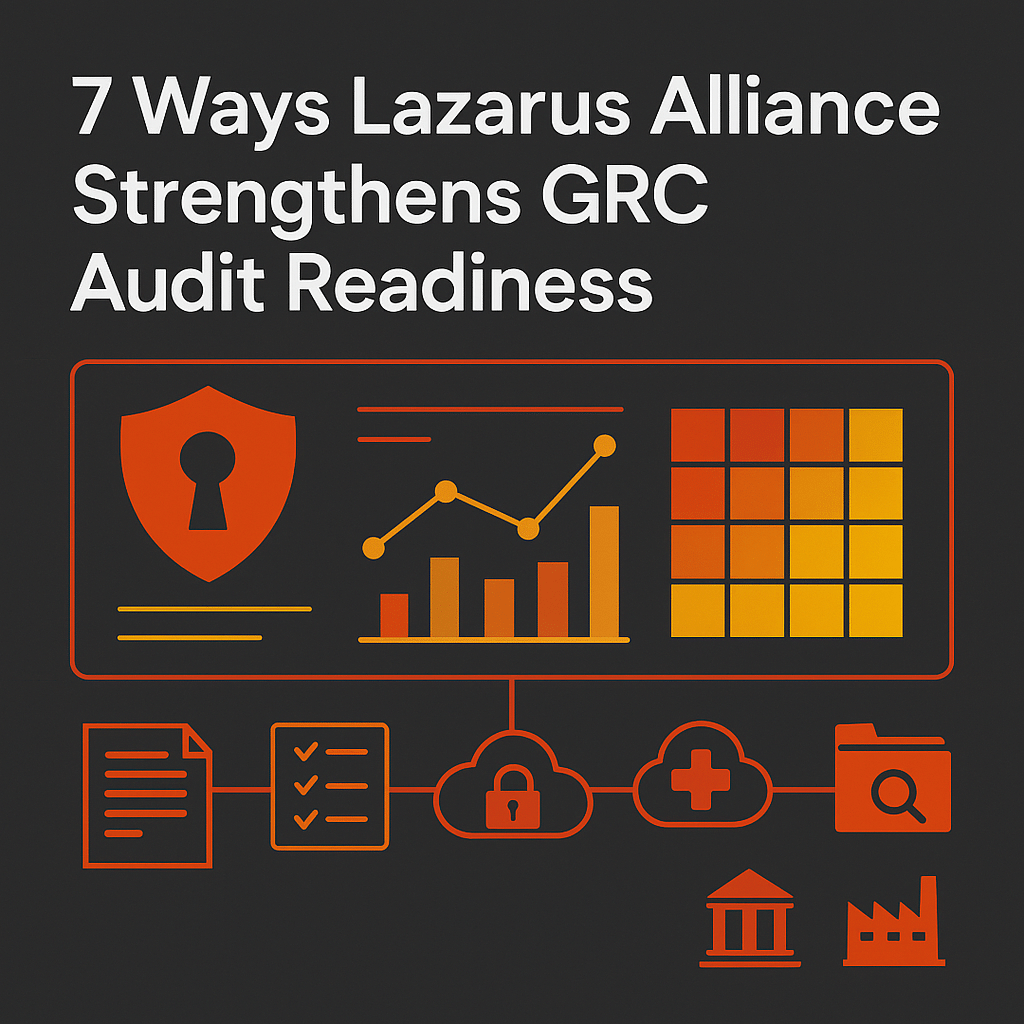
Audit readiness is often misunderstood as a final sprint: gather screenshots, chase control owners, and hope the assessor accepts the evidence. Regulated organizations learn quickly that this approach breaks down when one environment must satisfy FedRAMP, CMMC, PCI DSS, HIPAA, SOC 2, IRS 1075, CJIS, ISO 27001, C5, GovRAMP, and contractual security obligations at the same time. The stronger model is continuous GRC audit readiness: a disciplined operating system for governance, risk compliance, control ownership, evidence integrity, and executive accountability.
Lazarus Alliance strengthens GRC audit readiness by treating cybersecurity audits as operational validation, not paperwork. The goal is to prove that controls are designed correctly, operating consistently, traceable to authoritative requirements, and defensible when an assessor asks how risk decisions were made. That matters because NIST describes the Risk Management Framework as a lifecycle that includes categorizing systems, selecting controls, implementing controls, assessing controls, authorizing systems, and monitoring controls continuously, not as a one-time certification exercise NIST, SP 800-37 Rev. 2 Risk Management Framework.
1. Lazarus Alliance Aligns GRC Audit Scope to Real Regulatory Obligations
The first way Lazarus Alliance improves audit readiness is by converting vague compliance objectives into a precise audit universe. A regulated organization does not merely need a list of frameworks; it needs a defensible scope that identifies systems, data types, legal obligations, inherited controls, outsourced services, and customer contract requirements. NIST SP 800-53 provides a catalog of security and privacy controls that can be tailored to federal and high-assurance environments, making it a practical backbone for cross-framework scoping NIST, SP 800-53 Rev. 5 Security and Privacy Controls.
In practice, this means separating the systems that store cardholder data for PCI DSS, electronic protected health information for HIPAA, criminal justice information for CJIS, federal tax information for IRS 1075, controlled unclassified information for CMMC and DFARS programs, and federal information for FISMA or FedRAMP authorization. PCI DSS defines technical and operational requirements for protecting account data in payment environments PCI Security Standards Council, PCI DSS Document Library. HIPAA Security Rule safeguards apply to electronic protected health information under administrative, physical, and technical safeguard standards eCFR, HIPAA Security Rule Subpart C. The FBI CJIS Security Policy governs protection of criminal justice information for authorized agencies and supporting organizations FBI, CJIS Security Policy Resource Center. IRS Publication 1075 establishes safeguard expectations for federal tax information received by agencies and contractors IRS, Safeguards Program.
Implementation takeaway: build a scoping matrix with columns for system boundary, data type, owner, hosting model, third-party dependencies, applicable framework, control inheritance, evidence source, and assessor expectation. Lazarus Alliance applies this discipline in regulated audit services such as Lazarus Alliance NIST 800-53 and FISMA audit services, where boundary definition and control applicability determine whether the assessment is efficient or chaotic.
2. Lazarus Alliance Maps Controls Once, Then Tests Them Across Frameworks
Regulated industries often duplicate effort because each framework is managed in a separate spreadsheet. A single access review may satisfy NIST 800-53 AC-2 account management, SOC 2 logical access criteria, PCI DSS access control requirements, CMMC identity and access requirements, and ISO 27001 access control expectations when evidence is collected and described correctly. NIST SP 800-53 AC-2 addresses account management, including identifying account types, assigning account managers, establishing conditions for group and role membership, and disabling accounts when no longer required NIST, SP 800-53 Rev. 5 AC-2.
The audit-ready approach is to create a control harmonization layer: one authoritative internal control statement mapped to multiple external requirements. For example, an internal control might state: privileged accounts are approved by system owners, protected with phishing-resistant multifactor authentication where required, reviewed on a defined cadence, logged centrally, and removed upon role change or termination. That internal statement can be mapped to NIST 800-53 IA and AC families, PCI DSS identity and access requirements, SOC 2 common criteria for logical access, and CMMC practices aligned to NIST SP 800-171 requirements. NIST SP 800-171 Rev. 3 specifies security requirements for protecting controlled unclassified information in nonfederal systems and organizations NIST, SP 800-171 Rev. 3.
Common pitfall: organizations map frameworks at the policy level but fail at the evidence level. A policy saying access is reviewed quarterly is not sufficient if the assessor cannot see user populations, review dates, reviewer identity, exceptions, remediation tickets, and closure evidence. Lazarus Alliance helps organizations prepare for this kind of multi-framework assessment in programs such as Lazarus Alliance CMMC services, where control performance must be demonstrable across governance, technical, and operational domains.
3. Lazarus Alliance Builds Evidence That Is Complete, Current, and Assessor-Ready
Audit readiness depends on evidence quality. Assessors evaluate whether evidence proves both control design and operating effectiveness. A firewall standard may prove design intent, but operating effectiveness usually requires configuration exports, change tickets, rule review records, vulnerability scan results, exception approvals, and remediation evidence. NIST SP 800-53 CA-2 addresses control assessments, including determining whether controls are implemented correctly, operating as intended, and producing the desired outcome with respect to meeting security and privacy requirements NIST, SP 800-53 Rev. 5 CA-2.
A mature evidence package has five attributes: it is tied to a specific control, generated from an authoritative system of record, time-bounded to the audit period, reviewed by an accountable owner, and accompanied by remediation documentation when exceptions exist. For SOC reporting, the AICPA SOC suite addresses independent reports over system and organization controls, including SOC 1 and SOC 2 examinations used by service organizations and their customers AICPA & CIMA, SOC Suite of Services. Lazarus Alliance supports these evidence expectations through Lazarus Alliance SOC 1 and SOC 2 services.
Example walkthrough: for an incident response control, the audit file should include the approved incident response plan, role roster, escalation matrix, ticket examples, incident classification criteria, tabletop exercise records, lessons learned, and proof that corrective actions were assigned and completed. NIST SP 800-53 IR-4 covers incident handling capabilities including preparation, detection, analysis, containment, eradication, recovery, and user response activities NIST, SP 800-53 Rev. 5 IR-4.
4. Lazarus Alliance Converts Risk Management Into Audit-Defensible Governance
Governance risk compliance is not just a technology function. Audit readiness requires that leadership can explain risk appetite, exception approvals, control ownership, third-party reliance, and the rationale for accepting residual risk. NIST SP 800-37 describes authorization as a risk-based decision that senior officials make based on the security and privacy posture of the system and the common controls it relies on NIST, SP 800-37 Rev. 2.
Lazarus Alliance strengthens this area by helping organizations establish governance artifacts that auditors expect but teams often overlook: a control owner register, risk acceptance workflow, policy exception register, risk treatment plan, security steering committee minutes, control performance dashboards, and board-level risk reporting. These artifacts matter for regulated industries because many standards evaluate management oversight as well as technical configuration. ISO 27001 specifies requirements for establishing, implementing, maintaining, and continually improving an information security management system ISO, ISO/IEC 27001 Information Security Management Systems. Germany’s C5 criteria are designed for cloud security assurance and include organizational, technical, and procedural expectations for cloud providers BSI, Cloud Computing Compliance Criteria Catalogue C5.
Decision matrix: classify audit findings by business impact, regulatory exposure, exploitability, compensating controls, remediation cost, owner, and target closure date. A low-severity configuration issue in a public system that processes regulated data may deserve more executive attention than a higher-severity issue isolated in a non-production lab. Audit-ready governance shows that these decisions are intentional, documented, and monitored.
5. Lazarus Alliance Prepares Technical Controls for Real Assessor Scrutiny
Many organizations pass policy review but struggle when assessors test technical implementation. GRC audit readiness must therefore include configuration validation, vulnerability management, logging, identity governance, encryption, endpoint security, backup recoverability, and secure change management. NIST SP 800-53 SI-2 addresses flaw remediation, including identifying, reporting, and correcting information system flaws and installing security-relevant updates within organization-defined time periods NIST, SP 800-53 Rev. 5 SI-2.
For cloud and federal environments, assessors will also examine inherited controls, customer responsibilities, continuous monitoring, system security plans, plans of action and milestones, vulnerability scan cadence, and authorization boundary diagrams. FedRAMP provides standardized documents and templates for cloud authorization packages, including security plans, assessment materials, and continuous monitoring resources FedRAMP, Documents and Templates. Lazarus Alliance supports organizations pursuing this level of federal assurance through Lazarus Alliance FedRAMP services.
Technical readiness checklist:
- Export identity and access data directly from authoritative directories and privileged access tools.
- Reconcile user access evidence against HR status, role approvals, and termination records.
- Preserve vulnerability scan results, risk ratings, remediation tickets, false-positive approvals, and rescans.
- Collect configuration evidence for encryption, logging, endpoint protection, backup jobs, and network segmentation.
- Link every technical exception to a compensating control and expiration date.
This checklist is especially important for defense contractors because the CMMC program rule is codified in federal regulation and addresses assessment, affirmation, and cybersecurity model requirements for defense suppliers handling controlled unclassified information eCFR, CMMC Program Rule.
6. Lazarus Alliance Integrates Third-Party and Supply Chain Risk Into Audit Readiness
Auditors increasingly ask how organizations govern vendors, cloud providers, payment processors, managed service providers, developers, and data processors. Third-party risk is not separate from audit readiness because outsourced services can affect confidentiality, integrity, availability, privacy, and regulatory compliance. NIST SP 800-53 SR controls address supply chain risk management, including supplier relationships, provenance, notification agreements, and supply chain protection practices NIST, SP 800-53 Rev. 5 Supply Chain Risk Management controls.
An audit-ready third-party program includes vendor inventory, inherent risk ratings, due diligence records, contract security clauses, data processing terms, right-to-audit language, incident notification obligations, service commitments, SOC reports where applicable, vulnerability disclosure expectations, and termination procedures. For PCI environments, outsourced service providers must be managed so that payment security responsibilities are understood and maintained according to PCI DSS requirements PCI Security Standards Council, PCI DSS Document Library. For HIPAA-covered workflows, business associate relationships must support the protection of electronic protected health information under the HIPAA Security Rule eCFR, HIPAA Security Rule Subpart C.
Scenario: a healthcare technology provider hosts regulated workloads in a cloud environment, uses a payment processor for subscriptions, relies on a support vendor with limited administrative access, and shares analytics with a subcontractor. A weak audit file would store vendor contracts in a procurement folder. A strong GRC audit file would map each vendor to data type, system dependency, control inheritance, monitoring cadence, assessment evidence, incident notification terms, and residual risk acceptance.
7. Lazarus Alliance Moves Organizations From Point-in-Time Compliance to Continuous Readiness
The final way Lazarus Alliance strengthens audit readiness is by replacing annual panic with continuous monitoring. NIST SP 800-37 includes monitoring as a recurring RMF step, and NIST SP 800-53 CA-7 addresses continuous monitoring of controls, assessment results, remediation, and reporting NIST, SP 800-37 Rev. 2 NIST, SP 800-53 Rev. 5 CA-7.
Continuous readiness starts with measurable control health. Useful metrics include overdue access reviews, unresolved high-risk vulnerabilities, expired policy exceptions, untested incident response procedures, missing vendor reviews, stale risk acceptances, failed backup tests, open audit findings, and evidence aging. These are not vanity metrics; they are early warning indicators that an audit package is becoming unreliable. Continuum GRC’s 2026 Audit Readiness Benchmark Report examines audit readiness practices across organizations and is a useful resource for comparing operational maturity without relying on ad hoc spreadsheets.
Continuous readiness operating model: assign each control an owner, evidence source, refresh frequency, testing procedure, risk relationship, and escalation path. Then review control health in governance meetings before audit fieldwork begins. The result is a defensible GRC audit posture in which auditors see a living compliance program rather than a temporary document collection effort.
What CISOs and Compliance Leaders Should Ask Before the Next GRC Audit
Before scheduling cybersecurity audits, regulated organizations should ask seven practical questions:
- Do we have a current system boundary for every regulated environment?
- Can we map one internal control to every applicable framework requirement?
- Is evidence generated from authoritative systems rather than manually recreated?
- Do control owners understand what the assessor will test?
- Are risk acceptances approved, time-bound, and linked to compensating controls?
- Can we prove vendor oversight for every critical service provider?
- Do dashboards show control health continuously, not only during audit fieldwork?
If the answer to any question is uncertain, audit readiness is not yet mature. Lazarus Alliance helps organizations close that gap by combining control expertise, assessor perspective, technical validation, evidence discipline, and governance alignment. For regulated industries, that combination turns compliance from a disruptive event into a repeatable business capability.
Sources and References
- NIST, SP 800-37 Rev. 2 Risk Management Framework
- NIST, SP 800-53 Rev. 5 Security and Privacy Controls
- NIST, SP 800-171 Rev. 3 Protecting Controlled Unclassified Information
- PCI Security Standards Council, PCI DSS Document Library
- eCFR, HIPAA Security Rule Subpart C
- FBI, CJIS Security Policy Resource Center
- IRS, Safeguards Program
- AICPA & CIMA, SOC Suite of Services
- ISO, ISO/IEC 27001 Information Security Management Systems
- BSI, Cloud Computing Compliance Criteria Catalogue C5
- FedRAMP, Documents and Templates
- eCFR, CMMC Program Rule
- Lazarus Alliance, NIST 800-53 and FISMA Audit Services
- Lazarus Alliance, CMMC Services
- Lazarus Alliance, SOC 1 and SOC 2 Services
- Lazarus Alliance, FedRAMP Services
- Continuum GRC, 2026 Audit Readiness Benchmark Report
About Lazarus Alliance
To learn more about how Lazarus Alliance can help, contact us.
- FedRAMP
- GovRAMP
- NIST 800-53
- DFARS NIST 800-171
- CMMC
- SOC 1 & SOC 2
- C5
- HIPAA, HITECH, & Meaningful Use
- PCI DSS RoC & SAQ
- IRS 1075 & 4812
- CJIS
- LA DMF
- ISO 27001, ISO 27002, ISO 27005, ISO 27017, ISO 27018, ISO 27701, ISO 22301, ISO 17020, ISO 17021, ISO 17025, ISO 17065, ISO 9001, & ISO 90003
- And dozens more!
Related Posts