ISO 42001: 6 AI Governance Audit Moves by Lazarus Alliance

ISO 42001: 6 AI Governance Audit Moves by Lazarus Alliance

The most important ISO 42001 audit question is not whether an organization uses artificial intelligence. It is whether leadership can prove that AI is governed as an enterprise risk system rather than managed as a collection of experimental models. That distinction is where many AI compliance programs fail. A chatbot pilot, fraud model, document classifier, copiloted development workflow, or autonomous workflow agent can each create cybersecurity, privacy, operational, legal, and vendor-risk exposure. ISO/IEC 42001 gives organizations a management-system structure for that exposure by defining requirements for establishing, implementing, maintaining, and continually improving an artificial intelligence management system, or AIMS, as described by ISO, ISO/IEC 42001 Artificial intelligence management system.

For Lazarus Alliance, ISO 42001 is not a paperwork exercise. It is an assurance discipline. A credible AI governance audit must connect model inventories, risk assessments, impact assessments, access controls, logging, supplier oversight, privacy obligations, secure engineering, incident response, and board-level accountability. The six audit moves below reflect how mature organizations can turn AI governance into evidence that withstands executive scrutiny, customer due diligence, and formal audit procedures.
Read More

CJIS Cloud: 5 Security Assessment Keys by Lazarus Alliance

CJIS Cloud: 5 Security Assessment Keys by Lazarus Alliance

Contrarian view: CJIS modernization is not primarily a cloud migration problem. It is an evidence problem. A cloud environment can be engineered securely, but law enforcement leaders still need assessment-ready proof that Criminal Justice Information is identified, isolated, encrypted, governed, logged, and accessed only by authorized personnel. The FBI Criminal Justice Information Services Security Policy remains the central reference for agencies and service providers handling CJI, and the FBI maintains the official CJIS Security Policy Resource Center for policy materials and updates FBI, CJIS Security Policy Resource Center.

For police departments, sheriff’s offices, public safety agencies, prosecutors, SaaS vendors, managed service providers, and cloud hosting teams, CJIS compliance now intersects with NIST 800-53, FedRAMP, GovRAMP, SOC 2, ISO 27001, HIPAA, IRS 1075, PCI DSS, CMMC, DFARS NIST 800-171, C5, and LADMF obligations. Lazarus Alliance sees the same pattern across mature programs: the teams that succeed are not the ones with the thickest policy binders; they are the ones that can continuously demonstrate control performance.

Read More

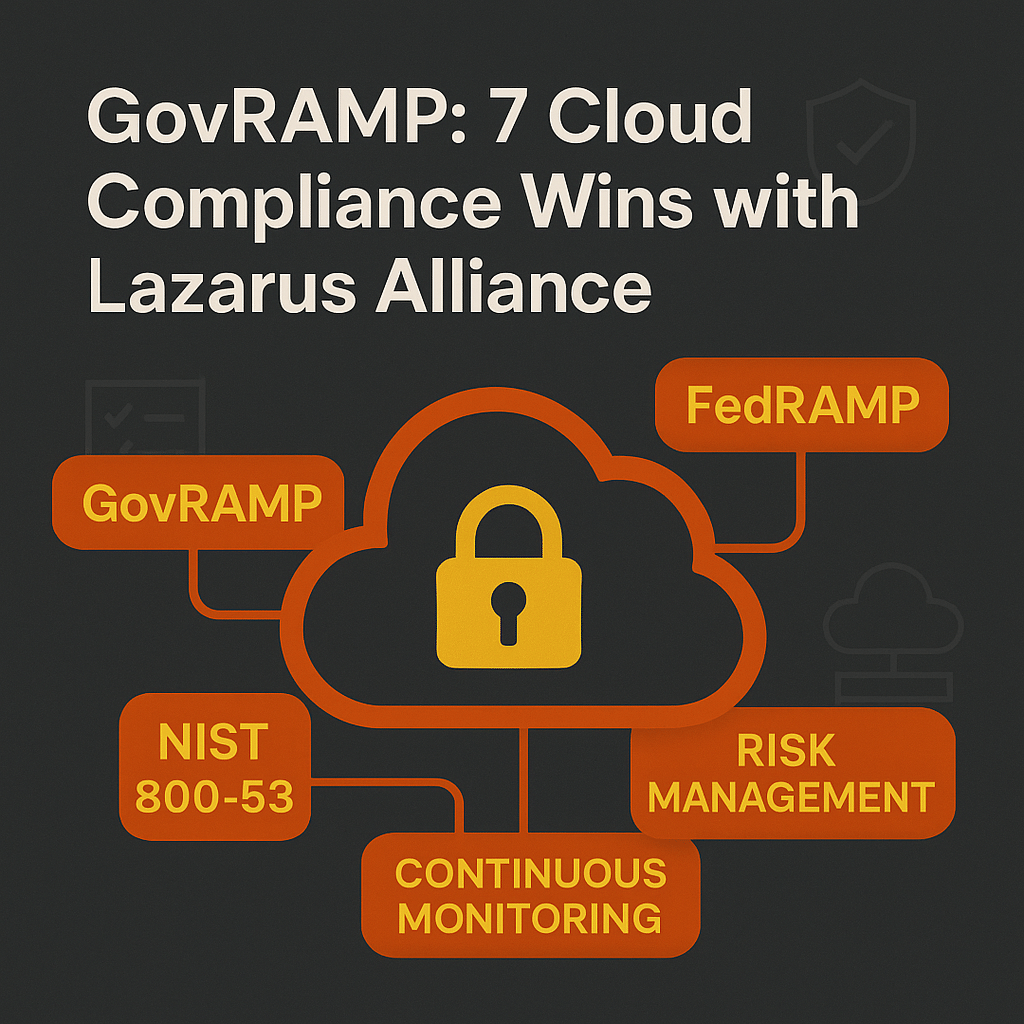
GovRAMP: 7 Cloud Compliance Wins with Lazarus Alliance

GovRAMP: 7 Cloud Compliance Wins with Lazarus Alliance

GovRAMP is not simply FedRAMP for state government. The real opportunity is more strategic: build one NIST 800-53-centered assurance program that can support public-sector procurement, FedRAMP reciprocity planning, CJIS conversations, SOC 2 customer assurance, PCI DSS segmentation, HIPAA safeguards, IRS 1075 data protection, and defense-sector overlays without restarting the audit process each time a buyer asks for evidence.

For cloud service providers, SaaS vendors, managed platforms, data analytics companies, and government technology suppliers, GovRAMP can become a commercial accelerator rather than a compliance bottleneck. Lazarus Alliance helps organizations translate cloud compliance requirements into assessor-ready evidence, practical risk management decisions, and repeatable cybersecurity audits aligned to the public-sector expectations that matter.

Read More