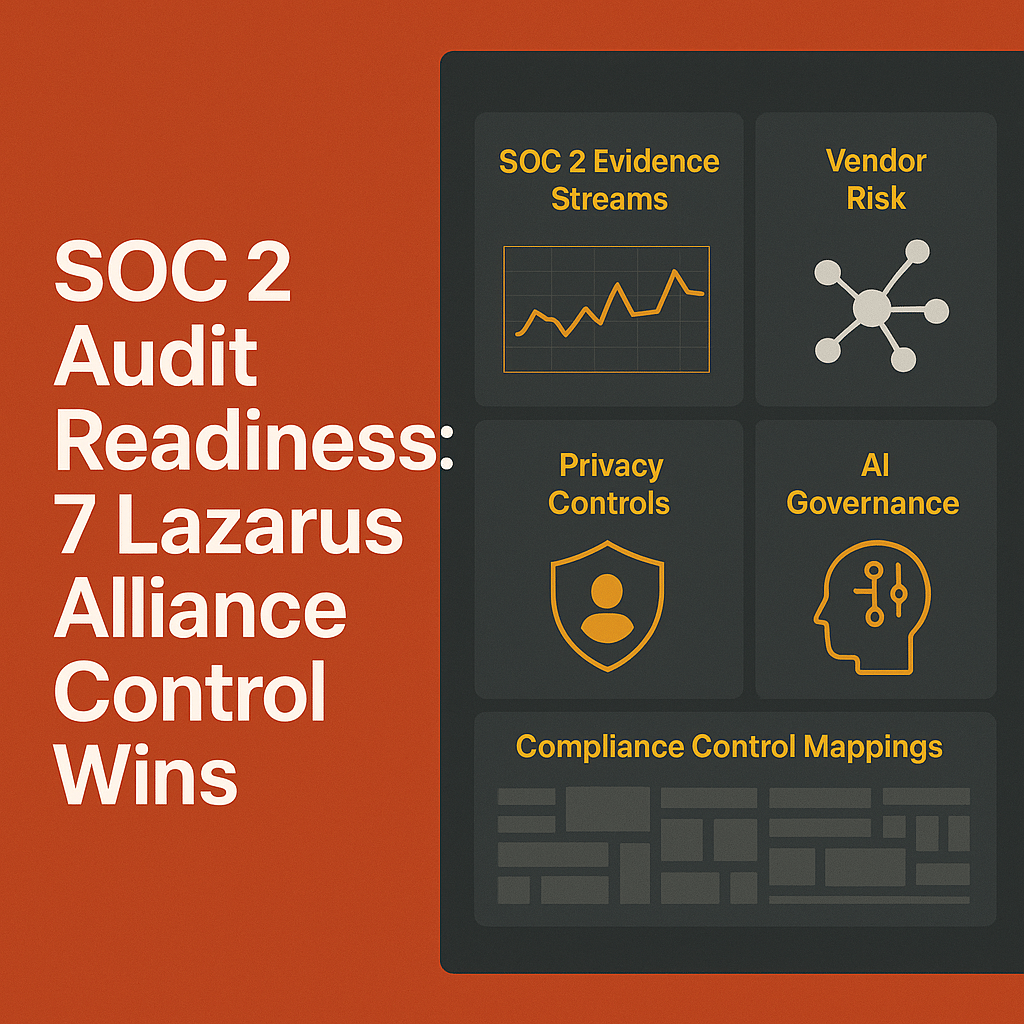
The fastest path to SOC 2 audit readiness is not to collect more screenshots. It is to design a control environment that produces trustworthy evidence as a byproduct of normal operations. That is the practical difference between organizations that survive a SOC 2 examination and organizations that use SOC 2 to win enterprise deals, reduce questionnaire fatigue, and strengthen security governance.
SOC 2 examinations are grounded in the AICPA Trust Services Criteria for security, availability, processing integrity, confidentiality, and privacy; the AICPA also provides description criteria used to prepare and evaluate the service organization system description in SOC 2 reporting AICPA & CIMA, SOC 2 Description Criteria. In 2026, customers are asking harder questions: Can you prove access reviews happened on time? Can you show privacy commitments are mapped to controls? Can you demonstrate vendor risk monitoring? Can you explain how AI is governed inside your service delivery environment?
For Lazarus Alliance, SOC 2 audit readiness is a control-engineering exercise, not a binder-building exercise. The seven control wins below translate the Trust Services Criteria into repeatable operations, continuous evidence, and cross-framework assurance for SaaS, cloud, healthcare technology, fintech, defense industrial base, and public-sector suppliers.
SOC 2 audit readiness starts with a defensible system boundary
The first control win is a precise SOC 2 system boundary. A weak boundary causes almost every downstream readiness failure: incomplete asset inventories, missing vendors, vague customer responsibility matrices, and evidence that does not match the service commitment.
A SOC 2 system description should identify the services in scope, infrastructure, software, people, procedures, data, and relevant trust commitments. The AICPA description criteria are specifically used to prepare and evaluate that description AICPA & CIMA, SOC 2 Description Criteria. Lazarus Alliance SOC readiness teams treat the system boundary as the audit map: every control, evidence request, vendor, data flow, and exception should trace back to that boundary. Organizations preparing for SOC 1 and SOC 2 support can align this scoping work with the Lazarus Alliance SOC 1 & SOC 2 services readiness model.
Implementation steps
- Define the service commitments: Document what customers are promised for security, availability, confidentiality, processing integrity, and privacy.
- Build a boundary diagram: Include cloud accounts, identity providers, CI/CD systems, logging platforms, production databases, support tools, and administrative endpoints.
- Map data flows: Show customer data entry points, storage locations, processing components, backup locations, retention rules, and deletion paths.
- Declare inherited controls: If a cloud provider, data center, or managed service performs part of the control, document the complementary user entity controls and vendor assurance relied upon.
Common pitfall: Teams often scope only the production application and forget privileged administration tools, support consoles, telemetry platforms, and AI-enabled customer support workflows. Auditors will follow the data and the administrative access path, not the marketing diagram.
Control Win 1: Map Trust Services Criteria to operational controls
SOC 2 audit readiness requires a control matrix that connects Trust Services Criteria points of focus to actual policies, procedures, technical configurations, tickets, logs, and reports. The security category is common to SOC 2 examinations, while availability, confidentiality, processing integrity, and privacy are selected based on service commitments and customer expectations AICPA & CIMA, SOC 2 Description Criteria.
A practical control matrix should include control owner, frequency, population, evidence source, testing method, exception handling, and mapping to other frameworks. This is where SOC 2 becomes more efficient: NIST SP 800-53 AC-2 addresses account management, AU-6 addresses audit record review, CA-7 addresses continuous monitoring, RA-5 addresses vulnerability monitoring and scanning, SA-9 addresses external system services, and SI-4 addresses system monitoring NIST, SP 800-53 Rev. 5. Those mappings help organizations reuse evidence for FedRAMP, GovRAMP, CJIS, IRS 1075, ISO 27001, HIPAA, PCI DSS, CMMC, DFARS NIST 800-171, C5, and LA DMF readiness programs.
Example control design
- SOC 2 risk: Former employees retain production access.
- Control: Human resources termination events trigger identity provider deactivation, privileged access removal, and ticketed verification within the approved service level.
- Evidence: HR roster, termination ticket, identity provider audit log, privileged access report, and reviewer sign-off.
- Crosswalk: NIST SP 800-53 AC-2 account management and NIST SP 800-171 Rev. 3 access control expectations for protecting controlled unclassified information in nonfederal systems NIST, SP 800-171 Rev. 3.
Control Win 2: Replace screenshot evidence with continuous evidence
The second control win is continuous evidence. Static screenshots are fragile because they capture one moment, rarely prove completeness, and often require manual reconciliation. Continuous evidence means control proof is generated through reliable systems of record: identity providers, cloud configuration APIs, endpoint management, ticketing, vulnerability scanners, SIEM, data-loss prevention tools, and vendor risk workflows.
FedRAMP modernization reinforces the same direction. FedRAMP 20x emphasizes a more automated, scalable approach to cloud security authorization and continuous monitoring FedRAMP, FedRAMP 20x. SOC 2 is not FedRAMP, but the assurance lesson is the same: evidence should be machine-verifiable, timestamped, complete, and tied to control performance.
What continuous evidence looks like
- Access review evidence: Population exported from the identity provider, reviewer approval, remediation ticket, and removal log.
- Change management evidence: Pull request, code review, test result, security scan, approval, deployment record, and rollback plan.
- Incident response evidence: Alert, triage note, severity classification, containment action, root-cause analysis, customer notification decision, and lessons learned.
- Vulnerability evidence: Scan scope, authenticated scan configuration, finding age, risk acceptance, remediation ticket, and retest result.
Continuum GRC’s 2026 Audit Readiness Benchmark Report examines audit readiness as an operational discipline, which aligns with the shift from periodic evidence collection to continuous control performance Continuum GRC, 2026 Audit Readiness Benchmark Report. The readiness target is simple: if an auditor asks for the population, sample, and proof, the evidence should already exist.
Control Win 3: Treat privacy controls as promises, not paperwork
Privacy controls are becoming a board-level SOC 2 readiness issue because customers increasingly expect assurance over collection, use, retention, disclosure, and disposal of personal information. The AICPA SOC 2 framework includes privacy as one of the Trust Services Criteria categories available for SOC 2 reporting AICPA & CIMA, SOC 2 Description Criteria. If privacy is included in scope, the organization must be able to prove its privacy commitments are implemented in operational controls.
A privacy commitment is auditable only when it can be translated into evidence. If the privacy notice says customers can request deletion, readiness evidence should include intake workflow, identity verification, downstream deletion tasks, exception handling, and completion records. If the product uses telemetry, the evidence should include consent logic, data minimization decisions, retention rules, and access restrictions.
Privacy readiness checklist
- Data inventory: Identify personal information, sensitive personal information, customer content, metadata, logs, and derived data.
- Purpose mapping: Link each data element to a business purpose, legal basis where applicable, system owner, and retention period.
- Access controls: Restrict privacy-sensitive data to approved roles and monitor administrative access.
- Retention and disposal: Configure retention schedules and prove deletion through system logs or workflow records.
- Subprocessor governance: Maintain data-processing terms, security commitments, and assurance evidence for vendors that process personal information.
Privacy is also tied to healthcare and regulated data programs. The HHS HIPAA Security Rule establishes administrative, physical, and technical safeguards for electronic protected health information HHS, HIPAA Security Rule. While HIPAA and SOC 2 are different frameworks, a healthcare technology company can reduce duplication by mapping HIPAA safeguards to SOC 2 security, confidentiality, and privacy controls. Continuum GRC’s privacy and data protection capabilities are designed for this type of obligation-to-control mapping Continuum GRC, Privacy & Data Protection.
Control Win 4: Make vendor risk part of the SOC 2 control environment
Vendor risk is no longer a back-office procurement task. In a modern SaaS environment, third parties may host production infrastructure, process customer data, deliver AI services, manage payments, support incident response, transmit logs, or provide administrative tooling. NIST SP 800-53 SA-9 addresses external system services, including the need to define and monitor security requirements for external providers NIST, SP 800-53 Rev. 5.
A SOC 2-ready vendor risk program should classify vendors by risk tier, data type, system access, business criticality, and customer commitment impact. It should not rely solely on annual questionnaires. High-risk vendors should have onboarding due diligence, contractual security requirements, evidence review, ongoing monitoring, incident notification obligations, and offboarding procedures.
Vendor risk decision matrix
- Tier 1 critical vendor: Hosts production, stores customer data, or has privileged access. Require security assurance report review, contract controls, annual reassessment, incident notification terms, and business continuity validation.
- Tier 2 important vendor: Supports operations or processes limited sensitive data. Require security questionnaire, policy review, access limitation, and periodic reassessment.
- Tier 3 low-risk vendor: No customer data and no production access. Require basic security terms and owner attestation.
For organizations with regulated customers, vendor risk must also support CJIS, PCI DSS, CMMC, IRS 1075, and public-sector cloud expectations. The FBI CJIS Security Policy Resource Center provides the official policy source for organizations that create, access, transmit, or store criminal justice information FBI, CJIS Security Policy Resource Center. PCI DSS applies to entities that store, process, or transmit account data, with official standard documents maintained by the PCI Security Standards Council PCI Security Standards Council, Document Library. Continuum GRC’s third-party and vendor risk capabilities support the evidence model needed for vendor due diligence, monitoring, and reassessment Continuum GRC, Third-Party & Vendor Risk.
Control Win 5: Build AI control assurance into SOC 2 readiness
AI is now part of the SOC 2 audit readiness conversation because AI tools can affect confidentiality, privacy, availability, processing integrity, and security monitoring. AI may appear in code generation, customer support, threat detection, data classification, user analytics, contract review, or product functionality. If AI touches customer data, production workflows, or security decisions, it belongs in the control inventory.
ISO/IEC 42001 is the international standard for an artificial intelligence management system, and ISO describes it as a management system standard for organizations providing or using AI-based products or services ISO, ISO/IEC 42001 Artificial Intelligence Management System. SOC 2 does not require ISO/IEC 42001 certification, but AI governance evidence can strengthen SOC 2 readiness when AI affects trust commitments.
AI assurance controls to include
- AI inventory: List approved AI systems, owners, use cases, data inputs, vendors, integrations, and risk ratings.
- Data exposure controls: Prohibit entry of customer confidential information into unapproved AI tools and monitor sanctioned AI usage.
- Model output review: Define when human review is required before AI-generated output affects customers, security decisions, or regulated records.
- Vendor AI due diligence: Review data usage terms, retention, training restrictions, security controls, and breach notification terms.
- Change control: Treat model, prompt, data pipeline, and policy changes as auditable changes when they affect service commitments.
Continuum GRC’s AI governance and risk resources support the inventory, risk assessment, and control mapping needed to connect AI operations with SOC 2 evidence Continuum GRC, AI Governance & Risk.
Control Win 6: Use cross-framework mapping to reduce audit fatigue
Organizations rarely pursue SOC 2 in isolation. A cloud provider may also need FedRAMP, GovRAMP, ISO 27001, PCI DSS, HIPAA, C5, or CJIS readiness. A defense contractor may need CMMC and DFARS NIST 800-171 alignment. A fintech provider may need SOC 1 for financial reporting controls and SOC 2 for trust services controls.
The DoD CMMC program is the official cybersecurity maturity model program for defense contractors handling federal contract information or controlled unclassified information DoD CIO, Cybersecurity Maturity Model Certification. NIST SP 800-171 Rev. 3 provides requirements for protecting controlled unclassified information in nonfederal systems and organizations NIST, SP 800-171 Rev. 3. ISO/IEC 27001 defines requirements for an information security management system ISO, ISO/IEC 27001 Information Security Management Systems.
The control win is to create a master control set. For example, one access review control can support SOC 2 common criteria, NIST SP 800-53 AC-2, ISO 27001 access control expectations, CMMC access control practices, HIPAA technical safeguards, and PCI DSS access requirements when scoped correctly. The evidence may need different formatting for each framework, but the underlying control operation should be consistent.
Control Win 7: Run readiness like an examination before the examination
The final win is disciplined pre-examination testing. A readiness assessment should not merely ask whether policies exist. It should test design and operating effectiveness using the same logic an examiner will use: population completeness, sample selection, evidence sufficiency, exception analysis, and management response.
Readiness testing walkthrough
- Population: Pull all production changes during the readiness period from the ticketing and repository systems.
- Sampling: Select changes across application, infrastructure, emergency, and configuration categories.
- Evidence: Verify approval, testing, segregation of duties, security review where required, deployment record, and post-deployment monitoring.
- Exception analysis: Determine whether missing approvals are isolated, systemic, or caused by unclear workflow design.
- Remediation: Update procedure, automate required fields, retrain owners, and retest before the SOC 2 examination period.
Readiness should produce a defensible audit trail: risk register updates, policy approvals, control owner attestations, evidence repository links, exception logs, corrective actions, and management review minutes. The result is not just a cleaner SOC 2 examination. It is a stronger operating model for security, privacy, vendor risk, and AI assurance.
Executive takeaway: SOC 2 readiness is control assurance engineering
SOC 2 audit readiness is strongest when it is engineered into everyday operations. The seven Lazarus Alliance control wins are: define the system boundary, map Trust Services Criteria to operational controls, implement continuous evidence, operationalize privacy commitments, mature vendor risk, govern AI use, and test readiness before the examination period.
For CISOs, compliance officers, and IT directors, the strategic move is to stop treating SOC 2 as an annual scramble. Build a control environment that can answer customer due diligence questions, support multiple frameworks, and prove control performance continuously. That is how SOC 2 becomes more than an attestation objective. It becomes a competitive trust program.
Sources and References
- AICPA & CIMA, SOC 2 Description Criteria
- NIST, SP 800-53 Rev. 5 Security and Privacy Controls
- NIST, SP 800-171 Rev. 3 Protecting Controlled Unclassified Information
- FedRAMP, FedRAMP 20x
- HHS, HIPAA Security Rule
- FBI, CJIS Security Policy Resource Center
- PCI Security Standards Council, Document Library
- DoD CIO, Cybersecurity Maturity Model Certification
- ISO, ISO/IEC 27001 Information Security Management Systems
- ISO, ISO/IEC 42001 Artificial Intelligence Management System
- Lazarus Alliance, SOC 1 & SOC 2 Services
- Continuum GRC, 2026 Audit Readiness Benchmark Report
- Continuum GRC, Privacy & Data Protection
- Continuum GRC, Third-Party & Vendor Risk
- Continuum GRC, AI Governance & Risk
About Lazarus Alliance
To learn more about how Lazarus Alliance can help, contact us.
- FedRAMP
- GovRAMP
- NIST 800-53
- DFARS NIST 800-171
- CMMC
- SOC 1 & SOC 2
- C5
- HIPAA, HITECH, & Meaningful Use
- PCI DSS RoC & SAQ
- IRS 1075 & 4812
- CJIS
- LA DMF
- ISO 27001, ISO 27002, ISO 27005, ISO 27017, ISO 27018, ISO 27701, ISO 22301, ISO 17020, ISO 17021, ISO 17025, ISO 17065, ISO 9001, & ISO 90003
- And dozens more!
Related Posts