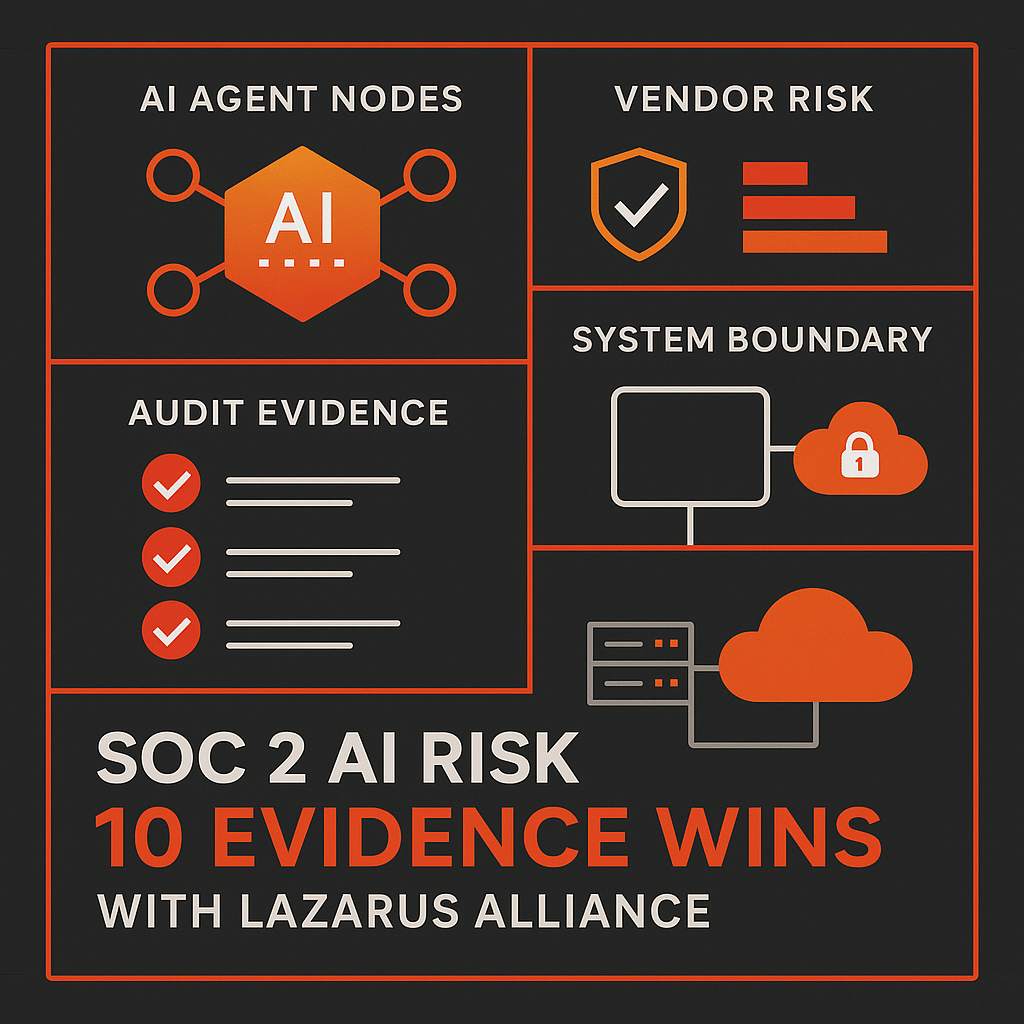
SOC 2 AI Risk: 10 Evidence Wins with Lazarus Alliance

SOC 2 AI Risk: 10 Evidence Wins with Lazarus Alliance

The hardest SOC 2 AI risk problem is not whether an AI tool is innovative; it is whether the auditor can see where the tool starts, what it can touch, who owns it, and what evidence proves it behaved as intended. AI agents, embedded copilots, retrieval-augmented generation, automated support bots, and vendor-hosted models create a new evidence challenge: they often act like users, integrations, processors, and decision engines at the same time.

For Lazarus Alliance, the practical answer is not to bolt a vague AI policy onto a SOC 2 audit. The answer is to convert AI risk into testable audit evidence mapped to system boundaries, vendor risk management, access control, logging, change management, privacy, confidentiality, and customer assurance. The AICPA explains that SOC 2 description criteria support evaluation of a service organization’s system across security, availability, processing integrity, confidentiality, and privacy, which means AI capabilities must be described and evidenced when they are relevant to the service commitment or system boundary AICPA & CIMA, SOC 2 Description Criteria.

This article gives CISOs, compliance officers, IT directors, and audit owners a field-tested evidence model: 10 SOC 2 evidence wins for AI agents, AI vendors, and AI system boundaries.
Read More

FedRAMP 20x Modernization: Risk Management Assessments by Lazarus

FedRAMP 20x Modernization: Risk Management Assessments by Lazarus

The FedRAMP 20x modernization initiative represents a fundamental shift from static documentation to dynamic, machine-readable risk intelligence. By replacing traditional System Security Plans with OSCAL packages and Key Security Indicators, the program demands that Cloud Service Providers demonstrate continuous risk posture rather than periodic snapshots. Lazarus Alliance brings specialized expertise in translating these new requirements into actionable compliance programs that align technical controls with organizational governance.

Read More

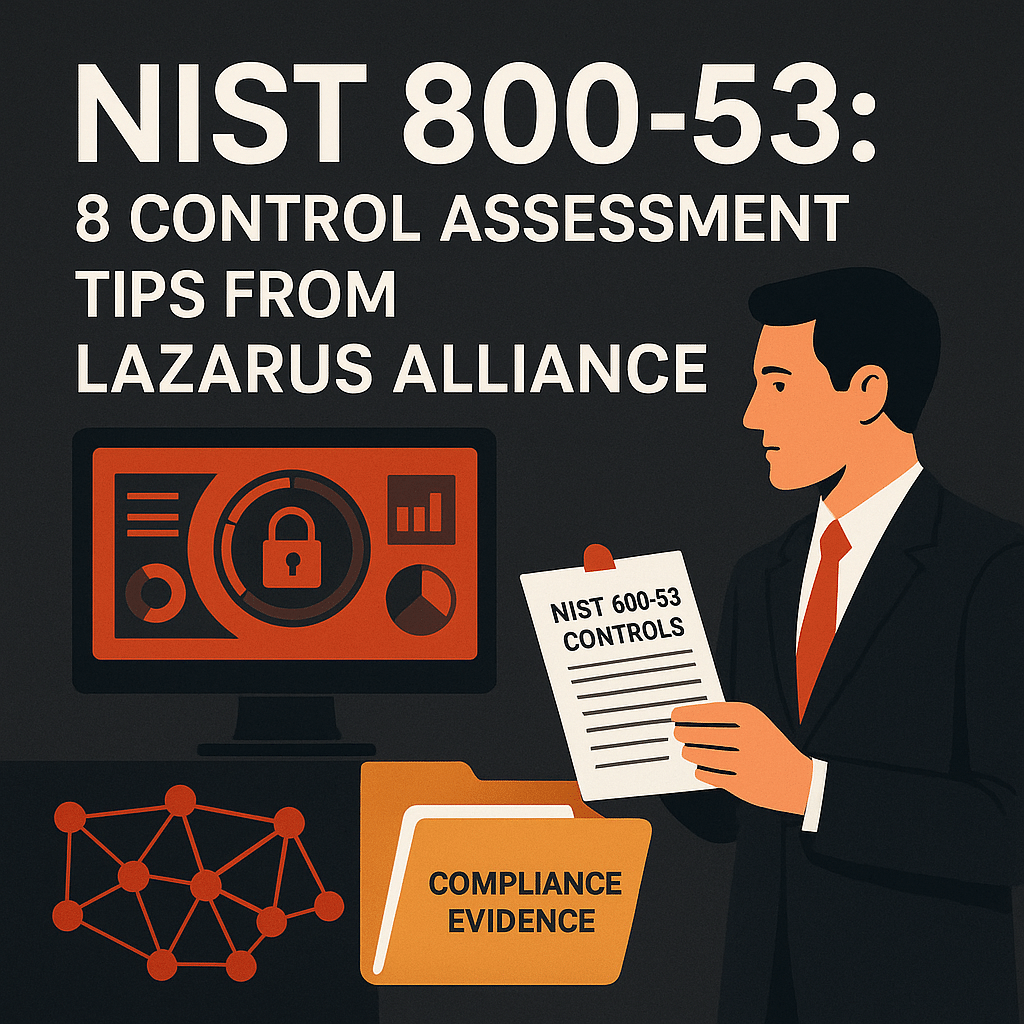
NIST 800-53: 8 Control Assessment Tips from Lazarus Alliance

NIST 800-53: 8 Control Assessment Tips from Lazarus Alliance

The strongest NIST 800-53 assessments are not won by having more screenshots; they are won by proving control intent, implementation, and operating effectiveness with evidence that is current, complete, attributable, and repeatable. NIST SP 800-53 provides a catalog of security and privacy controls used across federal and enterprise risk programs, and NIST SP 800-53A provides assessment procedures for determining whether those controls are implemented correctly, operating as intended, and producing the desired outcome NIST, SP 800-53 Rev. 5 NIST, SP 800-53A Rev. 5.

For CISOs, compliance officers, IT directors, and GRC leaders, the practical challenge is not simply mapping controls. It is building an evidence system that can survive a cybersecurity audit, support continuous monitoring, and reduce rework across FedRAMP, GovRAMP, FISMA, CMMC, DFARS NIST 800-171, SOC 2, PCI DSS, HIPAA, CJIS, IRS 1075, ISO 27001, C5, and LADMF programs. Lazarus Alliance approaches NIST 800-53 control assessment as a defensible assurance process: define scope, verify implementation, test operating effectiveness, reconcile exceptions, and preserve evidence in a way that supports authorization, procurement, and executive risk decisions Lazarus Alliance, FISMA and NIST Audit Services.

Read More