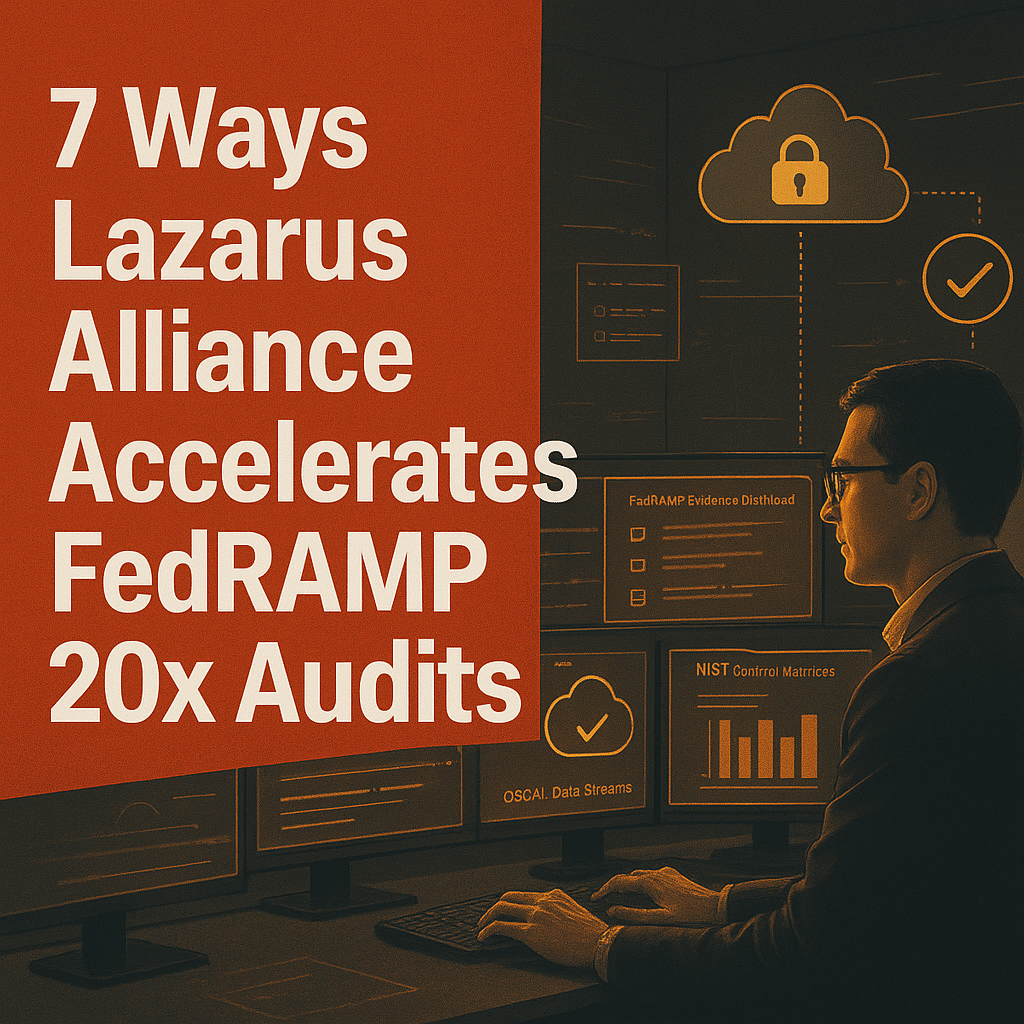
FedRAMP 20x is not simply a faster FedRAMP audit. It is a different evidence economy. The organizations that accelerate FedRAMP 20x audit readiness are not the ones that compress interviews into fewer calendar days; they are the ones that make control implementation, inheritance, risk decisions, and OSCAL evidence deterministic before an assessor ever opens the package.
FedRAMP reported that its Consolidated Rules for 2026, or CR26, were published in June 2026, that the FedRAMP 20x pipeline opened in August 2026, and that the program reported the first full CR26-compliant FedRAMP 20x Class C certification on October 29, 2026, according to FedRAMP, “Memo to Milestone”. FedRAMP also reported that FY26 produced 92 new FedRAMP Certifications, including 66 Rev5 and 26 20x certifications, and that the marketplace ended FY26 with 538 FedRAMP Certified cloud service offerings and 71 Initial Implementation listings, according to FedRAMP, “Memo to Milestone”. The message for cloud service providers is direct: audit velocity now depends on evidence quality, machine readability, governance discipline, and reusable risk narratives.
Lazarus Alliance helps cloud service providers, agencies, and highly regulated enterprises prepare for FedRAMP 20x by combining cybersecurity audits, compliance assessments, NIST 800-53 control validation, risk management, and OSCAL evidence planning into one readiness operating model. Organizations can review Lazarus Alliance’s FedRAMP audit and advisory capabilities at Lazarus Alliance FedRAMP Services.
What FedRAMP 20x Changes About FedRAMP Audit Readiness
FedRAMP 20x changes the center of gravity from document production to evidence assurance. FedRAMP describes 20x as a shift toward reduced assessment burden, improved evidence quality, machine-readable packages, and reuse of external security frameworks, according to FedRAMP, “From Foundation to Implementation”. FedRAMP also states that it will stop processing Legacy FedRAMP Rev5 Certification applications on June 11, 2027, according to FedRAMP, “Memo to Milestone”.
For CISOs and compliance leaders, the practical implication is clear: readiness must begin with control truth, not with a package template. A cloud provider that can show repeatable access governance, boundary protection, vulnerability remediation, configuration baselines, incident response, logging, contingency planning, and continuous monitoring in mapped, testable, machine-readable form will move faster than an organization that waits for assessor requests and then hunts for screenshots.
At Lazarus Alliance, we use a seven-lane FedRAMP 20x readiness model: scope, controls, evidence, automation, risk, reciprocity, and continuous monitoring. The goal is not to make the audit superficial. The goal is to remove ambiguity before formal assessment begins.
1. Start FedRAMP 20x With a Boundary That an Assessor Can Test
The fastest FedRAMP audit is often won or lost at the authorization boundary. A boundary that mixes production, corporate IT, shared tooling, unmanaged support paths, and unclear data flows creates rework. A testable boundary defines the cloud service offering, system components, external connections, management planes, customer responsibilities, inherited services, support workflows, logging paths, and data stores.
A strong FedRAMP 20x boundary package should answer five assessor questions immediately:
- What is in scope? Include compute, storage, network, identity, CI/CD, monitoring, ticketing, administrative access, backup, and recovery components.
- What is inherited? Identify cloud provider controls, managed service controls, corporate controls, and customer-responsible controls.
- Where does federal information flow? Map ingress, processing, storage, replication, logging, analytics, and egress.
- Who can administer the system? Document privileged roles, emergency access, break-glass workflow, federation, and service accounts.
- How is evidence generated? Tie each control to authoritative systems of record, such as identity platforms, vulnerability scanners, SIEM, ticketing, configuration management, and policy repositories.
This matters because NIST SP 800-53 includes access, audit, configuration, contingency, identification and authentication, incident response, risk assessment, and system and communications protection controls that must be implemented within a defined system context, according to NIST SP 800-53 Rev. 5, Update 1. When the boundary is vague, control testing becomes vague. When control testing is vague, findings multiply.
2. Map NIST 800-53 Controls to Real Control Owners and Real Systems
FedRAMP 20x audit acceleration depends on control ownership precision. “Security owns it” is not a control owner. A FedRAMP-ready control matrix should assign each requirement to an accountable owner, implementation system, evidence source, test method, frequency, and exception workflow.
For example, NIST SP 800-53 AC-2 addresses account management, including account creation, modification, disabling, and removal, according to NIST SP 800-53 Rev. 5, Update 1. In audit practice, AC-2 evidence should not be limited to a written policy. It should include role definitions, joiner-mover-leaver tickets, privileged access approvals, periodic access reviews, disabled account samples, service account ownership, and identity provider logs. NIST SP 800-53 AU-2 and AU-6 address event logging and audit record review, analysis, and reporting, according to NIST SP 800-53 Rev. 5, Update 1. That means the audit package should show what events are logged, where they are stored, who reviews alerts, how exceptions are escalated, and how log integrity is protected.
Lazarus Alliance accelerates this work by turning the control catalog into an assessment-ready evidence architecture. Our NIST 800-53 and FISMA audit services help organizations validate control implementation, test evidence quality, and reduce duplicated work across federal compliance programs, as described by Lazarus Alliance NIST 800-53 / FISMA Services.
3. Build OSCAL Evidence Before the FedRAMP Audit Package Is Requested
OSCAL evidence is where many FedRAMP 20x programs either gain speed or lose it. OSCAL, the Open Security Controls Assessment Language, is a machine-readable format used for security control catalogs, profiles, system security plans, assessment plans, assessment results, and plans of action and milestones, according to NIST OSCAL Documentation. FedRAMP’s automation program supports machine-readable security authorization packages through OSCAL resources, according to FedRAMP Automation.
The mistake is treating OSCAL as a formatting exercise at the end of readiness. A better approach is to design evidence so it can be serialized, validated, refreshed, and reused. That means every control should have metadata: source system, collection date, owner, control mapping, asset scope, risk relevance, sampling method, and retention rule.
A practical OSCAL evidence lane includes:
- Control implementation statements written in testable language, not marketing language.
- Automated evidence feeds from identity, vulnerability, endpoint, cloud posture, configuration, and ticketing systems.
- Human-approved artifacts such as risk acceptances, architecture diagrams, policies, procedures, and incident lessons learned.
- Evidence freshness rules that distinguish point-in-time artifacts from continuously updated telemetry.
- Traceability from system component to control objective to assessment procedure to artifact.
Continuum GRC’s 2026 Audit Readiness Benchmark Report examines audit readiness practices across organizations and is a useful resource for leaders evaluating evidence maturity and readiness operations, according to Continuum GRC, 2026 Audit Readiness Benchmark Report. The strategic point is simple: if evidence cannot be traced, refreshed, and defended, it will slow the FedRAMP audit.
4. Use Risk Management to Explain Control Reality, Not Hide Exceptions
FedRAMP 20x does not eliminate risk management. It makes risk management more visible. A mature FedRAMP audit package should show how the organization identifies risk, evaluates likelihood and impact, prioritizes remediation, accepts residual risk, and monitors exceptions.
NIST SP 800-53 RA-5 addresses vulnerability monitoring and scanning, including identifying vulnerabilities, reporting results, and remediating findings, according to NIST SP 800-53 Rev. 5, Update 1. NIST SP 800-53 CA-5 addresses plans of action and milestones for documenting planned remediation actions, according to NIST SP 800-53 Rev. 5, Update 1. These controls work best when risk decisions are supported by asset criticality, exploitability, exposure, compensating controls, remediation ownership, and target dates.
The urgency is not theoretical. Verizon’s 2026 Data Breach Investigations Report analyzed 31,861 security incidents and 22,625 confirmed data breaches, and reported that 31% of breaches began with vulnerability exploitation, 48% involved ransomware, 48% involved a third party, and 62% involved the human element, according to Verizon, 2026 Data Breach Investigations Report. Those figures align with what assessors scrutinize: patch governance, third-party dependencies, privileged access, phishing resistance, incident response, and evidence that remediation is more than ticket closure.
Lazarus Alliance accelerates readiness by reviewing POA&M logic before the formal FedRAMP audit. We look for unsupported risk acceptance, duplicate findings, weak compensating controls, missing asset context, stale vulnerability evidence, and remediation claims that are not supported by retest artifacts.
5. Engineer Reuse Across FedRAMP, GovRAMP, SOC 2, ISO 27001, CMMC, HIPAA, PCI DSS, CJIS, C5, IRS 1075, and LADMF
A FedRAMP 20x program should not live in a compliance silo. Many cloud providers also need SOC 1, SOC 2, ISO 27001, PCI DSS, HIPAA, CJIS, CMMC, DFARS NIST 800-171, GovRAMP, C5, IRS 1075, or LADMF readiness. The acceleration opportunity is to map once, test once where appropriate, and reuse defensible evidence across frameworks without overstating equivalence.
For example, DFARS 252.204-7019 requires offerors subject to NIST SP 800-171 to have a current assessment not more than three years old unless the solicitation specifies a shorter period, and requires summary-level scores to be posted in SPRS for covered contractor information systems relevant to the offer, according to Acquisition.gov, DFARS 252.204-7019. For state, local, tribal, territorial, and education cloud markets, GovRAMP opened public comment on RFC GR-2601 for a proposed FedRAMP 20x Delta Assessment, with comments open through December 4, 2026, according to GovRAMP, Proposed 20x Delta Assessment.
Cross-framework reuse works when evidence is normalized by control objective. For instance, access review evidence may support NIST 800-53 AC controls, SOC 2 common criteria, ISO 27001 access controls, PCI DSS access control requirements, HIPAA technical safeguards, CJIS access management expectations, and CMMC access control practices. But reuse fails when teams assume that one report automatically satisfies a different regulatory purpose.
Lazarus Alliance helps organizations rationalize overlapping requirements through multi-framework cybersecurity audits and compliance assessments, including FedRAMP, GovRAMP, NIST 800-53, SOC, HIPAA, PCI DSS, CJIS, CMMC, DFARS NIST 800-171, IRS 1075, LADMF, and ISO programs. For cloud providers pursuing state and federal alignment, Lazarus Alliance’s GovRAMP services are available at Lazarus Alliance GovRAMP Services.
6. Replace Screenshot Compliance With Assessor-Ready Control Telemetry
FedRAMP 20x rewards organizations that can prove controls through trustworthy telemetry. Screenshots still have limited value for point-in-time confirmation, but they do not scale well for continuous monitoring, sampling, or machine-readable evidence packages.
Assessor-ready telemetry should include identity logs, privileged access records, vulnerability scan exports, configuration state, endpoint posture, cloud security posture, change records, incident tickets, backup validation, SIEM alerts, data protection controls, encryption configuration, and policy exceptions. Each evidence source should have integrity safeguards, timestamps, ownership, retention settings, and a clear relationship to scoped assets.
Consider a common example: a SaaS provider claims multifactor authentication is enforced for administrators. Weak evidence would be a screenshot of an MFA settings page. Stronger evidence includes identity policy exports, administrative group membership, conditional access rules, recent authentication logs, break-glass account controls, exception approvals, and periodic access review records. Strongest evidence adds automated checks that alert when an administrator is created outside the approved workflow.
NIST SP 800-53 CM-2 addresses baseline configuration, CM-3 addresses configuration change control, IA-2 addresses identification and authentication for organizational users, and SC-13 addresses cryptographic protection, according to NIST SP 800-53 Rev. 5, Update 1. FedRAMP 20x readiness improves when these controls are supported by live operational evidence instead of static artifacts.
For organizations using GRC technology to coordinate evidence, Continuum GRC provides risk, audit, and compliance management capabilities, including IT and cybersecurity risk workflows described at Continuum GRC IT & Cybersecurity Risk. Technology does not replace expert assessment, but it can reduce manual evidence friction when paired with disciplined control engineering.
7. Treat Continuous Monitoring as the FedRAMP 20x Operating Model
FedRAMP audit readiness does not end when an assessment package is submitted. Continuous monitoring is the operating model that keeps authorization defensible. The organizations that accelerate FedRAMP 20x are the ones that maintain audit posture every week: vulnerability queues, change approvals, access reviews, configuration drift, incident lessons learned, third-party risk, risk acceptance, and POA&M closure.
NIST’s 2026 governance guidance reinforces that cybersecurity governance belongs inside enterprise risk management. NIST SP 800-221r1 aligns ICT risk management with the NIST Cybersecurity Framework 2.0 functions of Govern, Identify, Protect, Detect, Respond, and Recover, according to NIST CSRC, ICT Risk Programs Draft. NIST also released draft SP 800-100r1 for executive cybersecurity leadership, covering governance, risk management, awareness and training, contingency planning, configuration management, incident response, and continuous monitoring, according to NIST, Draft SP 800-100 Revision 1.
A practical FedRAMP 20x continuous monitoring cadence includes:
- Daily: alert triage, privileged access monitoring, vulnerability intake, and cloud posture checks.
- Weekly: vulnerability prioritization, change review, exception review, and evidence freshness checks.
- Monthly: control-owner attestation, POA&M validation, metrics review, and third-party issue tracking.
- Quarterly: access recertification, tabletop exercises, incident response improvements, and risk register updates.
- Assessment cycle: independent validation, sampling, package review, OSCAL quality checks, and executive risk sign-off.
The most common misconception is that continuous monitoring is merely a report. In practice, it is a governance loop. Findings must have owners. Exceptions must have expiration dates. Metrics must influence priorities. Risk acceptances must be revisited. Control failures must produce corrective actions that are retested.
A FedRAMP 20x Decision Matrix for Readiness Leaders
Use this decision matrix to determine whether your organization is positioned for accelerated FedRAMP 20x audit readiness:
- If your system boundary changes faster than your diagrams, prioritize architecture discovery, data-flow mapping, and change governance before evidence packaging.
- If control owners cannot name their evidence source, prioritize control accountability workshops and evidence-source mapping.
- If your POA&M contains stale or duplicate items, prioritize risk normalization, remediation governance, and retesting discipline.
- If your evidence is mostly screenshots, prioritize telemetry, automated exports, authoritative source systems, and OSCAL metadata.
- If you need FedRAMP and GovRAMP, prioritize shared NIST 800-53 control mapping and identify where program-specific deltas remain.
- If you also support defense, healthcare, financial services, or law enforcement customers, prioritize crosswalks to DFARS NIST 800-171, CMMC, HIPAA, PCI DSS, CJIS, IRS 1075, ISO 27001, SOC 2, LADMF, and C5.
- If executives only see compliance status at audit time, prioritize governance metrics, risk reporting, and continuous monitoring dashboards.
How Lazarus Alliance Accelerates FedRAMP 20x Audits
Lazarus Alliance accelerates FedRAMP 20x audit readiness by focusing on what assessors need to validate: scoped systems, implemented controls, reliable evidence, documented risk decisions, and repeatable continuous monitoring. Our approach integrates cybersecurity audits, compliance assessments, NIST 800-53 control testing, OSCAL evidence planning, risk management, and multi-framework mapping so that cloud providers can prepare with confidence instead of reacting to audit friction.
For a SaaS provider preparing for FedRAMP 20x, a typical Lazarus Alliance readiness engagement may begin with boundary confirmation, control-owner interviews, evidence inventory, and inherited-control review. The next phase validates high-risk control areas such as identity, vulnerability management, logging, incident response, encryption, configuration management, backup, and vendor dependencies. The final readiness phase focuses on package defensibility: OSCAL traceability, assessor-ready narratives, POA&M quality, sampling support, and executive risk acceptance.
The outcome is not a promise that every finding disappears. The outcome is audit control. Findings become understandable, prioritized, assigned, and remediated. Evidence becomes traceable. Risk becomes explainable. Leadership gains a defensible view of readiness before the formal FedRAMP audit begins.
FedRAMP 20x rewards organizations that can prove security with clarity. Lazarus Alliance helps make that proof faster, stronger, and more reusable.
Sources and References
- FedRAMP, “Memo to Milestone,” https://www.fedramp.gov/2026-11-02-memo-to-milestone/
- FedRAMP, “From Foundation to Implementation,” https://demo.fedramp.gov/2026-10-08-from-foundation-to-implementation/
- FedRAMP, “FedRAMP Certification,” https://www.fedramp.gov/2026/reference/20x/b/fedramp-certification/
- FedRAMP Automation, https://automate.fedramp.gov/
- NIST OSCAL Documentation, https://pages.nist.gov/OSCAL/
- NIST SP 800-53 Rev. 5, Update 1, https://csrc.nist.gov/pubs/sp/800/53/r5/upd1/final
- NIST CSRC, ICT Risk Programs Draft, https://csrc.nist.gov/News/2026/governing-and-managing-ict-risk-programs-draft
- NIST, Draft SP 800-100 Revision 1 Information Security Handbook, https://www.nist.gov/news-events/news/2026/10/nist-releases-draft-sp-800-100-revision-1-information-security-handbook
- Acquisition.gov, DFARS 252.204-7019, https://www.acquisition.gov/dfars/252.204-7019-notice-nistsp-800-171-dod-assessment-requirements.?searchTerms=252.204-7019
- GovRAMP, Proposed 20x Delta Assessment, https://govramp.org/news/govramp-opens-public-comment-period-on-proposed-20x-delta-assessment
- Verizon, 2026 Data Breach Investigations Report, https://www.verizon.com/business/resources/reports/2026-dbir-data-breach-investigations-report.pdf
- Lazarus Alliance FedRAMP Services, https://lazarusalliance.com/services/audit-compliance/fedramp/
- Lazarus Alliance NIST 800-53 / FISMA Services, https://lazarusalliance.com/fisma-nist-audit/
- Lazarus Alliance GovRAMP Services, https://lazarusalliance.com/services/audit-compliance/stateramp/
- Continuum GRC, 2026 Audit Readiness Benchmark Report, https://continuumgrc.com/2026-audit-readiness-benchmark-report/
- Continuum GRC IT & Cybersecurity Risk, https://continuumgrc.com/risk-management-audit/
About Lazarus Alliance
To learn more about how Lazarus Alliance can help, contact us.
- FedRAMP
- GovRAMP
- NIST 800-53
- DFARS NIST 800-171
- CMMC
- SOC 1 & SOC 2
- C5
- HIPAA, HITECH, & Meaningful Use
- PCI DSS RoC & SAQ
- IRS 1075 & 4812
- CJIS
- LA DMF
- ISO 27001, ISO 27002, ISO 27005, ISO 27017, ISO 27018, ISO 27701, ISO 22301, ISO 17020, ISO 17021, ISO 17025, ISO 17065, ISO 9001, & ISO 90003
- And dozens more!
Related Posts