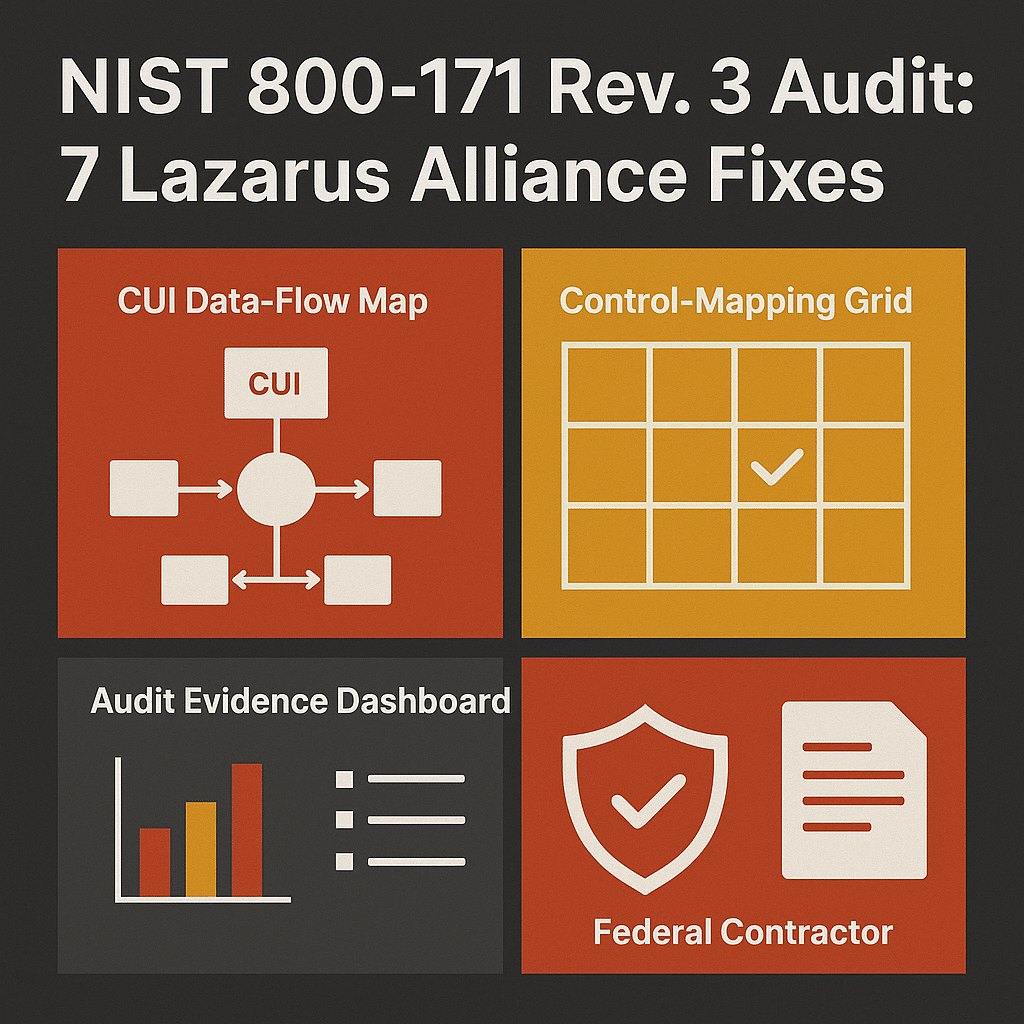
Contrarian audit lesson: the hardest part of a NIST 800-171 Rev. 3 audit is not reading the new requirements. It is proving, with repeatable evidence, that Controlled Unclassified Information is protected across contracts, cloud services, endpoints, administrators, subcontractors, and inherited controls. NIST describes SP 800-171 Rev. 3 as security requirements for protecting CUI in nonfederal systems and organizations, and the publication is explicitly tied to the federal CUI program and the protection of CUI outside federal systems NIST, SP 800-171 Rev. 3.
For federal contractors, the practical challenge in 2026 is version-aware audit readiness. Many contract clauses, customer questionnaires, and CMMC preparation activities still require defensible NIST 800-171 evidence, while Rev. 3 changes how organizations should think about control mapping, parameters, scoping, and assessment artifacts. Lazarus Alliance approaches this as an evidence-engineering problem: define where CUI lives, map obligations once, test controls like an assessor, and make every assertion traceable to a system, owner, ticket, log, configuration, or approved policy.
NIST 800-171 Rev. 3 Readiness Starts with CUI, Not Controls
A NIST 800-171 Rev. 3 audit should begin with the data, not the spreadsheet. CUI is information that requires safeguarding or dissemination controls under federal law, regulation, or government-wide policy, and the National Archives and Records Administration maintains the CUI program and CUI Registry NARA, Controlled Unclassified Information. The federal CUI rule in 32 CFR Part 2002 establishes government-wide CUI requirements and responsibilities for agencies, including marking, safeguarding, dissemination, decontrol, and misuse reporting expectations eCFR, 32 CFR Part 2002.
That distinction matters because many failed readiness efforts start by treating every corporate asset as in scope. Others do the opposite and under-scope SaaS tools, developer repositories, help-desk attachments, engineering workstations, temporary export folders, backup systems, and subcontractor portals. Both mistakes weaken audit readiness. A credible CUI compliance program defines the authorized boundary, the data flows, the system components, and the responsibilities for inherited, shared, and customer-managed controls.
Lazarus Alliance Fix 1: Build a CUI evidence boundary. Create a CUI inventory that links each CUI category to systems, users, contracts, storage locations, transmission paths, retention rules, and subcontractor touchpoints. The boundary should include production, test, administrative, backup, logging, and support environments when those environments store, process, transmit, or can materially affect CUI. For each asset, document whether the control is implemented by the contractor, inherited from a cloud provider, shared with a managed service, or assigned to a subcontractor.
Example: A defense manufacturer may know that drawings are stored in a product lifecycle management platform, but an assessor will also ask whether CUI appears in email attachments, supplier quality tickets, endpoint sync folders, vulnerability scanner exports, SIEM logs, and backup snapshots. A defensible CUI boundary answers those questions before the audit begins.
Fix 2: Use Version-Aware Control Mapping for Federal Contractors
NIST SP 800-171 Rev. 3 is not merely a renumbering exercise. It is aligned with NIST control concepts and tailoring logic, while NIST SP 800-53 Rev. 5 provides the broader catalog of security and privacy controls used across federal systems and many public-sector assurance programs NIST, SP 800-53 Rev. 5. NIST SP 800-53B defines control baselines for federal information systems and organizations, including low, moderate, and high baselines NIST, SP 800-53B.
Federal contractors also need to preserve contractual traceability. DFARS 252.204-7012 requires covered contractors to provide adequate security for covered defense information and to rapidly report cyber incidents involving covered defense information or operationally critical support Acquisition.gov, DFARS 252.204-7012. DFARS 252.204-7020 addresses NIST SP 800-171 DoD assessment requirements and contractor obligations related to assessments and access to facilities, systems, and personnel Acquisition.gov, DFARS 252.204-7020. DoD also describes CMMC as a program that aligns cybersecurity requirements to the sensitivity of information, including Federal Contract Information and CUI DoD CIO, Cybersecurity Maturity Model Certification.
Lazarus Alliance Fix 2: Maintain a dual-baseline control crosswalk that maps current contract obligations, NIST 800-171 Rev. 3 readiness, NIST 800-53 control families, CMMC expectations, and customer-specific requirements. Lazarus Alliance supports contractors through DFARS and NIST 800-171 assessments Lazarus Alliance, DFARS NIST 800-171 Audit Services and CMMC readiness activities Lazarus Alliance, CMMC Services.
A practical crosswalk should include: control ID, requirement statement, assessment objective, applicable system components, evidence artifacts, owner, implementation status, related risks, POA&M item, test result, and control inheritance. Avoid the common pitfall of mapping a policy to every requirement. A policy may support governance, but it rarely proves operating effectiveness.
Fix 3: Replace Screenshot Hoarding with Audit-Ready Evidence Engineering
NIST SP 800-171A provides assessment procedures for determining whether NIST SP 800-171 security requirements are satisfied, and the assessment approach includes methods such as examine, interview, and test NIST, SP 800-171A Rev. 3. That means evidence must prove more than design intent. It must support assessor testing.
Lazarus Alliance Fix 3: Build an evidence repository around control assertions. Each assertion should answer four questions: What is the requirement? What system or process implements it? What artifact proves it? How do we know it operated during the review period? Strong evidence includes configuration exports, access review records, vulnerability scan results, change tickets, incident exercises, backup restoration logs, SIEM alert samples, encryption settings, privileged-access approvals, vendor attestations, and signed risk decisions.
For example, an access-control requirement mapped to NIST SP 800-53 AC-2, AC-3, and AC-6 should not rely only on an access management policy. The evidence package should include identity provider groups, privileged role assignments, access request tickets, termination samples, periodic access review signoffs, conditional access rules, service account ownership, and exceptions with expiration dates. NIST SP 800-53 AC-2 covers account management, AC-3 covers access enforcement, and AC-6 covers least privilege NIST, SP 800-53 Rev. 5.
Continuum GRC’s 2026 Audit Readiness Benchmark Report examines audit readiness as an operational discipline rather than a last-minute documentation sprint Continuum GRC, 2026 Audit Readiness Benchmark Report. The practical takeaway: evidence should be collected continuously, normalized by control, and reviewed before the assessor requests it.
Fix 4: Strengthen Identity, MFA, and Privileged Access Before the Audit
Identity failures create outsized audit risk because they affect multiple control families at once: access control, audit and accountability, configuration management, incident response, personnel security, and system integrity. NIST SP 800-53 includes controls for identification and authentication, authenticator management, least privilege, separation of duties, and audit logging, including IA-2, IA-5, AC-5, AC-6, AU-2, and AU-12 NIST, SP 800-53 Rev. 5.
Lazarus Alliance Fix 4: Create an identity control package that separates workforce users, privileged users, service accounts, emergency accounts, external collaborators, and subcontractor accounts. For each category, document onboarding, approval, authentication, authorization, review, logging, and deprovisioning. Multifactor authentication evidence should show enforcement, scope, exceptions, and monitoring. Privileged access evidence should show role design, time-bound elevation when feasible, session logging, break-glass governance, and quarterly-style review practices when contractually or internally required.
Audit scenario: A contractor states that all users have MFA. During testing, the assessor finds legacy protocol access, local administrator accounts outside the identity provider, and shared service accounts with no named owner. The finding is not simply an MFA gap; it becomes a boundary, inventory, privileged access, logging, and risk acceptance gap. Fixing identity before the audit prevents cascading exceptions.
Fix 5: Map Technical Controls to Evidence, Not Aspirations
Technical control mapping is where many CUI compliance programs become too abstract. NIST SP 800-171 Rev. 3 readiness should connect each security requirement to concrete configurations and operational telemetry. NIST SP 800-53 control families such as Configuration Management, System and Communications Protection, System and Information Integrity, Audit and Accountability, and Risk Assessment provide useful anchors for implementation and testing NIST, SP 800-53 Rev. 5.
Lazarus Alliance Fix 5: For every technical control, define a minimum evidence set. Configuration management evidence should include secure baselines, approved deviations, change records, endpoint hardening status, and cloud configuration exports. Vulnerability management evidence should include authenticated scan coverage, severity criteria, remediation SLAs, exception approvals, rescans, and risk treatment. Logging evidence should include event source inventory, retention settings, alert logic, investigation tickets, and sample incidents. Encryption evidence should include protocols, key management responsibilities, certificate lifecycle, storage encryption, and data-flow coverage.
This same discipline helps with multi-framework compliance. Organizations that must also support FedRAMP, NIST 800-53/FISMA, SOC 2, PCI DSS, HIPAA, CJIS, IRS 1075, ISO 27001, GovRAMP, C5, or LADMF should avoid maintaining separate evidence silos. Lazarus Alliance helps organizations align NIST 800-53 and FISMA programs Lazarus Alliance, FISMA NIST Audit Services, which is useful when federal-contractor CUI controls must map into broader public-sector assurance requirements.
Fix 6: Treat Subcontractors and Cloud Inheritance as Testable Controls
Federal contractors frequently underestimate subcontractor and cloud-provider evidence. DFARS 252.204-7012 includes safeguarding and cyber incident reporting obligations for covered defense information, and contractors should treat flow-down and incident coordination as auditable processes rather than procurement boilerplate Acquisition.gov, DFARS 252.204-7012. NIST SP 800-171 Rev. 3 applies to nonfederal systems and organizations that process, store, or transmit CUI, making third-party touchpoints central to scoping NIST, SP 800-171 Rev. 3.
Lazarus Alliance Fix 6: Build a third-party CUI assurance matrix. For each subcontractor or cloud service, identify the CUI handled, contractual clauses, security responsibilities, incident notification path, encryption responsibilities, access model, logging visibility, assessment artifacts, and residual risk. Do not accept a generic certification as complete evidence unless it maps to the CUI use case and the shared-responsibility model.
Continuum GRC’s risk management capabilities can help organizations connect risks, controls, vendors, evidence, and remediation tasks in a single operational model Continuum GRC, IT and Cybersecurity Risk Management. The audit value is traceability: if a subcontractor stores CUI, the contractor can show the contract clause, data-flow diagram, access method, evidence request, review result, and POA&M decision.
Fix 7: Run the NIST 800-171 Rev. 3 Audit Before the Assessor Does
Audit readiness is a rehearsal, not a binder. NIST SP 800-171A assessment procedures are designed to evaluate whether requirements are satisfied through examination, interviews, and testing NIST, SP 800-171A Rev. 3. A contractor that has never walked through evidence with control owners is gambling on the assessor’s first impression.
Lazarus Alliance Fix 7: Conduct a readiness audit in three passes. Pass one is scoping: validate CUI categories, assets, users, network paths, cloud services, and subcontractors. Pass two is design: verify that policies, procedures, standards, diagrams, roles, and control narratives match the actual environment. Pass three is operating effectiveness: sample tickets, logs, configurations, reviews, incidents, scans, training records, and exceptions.
Use a simple decision matrix for each requirement:
- Implemented and evidenced: control works, owner is assigned, evidence is current, and testing is repeatable.
- Implemented but weakly evidenced: control may work, but artifacts are incomplete, stale, or not tied to the CUI boundary.
- Partially implemented: control works for some systems, users, or locations but not the full CUI scope.
- Not implemented: gap requires a POA&M item, compensating control analysis, and executive risk decision.
- Not applicable: rationale is documented, approved, and traceable to the system boundary.
The executive package should include the system security plan, CUI boundary, control crosswalk, evidence index, risk register, POA&M, subcontractor matrix, incident reporting workflow, and management attestation. For C-suite audiences, translate technical gaps into contract risk, delivery risk, cyber risk, and remediation investment.
Common NIST 800-171 Rev. 3 Audit Pitfalls Lazarus Alliance Sees
- Confusing IT scope with CUI scope: not every system is automatically in scope, but every system that stores, processes, transmits, protects, administers, backs up, or materially affects CUI must be evaluated.
- Mapping controls without testing them: a crosswalk is not evidence. Assessors need artifacts and repeatable testing logic.
- Overreliance on policy documents: policies establish intent; logs, tickets, configurations, reviews, and records prove operation.
- Ignoring inherited controls: cloud and platform controls must be documented through shared responsibility, not assumed.
- Leaving subcontractors outside the evidence model: CUI flow-down, access, incident reporting, and assurance evidence must be managed.
- Maintaining separate frameworks: CUI compliance, CMMC, NIST 800-53, SOC 2, ISO 27001, PCI DSS, HIPAA, CJIS, IRS 1075, C5, GovRAMP, and LADMF should share a normalized control and evidence model where possible.
How Lazarus Alliance Helps Federal Contractors Reach Audit Readiness
Lazarus Alliance brings an assessor’s mindset to NIST 800-171 Rev. 3 readiness: evidence first, scope clarity, control traceability, and practical remediation. The objective is not to create more paperwork. It is to create a defensible compliance operating model that survives contract scrutiny, customer due diligence, internal governance review, and formal assessment.
For federal contractors, the fastest path is a structured readiness engagement: confirm the CUI boundary, build the Rev. 3 control map, test priority controls, validate SSP and POA&M content, review DFARS and CMMC alignment, and create an evidence repository that control owners can maintain. The result is a compliance program that is easier to audit because it reflects how the environment actually works.
If your organization handles CUI, the right question is not whether NIST 800-171 Rev. 3 will affect you. The right question is whether your evidence, control mapping, and CUI protection program are ready to prove it.
Sources and References
- NIST, SP 800-171 Rev. 3, Protecting Controlled Unclassified Information in Nonfederal Systems and Organizations
- NIST, SP 800-171A Rev. 3, Assessing Security Requirements for Controlled Unclassified Information
- NIST, SP 800-53 Rev. 5, Security and Privacy Controls for Information Systems and Organizations
- NIST, SP 800-53B, Control Baselines for Information Systems and Organizations
- NARA, Controlled Unclassified Information
- eCFR, 32 CFR Part 2002, Controlled Unclassified Information
- Acquisition.gov, DFARS 252.204-7012, Safeguarding Covered Defense Information and Cyber Incident Reporting
- Acquisition.gov, DFARS 252.204-7020, NIST SP 800-171 DoD Assessment Requirements
- DoD CIO, Cybersecurity Maturity Model Certification
- Lazarus Alliance, DFARS NIST 800-171 Audit Services
- Lazarus Alliance, CMMC Services
- Lazarus Alliance, FISMA NIST Audit Services
- Continuum GRC, 2026 Audit Readiness Benchmark Report
- Continuum GRC, IT and Cybersecurity Risk Management
About Lazarus Alliance
To learn more about how Lazarus Alliance can help, contact us.
- FedRAMP
- GovRAMP
- NIST 800-53
- DFARS NIST 800-171
- CMMC
- SOC 1 & SOC 2
- C5
- HIPAA, HITECH, & Meaningful Use
- PCI DSS RoC & SAQ
- IRS 1075 & 4812
- CJIS
- LA DMF
- ISO 27001, ISO 27002, ISO 27005, ISO 27017, ISO 27018, ISO 27701, ISO 22301, ISO 17020, ISO 17021, ISO 17025, ISO 17065, ISO 9001, & ISO 90003
- And dozens more!
Related Posts