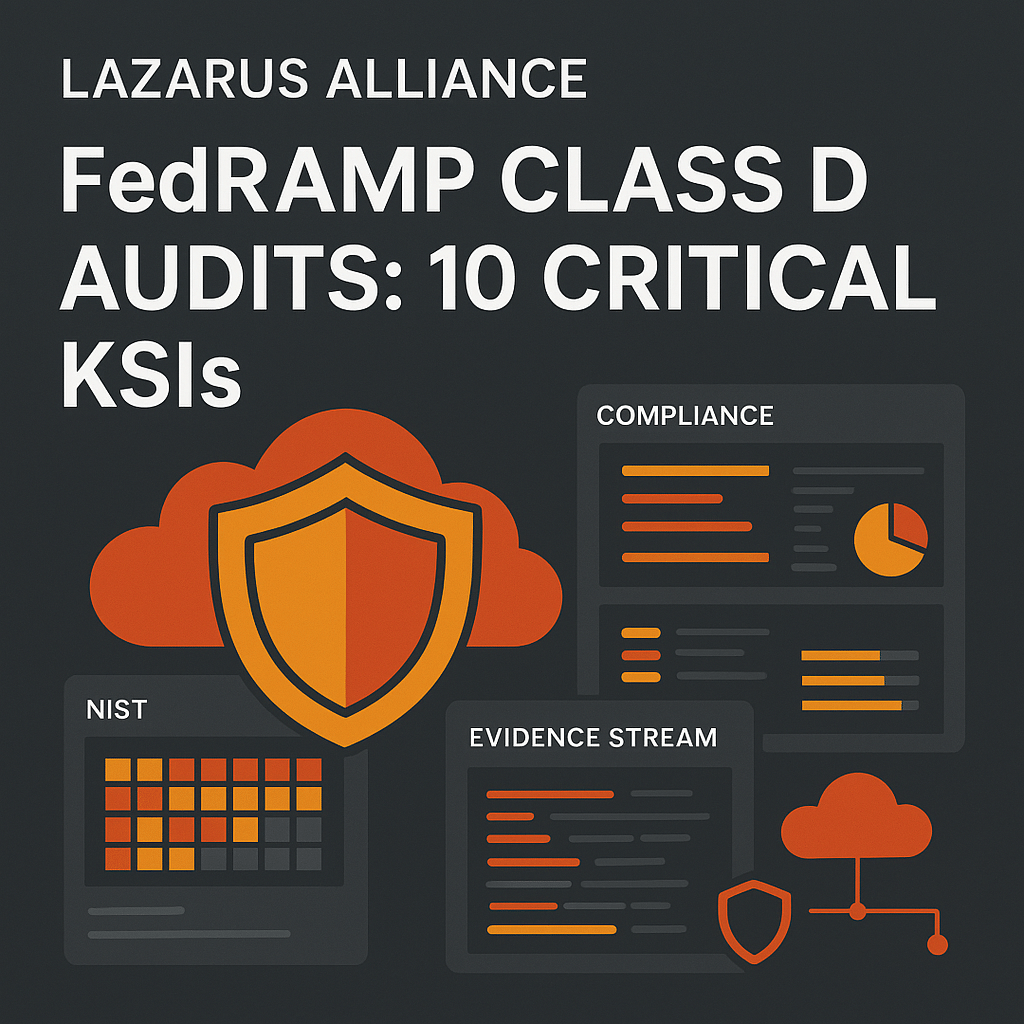
FedRAMP Class D is not simply “FedRAMP High with a faster checklist.” The strategic shift is that high-assurance cloud authorization is moving toward machine-readable evidence, repeatable validation, and continuous risk signals that can withstand scrutiny from federal agencies, mission owners, and assessors. For cloud service providers supporting sensitive federal workloads, the critical question is no longer whether a control is documented; it is whether the evidence proves the control is implemented, operating, monitored, and resilient under adversarial conditions.
FedRAMP has reported that FedRAMP 20x is moving from concept into an operating model, including 26 FedRAMP 20x certifications among 92 new FedRAMP certifications in FY26, and FedRAMP has stated that it will stop processing legacy Rev5 certification applications on June 11, 2027, according to FedRAMP, From Foundation to Implementation. The Class D discussion raises the stakes further: FedRAMP published RFC-0036 for FedRAMP 20x Class D cloud-hosted pilot requirements on October 15, 2026, with public comments open until November 19, 2026, and the RFC proposes 10 new Key Security Indicators for the highest-assurance FedRAMP 20x class, according to the FedRAMP Community RFC-0036 discussion.
For Lazarus Alliance clients, the takeaway is direct: FedRAMP Class D readiness should be treated as a high-assurance cloud risk management program, not a paperwork sprint. The ten Key Security Indicator areas below provide an audit-oriented operating model for preparing sensitive workloads for Class D expectations while preserving alignment with NIST 800-53 High, FedRAMP, GovRAMP, CJIS, CMMC, DFARS NIST 800-171, SOC 2, PCI DSS, HIPAA, IRS 1075, ISO 27001, C5, and the Lazarus Alliance Data Management Framework.
What FedRAMP Class D Means for High Assurance Cloud Programs
FedRAMP Class D should be understood as the emerging high-assurance path for cloud-hosted services that support sensitive federal workloads. FedRAMP’s RFC-0036 states that the pilot is intended to test the highest assurance FedRAMP 20x class for cloud-hosted services and includes 10 new Key Security Indicators, according to the FedRAMP Community RFC-0036 discussion. In practical audit terms, a Key Security Indicator is a measurable signal that helps determine whether the system’s security posture is trustworthy, current, and defensible.
Class D preparation should begin with NIST 800-53 High because FedRAMP security baselines are built from NIST SP 800-53 controls, and NIST SP 800-53 defines security and privacy controls for federal information systems and organizations, according to NIST SP 800-53 Rev. 5. However, the audit emphasis for Class D is likely to be less tolerant of static artifacts. A control narrative that says encryption, logging, or privileged access management exists will not be enough if evidence cannot show configuration state, coverage, exception handling, alerting, and remediation.
Lazarus Alliance approaches FedRAMP readiness as an evidence engineering discipline. Our FedRAMP audit and compliance services focus on authorization strategy, control implementation, assessment preparation, evidence quality, and continuous monitoring alignment. For organizations already operating under FISMA or NIST 800-53 programs, the Lazarus Alliance NIST 800-53 and FISMA audit services can help harmonize federal control evidence across overlapping obligations.
The Lazarus Alliance FedRAMP Class D KSI Readiness Model
The following 10 KSI areas are Lazarus Alliance’s audit-oriented interpretation of what high-assurance cloud teams should be ready to prove as FedRAMP Class D evolves. They are not a substitute for the final FedRAMP Class D requirements; they are a practical readiness model for CISOs, compliance officers, cloud architects, and federal go-to-market leaders.
1. Identity, Privilege, and Session Governance KSI
The first Class D readiness question is whether the organization can prove that privileged access is tightly governed, continuously reviewed, and attributable to individual actors. NIST SP 800-53 AC-2 addresses account management, AC-3 addresses access enforcement, AC-5 addresses separation of duties, AC-6 addresses least privilege, and IA-2 addresses identification and authentication for organizational users, according to NIST SP 800-53 Rev. 5.
Audit-ready evidence: identity provider exports, privileged access management logs, emergency access approvals, service account inventories, conditional access policies, authentication configuration, and recertification records. For Class D, assessors will expect the evidence to show not only that privileged users exist, but that access is risk-scored, time-bound, approved, monitored, and revoked when no longer required.
Common pitfall: many cloud teams can show MFA policies but cannot explain non-human identities, workload identities, CI/CD tokens, break-glass accounts, or stale service principals. In a high-assurance cloud environment, unmanaged machine identity is often the hidden privileged-access problem.
2. Cryptographic Protection and Key Custody KSI
High-assurance cloud programs must prove that sensitive federal data is protected in transit, at rest, and through the full key lifecycle. NIST SP 800-53 SC-12 addresses cryptographic key establishment and management, SC-13 addresses cryptographic protection, and SC-28 addresses protection of information at rest, according to NIST SP 800-53 Rev. 5. Federal cryptographic modules are commonly evaluated through the Cryptographic Module Validation Program, which is jointly operated by NIST and the Canadian Centre for Cyber Security, according to NIST, Cryptographic Module Validation Program.
Audit-ready evidence: encryption architecture diagrams, key management policies, key rotation records, certificate inventories, hardware security module configuration, cloud key management logs, and exception registers. Sensitive workloads should have clear answers for tenant-managed keys, customer-managed keys, key escrow, key destruction, and administrative separation between data operators and key custodians.
Scenario: a SaaS provider hosts regulated case-management data for federal users. A Class D-style review would look beyond the statement that database encryption is enabled. It would ask who can rotate keys, how access to key material is approved, whether backups inherit encryption controls, whether logs contain sensitive data, and whether cryptographic exceptions are tracked to closure.
3. Boundary, Segmentation, and Zero Trust Enforcement KSI
High-assurance cloud depends on strong logical boundaries. NIST SP 800-53 SC-7 addresses boundary protection, AC-4 addresses information flow enforcement, and SC-32 addresses system partitioning, according to NIST SP 800-53 Rev. 5. CISA describes Zero Trust as a security model that assumes no implicit trust based solely on network location and continuously evaluates access, according to CISA, Zero Trust Maturity Model.
Audit-ready evidence: network segmentation diagrams, security group rules, firewall policies, private endpoint configurations, egress controls, service mesh policies, workload isolation rules, and data flow diagrams. The strongest evidence includes automated validation that deployed cloud rules match approved architecture.
Common pitfall: cloud environments often start segmented but drift into flat architectures through temporary exceptions, developer-created rules, unmanaged peering, or overly permissive egress. For Class D, segmentation should be testable, not merely diagrammed.
4. Vulnerability, Patch, and Exposure Management KSI
Vulnerability management is a core high-assurance indicator because known exposures are a common breach pathway. NIST SP 800-53 RA-5 addresses vulnerability monitoring and scanning, SI-2 addresses flaw remediation, and CM-6 addresses configuration settings, according to NIST SP 800-53 Rev. 5. CISA maintains the Known Exploited Vulnerabilities Catalog to help organizations prioritize vulnerabilities that are known to be exploited, according to CISA, Known Exploited Vulnerabilities Catalog.
Audit-ready evidence: authenticated scan results, container image scans, infrastructure-as-code scans, software composition analysis, remediation tickets, risk acceptances, compensating controls, and rescans proving closure. A high-assurance program should tie vulnerability severity to exploitability, asset criticality, internet exposure, and mission impact.
Implementation step: create a single exposure register that combines cloud configuration findings, CVEs, container findings, endpoint vulnerabilities, third-party component issues, and penetration test observations. Assessors should be able to trace each high-risk finding from detection to disposition.
5. Continuous Logging, Detection, and Evidence Telemetry KSI
FedRAMP Class D readiness requires logging that supports both security operations and audit assurance. NIST SP 800-53 AU-2 addresses event logging, AU-6 addresses audit record review, analysis, and reporting, AU-12 addresses audit record generation, and SI-4 addresses system monitoring, according to NIST SP 800-53 Rev. 5.
Audit-ready evidence: log source inventories, SIEM ingestion status, alert rules, incident tickets, detection use cases, retention settings, time synchronization configuration, and sample event traces. For sensitive workloads, logs should cover identity events, administrative actions, network flow, data access, workload changes, security tool status, and failed control operations.
Expert perspective: logs that exist but are not reviewed are weak evidence. Logs that are reviewed but not tied to defined detections are still incomplete. The strongest Class D evidence shows detection engineering, alert triage, false-positive handling, incident escalation, and continuous tuning.
6. Secure SDLC, Supply Chain, and Change Integrity KSI
Cloud authorization increasingly depends on software supply chain assurance. NIST SP 800-53 SA-10 addresses developer configuration management, SA-11 addresses developer testing and evaluation, SA-15 addresses development process standards, and SR-family controls address supply chain risk management, according to NIST SP 800-53 Rev. 5. NIST SP 800-218 provides the Secure Software Development Framework for reducing software vulnerabilities, according to NIST SP 800-218, Secure Software Development Framework.
Audit-ready evidence: secure coding standards, threat models, pull request approvals, CI/CD pipeline controls, dependency manifests, artifact signing, build logs, static and dynamic testing results, and segregation between development and production deployment privileges. High-assurance teams should be able to prove that emergency changes do not bypass security review permanently.
Common pitfall: many organizations treat application security testing as a point-in-time gate. A Class D-oriented program should treat code, dependencies, containers, infrastructure-as-code, and pipeline identities as continuously assessed assets.
7. Configuration, Asset, and Drift Control KSI
You cannot secure what you cannot identify, baseline, and monitor. NIST SP 800-53 CM-2 addresses baseline configuration, CM-3 addresses configuration change control, CM-8 addresses system component inventory, and CA-7 addresses continuous monitoring, according to NIST SP 800-53 Rev. 5.
Audit-ready evidence: cloud asset inventories, tagging standards, approved baselines, configuration compliance dashboards, drift reports, change approvals, infrastructure-as-code repositories, and exception workflows. The asset inventory must include compute, storage, databases, serverless functions, containers, identities, APIs, encryption keys, logs, and third-party integrations.
Continuum GRC’s 2026 Audit Readiness Benchmark Report examines audit readiness practices across 275 organizations and is a useful resource for leaders evaluating how evidence quality and operational discipline affect assessment outcomes. For FedRAMP Class D, the practical lesson is that audit readiness should be continuous, not assembled after control owners receive an evidence request.
8. Incident Response, Recovery, and Resilience KSI
High-assurance cloud workloads must prove operational resilience, not merely incident response documentation. NIST SP 800-53 IR-4 addresses incident handling, IR-6 addresses incident reporting, CP-2 addresses contingency planning, CP-4 addresses contingency plan testing, CP-9 addresses system backup, and CP-10 addresses system recovery and reconstitution, according to NIST SP 800-53 Rev. 5. CISA provides federal incident reporting and response resources through its incident reporting channels, according to CISA, Report a Cyber Issue.
Audit-ready evidence: incident response plan, tabletop exercises, after-action reports, backup restoration tests, disaster recovery test results, escalation matrices, communication templates, and lessons-learned remediation. Sensitive federal workloads should have documented recovery time objectives, recovery point objectives, dependency maps, and evidence that restoration procedures actually work.
Scenario: a cloud analytics provider suffers a destructive attack against a production tenant. A Class D-style review will ask whether the provider can isolate affected resources, preserve forensic evidence, restore trusted services, validate backup integrity, notify stakeholders, and prevent recurrence through root-cause remediation.
9. Data Governance, Privacy, and Regulated Workload Mapping KSI
FedRAMP Class D readiness must connect technical controls to data sensitivity. NIST SP 800-53 PL-8 addresses security and privacy architectures, PT-family controls address personally identifiable information processing and transparency, and MP-family controls address media protection, according to NIST SP 800-53 Rev. 5. For healthcare workloads, HHS describes the HIPAA Security Rule as establishing national standards to protect electronic protected health information, according to HHS, HIPAA Security Rule. For criminal justice workloads, the FBI maintains the CJIS Security Policy Resource Center for CJIS security policy materials, according to FBI, CJIS Security Policy Resource Center.
Audit-ready evidence: data classification standards, data flow maps, tenant data isolation evidence, retention schedules, privacy impact analysis, data loss prevention rules, tokenization decisions, and regulated-data mappings. Organizations serving multiple sectors should map evidence once and reuse it across FedRAMP, CJIS, HIPAA, IRS 1075, PCI DSS, SOC 2, and ISO 27001 wherever control intent overlaps.
Lazarus Alliance supports this cross-framework strategy through specialized programs such as CJIS audit and compliance services and HIPAA audit services, helping organizations avoid duplicative evidence collection while preserving framework-specific rigor.
10. Continuous Authorization, OSCAL, and Machine-Readable Evidence KSI
The most distinctive FedRAMP 20x theme is the movement toward faster, evidence-driven authorization. FedRAMP reported 71 Initial Implementation listings and 760 new agency ATOs or ATUs in FY26, according to FedRAMP, From Foundation to Implementation. NIST’s Open Security Controls Assessment Language is designed to standardize security control information in machine-readable formats, according to NIST, OSCAL.
Audit-ready evidence: control implementation statements, assessment objectives, automated evidence feeds, control inheritance records, vulnerability data, configuration state, POA&M status, and continuous monitoring outputs. A Class D-ready organization should be able to produce evidence that is current, traceable, complete, and tied to specific control objectives.
Continuum GRC’s FedRAMP-authorized platform and A.ITAM AI auditor support risk management, evidence organization, and compliance operations for complex assurance environments, as described by Continuum GRC. The goal is not to replace assessor judgment; it is to improve evidence precision, reduce manual assembly, and help control owners maintain audit posture between formal assessments.
How to Prepare for FedRAMP Class D Compliance Assessments
A successful Class D readiness program should begin with a control-to-evidence matrix. Each NIST 800-53 High control should have an owner, implementation statement, authoritative evidence source, collection frequency, test method, exception path, and remediation workflow. NIST SP 800-53A provides assessment procedures for determining whether controls are implemented correctly, operating as intended, and producing the desired outcome, according to NIST SP 800-53A Rev. 5.
Lazarus Alliance recommends the following Class D readiness sequence:
- Define authorization scope: identify boundaries, interconnections, inherited controls, tenant responsibilities, and federal data types.
- Map KSIs to NIST 800-53 High: align identity, encryption, logging, vulnerability, incident response, supply chain, and data governance evidence to specific control objectives.
- Validate implementation: test deployed configurations against documented architecture instead of relying on policy-only artifacts.
- Automate evidence where defensible: use APIs, cloud-native logs, configuration exports, and OSCAL-compatible evidence structures where possible.
- Run assessor-style testing: sample tickets, inspect settings, trace access, verify remediation, and challenge risk acceptances before the formal assessment.
- Operate continuous monitoring: maintain dashboards for vulnerabilities, configuration drift, privileged access, incidents, POA&M items, and control exceptions.
Cross-Framework Impact: FedRAMP Class D Beyond Federal Cloud
FedRAMP Class D preparation can strengthen broader compliance programs because the same evidence often supports multiple assurance obligations. GovRAMP and state cloud procurement programs commonly rely on NIST 800-53-style assurance concepts, and Lazarus Alliance provides GovRAMP audit and compliance services for organizations pursuing state and local cloud trust requirements. Defense contractors can reuse portions of identity, access control, incident response, configuration, and audit evidence for CMMC and DFARS NIST 800-171 readiness, while payment, healthcare, and law-enforcement providers can align evidence to PCI DSS, HIPAA, and CJIS expectations.
The key is control rationalization. A single privileged access review may support NIST 800-53 AC-2, SOC 2 common criteria, ISO 27001 access control expectations, CJIS access management, and internal risk governance. However, assessors will still evaluate framework-specific requirements, sampling rules, evidence periods, and scope boundaries. Reuse is powerful only when the evidence is accurate for each framework’s control intent.
Executive Takeaways for Sensitive Federal Workloads
FedRAMP Class D is a signal that federal cloud assurance is becoming more rigorous, more telemetry-driven, and more continuous. The organizations that succeed will be those that treat Key Security Indicators as operational controls rather than assessment labels. They will know who has access, where data resides, how configurations drift, which vulnerabilities matter, whether backups restore, how incidents escalate, and whether evidence can be produced without heroic manual effort.
For CISOs and compliance leaders, the immediate action is to test the evidence chain. Select one critical workload and trace 10 items: a privileged user, a service account, a data store, an encryption key, a firewall rule, a vulnerability, a code deployment, a log source, an incident ticket, and a backup restoration. If any item cannot be traced from policy to implementation to operating evidence, that is where Class D readiness work should begin.
Lazarus Alliance helps cloud providers, federal contractors, healthcare technology vendors, financial services organizations, and government suppliers build assessment-ready compliance programs that stand up to high-assurance scrutiny. FedRAMP Class D may be emerging, but the disciplines it demands are already clear: strong governance, technical depth, continuous evidence, and disciplined cloud risk management.
Sources and References
- FedRAMP, From Foundation to Implementation, https://www.fedramp.gov/2026-10-08-from-foundation-to-implementation/
- FedRAMP Community, RFC-0036 FedRAMP 20x Class D Cloud-Hosted Pilot Requirements, https://github.com/FedRAMP/community/discussions/180
- NIST, SP 800-53 Rev. 5 Security and Privacy Controls, https://csrc.nist.gov/pubs/sp/800/53/r5/upd1/final
- NIST, SP 800-53A Rev. 5 Assessing Security and Privacy Controls, https://csrc.nist.gov/pubs/sp/800/53/a/r5/final
- NIST, Cryptographic Module Validation Program, https://csrc.nist.gov/projects/cryptographic-module-validation-program
- CISA, Zero Trust Maturity Model, https://www.cisa.gov/zero-trust-maturity-model
- CISA, Known Exploited Vulnerabilities Catalog, https://www.cisa.gov/known-exploited-vulnerabilities-catalog
- NIST, SP 800-218 Secure Software Development Framework, https://csrc.nist.gov/pubs/sp/800/218/final
- CISA, Report a Cyber Issue, https://www.cisa.gov/report
- HHS, HIPAA Security Rule, https://www.hhs.gov/hipaa/for-professionals/security/index.html
- FBI, CJIS Security Policy Resource Center, https://le.fbi.gov/cjis-division/cjis-security-policy-resource-center
- NIST, Open Security Controls Assessment Language, https://pages.nist.gov/OSCAL/
- Lazarus Alliance, FedRAMP Audit and Compliance Services, https://lazarusalliance.com/services/audit-compliance/fedramp/
- Lazarus Alliance, NIST 800-53 and FISMA Audit Services, https://lazarusalliance.com/fisma-nist-audit/
- Lazarus Alliance, CJIS Audit and Compliance Services, https://lazarusalliance.com/criminal-justice-information-services-cjis/
- Lazarus Alliance, HIPAA Audit Services, https://lazarusalliance.com/services/audit-compliance/hipaa-audit/
- Lazarus Alliance, GovRAMP Audit and Compliance Services, https://lazarusalliance.com/services/audit-compliance/stateramp/
- Continuum GRC, 2026 Audit Readiness Benchmark Report, https://continuumgrc.com/2026-audit-readiness-benchmark-report/
- Continuum GRC, FedRAMP-Authorized GRC Platform, https://continuumgrc.com/
About Lazarus Alliance
To learn more about how Lazarus Alliance can help, contact us.
- FedRAMP
- GovRAMP
- NIST 800-53
- DFARS NIST 800-171
- CMMC
- SOC 1 & SOC 2
- C5
- HIPAA, HITECH, & Meaningful Use
- PCI DSS RoC & SAQ
- IRS 1075 & 4812
- CJIS
- LA DMF
- ISO 27001, ISO 27002, ISO 27005, ISO 27017, ISO 27018, ISO 27701, ISO 22301, ISO 17020, ISO 17021, ISO 17025, ISO 17065, ISO 9001, & ISO 90003
- And dozens more!
Related Posts