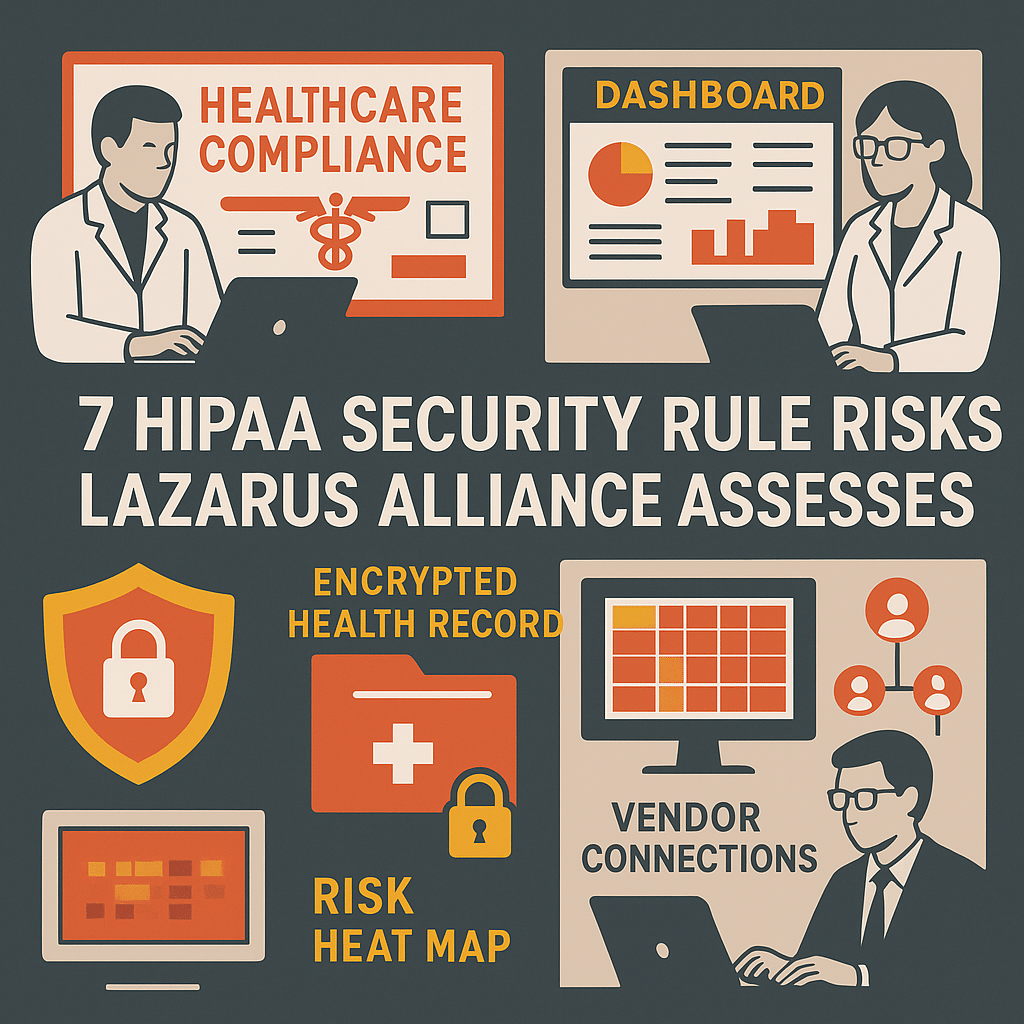
Why HIPAA risk analysis fails when it becomes a paperwork exercise
The strongest HIPAA Security Rule programs do not begin with a template. They begin with a defensible understanding of where electronic protected health information, or ePHI, is created, received, maintained, transmitted, accessed, logged, backed up, and shared. The HIPAA Security Rule establishes national standards for protecting ePHI, and covered entities and business associates must implement administrative, physical, and technical safeguards appropriate to their environments, according to HHS, Summary of the HIPAA Security Rule.
The contrarian truth is that many healthcare organizations do not fail HIPAA because they lack security tools. They fail because risk analysis, evidence collection, vendor oversight, configuration management, and executive governance operate in separate lanes. Lazarus Alliance assesses HIPAA Security Rule risk as an integrated compliance and cybersecurity problem: the same identity, encryption, monitoring, vulnerability, incident response, and third-party controls that support HIPAA also support NIST 800-53, SOC 2, PCI DSS, FedRAMP, GovRAMP, CJIS, CMMC, ISO 27001, IRS 1075, C5, and LADMF readiness when properly mapped and evidenced.
That integrated view matters in 2026. The Center for Internet Security reports that the final HIPAA Security Rule update is listed for July 2027, while emphasizing that the current Security Rule remains fully in effect and enforceable; CIS also notes that OCR has pointed regulated entities toward standardized security baselines and ongoing hardening rather than one-time configuration work, according to Center for Internet Security, Healthcare Cybersecurity: What Regulators Are Looking For Now.
Below are seven HIPAA Security Rule risks Lazarus Alliance assesses during HIPAA risk analysis, healthcare compliance reviews, cybersecurity audits, and compliance assessments. Each risk includes the audit issue, technical implications, common pitfalls, and practical remediation steps.
1. Incomplete HIPAA Security Rule scope and ePHI data-flow visibility
The first risk is not a firewall problem; it is a scoping problem. HIPAA risk analysis must cover systems that create, receive, maintain, or transmit ePHI, and the Security Rule requires an accurate and thorough assessment of potential risks and vulnerabilities to the confidentiality, integrity, and availability of ePHI under 45 CFR 164.308(a)(1)(ii)(A), as stated in eCFR, 45 CFR 164.308.
Lazarus Alliance often assesses whether the organization can prove the path of ePHI across the electronic health record, revenue-cycle platforms, telehealth applications, imaging repositories, laboratory interfaces, cloud storage, data warehouses, endpoint devices, secure messaging tools, backup platforms, and third-party integrations. HHS guidance explains that risk analysis should identify where ePHI is stored, received, maintained, or transmitted, according to HHS OCR, Guidance on Risk Analysis Requirements under the HIPAA Security Rule.
Common gap: the asset inventory lists servers and applications but omits APIs, shadow reporting databases, exported spreadsheets, scanning folders, remote monitoring tools, or software-as-a-service platforms used by clinical and administrative teams. In an audit, unsupported scope decisions can invalidate otherwise mature technical safeguards because the evidence does not demonstrate coverage of all relevant ePHI locations.
Implementation steps:
- Build an ePHI data-flow map that includes system owner, data type, transmission channel, authentication method, encryption status, logging source, backup location, and business associate relationship.
- Classify systems by ePHI exposure, clinical criticality, internet exposure, privileged access, and recovery priority.
- Use the ePHI inventory as the authoritative scope for HIPAA risk analysis, vulnerability management, vendor risk management, incident response planning, and audit evidence collection.
2. Risk analysis without risk treatment, ownership, and measurable remediation
The second risk is treating HIPAA risk analysis as a static document rather than a management process. The Security Rule requires covered entities and business associates to implement security measures sufficient to reduce risks and vulnerabilities to a reasonable and appropriate level under 45 CFR 164.308(a)(1)(ii)(B), as provided in eCFR, 45 CFR 164.308.
In practice, Lazarus Alliance assesses whether each risk has a defined owner, likelihood rationale, impact rationale, affected ePHI assets, mapped safeguards, treatment decision, remediation milestone, compensating control, residual-risk decision, and executive acceptance when risk remains. NIST SP 800-66 Rev. 2 provides implementation guidance for applying the HIPAA Security Rule through a structured risk management lens, according to NIST, SP 800-66 Rev. 2.
Audit example: a hospital identifies unsupported operating systems in a clinical subnet but does not document device owners, segmentation rules, patch constraints, compensating monitoring, biomedical vendor dependencies, or target decommission dates. The finding is not simply that legacy systems exist. The finding is that risk treatment cannot be validated.
Implementation steps:
- Use a risk register that links each HIPAA risk to specific assets, controls, evidence, exceptions, and corrective action plans.
- Require risk owners to update status at least during governance reviews and after material environmental changes such as new integrations, acquisitions, cloud migrations, or high-impact vulnerabilities.
- Align risk scoring with enterprise cyber governance by using functions such as Govern, Identify, Protect, Detect, Respond, and Recover from the NIST Cybersecurity Framework 2.0, described by NIST, Cybersecurity Framework.
3. Access control weaknesses across users, administrators, service accounts, and clinical workflows
The third risk is inadequate access governance. HIPAA requires workforce security controls, information access management, access authorization, and access establishment or modification under 45 CFR 164.308(a)(3) and 164.308(a)(4), as stated in eCFR, 45 CFR 164.308. HIPAA technical safeguards also include access control requirements such as unique user identification, emergency access procedures, automatic logoff, and encryption and decryption mechanisms under 45 CFR 164.312(a), as provided in eCFR, 45 CFR 164.312.
Lazarus Alliance examines access at several levels: human users, privileged administrators, break-glass accounts, shared clinical workstations, service accounts, application programming interfaces, robotic process automation, managed service accounts, and vendor support channels. This is where HIPAA technical safeguards intersect with NIST 800-53 controls such as AC-2 for account management, AC-6 for least privilege, IA-2 for identification and authentication, and AU-2 for event logging, as cataloged in NIST, SP 800-53 Rev. 5.
Common gap: user access reviews focus on employees but exclude local administrators, database administrators, integration accounts, cloud console users, EHR super users, and vendor remote access. Another frequent issue is that emergency access accounts exist but are not monitored, tested, or reviewed after use.
Implementation steps:
- Define role-based access for clinical, billing, administrative, IT, security, and vendor personas, then test whether production access matches approved roles.
- Require multifactor authentication for privileged access, remote access, cloud administration, and high-risk applications where feasible and documented.
- Track joiner-mover-leaver evidence, access approvals, privileged access reviews, terminated-user deprovisioning, and emergency-access reviews as audit-ready artifacts.
4. Audit controls and monitoring that do not support detection, investigation, or accountability
The fourth risk is insufficient logging. HIPAA requires audit controls that record and examine activity in information systems that contain or use ePHI under 45 CFR 164.312(b), and it requires mechanisms to authenticate ePHI and corroborate that it has not been altered or destroyed in an unauthorized manner under 45 CFR 164.312(c), according to eCFR, 45 CFR 164.312.
Logging is not audit-ready merely because a system has logs. Lazarus Alliance assesses whether logs are enabled, centralized, normalized, protected from alteration, correlated with identity, retained according to policy, reviewed for suspicious activity, and used during incident response. For healthcare environments, monitoring must cover EHR access, privileged changes, cloud storage access, endpoint alerts, remote access, VPN activity, email security events, database activity, API calls, backup administration, and vendor support sessions.
Scenario: a compliance team can show that the EHR records chart access, but the organization cannot correlate that access with identity provider events, endpoint location, privileged-role assignment, or data-export activity. The audit issue becomes whether the organization can detect inappropriate access and reconstruct events involving ePHI.
Implementation steps:
- Define log sources required for ePHI systems, including identity, endpoint, network, application, database, cloud, email, and backup telemetry.
- Create detection rules for anomalous chart access, mass export activity, after-hours privileged access, impossible travel, disabled logging, failed login spikes, and unusual vendor access.
- Test incident reconstruction by selecting a user, application, ePHI record type, and timeframe, then validating whether the evidence supports a defensible investigation timeline.
5. Weak technical safeguards for encryption, configuration, vulnerability management, and ransomware resilience
The fifth risk is technical safeguard drift. HIPAA transmission security requires measures to guard against unauthorized access to ePHI transmitted over an electronic communications network under 45 CFR 164.312(e), and encryption is identified in the access control and transmission security standards as an addressable implementation specification under 45 CFR 164.312(a)(2)(iv) and 164.312(e)(2)(ii), as provided in eCFR, 45 CFR 164.312.
Addressable does not mean optional. HHS explains that covered entities must assess whether an addressable implementation specification is reasonable and appropriate and must implement it if reasonable and appropriate or document an equivalent alternative if not, according to HHS, Summary of the HIPAA Security Rule.
Lazarus Alliance assesses encryption at rest, encryption in transit, key management, certificate lifecycle, endpoint disk encryption, database encryption, object-storage policies, secure email, backups, and media handling. We also assess hardening baselines, vulnerability management, patch governance, endpoint detection, network segmentation, secure configuration, and penetration-testing evidence. The threat context is material: Verizon analyzed 31,861 security incidents and 22,625 confirmed data breaches in its 2026 DBIR; the report states that 31% of breaches began with vulnerability exploitation, 48% involved ransomware, 48% involved a third party, 62% involved the human element, and the median full remediation time for KEV vulnerabilities was 43 days, according to Verizon, 2026 Data Breach Investigations Report.
Implementation steps:
- Baseline ePHI systems against hardened configuration standards, then track exceptions with risk acceptance and expiration dates.
- Prioritize exploited vulnerabilities, internet-facing assets, identity infrastructure, remote access, EHR dependencies, and backup systems.
- Validate ransomware resilience through immutable backups, restore testing, segmented administrative access, endpoint containment, and incident-response tabletop exercises.
6. Vendor risk management and business associate oversight that stop at contract execution
The sixth risk is treating vendor risk management as a legal workflow instead of an operational security process. HIPAA requires business associate arrangements and written contracts or other arrangements where a business associate creates, receives, maintains, or transmits ePHI on behalf of a covered entity, as described in 45 CFR 164.308(b) and 45 CFR 164.314(a) in eCFR, 45 CFR 164.308 and eCFR, 45 CFR 164.314.
Lazarus Alliance assesses whether business associate agreements are supported by vendor security due diligence, data-flow validation, subprocessors, cloud architecture, access controls, audit logging, breach-notification workflows, incident escalation, encryption, backup posture, and termination procedures. This is especially important for cloud-hosted clinical platforms, revenue-cycle vendors, managed IT providers, AI-enabled documentation tools, medical device vendors, billing clearinghouses, telehealth platforms, and analytics providers.
Common misconception: a signed business associate agreement proves HIPAA compliance. It does not. The agreement is necessary, but assessors also look for a risk-based process showing how the organization evaluates, monitors, and responds to vendor risk. Lazarus Alliance supports healthcare organizations through HIPAA audits and assessments via Lazarus Alliance HIPAA audit services, and vendor oversight can be operationalized through structured workflows such as Continuum GRC third-party and vendor risk management.
Implementation steps:
- Tier vendors by ePHI volume, system criticality, connectivity, privileged access, hosting model, geographic exposure, and incident impact.
- Request evidence appropriate to vendor risk, such as SOC 2 reports, penetration-test summaries, vulnerability management metrics, encryption architecture, disaster-recovery test results, and incident-response procedures.
- Track remediation findings, renewal dates, subcontractor changes, offshore access, breach-notification commitments, and termination or data-return obligations.
7. Incident response, contingency planning, and evidence readiness that cannot withstand scrutiny
The seventh risk is weak operational resilience. HIPAA requires security incident procedures under 45 CFR 164.308(a)(6), including response and reporting, and contingency planning under 45 CFR 164.308(a)(7), including data backup plans, disaster recovery plans, emergency mode operation plans, testing and revision procedures, and applications and data criticality analysis, according to eCFR, 45 CFR 164.308.
Lazarus Alliance assesses whether incident response and contingency plans are executable under pressure. We review escalation paths, legal and privacy coordination, forensic preservation, breach assessment workflows, communications approvals, ransomware playbooks, clinical downtime procedures, backup restoration, cyber insurance coordination, law-enforcement decision points, and post-incident corrective action. We also examine whether evidence is retained in a way that supports cybersecurity audits, compliance assessments, and regulatory inquiries.
Audit-ready evidence includes:
- Current incident response plans, tabletop exercise records, after-action reports, and corrective action tracking.
- Backup schedules, restore test results, disaster recovery objectives, emergency-mode workflows, and downtime procedure validation.
- Security-event tickets, escalation records, forensic images or preservation decisions, executive briefings, and remediation evidence.
For organizations managing multiple frameworks, Lazarus Alliance often maps HIPAA controls to NIST 800-53, SOC 2 Trust Services Criteria, PCI DSS, CJIS, FedRAMP, GovRAMP, CMMC, DFARS NIST 800-171, ISO 27001, IRS 1075, C5, and LADMF evidence domains. That mapping reduces audit fatigue because the same artifact can support multiple obligations when scope, control intent, ownership, and evidence quality are clear. Organizations can support broader control testing through Lazarus Alliance Laboratories and manage risk registers, evidence, and corrective actions through Continuum GRC IT and cybersecurity risk management.
The Lazarus Alliance VERIFY-7 assessment model for HIPAA risk analysis
Lazarus Alliance applies a practical VERIFY-7 model to HIPAA Security Rule reviews:
- V – Validate scope: confirm ePHI systems, data flows, vendors, users, integrations, and environments.
- E – Examine risk: assess threats, vulnerabilities, likelihood, impact, control maturity, and residual risk.
- R – Review safeguards: test administrative, physical, and technical safeguards against HIPAA requirements.
- I – Inspect evidence: verify that policies, configurations, tickets, logs, reports, and approvals prove control operation.
- F – Find gaps: identify root causes, control design failures, operating failures, and documentation gaps.
- Y – Yield remediation: prioritize corrective actions by risk, regulatory impact, exploitability, and operational dependency.
- 7 – Sustain seven risk domains: scope, risk treatment, access, monitoring, technical safeguards, vendors, and resilience.
This approach gives CISOs, compliance officers, IT directors, privacy officers, and executive leadership a defensible view of healthcare compliance risk. The goal is not merely to pass an assessment. The goal is to show that HIPAA risk analysis drives real security decisions, measurable remediation, and repeatable evidence collection.
Key takeaways for healthcare compliance leaders
- HIPAA Security Rule risk analysis must be tied to real ePHI systems, data flows, technical safeguards, and business associate dependencies.
- Audit readiness depends on evidence quality: screenshots alone rarely prove sustained control operation.
- Vendor risk management must extend beyond business associate agreements into technical validation, monitoring, and remediation tracking.
- Ransomware, vulnerability exploitation, third-party exposure, and human factors should directly influence HIPAA risk scoring and corrective action planning.
- Cross-framework mapping can reduce duplicate work across HIPAA, NIST 800-53, SOC 2, PCI DSS, FedRAMP, GovRAMP, CJIS, CMMC, ISO 27001, IRS 1075, C5, and LADMF when evidence is structured correctly.
For healthcare organizations, HIPAA compliance is not a checkbox. It is a governance discipline, a technical control program, and an operational resilience obligation. Lazarus Alliance assesses the seven risks above to help organizations strengthen cybersecurity, support regulatory compliance, and build evidence that stands up to scrutiny.
Sources and References
- HHS, Summary of the HIPAA Security Rule, https://www.hhs.gov/hipaa/for-professionals/security/laws-regulations/index.html
- HHS OCR, Guidance on Risk Analysis Requirements under the HIPAA Security Rule, https://www.hhs.gov/hipaa/for-professionals/security/guidance/guidance-risk-analysis/index.html
- eCFR, 45 CFR 164.308, https://www.ecfr.gov/current/title-45/subtitle-A/subchapter-C/part-164/subpart-C/section-164.308
- eCFR, 45 CFR 164.312, https://www.ecfr.gov/current/title-45/subtitle-A/subchapter-C/part-164/subpart-C/section-164.312
- eCFR, 45 CFR 164.314, https://www.ecfr.gov/current/title-45/subtitle-A/subchapter-C/part-164/subpart-C/section-164.314
- NIST, SP 800-66 Rev. 2, https://csrc.nist.gov/pubs/sp/800/66/r2/final
- NIST, SP 800-53 Rev. 5, https://csrc.nist.gov/pubs/sp/800/53/r5/upd1/final
- NIST, Cybersecurity Framework, https://www.nist.gov/cyberframework
- Center for Internet Security, Healthcare Cybersecurity: What Regulators Are Looking For Now, https://www.cisecurity.org/insights/blog/healthcare-cybersecurity-what-regulators-are-looking-for-now
- Verizon, 2026 Data Breach Investigations Report, https://www.verizon.com/business/resources/reports/2026-dbir-data-breach-investigations-report.pdf
- Lazarus Alliance, HIPAA Audit Services, https://lazarusalliance.com/services/audit-compliance/hipaa-audit/
- Lazarus Alliance Laboratories, https://lazarusalliance.com/lazarus-alliance-laboratories/
- Continuum GRC, Third-Party and Vendor Risk, https://continuumgrc.com/third-party-vendor-risk/
- Continuum GRC, IT and Cybersecurity Risk Management, https://continuumgrc.com/risk-management-audit/
About Lazarus Alliance
To learn more about how Lazarus Alliance can help, contact us.
- FedRAMP
- GovRAMP
- NIST 800-53
- DFARS NIST 800-171
- CMMC
- SOC 1 & SOC 2
- C5
- HIPAA, HITECH, & Meaningful Use
- PCI DSS RoC & SAQ
- IRS 1075 & 4812
- CJIS
- LA DMF
- ISO 27001, ISO 27002, ISO 27005, ISO 27017, ISO 27018, ISO 27701, ISO 22301, ISO 17020, ISO 17021, ISO 17025, ISO 17065, ISO 9001, & ISO 90003
- And dozens more!
Related Posts