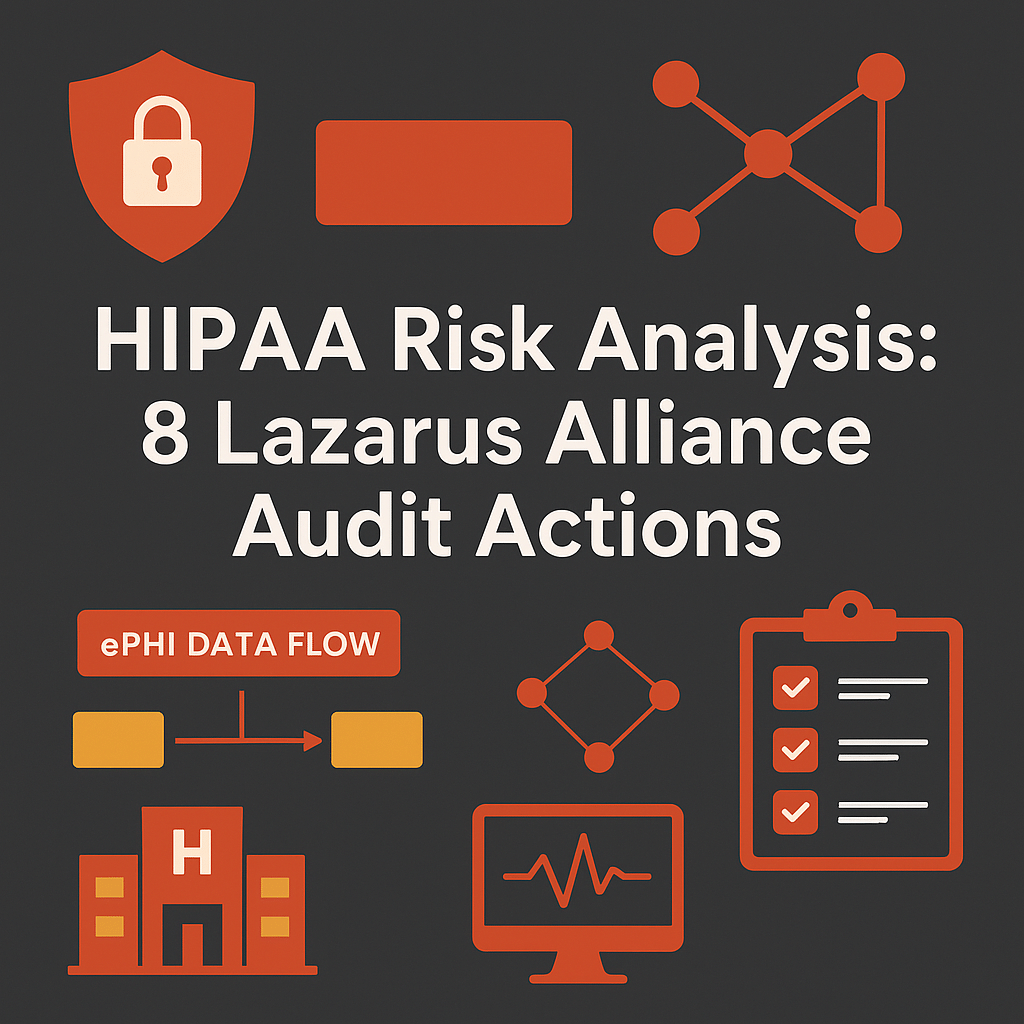
HIPAA risk analysis is no longer a paperwork exercise. In the current healthcare threat environment, the practical question is not whether an organization has a risk analysis document, but whether that document can withstand OCR scrutiny, support defensible risk management decisions, and prove that electronic protected health information, or ePHI, is protected across applications, cloud platforms, medical devices, vendors, and identity systems.
The contrarian lesson from modern HIPAA Security Rule readiness is simple: many organizations fail because they treat risk analysis as a compliance artifact instead of an evidence-backed operating model. The Security Rule requires covered entities and business associates to implement policies and procedures that prevent, detect, contain, and correct security violations, and it requires an accurate and thorough assessment of potential risks and vulnerabilities to the confidentiality, integrity, and availability of ePHI under the administrative safeguards at 45 CFR 164.308. OCR guidance likewise emphasizes that risk analysis must identify where ePHI is stored, received, maintained, or transmitted, and must assess threats, vulnerabilities, likelihood, impact, and risk levels in a documented manner, according to HHS OCR, Guidance on Risk Analysis.
For healthcare executives, CISOs, compliance officers, and IT directors, the modernization signal is unmistakable. The proposed HIPAA Security Rule update would add more explicit expectations for items such as technology asset inventories, network maps, vulnerability scanning, penetration testing, multifactor authentication, encryption, annual compliance audits, business associate verification, and recovery procedures, as described in the Federal Register, HIPAA Security Rule To Strengthen the Cybersecurity of Electronic Protected Health Information. Even before finalization, these items reflect where OCR enforcement and assessor expectations are heading: traceable evidence, repeatable control testing, and risk-based remediation.
HIPAA Risk Analysis in 2026: What OCR Expects to See
A HIPAA risk analysis is a formal, documented assessment of how ePHI could be compromised and whether existing safeguards reduce risk to a reasonable and appropriate level. Under the HIPAA Security Rule, risk analysis is required at 45 CFR 164.308(a)(1)(ii)(A), while risk management is required at 45 CFR 164.308(a)(1)(ii)(B). These are separate but inseparable activities: analysis identifies and evaluates risk; risk management prioritizes, funds, assigns, and verifies corrective action.
OCR enforcement commonly focuses on whether the organization performed an enterprise-wide analysis, whether ePHI locations were fully considered, whether risks were ranked consistently, and whether remediation was tracked to closure. HHS describes HIPAA compliance enforcement through complaint investigations, compliance reviews, and corrective action processes in HHS OCR, Enforcement Examples. For breach response, covered entities must also consider the HIPAA Breach Notification Rule, including notification duties for breaches of unsecured protected health information, as summarized by HHS OCR, Breach Notification Rule.
The most important audit principle is scope completeness. A risk analysis that excludes billing systems, cloud file shares, remote access tools, imaging platforms, patient portals, APIs, backup environments, or business associate integrations is usually not defensible. Lazarus Alliance helps healthcare organizations prepare for independent review through structured healthcare compliance assessments, HIPAA audit readiness, and control validation services described in Lazarus Alliance, HIPAA Audit Services.
8 Lazarus Alliance Audit Actions for HIPAA Security Rule Modernization
1. Define ePHI scope with asset inventory and data-flow mapping
The first audit action is to prove where ePHI exists and how it moves. This includes EHR platforms, revenue cycle systems, laboratory interfaces, telehealth tools, clinical messaging, SFTP workflows, data warehouses, backups, endpoint caches, identity stores, SIEM logs, and cloud object storage. The Security Rule applies to ePHI that is created, received, maintained, or transmitted by covered entities and business associates, and the general requirements are established at 45 CFR 164.306.
Audit evidence to collect: a technology asset inventory, application owner list, ePHI data-flow diagrams, interface inventories, network segmentation diagrams, system boundary descriptions, cloud service responsibility matrices, and business associate data exchange maps. The proposed Security Rule modernization would make technology asset inventories and network maps more explicit, according to the Federal Register proposal.
Example: A hospital may believe its risk analysis covers only the EHR. In practice, ePHI may also reside in radiology workstations, dictation tools, claims clearinghouse exports, patient engagement SaaS platforms, and temporary analytics extracts. If these systems are absent from the asset inventory, the risk analysis is incomplete before threats and controls are even evaluated.
2. Build a defensible threat, vulnerability, likelihood, and impact model
The second audit action is to standardize how risk is scored. OCR risk analysis guidance describes core activities such as identifying threats and vulnerabilities, assessing current security measures, determining likelihood and impact, assigning risk levels, and documenting results, according to HHS OCR, Guidance on Risk Analysis. A mature scoring model should distinguish between inherent risk, control effectiveness, residual risk, and risk acceptance.
Implementation detail: use a repeatable scale such as likelihood from 1 to 5 and impact from 1 to 5, but do not stop there. Define impact criteria for patient safety, ePHI volume, regulatory exposure, operational downtime, financial loss, and reputational harm. Tie vulnerabilities to observable evidence, such as unencrypted databases, unsupported operating systems, excessive privileged access, weak logging, failed backups, missing endpoint detection, or inadequate vendor due diligence.
Audit pitfall: risk registers that list generic risks, such as ransomware, without identifying vulnerable assets, exposed data, control gaps, owners, due dates, and remediation evidence. Auditors expect traceability from risk statement to control deficiency to corrective action.
3. Validate administrative safeguards, not just technical tools
HIPAA risk management depends on governance. The administrative safeguards in 45 CFR 164.308 include security management processes, assigned security responsibility, workforce security, information access management, security awareness and training, security incident procedures, contingency planning, and evaluation. A healthcare compliance assessment should test whether these safeguards operate, not merely whether policies exist.
Audit evidence to collect: security committee minutes, board reporting, risk acceptance approvals, sanctions policy enforcement, workforce access authorization records, phishing training records, incident response exercises, backup restoration tests, disaster recovery results, and periodic evaluation reports. HHS OCR risk management guidance explains that covered entities must implement security measures sufficient to reduce risks and vulnerabilities to a reasonable and appropriate level, according to HHS OCR, Guidance on Risk Management.
Expert perspective: Lazarus Alliance auditors often look for the bridge between executive governance and operational control performance. If leadership accepts a high-risk exposure, the decision should be documented with compensating controls, expiration dates, and re-review triggers.
4. Test access control, identity, MFA, and privileged access
Technical safeguards at 45 CFR 164.312 include access control, audit controls, integrity, person or entity authentication, and transmission security. In practical audit terms, identity is one of the highest-value HIPAA control domains because compromised credentials can expose ePHI across EHR, VPN, cloud, email, and administrative systems.
Testing procedures: sample new hires, transfers, terminations, privileged users, emergency access accounts, service accounts, API keys, and remote access groups. Confirm that access is approved, role-based, reviewed, logged, and removed promptly. Map HIPAA access expectations to NIST control concepts such as AC-2 for account management, AC-6 for least privilege, IA-2 for identification and authentication, and AU-2 for event logging in NIST SP 800-53 Revision 5.
Modernization signal: the proposed Security Rule would make MFA more explicit for many environments, according to the Federal Register proposal. Audit teams should already verify MFA coverage for remote access, privileged access, cloud administration, email, VPN, EHR administrative functions, and third-party support.
5. Prove encryption, transmission security, logging, and integrity controls
The Security Rule includes addressable implementation specifications, but addressable does not mean optional. Under 45 CFR 164.306(d), an entity must assess whether an addressable specification is reasonable and appropriate, implement it if so, or document an equivalent alternative if not. Encryption and transmission security must therefore be evaluated in context, documented, and supported by risk analysis.
Audit evidence to collect: encryption standards, key management procedures, TLS configuration results, database encryption settings, endpoint encryption reports, mobile device controls, email security configurations, SIEM alert rules, audit log retention settings, and integrity monitoring. Map these controls to NIST concepts such as SC-13 for cryptographic protection, SC-8 for transmission confidentiality and integrity, AU-6 for audit record review, and SI-7 for software and information integrity in NIST SP 800-53 Revision 5.
Scenario: A healthcare SaaS provider encrypts production databases but stores nightly exports in an analytics bucket with weaker access controls. The risk analysis should identify the export workflow, classify the data as ePHI, evaluate storage and access risks, and require remediation evidence such as bucket policies, encryption settings, access reviews, and logging.
6. Operationalize vulnerability scanning, penetration testing, and remediation
Risk analysis must be continuously informed by technical findings. The proposed Security Rule would add more explicit requirements for vulnerability scanning at least every six months and penetration testing at least every twelve months, according to the Federal Register proposal. Even where an organization is still operating under the current Security Rule, these practices are becoming baseline expectations for healthcare risk management.
Audit evidence to collect: authenticated internal scans, external scans, cloud configuration scans, container and image scans, web application testing, penetration test reports, retest evidence, remediation tickets, exception approvals, and executive risk reporting. Lazarus Alliance Laboratories supports technical validation activities such as testing and evidence development through Lazarus Alliance Laboratories.
Common gap: vulnerability reports exist, but they are not tied to ePHI systems, compensating controls, business owners, service-level targets, or risk register updates. Auditors will look for closed-loop remediation, not just scan output.
7. Assess business associates and third-party ePHI dependencies
Business associate risk is central to healthcare compliance because vendors may create, receive, maintain, or transmit ePHI on behalf of covered entities. HIPAA business associate contract requirements are addressed at 45 CFR 164.314. Vendor risk management should therefore be integrated into the HIPAA risk analysis, not performed as a separate procurement checklist.
Audit evidence to collect: business associate agreements, vendor inventories, data classification, subcontractor disclosures, security questionnaires, SOC reports where applicable, incident notification commitments, encryption requirements, access methods, offshore support restrictions, termination procedures, and periodic reassessments. Continuum GRC supports third-party risk evidence management and vendor oversight workflows through Continuum GRC, Third-Party and Vendor Risk.
Example: A patient billing vendor may use a subcontracted cloud platform, offshore support desk, and separate analytics provider. A defensible HIPAA risk analysis should identify each dependency, confirm contractual controls, evaluate technical access, and document residual risk.
8. Convert risk analysis into measurable risk management and audit-ready evidence
The final audit action is the one organizations most often neglect: convert findings into a funded, governed, measurable risk management plan. Risk management under 45 CFR 164.308(a)(1)(ii)(B) requires implementing security measures sufficient to reduce risks and vulnerabilities to a reasonable and appropriate level. That means each material risk needs an owner, treatment decision, budget path, due date, evidence requirement, and verification method.
Decision matrix:
- Remediate: fix control gaps such as missing MFA, unsupported systems, or unencrypted storage.
- Mitigate: add compensating controls such as segmentation, monitoring, endpoint controls, or restricted access.
- Transfer: use contractual, insurance, or managed service arrangements while recognizing that accountability remains with the regulated entity.
- Accept: document the business rationale, residual risk, approval authority, expiration date, and monitoring criteria.
Continuum GRC supports risk register management, control mapping, and audit evidence workflows through Continuum GRC, IT and Cybersecurity Risk. The objective is not to create more spreadsheets; it is to maintain a living evidence model that connects assets, controls, risks, vendors, vulnerabilities, incidents, and remediation.
How HIPAA Risk Analysis Connects to NIST, SOC 2, PCI DSS, FedRAMP, CJIS, CMMC, ISO 27001, IRS 1075, C5, GovRAMP, and LA DMF
Healthcare organizations rarely operate under HIPAA alone. A payer may need SOC 2 for customer assurance, PCI DSS for payment environments, NIST 800-53 for federal contracts, CJIS for law enforcement data exchange, IRS 1075 for federal tax information, ISO 27001 for international customers, CMMC and DFARS NIST 800-171 for defense healthcare work, C5 for German cloud assurance, GovRAMP for state and education buyers, or LA DMF for specialized audit domains. The most efficient approach is a common control framework.
NIST SP 800-66 provides guidance for implementing the HIPAA Security Rule and maps HIPAA concepts to cybersecurity control practices, according to NIST SP 800-66 Revision 2. NIST SP 800-53 provides a broad control catalog that supports mapping across access control, audit logging, contingency planning, configuration management, incident response, risk assessment, system integrity, and supply chain controls, according to NIST SP 800-53 Revision 5. The NIST Cybersecurity Framework organizes cybersecurity outcomes around govern, identify, protect, detect, respond, and recover functions, according to NIST, Cybersecurity Framework.
Practical takeaway: do not perform separate risk assessments for every framework if the same evidence can satisfy multiple obligations. Instead, map HIPAA requirements to NIST controls, then cross-reference SOC 2 trust services criteria, PCI DSS payment controls, FedRAMP and GovRAMP cloud controls, CJIS security expectations, CMMC practices, ISO 27001 Annex A controls, IRS 1075 safeguards, C5 criteria, and internal policy commitments. This reduces audit fatigue and improves evidence consistency.
Common HIPAA Risk Analysis Mistakes That Trigger Audit Findings
- Confusing a gap assessment with a risk analysis. A checklist can support a risk analysis, but it does not replace threat, vulnerability, likelihood, impact, and residual risk evaluation.
- Excluding cloud and SaaS platforms. If a system stores, processes, or transmits ePHI, it belongs in scope regardless of hosting model.
- Treating addressable specifications as optional. The Security Rule requires a reasoned and documented decision for addressable implementation specifications under 45 CFR 164.306(d).
- Failing to validate controls. Policies are necessary, but auditors also expect configuration screenshots, logs, tickets, approvals, scan results, test results, and management review evidence.
- No remediation governance. Risk analysis without risk management leaves the organization exposed to repeat findings and OCR scrutiny.
Executive Checklist: A Defensible HIPAA Risk Analysis Package
- Enterprise ePHI inventory and data-flow diagrams.
- Documented methodology for threats, vulnerabilities, likelihood, impact, and risk ranking.
- Administrative, physical, and technical safeguard assessment mapped to HIPAA Security Rule citations.
- Identity, access, MFA, privileged access, and termination testing.
- Encryption, logging, integrity, and transmission security evidence.
- Vulnerability scanning, penetration testing, remediation tickets, and retest results.
- Business associate inventory, contracts, assessments, and subcontractor visibility.
- Risk register with owners, due dates, treatment decisions, approvals, and closure evidence.
- Board or executive reporting that shows risk trends, overdue items, and residual risk decisions.
- Crosswalk to NIST 800-53, NIST SP 800-66, SOC 2, PCI DSS, FedRAMP, CMMC, CJIS, IRS 1075, ISO 27001, C5, GovRAMP, and LA DMF where applicable.
Conclusion: Make HIPAA Risk Management Audit-Ready Before OCR Asks
The organizations best prepared for HIPAA Security Rule modernization are not waiting for final rule language to begin improving evidence quality. They are building asset inventories, mapping ePHI flows, validating technical safeguards, testing third-party dependencies, and connecting risk analysis to risk management. This is the practical difference between having a document and operating a defensible healthcare compliance program.
Lazarus Alliance helps covered entities, business associates, healthcare technology providers, and regulated cloud environments assess HIPAA risk, validate safeguards, and align healthcare compliance evidence with broader frameworks. The goal is not merely to satisfy an audit. The goal is to protect patients, prove due diligence, and maintain resilient operations when OCR, customers, partners, or executives ask for evidence.
Sources and References
- eCFR, 45 CFR 164.306 Security Standards: General Rules
- eCFR, 45 CFR 164.308 Administrative Safeguards
- eCFR, 45 CFR 164.312 Technical Safeguards
- eCFR, 45 CFR 164.314 Organizational Requirements
- HHS OCR, Guidance on Risk Analysis
- HHS OCR, Guidance on Risk Management
- HHS OCR, Enforcement Examples
- HHS OCR, Breach Notification Rule
- Federal Register, HIPAA Security Rule To Strengthen the Cybersecurity of Electronic Protected Health Information
- NIST SP 800-66 Revision 2, Implementing the HIPAA Security Rule
- NIST SP 800-53 Revision 5, Security and Privacy Controls
- NIST, Cybersecurity Framework
- Lazarus Alliance, HIPAA Audit Services
- Lazarus Alliance Laboratories
- Continuum GRC, IT and Cybersecurity Risk
- Continuum GRC, Third-Party and Vendor Risk
About Lazarus Alliance
To learn more about how Lazarus Alliance can help, contact us.
- FedRAMP
- GovRAMP
- NIST 800-53
- DFARS NIST 800-171
- CMMC
- SOC 1 & SOC 2
- C5
- HIPAA, HITECH, & Meaningful Use
- PCI DSS RoC & SAQ
- IRS 1075 & 4812
- CJIS
- LA DMF
- ISO 27001, ISO 27002, ISO 27005, ISO 27017, ISO 27018, ISO 27701, ISO 22301, ISO 17020, ISO 17021, ISO 17025, ISO 17065, ISO 9001, & ISO 90003
- And dozens more!
Related Posts