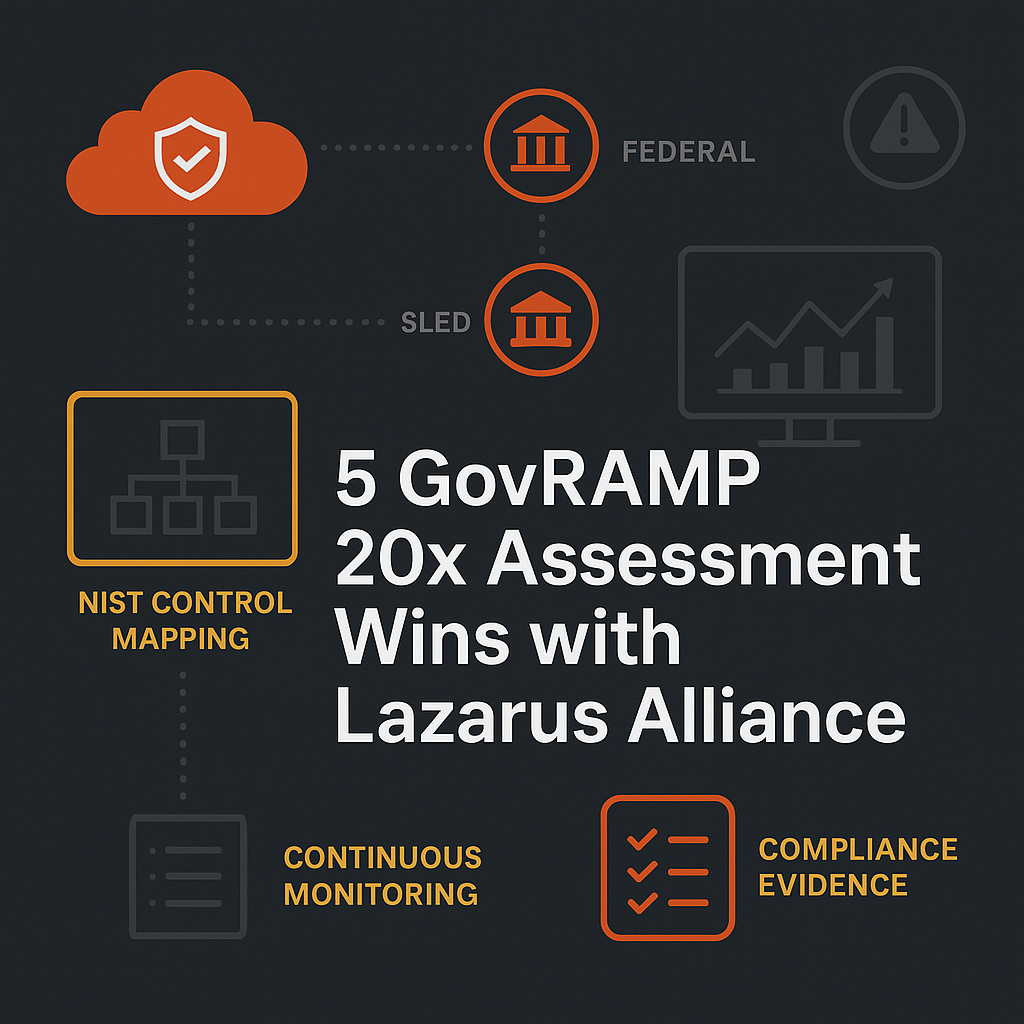
The most important GovRAMP 20x takeaway is counterintuitive: reciprocity does not eliminate assessment work; it changes where the work must be precise. Cloud service providers serving state, local, tribal, territorial, and education buyers still need defensible scoping, NIST 800-53 mapping, evidence integrity, control inheritance analysis, and continuous monitoring discipline. What changes under the emerging GovRAMP and FedRAMP 20x alignment model is that duplicative evidence can be reduced when the assessment package is engineered for reuse from the beginning.
That is where Lazarus Alliance brings practical value. A GovRAMP assessment is not just a documentation exercise. It is a risk management, control validation, and assurance communication project for SLED cloud compliance stakeholders who need to trust the service before procurement, onboarding, and production use. Lazarus Alliance supports organizations navigating GovRAMP, FedRAMP, NIST 800-53, SOC 1, SOC 2, CJIS, PCI DSS, CMMC, DFARS NIST 800-171, C5, ISO 27001, HIPAA, IRS 1075, and LADMF assurance expectations through integrated compliance assessments and audit-ready evidence practices.
Why GovRAMP and FedRAMP 20x Reciprocity Matters Now
GovRAMP opened public comment on RFC GR-2601, a proposed 20x Delta Assessment designed to align FedRAMP 20x concepts with GovRAMP security verification requirements for state, local, tribal, territorial, and education cloud assurance, with comments open through December 4, 2026, at 5 p.m. ET, according to GovRAMP. The same GovRAMP notice states that the Delta Assessment is intended to bridge FedRAMP 20x concepts with established NIST-based requirements used by GovRAMP and SLTT governments, according to GovRAMP.
FedRAMP is also accelerating its 20x operating model. FedRAMP reported that the FedRAMP Consolidated Rules for 2026 were published in June 2026, the 20x pipeline opened in August 2026, and the first full CR26-compliant FedRAMP 20x Class C certification was reported on October 29, 2026, according to FedRAMP. FedRAMP also reported that FY26 produced 92 new FedRAMP Certifications, including 66 Rev5 and 26 20x certifications, and ended FY26 with 538 FedRAMP Certified cloud service offerings and 71 Initial Implementation listings, according to FedRAMP. FedRAMP has stated that it will stop processing Legacy FedRAMP Rev5 Certification applications on June 11, 2027, according to FedRAMP.
For cloud providers, this creates an opportunity and a deadline. The opportunity is reusable assurance for SLED and federal markets. The deadline is operational: providers that wait to organize evidence, control ownership, machine-readable artifacts, and continuous monitoring workflows will face rework when buyers ask whether their FedRAMP 20x package can support a GovRAMP assessment.
Win 1: A Reciprocity-Ready GovRAMP Assessment Strategy
The first win is a deliberate reciprocity strategy. A provider should not ask, “Can we reuse FedRAMP evidence for GovRAMP?” The better question is, “Which controls, implementation statements, test results, inherited services, customer responsibilities, and continuous monitoring artifacts can be trusted by both assurance communities without reinterpretation?”
Lazarus Alliance approaches this by building a reciprocity matrix across the provider’s authorization boundary, system components, data types, shared responsibility model, and control evidence. That matrix identifies where the FedRAMP 20x package can be reused, where GovRAMP-specific validation is likely, and where customer-facing SLED procurement artifacts need clearer language. Organizations preparing for both programs can work with Lazarus Alliance’s GovRAMP assessment services and FedRAMP services to align assessment planning before evidence collection becomes fragmented.
Practical example: the hidden cost of ambiguous inheritance
Consider a SaaS provider hosted on a hyperscale cloud platform. The provider may inherit physical security, environmental protection, and portions of network infrastructure controls from the infrastructure provider. However, the SaaS provider still owns tenant isolation, privileged access management, configuration baselines, logging, incident response, vulnerability remediation, and customer notification processes. If the package simply says “inherited” without defining exactly which control objectives are inherited and which remain the SaaS provider’s responsibility, SLED reviewers may treat the package as incomplete.
A stronger approach is to document inheritance at the control objective level, map inherited services to evidence artifacts, and define provider-owned compensating procedures. This is especially important for NIST 800-53 AC-2, which addresses account management requirements, including account identification, assignment, monitoring, and disabling conditions, according to NIST SP 800-53 AC-2.
Win 2: NIST 800-53 Mapping That Survives Assessor Scrutiny
The second win is high-fidelity NIST 800-53 mapping. Many assessment delays are not caused by missing tools; they are caused by weak traceability between a requirement, an implementation statement, the evidence artifact, and the test result. A strong GovRAMP assessment package should allow an assessor to move from a control requirement to the exact policy, procedure, ticket, screenshot, configuration export, log query, scan report, or interview record supporting that requirement.
Lazarus Alliance evaluates NIST 800-53 mapping at four levels:
- Requirement-level mapping: Each control and enhancement is tied to a specific implementation narrative.
- System-level mapping: Each narrative identifies the component, environment, boundary, service role, or team responsible.
- Evidence-level mapping: Each claim is supported by current, relevant, and complete evidence.
- Assessment-level mapping: Test procedures produce repeatable results that validate the implementation statement.
For example, NIST 800-53 CM-2 addresses baseline configuration requirements, including developing, documenting, and maintaining baseline configurations for information systems, according to NIST SP 800-53 CM-2. A weak evidence package might include a generic hardening policy. A stronger package includes the approved baseline, configuration-as-code repository, change approval records, drift detection alerts, exception register, and sample production configuration exports.
Similarly, NIST 800-53 RA-5 addresses vulnerability monitoring and scanning, including scanning for vulnerabilities and remediating legitimate findings, according to NIST SP 800-53 RA-5. A mature assessment package should not merely attach a scanner PDF. It should demonstrate authenticated scanning coverage, asset inventory reconciliation, severity criteria, remediation service-level expectations, false-positive review, risk acceptance approval, and retest evidence.
For organizations that must coordinate GovRAMP, FISMA, and other NIST-based assessments, Lazarus Alliance’s NIST 800-53 and FISMA audit services help structure controls so the same evidence can support multiple compliance assessments without losing specificity.
Win 3: Continuous Monitoring Built into the Assessment, Not Bolted on Later
The third win is continuous monitoring by design. GovRAMP and FedRAMP 20x reciprocity will reward providers that can show current security posture, not stale documentation. NIST 800-53 CA-7 addresses continuous monitoring, including ongoing assessment of controls, security state monitoring, and reporting, according to NIST SP 800-53 CA-7. NIST 800-53 SI-4 addresses system monitoring, including monitoring systems to detect attacks and indicators of potential attacks, according to NIST SP 800-53 SI-4.
Continuous monitoring is where many providers underestimate assessor expectations. A dashboard is not evidence unless it is tied to defined control objectives, alert thresholds, escalation workflows, response records, and management review. A vulnerability scan is not enough unless it can be reconciled to the asset inventory and remediation workflow. A security information and event management system is not enough unless detection content, alert triage, retention, and incident handoff are documented and tested.
Operational checklist for SLED cloud compliance monitoring
- Asset accountability: Maintain an authoritative inventory for production, staging, administrative, network, identity, container, and serverless assets.
- Configuration drift: Detect unauthorized changes to baseline configurations and document remediation or risk acceptance.
- Vulnerability lifecycle: Track scan coverage, validation, prioritization, remediation, exception approval, and retesting.
- Identity monitoring: Review privileged access, service accounts, dormant users, emergency accounts, and federation changes.
- Incident readiness: Connect alerts to incident response criteria, customer notification obligations, and executive reporting.
- Management review: Preserve evidence that leadership reviews risk trends, recurring findings, and unresolved exceptions.
The business reason is clear. The Verizon 2026 Data Breach Investigations Report analyzed 31,861 security incidents and 22,625 confirmed data breaches, reporting that 31% of breaches began with vulnerability exploitation, 48% involved ransomware, 48% involved a third party, and 62% involved the human element, according to Verizon, 2026 Data Breach Investigations Report. For SLED customers, those patterns translate into procurement scrutiny over patching, third-party access, administrator behavior, and incident response transparency.
Providers can also use GRC tooling to sustain evidence rather than assemble it only during assessment windows. Continuum GRC’s FedRAMP-authorized GRC platform supports risk and audit management workflows, including cybersecurity risk, vendor risk, privacy, regulatory change, and AI governance use cases, according to Continuum GRC.
Win 4: Machine-Readable Evidence and Assessor-Ready Packages
The fourth win is evidence quality. FedRAMP has described 20x as a shift toward reduced assessment burden, improved evidence quality, machine-readable packages, and reuse of external security frameworks, according to FedRAMP. That direction matters for GovRAMP because reusable assurance depends on evidence that can be interpreted consistently across reviewers, programs, and procurement teams.
Machine-readable evidence does not mean dumping raw data into a repository. It means standardizing control metadata, system component references, roles, dates, evidence types, test status, responsible owners, and remediation states. The practical goal is to reduce ambiguity. If a control implementation changes, the package should make it clear which evidence is stale, which evidence remains valid, and which downstream controls are affected.
Lazarus Alliance recommends an assessment evidence model with these fields:
- Control ID: NIST 800-53 control or mapped framework requirement.
- Implementation owner: Named business or technical control owner.
- System component: Application, platform, network, identity, database, endpoint, container, or managed service.
- Evidence artifact: Policy, procedure, export, ticket, scan, log, diagram, interview, or test record.
- Freshness rule: Frequency and expiration criteria for recurring evidence.
- Assessment status: Implemented, partially implemented, not implemented, inherited, risk accepted, or not applicable.
- Remediation linkage: POA&M item, ticket number, target date, and validation result.
This structure also supports cross-framework control reuse. A single identity governance evidence set may support GovRAMP, FedRAMP, SOC 2, ISO 27001, HIPAA, IRS 1075, and PCI DSS requirements when the evidence is properly scoped and mapped. However, reuse should never blur the difference between frameworks. SOC 2 evaluates trust services criteria for service organizations, while GovRAMP and FedRAMP are NIST-based public-sector cloud assurance programs. PCI DSS v4.0.1 is a limited revision addressing stakeholder feedback and questions received after PCI DSS v4.0 was published, according to PCI Security Standards Council. Each framework has its own assessment audience and evidence expectations.
Win 5: Risk Management That Connects Governance, Procurement, and Technical Controls
The fifth win is executive-grade risk management. SLED cloud compliance is not only about technical control validation. It is also about whether the provider can explain risk to agency leaders, procurement teams, security architects, legal reviewers, and program owners in language they can act on.
NIST has emphasized governance as a central organizing layer for cybersecurity risk. NIST’s 2026 draft SP 800-221r1 aligns ICT risk management with the Cybersecurity Framework 2.0 functions Govern, Identify, Protect, Detect, Respond, and Recover, according to NIST CSRC. That matters because GovRAMP assessment findings should feed enterprise risk decisions, not sit in a compliance silo.
Decision matrix: when FedRAMP 20x evidence may need GovRAMP delta work
- Low delta likelihood: The same production boundary, services, data flows, and control owners apply to federal and SLED customers; evidence is current and mapped to NIST 800-53 controls.
- Moderate delta likelihood: The SLED deployment uses different regions, identity providers, support teams, subcontractors, logging pipelines, or backup configurations.
- High delta likelihood: The provider offers SLED-specific features, CJIS workflows, education records, healthcare data, payment data, tax information, or separate administrative access models.
- Critical delta likelihood: The SLED offering relies on unmanaged customer responsibilities, undocumented compensating controls, manual change approvals, or unresolved vulnerability exceptions.
This matrix helps leaders decide where to invest before assessment. For example, a justice-sector SLED customer may evaluate cloud architecture against CJIS expectations, while the applicable state CJIS Systems Agency assesses compliance rather than a central national body, according to AWS Public Sector Blog summarizing FBI CJIS Security Policy context. Healthcare agencies may focus on HIPAA Security Rule risk analysis, technical safeguards, and vendor oversight because the current Security Rule remains enforceable, according to Center for Internet Security. Defense-related customers may ask about CMMC, DFARS, and NIST SP 800-171 obligations; DFARS 252.204-7019 requires applicable offerors to have a current NIST SP 800-171 assessment not more than three years old unless the solicitation specifies a shorter period, according to Acquisition.gov.
Common GovRAMP 20x Assessment Pitfalls
Pitfall 1: Treating reciprocity as automatic approval. FedRAMP 20x evidence may accelerate GovRAMP review, but the SLED environment, customer obligations, state-specific expectations, and GovRAMP verification requirements still matter.
Pitfall 2: Writing control narratives that cannot be tested. If an implementation statement says access is reviewed periodically but does not define scope, frequency, evidence, exceptions, and approvers, it is not assessor-ready.
Pitfall 3: Ignoring customer responsibility matrices. SLED buyers need to know what the provider secures, what the customer must configure, and where shared controls require coordination.
Pitfall 4: Separating compliance assessments from operational security. Continuous monitoring, vulnerability management, incident response, and identity governance should operate continuously, not only during assessment collection.
Pitfall 5: Over-mapping across frameworks. Mapping SOC 2, ISO 27001, C5, HIPAA, PCI DSS, IRS 1075, CJIS, CMMC, DFARS NIST 800-171, LADMF, GovRAMP, and FedRAMP can reduce duplication, but each framework still requires evidence that matches its scope, control intent, and assessment audience.
Lazarus Alliance Methodology for GovRAMP Assessment Wins
Lazarus Alliance helps organizations move from fragmented compliance to audit-ready assurance through a disciplined methodology:
- Scope the service boundary: Confirm environments, components, data categories, interfaces, identities, administrative paths, and third-party services.
- Build the NIST 800-53 traceability layer: Map controls to implementation statements, evidence, tests, owners, and remediation items.
- Analyze FedRAMP 20x reuse potential: Identify reusable evidence, GovRAMP delta requirements, and SLED-specific risk factors.
- Validate technical controls: Review access controls, logging, vulnerability management, configuration management, encryption, backup, incident response, and continuous monitoring.
- Prepare assessor-ready evidence: Normalize artifacts, define freshness rules, resolve contradictions, and document inherited controls.
- Operationalize continuous monitoring: Establish recurring evidence collection, executive reporting, POA&M governance, and change-triggered reassessment.
The result is not just a better package. It is a stronger cloud assurance program that can support SLED procurement, federal alignment, customer due diligence, and ongoing risk management.
Bottom Line: GovRAMP 20x Rewards Evidence Discipline
GovRAMP and FedRAMP 20x reciprocity can reduce duplicative work, but only when the evidence is structured, current, mapped, and trustworthy. Cloud providers that invest now in NIST 800-53 mapping, continuous monitoring, machine-readable evidence, and governance-level risk reporting will be better positioned for SLED cloud compliance and faster customer trust.
Lazarus Alliance brings the assessment experience, control expertise, and cross-framework perspective needed to turn GovRAMP 20x readiness into measurable assurance. For providers serving government, education, healthcare, justice, defense, and regulated-data customers, the win is not merely passing an assessment. The win is building a reusable trust architecture for every market that depends on secure cloud services.
Sources and References
- GovRAMP, GovRAMP Opens Public Comment Period on Proposed 20x Delta Assessment
- FedRAMP, Memo to Milestone
- Lazarus Alliance, GovRAMP Assessment Services
- Lazarus Alliance, FedRAMP Services
- Lazarus Alliance, NIST 800-53 and FISMA Audit Services
- NIST SP 800-53 AC-2, Account Management
- NIST SP 800-53 CM-2, Baseline Configuration
- NIST SP 800-53 RA-5, Vulnerability Monitoring and Scanning
- NIST SP 800-53 CA-7, Continuous Monitoring
- NIST SP 800-53 SI-4, System Monitoring
- Verizon, 2026 Data Breach Investigations Report
- Continuum GRC, FedRAMP-Authorized GRC Platform
- PCI Security Standards Council, Document Library
- NIST CSRC, Governing and Managing ICT Risk Programs Draft
- AWS Public Sector Blog, Building a RAG Architecture to Support CJIS Compliance
- Center for Internet Security, Healthcare Cybersecurity: What Regulators Are Looking For Now
- Acquisition.gov, DFARS 252.204-7019 Notice of NIST SP 800-171 DoD Assessment Requirements
About Lazarus Alliance
To learn more about how Lazarus Alliance can help, contact us.
- FedRAMP
- GovRAMP
- NIST 800-53
- DFARS NIST 800-171
- CMMC
- SOC 1 & SOC 2
- C5
- HIPAA, HITECH, & Meaningful Use
- PCI DSS RoC & SAQ
- IRS 1075 & 4812
- CJIS
- LA DMF
- ISO 27001, ISO 27002, ISO 27005, ISO 27017, ISO 27018, ISO 27701, ISO 22301, ISO 17020, ISO 17021, ISO 17025, ISO 17065, ISO 9001, & ISO 90003
- And dozens more!
Related Posts