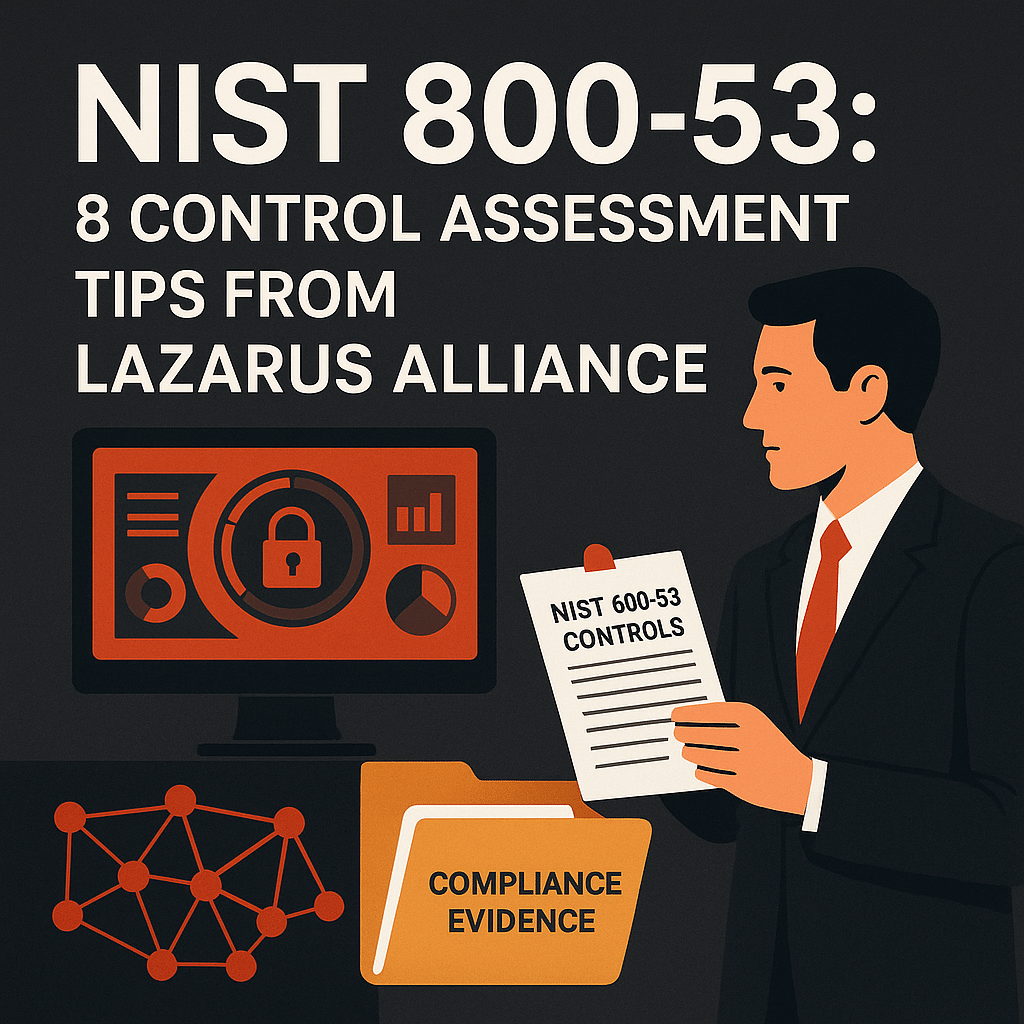
The strongest NIST 800-53 assessments are not won by having more screenshots; they are won by proving control intent, implementation, and operating effectiveness with evidence that is current, complete, attributable, and repeatable. NIST SP 800-53 provides a catalog of security and privacy controls used across federal and enterprise risk programs, and NIST SP 800-53A provides assessment procedures for determining whether those controls are implemented correctly, operating as intended, and producing the desired outcome NIST, SP 800-53 Rev. 5 NIST, SP 800-53A Rev. 5.
For CISOs, compliance officers, IT directors, and GRC leaders, the practical challenge is not simply mapping controls. It is building an evidence system that can survive a cybersecurity audit, support continuous monitoring, and reduce rework across FedRAMP, GovRAMP, FISMA, CMMC, DFARS NIST 800-171, SOC 2, PCI DSS, HIPAA, CJIS, IRS 1075, ISO 27001, C5, and LADMF programs. Lazarus Alliance approaches NIST 800-53 control assessment as a defensible assurance process: define scope, verify implementation, test operating effectiveness, reconcile exceptions, and preserve evidence in a way that supports authorization, procurement, and executive risk decisions Lazarus Alliance, FISMA and NIST Audit Services.
NIST 800-53 Control Assessment: Why Evidence Quality Now Matters More Than Control Count
NIST 800-53 contains 20 control families, including families for access control, audit and accountability, configuration management, incident response, risk assessment, system and communications protection, supply chain risk management, and privacy-related controls NIST, SP 800-53 Rev. 5. NIST 800-53A structures control assessment around objectives, determination statements, and assessment methods such as examine, interview, and test, which means an assessor expects more than policy statements and static screenshots NIST, SP 800-53A Rev. 5.
That distinction is critical because modern compliance assessment is becoming evidence-centric. FedRAMP automation guidance supports machine-readable packages using OSCAL artifacts for system security plans, assessment plans, assessment results, and plans of action and milestones, which reflects the broader move from document-heavy compliance toward structured, reusable, continuously updated assurance data FedRAMP, Automation and OSCAL Resources. NIST also maintains OSCAL as a standardized language for representing controls, control implementations, assessment information, and POA&M data in machine-readable formats NIST, Open Security Controls Assessment Language.
The contrarian lesson from mature audits is this: a smaller evidence set that is mapped, dated, attributable, and technically verifiable is usually stronger than a large evidence dump. The eight tips below reflect Lazarus Alliance’s field-tested approach to NIST 800-53 control assessment, cybersecurity audit readiness, and GRC evidence quality.
Tip 1: Start With Assessment Objectives, Not Spreadsheet Rows
A NIST 800-53 control assessment should begin with the assessment objective in NIST 800-53A, not with a generic request list. NIST 800-53A describes assessment procedures through determination statements that help assessors decide whether each control requirement is satisfied, partially satisfied, or not satisfied NIST, SP 800-53A Rev. 5.
Implementation walkthrough: for AC-2, Account Management, do not submit only an access control policy. Build an evidence bundle that demonstrates approved account creation, account modification, account disabling, periodic review, privileged account handling, and automated or manual enforcement mechanisms aligned to the organization-defined parameters in the control NIST, SP 800-53 Rev. 5, AC-2. The evidence should include policy, procedure, ticket samples, identity provider exports, privileged access management logs, reviewer attestations, and a trace from the authoritative HR source to the identity system.
Common pitfall: organizations often map one artifact to an entire control family. A single IAM policy does not prove AC-2 operating effectiveness, just as a vulnerability management policy does not prove RA-5 scanning cadence, authenticated scanning coverage, risk ranking, or remediation tracking NIST, SP 800-53 Rev. 5, RA-5.
Tip 2: Define System Boundary and Inheritance Before Collecting Evidence
NIST Risk Management Framework guidance emphasizes system categorization, control selection, control implementation, assessment, authorization, and monitoring as connected steps, so evidence quality depends on knowing exactly what system, environment, data type, and control responsibility is in scope NIST, SP 800-37 Rev. 2. Boundary confusion creates duplicate evidence, missing evidence, and false assumptions about inherited controls.
For a cloud SaaS provider pursuing federal or public-sector assurance, inherited controls may come from an IaaS provider, a managed database service, a corporate identity platform, or an enterprise logging service. FedRAMP and GovRAMP programs are closely tied to NIST 800-53-based cloud security assurance, and Lazarus Alliance supports organizations that need FedRAMP and GovRAMP readiness, assessment coordination, and evidence alignment Lazarus Alliance, FedRAMP Services Lazarus Alliance, GovRAMP Services.
Evidence test: every inherited control should identify the provider, artifact owner, inheritance type, contract or service commitment, monitoring method, and residual customer responsibility. For example, SC-13 cryptographic protection may rely on cloud-native key management, but the customer may still be responsible for key rotation policy, administrative access, logging, and separation of duties NIST, SP 800-53 Rev. 5, SC-13.
Tip 3: Grade Evidence With the Lazarus Alliance Evidence Fitness Model
Lazarus Alliance recommends grading evidence before the assessor sees it. A practical evidence quality model uses four levels: Level 0, assertion only; Level 1, documented intent; Level 2, implemented configuration; and Level 3, operating effectiveness over time. This approach aligns with NIST 800-53A’s use of examine, interview, and test methods because it separates what management says, what the system is configured to do, and what telemetry proves actually happened NIST, SP 800-53A Rev. 5.
Example: for AU-2, Event Logging, and AU-6, Audit Record Review, Level 1 evidence may be a logging policy, Level 2 evidence may be SIEM configuration showing enabled sources, and Level 3 evidence may be time-bounded alerts, review tickets, escalations, and closure records demonstrating that security events were reviewed and acted upon NIST, SP 800-53 Rev. 5, AU-2 and AU-6. PCI DSS also sets explicit audit-log retention expectations, including retaining audit-log history for at least 12 months and keeping at least the most recent three months immediately available, which illustrates why time-based evidence matters in regulated environments PCI Security Standards Council, PCI DSS v4.0.1.
Action step: require every evidence item to answer five questions: what control objective does it support, who owns it, when was it generated, what population does it cover, and what exception handling proves management oversight.
Tip 4: Use Population-Based Sampling, Not Anecdotal Screenshots
Assessors need confidence that a control works for the whole population, not merely for one convenient example. NIST 800-53A allows assessment methods that include examining specifications and records, interviewing personnel, and testing mechanisms, and the strongest evidence packages connect sample items to a complete population NIST, SP 800-53A Rev. 5.
Scenario: an organization submits three terminated-user tickets for AC-2 account disabling. Stronger evidence would include the full termination population from the HR system for the assessment period, the identity provider status for each account, deprovisioning timestamps, privileged account checks, exceptions, and management approval for any delayed removal. If service accounts or non-human identities exist, include ownership, business justification, rotation status, and monitoring evidence because AC-2 and IA-2 authentication controls apply to more than ordinary employee accounts NIST, SP 800-53 Rev. 5, AC-2 and IA-2.
This same population logic applies to CM-2 baseline configuration, CM-6 configuration settings, RA-5 vulnerability scanning, CP-9 system backup, and IR-4 incident handling evidence NIST, SP 800-53 Rev. 5. The question is always: does the evidence prove the control operated across the relevant assets, users, transactions, systems, or time period?
Tip 5: Build Cross-Framework Evidence Once, Then Map It Carefully
NIST 800-53 evidence often supports multiple frameworks, but reuse requires disciplined mapping. NIST SP 800-171 establishes security requirements for protecting Controlled Unclassified Information in nonfederal systems, while NIST 800-53 provides a broader control catalog used for federal systems, cloud authorizations, and enterprise control baselines NIST, SP 800-171 Rev. 3 NIST, SP 800-53 Rev. 5. Defense contractors also need to understand how CMMC expectations relate to NIST 800-171 implementation and assessment readiness DoD CIO, Cybersecurity Maturity Model Certification.
For customer assurance, SOC 2 evaluates a service organization’s system against trust services criteria for security, availability, processing integrity, confidentiality, and privacy, so many access control, change management, incident response, vendor management, and logging artifacts can support both NIST 800-53 and SOC 2 when scoped correctly AICPA & CIMA, SOC 2 Description Criteria. Lazarus Alliance supports SOC 1 and SOC 2 audits for organizations that need assurance reporting alongside NIST-based compliance programs Lazarus Alliance, SOC 1 and SOC 2 Services.
Decision matrix: reuse evidence when the control objective, system boundary, assessment period, data population, and operating requirement match. Do not reuse evidence when a framework has a stricter cadence, a different data scope, a different assessor expectation, or a different legal driver.
Tip 6: Treat Continuous Monitoring as an Evidence Pipeline
NIST Risk Management Framework guidance treats monitoring as an ongoing activity after authorization, and NIST 800-53 includes CA-7 Continuous Monitoring to support awareness of security and privacy posture over time NIST, SP 800-37 Rev. 2 NIST, SP 800-53 Rev. 5, CA-7. Continuous monitoring is not merely a dashboard; it is an evidence pipeline that connects scanners, endpoint tools, cloud control planes, ticketing systems, asset inventories, SIEM platforms, and risk registers.
FedRAMP’s automation resources and OSCAL ecosystem show why machine-readable evidence is becoming strategically important for cloud compliance and public-sector assurance FedRAMP, Automation and OSCAL Resources NIST, OSCAL. Continuum GRC’s 2026 Audit Readiness Benchmark Report examines how organizations prepare for audits across complex compliance portfolios, and the Continuum GRC platform supports IT and cybersecurity risk workflows for teams that need integrated GRC operations Continuum GRC, 2026 Audit Readiness Benchmark Report Continuum GRC, IT and Cybersecurity Risk.
Action step: define control telemetry for each high-risk control. For RA-5, capture scanner scope, credentialed status, authenticated scan failures, severity normalization, remediation tickets, compensating controls, and risk acceptance. For CM-6, capture configuration baseline drift, exception approvals, remediation windows, and change tickets. For IR-4, capture incident declaration, containment, eradication, recovery, lessons learned, and executive notification evidence NIST, SP 800-53 Rev. 5.
Tip 7: Validate Third-Party and Supply Chain Controls With Contractual and Technical Proof
NIST 800-53 includes supply chain risk management controls, including the SR family, and SA-9 addresses external system services, making vendor evidence an assessment priority rather than a procurement footnote NIST, SP 800-53 Rev. 5, SR Family and SA-9. Third-party controls are especially important when a provider hosts regulated data, administers production infrastructure, performs development work, or has access to security-relevant telemetry.
Evidence should include: executed agreements, security addenda, data processing terms, breach notification obligations, SOC reports where applicable, penetration testing summaries, vulnerability remediation attestations, access review records, and proof that vendor exceptions are tracked in the organization’s risk register. For CJIS environments, the FBI CJIS Security Policy resource center is the authoritative source for policy materials governing Criminal Justice Information security expectations FBI, CJIS Security Policy Resource Center. For tax information environments, IRS Publication 1075 provides safeguards for federal tax information handled by agencies and their contractors IRS, Publication 1075.
Common misconception: a vendor’s assurance report does not automatically satisfy your NIST 800-53 responsibility. You must verify scope, complementary user entity controls, exceptions, subservice organizations, assessment period, and whether the report covers the specific service, region, and data flow you rely on.
Tip 8: Close Findings With Root Cause, Not Cosmetic Remediation
NIST 800-53 assessments frequently produce findings related to missing documentation, inconsistent implementation, incomplete monitoring, or delayed remediation. NIST 800-37 ties assessment results, authorization decisions, and ongoing monitoring together, so unresolved findings should be managed through risk-based remediation rather than treated as one-time paperwork defects NIST, SP 800-37 Rev. 2.
A high-quality POA&M entry should identify the affected control, root cause, asset or population impact, severity, interim mitigation, accountable owner, target completion, validation method, and closure evidence. In HIPAA-regulated environments, the Security Rule requires covered entities and business associates to implement administrative, physical, and technical safeguards for electronic protected health information, so remediation evidence should prove both technical correction and governance oversight eCFR, HIPAA Security Rule. In privacy-sensitive data programs such as LADMF access, the National Technical Information Service provides the Limited Access Death Master File access program, and organizations should align access controls, purpose limitation, and monitoring evidence to the governing access requirements NTIS, Limited Access Death Master File.
Assessor-ready closure package: include the original finding, root cause analysis, corrected configuration or process artifact, post-remediation test evidence, management approval, and continuous monitoring trigger that prevents recurrence. Cosmetic remediation fixes the artifact; root-cause remediation fixes the control system.
What CISOs Should Ask Before a NIST 800-53 Cybersecurity Audit
- Is the boundary defensible? Confirm systems, data types, environments, inherited controls, and excluded components.
- Does every control have an owner? Map technical, process, and governance responsibilities to named accountable roles.
- Is evidence time-bound? Distinguish point-in-time configuration from operating effectiveness over the assessment period.
- Can we reproduce the evidence? Store source queries, exports, timestamps, and population definitions.
- Are exceptions risk-managed? Link deviations to risk acceptances, compensating controls, POA&M items, and executive visibility.
- Can evidence support multiple frameworks? Map once, validate carefully, and avoid assuming equivalency where scope differs.
For organizations pursuing NIST 800-53, FedRAMP, GovRAMP, SOC 2, CMMC, PCI DSS, HIPAA, CJIS, IRS 1075, ISO 27001, C5, or LADMF readiness, the strategic goal is not simply passing the next audit. The goal is building a control evidence architecture that enables continuous monitoring, faster procurement responses, stronger customer assurance, and clearer executive risk decisions. Lazarus Alliance helps organizations assess, validate, and improve that architecture across complex regulatory environments Lazarus Alliance, FISMA and NIST Audit Services.
Sources and References
- NIST, SP 800-53 Rev. 5: Security and Privacy Controls for Information Systems and Organizations
- NIST, SP 800-53A Rev. 5: Assessing Security and Privacy Controls
- NIST, SP 800-37 Rev. 2: Risk Management Framework for Information Systems and Organizations
- NIST, SP 800-171 Rev. 3: Protecting Controlled Unclassified Information
- NIST, Open Security Controls Assessment Language
- FedRAMP, Automation and OSCAL Resources
- DoD CIO, Cybersecurity Maturity Model Certification
- PCI Security Standards Council, PCI DSS v4.0.1
- AICPA & CIMA, SOC 2 Description Criteria
- FBI, CJIS Security Policy Resource Center
- IRS, Publication 1075
- eCFR, HIPAA Security Rule
- NTIS, Limited Access Death Master File
- Lazarus Alliance, FISMA and NIST Audit Services
- Lazarus Alliance, FedRAMP Services
- Lazarus Alliance, GovRAMP Services
- Lazarus Alliance, SOC 1 and SOC 2 Services
- Continuum GRC, 2026 Audit Readiness Benchmark Report
- Continuum GRC, IT and Cybersecurity Risk
About Lazarus Alliance
To learn more about how Lazarus Alliance can help, contact us.
- FedRAMP
- GovRAMP
- NIST 800-53
- DFARS NIST 800-171
- CMMC
- SOC 1 & SOC 2
- C5
- HIPAA, HITECH, & Meaningful Use
- PCI DSS RoC & SAQ
- IRS 1075 & 4812
- CJIS
- LA DMF
- ISO 27001, ISO 27002, ISO 27005, ISO 27017, ISO 27018, ISO 27701, ISO 22301, ISO 17020, ISO 17021, ISO 17025, ISO 17065, ISO 9001, & ISO 90003
- And dozens more!
Related Posts