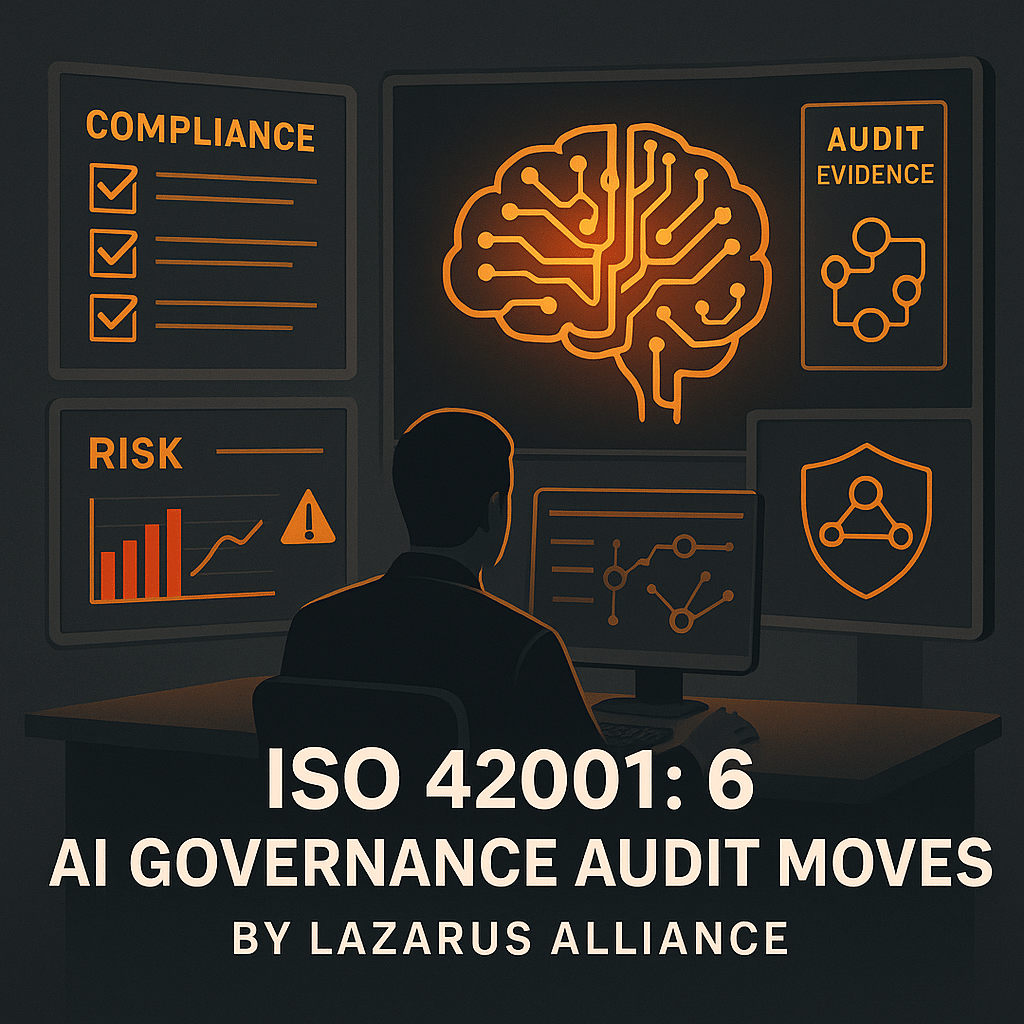
The most important ISO 42001 audit question is not whether an organization uses artificial intelligence. It is whether leadership can prove that AI is governed as an enterprise risk system rather than managed as a collection of experimental models. That distinction is where many AI compliance programs fail. A chatbot pilot, fraud model, document classifier, copiloted development workflow, or autonomous workflow agent can each create cybersecurity, privacy, operational, legal, and vendor-risk exposure. ISO/IEC 42001 gives organizations a management-system structure for that exposure by defining requirements for establishing, implementing, maintaining, and continually improving an artificial intelligence management system, or AIMS, as described by ISO, ISO/IEC 42001 Artificial intelligence management system.
For Lazarus Alliance, ISO 42001 is not a paperwork exercise. It is an assurance discipline. A credible AI governance audit must connect model inventories, risk assessments, impact assessments, access controls, logging, supplier oversight, privacy obligations, secure engineering, incident response, and board-level accountability. The six audit moves below reflect how mature organizations can turn AI governance into evidence that withstands executive scrutiny, customer due diligence, and formal audit procedures.
ISO 42001 AI Governance Starts With an Evidence Spine
ISO 42001 asks organizations to operate AI governance as a management system, meaning the program must have scope, leadership ownership, planning, support, operations, performance evaluation, and improvement mechanisms, according to ISO, ISO/IEC 42001. In practice, auditors want to see an evidence spine: a traceable chain from an AI use case to the business owner, intended purpose, data sources, risk classification, controls, testing results, approvals, monitoring outputs, incidents, and corrective actions.
Lazarus Alliance recommends treating the evidence spine as the core artifact for ISO 42001 readiness. If the organization cannot show who owns an AI system, what risk decision was made, what controls were selected, and how operating effectiveness is monitored, then the AIMS is not audit-ready. This is also where ISO 42001 connects naturally with cybersecurity audit programs. NIST SP 800-53 control RA-3 addresses risk assessment, CA-7 addresses continuous monitoring, AC-2 addresses account management, AU-2 addresses event logging, and SA-9 addresses external system services, as defined in NIST SP 800-53 Rev. 5, Security and Privacy Controls for Information Systems and Organizations.
Actionable takeaway: before scheduling an ISO 42001 audit, build an AI system register with mandatory fields for owner, purpose, user population, data classification, model source, deployment environment, supplier dependency, risk rating, monitoring method, and approval status. This register should reconcile with identity management, data governance, vendor management, vulnerability management, and incident response records.
Move 1: Define the ISO 42001 Audit Scope Around Real AI Risk
The first audit move is to scope the AIMS based on operational AI risk, not organizational politics. Many organizations initially attempt to narrow the ISO 42001 scope to a single innovation team. That may be appropriate for a limited certification boundary, but it is risky if production AI exists elsewhere in software engineering, customer support, security operations, underwriting, clinical administration, claims processing, hiring workflows, fraud analytics, or procurement.
Audit scope should answer four questions:
- Which AI systems are included? Include internally developed models, third-party AI platforms, embedded AI features in SaaS tools, AI agents, and automated decision-support workflows.
- Which decisions or outcomes are affected? Distinguish low-risk summarization from AI outputs that influence access, eligibility, safety, financial loss, legal obligations, or regulated data processing.
- Which data is processed? Map personal information, protected health information, cardholder data, controlled unclassified information, criminal justice information, taxpayer information, and confidential business data to the AI use case.
- Which controls already exist? Reuse mature evidence from ISO 27001, SOC 2, FedRAMP, PCI DSS, HIPAA, CMMC, CJIS, IRS 1075, GovRAMP, C5, and NIST-based programs where possible.
This scoping decision should be documented and approved by leadership. NIST’s AI Risk Management Framework organizes AI risk work through Govern, Map, Measure, and Manage functions, which can help leadership structure ISO 42001 scope discussions around context, measurement, and risk treatment rather than abstract AI ethics language, according to NIST, Artificial Intelligence Risk Management Framework.
Example: a healthcare SaaS provider may use AI to summarize support tickets, generate code, triage patient portal messages, and detect anomalous billing patterns. Only the support summarizer may appear benign at first glance. However, the patient triage and billing models can implicate HIPAA Security Rule risk analysis obligations under 45 CFR 164.308(a)(1)(ii)(A), as codified in eCFR, HIPAA Security Standards for the Protection of Electronic Protected Health Information. The audit scope must capture those higher-risk workflows.
Lazarus Alliance supports organizations aligning AI management systems with broader ISO programs through its ISO audit services, helping teams avoid duplicated control work and fragmented evidence.
Move 2: Build an AI Risk Management Method That Auditors Can Reperform
The second move is to make AI risk assessment repeatable. An ISO 42001 auditor should be able to select an AI system from the inventory, inspect the assessment record, and understand how the risk rating was determined. A narrative that says the model is low risk because the team believes it is low risk will not hold up. The method should define rating criteria, inherent risk, control effectiveness, residual risk, risk acceptance authority, reassessment triggers, and escalation thresholds.
A practical AI risk taxonomy should include at least the following domains:
- Cybersecurity: prompt injection, model extraction, insecure plugin access, unauthorized data exposure, poisoned training data, vulnerable deployment pipelines, and excessive service-account privileges.
- Privacy and data protection: personal data minimization, retention, secondary use, cross-border processing, consent or authorization assumptions, and reidentification risk.
- Safety and reliability: hallucination, drift, adversarial inputs, inadequate testing, and incorrect automation thresholds.
- Legal and compliance: sector-specific obligations for defense, healthcare, payment, criminal justice, public sector, and financial services use cases.
- Third-party and supply chain: model provenance, contractual restrictions, subprocessor visibility, audit rights, incident notice, data use limitations, and continuity risk.
- Human oversight: review requirements, override authority, exception handling, and accountability for final decisions.
For organizations handling controlled unclassified information, NIST SP 800-171 Rev. 3 defines security requirements for protecting CUI in nonfederal systems and organizations, according to NIST SP 800-171 Rev. 3. Defense contractors should also account for CMMC program expectations codified in eCFR, 32 CFR Part 170 Cybersecurity Maturity Model Certification Program. If AI tools process CUI, the AI risk assessment must integrate CUI boundary analysis, access control, encryption, logging, supplier flow-down, and incident response evidence.
Actionable takeaway: create an AI risk assessment worksheet that an auditor can reperform from source evidence. Include the risk scenario, likelihood rationale, impact rationale, mapped controls, test evidence, residual risk, approval authority, and next reassessment date.
Move 3: Map AI Governance Controls to Cybersecurity Audit Evidence
The third move is to stop treating AI compliance as a stand-alone policy library. ISO 42001 assurance becomes stronger when mapped to existing cybersecurity audit evidence. Most AI governance failures are not purely algorithmic. They involve familiar control breakdowns: unmanaged assets, weak access control, insufficient logging, unclear vendor ownership, missing change approvals, untested incident response, or poorly defined system boundaries.
Consider the following control mappings:
- Identity and access: NIST SP 800-53 AC-2 covers account management, and AC-6 covers least privilege, according to NIST SP 800-53 Rev. 5. For AI, auditors will ask whether model administrators, prompt engineers, service accounts, API keys, and AI agents have approved access and periodic review.
- Logging and monitoring: NIST SP 800-53 AU-2 covers event logging and AU-6 covers audit record review, according to NIST SP 800-53 Rev. 5. For AI, evidence should include prompt logs where appropriate, model output review, administrative activity, data export events, and alert handling.
- Change management: NIST SP 800-53 CM-3 covers configuration change control, according to NIST SP 800-53 Rev. 5. For AI, changes include model version updates, retrieval corpus changes, prompt-template changes, guardrail changes, and plugin integrations.
- Supplier oversight: NIST SP 800-53 SA-9 addresses external system services, according to NIST SP 800-53 Rev. 5. For AI, supplier oversight should include data-use terms, model training restrictions, incident notification, subcontractor transparency, and availability commitments.
This mapping matters in SOC reporting as well. The AICPA describes SOC 2 criteria as covering security, availability, processing integrity, confidentiality, and privacy, according to AICPA & CIMA, SOC 2 Description Criteria. When AI functionality is material to the system description, customers increasingly expect the SOC boundary, data flows, subservice organizations, and control activities to address AI-enabled processing. Lazarus Alliance provides SOC 1 and SOC 2 audit services that can help organizations align customer assurance reporting with emerging AI governance expectations.
Actionable takeaway: create a crosswalk from ISO 42001 clauses and AI control objectives to NIST 800-53, SOC 2, ISO 27001, and sector frameworks. Then attach actual evidence, not just policy references.
Move 4: Test AI Systems Like Production Systems, Not Lab Experiments
The fourth move is technical validation. AI governance audits should not rely solely on committee minutes and acceptable-use policies. Auditors need evidence that AI systems are tested before deployment and monitored after release. Testing should be proportional to the risk of the AI system and should include security, privacy, performance, reliability, and misuse scenarios.
High-value test procedures include:
- Prompt-injection testing: attempt to override system instructions, exfiltrate hidden prompts, access restricted documents, or trigger unauthorized tool use.
- Retrieval testing: verify that retrieval-augmented generation sources only approved repositories and respects access permissions.
- Data leakage testing: test whether protected, confidential, or regulated data appears in outputs outside authorized contexts.
- Model drift monitoring: define performance thresholds, drift indicators, alert routing, and retraining approval procedures.
- Human override testing: confirm that reviewers can reject, correct, or escalate AI outputs and that overrides are logged.
- Business continuity testing: verify fallback procedures if the AI service, model endpoint, or third-party provider is unavailable.
In payment environments, PCI DSS v4.0.1 requires organizations to protect account data and maintain a secure environment for payment processing, and the standard includes requirements for vulnerability management, access control, logging, and secure software development, according to PCI Security Standards Council, PCI DSS v4.0.1. If AI assists payment-page code generation, fraud scoring, customer service, or transaction review, testing must confirm that AI does not introduce unauthorized scripts, data exposure, or uncontrolled changes.
For law-enforcement and public-safety environments, the FBI CJIS Security Policy Resource Center provides official policy resources for safeguarding criminal justice information, according to FBI, CJIS Security Policy Resource Center. AI tools that summarize reports, transcribe evidence, search records, or support investigations require tight access control, encryption, logging, and personnel governance. Lazarus Alliance maintains dedicated CJIS audit and compliance resources for organizations operating in those sensitive environments.
Actionable takeaway: require pre-production AI test reports with scenario design, test data controls, pass-fail criteria, remediation tickets, approval records, and post-deployment monitoring requirements.
Move 5: Govern AI Suppliers, Embedded Models, and SaaS Features
The fifth move is supplier assurance. AI governance programs often focus on internal model development while missing embedded AI inside commercial tools. A vendor may add AI summarization, recommendation, classification, code generation, or automated workflow features to an existing SaaS platform. If that feature processes regulated or confidential data, the organization still owns the risk decision.
Supplier due diligence should include:
- Whether customer data is used to train or improve provider models.
- Where data is processed and retained.
- Whether logs contain prompts, files, identifiers, or regulated data.
- How the provider separates tenants and restricts administrative access.
- Whether subcontractors or model providers are involved.
- What audit reports, penetration test summaries, incident notices, and contractual commitments are available.
- Whether opt-out, deletion, retention, and export controls are available.
FedRAMP emphasizes standardized security assessment, authorization, and continuous monitoring for cloud products and services used by federal agencies, according to FedRAMP, Program Overview. GovRAMP addresses cloud security authorization for state and local government markets, according to GovRAMP. If AI functionality is part of a cloud service offered to public-sector buyers, the supplier evidence model should align AI governance with inherited controls, boundary diagrams, continuous monitoring, vulnerability management, and incident response evidence. Lazarus Alliance supports public-sector cloud assurance through FedRAMP services and related NIST-based audit capabilities.
Tax, benefits, and identity workflows require particular care. IRS Publication 1075 establishes safeguards for federal tax information received by agencies and their contractors, according to IRS, Publication 1075 Tax Information Security Guidelines for Federal, State and Local Agencies. If AI systems ingest, summarize, classify, or route federal tax information, supplier contracts and technical controls must address that data category explicitly.
Actionable takeaway: update vendor intake forms to include AI-specific questions and require a risk acceptance decision before enabling new AI features in enterprise SaaS platforms.
Move 6: Operationalize AI Compliance With Continuous Assurance
The sixth move is continuous assurance. ISO 42001 audits should verify that AI governance operates continuously, not only during annual policy refreshes. Evidence should show recurring risk reviews, control testing, incident trend analysis, supplier reassessment, model performance monitoring, training completion, exception review, and management review.
Continuous AI assurance should include three layers:
- Operational telemetry: access logs, API usage, model endpoint activity, data export events, guardrail alerts, vulnerability findings, and incident records.
- Governance telemetry: approval aging, unresolved risk acceptances, overdue supplier reviews, policy exceptions, training completion, and corrective action status.
- Executive telemetry: top AI risks, high-impact use cases, incidents, unresolved audit findings, regulatory exposure, and investment decisions.
Continuum GRC’s AI Governance and Risk resources address the need to manage AI risk alongside enterprise risk, vendor risk, privacy, and compliance operations. Continuum GRC’s 2026 Audit Readiness Benchmark Report also examines audit readiness practices across organizations, providing a useful reference point for leaders seeking to mature evidence management without inventing a separate AI compliance silo.
Actionable takeaway: define AI key risk indicators and key control indicators. Examples include percentage of AI systems with approved owners, percentage with completed risk assessments, unresolved high-risk AI findings, number of AI supplier exceptions, privileged AI accounts without recent review, and AI incidents by severity.
Common ISO 42001 Audit Pitfalls Lazarus Alliance Sees
Pitfall 1: treating acceptable-use policy as governance. A policy is necessary, but it does not prove risk assessment, control operation, or monitoring. Auditors need records.
Pitfall 2: excluding shadow AI from the inventory. Browser extensions, unmanaged copilots, personal accounts, and AI features embedded in SaaS tools can process sensitive data without formal approval.
Pitfall 3: ignoring non-human identities. AI agents, service accounts, API tokens, and automation bots require ownership, least privilege, logging, rotation, and deprovisioning under the same control logic used for privileged accounts.
Pitfall 4: failing to connect privacy and cybersecurity. AI risk assessments that ignore data classification, retention, purpose limitation, and access pathways rarely survive detailed audit testing.
Pitfall 5: accepting vendor marketing as supplier assurance. Auditors expect contracts, reports, technical documentation, data-processing terms, incident procedures, and control evidence.
Pitfall 6: using a one-time model review. AI systems change as data, prompts, retrieval sources, providers, users, and business processes change. Governance must detect and respond to those changes.
How Lazarus Alliance Approaches ISO 42001 AI Management System Audits
Lazarus Alliance approaches ISO 42001 through a practical assurance lens: define the AIMS boundary, verify leadership accountability, validate the AI inventory, assess risk methodology, test control design, inspect operating evidence, evaluate supplier governance, and confirm continual improvement. The goal is not to slow responsible innovation. The goal is to make AI adoption defensible.
For CISOs and compliance officers, the strongest strategy is to integrate ISO 42001 with existing cybersecurity audit programs. Use NIST 800-53, ISO 27001, SOC 2, PCI DSS, HIPAA, CMMC, CJIS, IRS 1075, FedRAMP, GovRAMP, C5, and LADMF governance where those obligations apply. Then layer AI-specific risk assessment, model governance, human oversight, impact analysis, and monitoring on top. This avoids duplicative evidence collection and gives executives a single view of risk.
Bottom line: ISO 42001 is becoming the management-system language for AI governance assurance. Organizations that build evidence now will be better positioned for customer due diligence, procurement reviews, board oversight, and formal audits. Organizations that wait until AI risk is discovered through an incident, regulatory inquiry, or failed customer review will find that policies alone are not enough.
Sources and References
- ISO, ISO/IEC 42001 Artificial intelligence management system, https://www.iso.org/standard/81230.html
- NIST, Artificial Intelligence Risk Management Framework, https://www.nist.gov/itl/ai-risk-management-framework
- NIST, SP 800-53 Rev. 5 Security and Privacy Controls for Information Systems and Organizations, https://csrc.nist.gov/pubs/sp/800/53/r5/upd1/final
- NIST, SP 800-171 Rev. 3 Protecting Controlled Unclassified Information in Nonfederal Systems and Organizations, https://csrc.nist.gov/pubs/sp/800/171/r3/final
- eCFR, 32 CFR Part 170 Cybersecurity Maturity Model Certification Program, https://www.ecfr.gov/current/title-32/subtitle-A/chapter-I/subchapter-M/part-170
- eCFR, HIPAA Security Standards for the Protection of Electronic Protected Health Information, https://www.ecfr.gov/current/title-45/subtitle-A/subchapter-C/part-164/subpart-C
- PCI Security Standards Council, PCI DSS v4.0.1, https://docs-prv.pcisecuritystandards.org/PCI%20DSS/Standard/PCI-DSS-v4_0_1.pdf
- FBI, CJIS Security Policy Resource Center, https://le.fbi.gov/cjis-division/cjis-security-policy-resource-center
- AICPA & CIMA, SOC 2 Description Criteria, https://www.aicpa-cima.com/resources/article/get-description-criteria-for-your-organizations-soc-2-r-report
- FedRAMP, Program Overview, https://www.fedramp.gov/
- GovRAMP, https://www.govramp.org/
- IRS, Publication 1075 Tax Information Security Guidelines for Federal, State and Local Agencies, https://www.irs.gov/pub/irs-pdf/p1075.pdf
- Lazarus Alliance, ISO Audit Services, https://lazarusalliance.com/services/audit-compliance/iso-audits/
- Lazarus Alliance, SOC 1 and SOC 2 Audit Services, https://lazarusalliance.com/services/audit-compliance/soc/
- Lazarus Alliance, CJIS Audit and Compliance, https://lazarusalliance.com/criminal-justice-information-services-cjis/
- Lazarus Alliance, FedRAMP Services, https://lazarusalliance.com/services/audit-compliance/fedramp/
- Continuum GRC, AI Governance and Risk, https://continuumgrc.com/ai-governance-risks/
- Continuum GRC, 2026 Audit Readiness Benchmark Report, https://continuumgrc.com/2026-audit-readiness-benchmark-report/
About Lazarus Alliance
To learn more about how Lazarus Alliance can help, contact us.
- FedRAMP
- GovRAMP
- NIST 800-53
- DFARS NIST 800-171
- CMMC
- SOC 1 & SOC 2
- C5
- HIPAA, HITECH, & Meaningful Use
- PCI DSS RoC & SAQ
- IRS 1075 & 4812
- CJIS
- LA DMF
- ISO 27001, ISO 27002, ISO 27005, ISO 27017, ISO 27018, ISO 27701, ISO 22301, ISO 17020, ISO 17021, ISO 17025, ISO 17065, ISO 9001, & ISO 90003
- And dozens more!
Related Posts