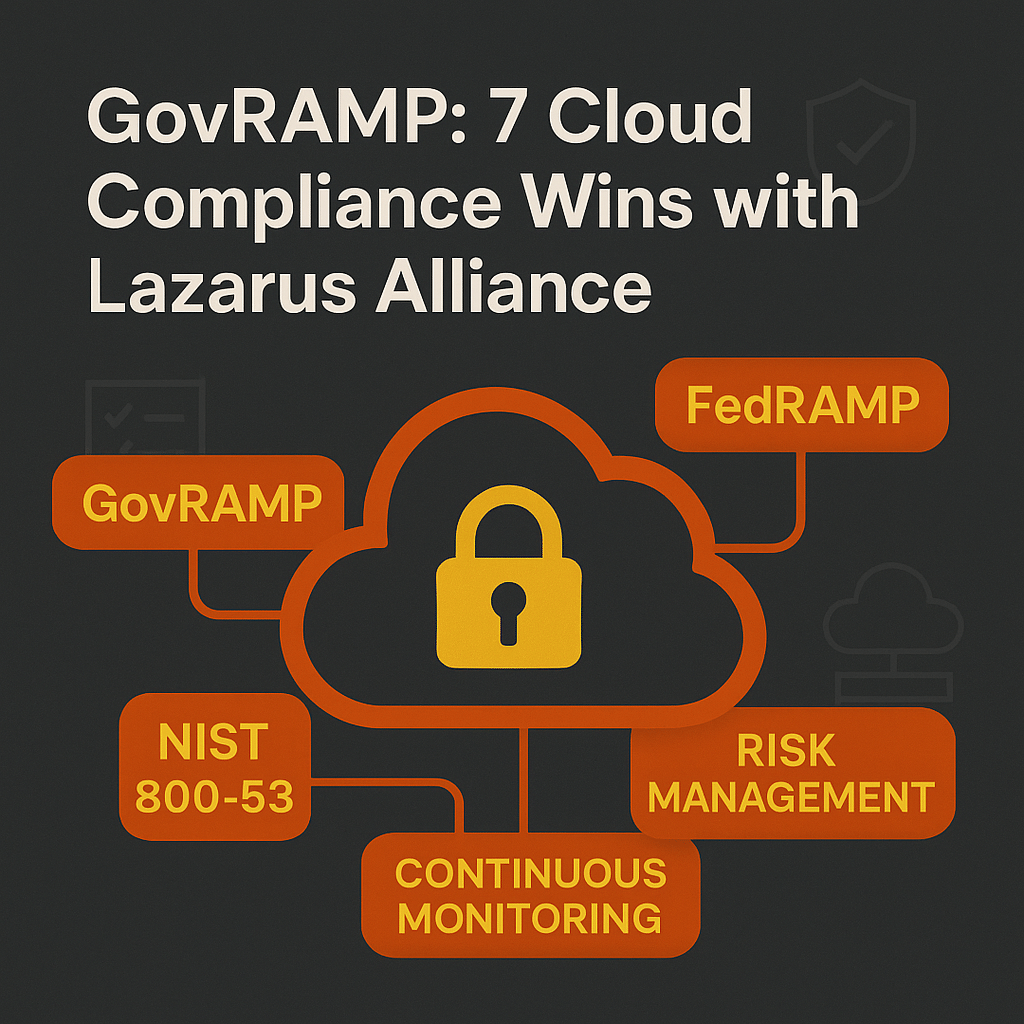
GovRAMP is not simply FedRAMP for state government. The real opportunity is more strategic: build one NIST 800-53-centered assurance program that can support public-sector procurement, FedRAMP reciprocity planning, CJIS conversations, SOC 2 customer assurance, PCI DSS segmentation, HIPAA safeguards, IRS 1075 data protection, and defense-sector overlays without restarting the audit process each time a buyer asks for evidence.
For cloud service providers, SaaS vendors, managed platforms, data analytics companies, and government technology suppliers, GovRAMP can become a commercial accelerator rather than a compliance bottleneck. Lazarus Alliance helps organizations translate cloud compliance requirements into assessor-ready evidence, practical risk management decisions, and repeatable cybersecurity audits aligned to the public-sector expectations that matter.
GovRAMP and StateRAMP: Public-Sector Cloud Assurance with a NIST 800-53 Backbone
GovRAMP, formerly known as StateRAMP, is a public-sector cloud security authorization program for providers serving state, local, tribal, territorial, and education markets; framework-tracking analysis identifies GovRAMP as distinct from FedRAMP, which applies to federal cloud authorization pathways, and notes GovRAMP levels such as Core, Low, Low+, Moderate, and High Normdiff, GovRAMP Framework Summary. FedRAMP, by contrast, is the federal government cloud security authorization program and publishes federal cloud authorization resources, baselines, templates, and modernization information through FedRAMP.gov FedRAMP, Official Program Site.
The common denominator is NIST SP 800-53. NIST describes SP 800-53 as a catalog of security and privacy controls for information systems and organizations, and its control families include access control, audit and accountability, configuration management, contingency planning, identification and authentication, incident response, risk assessment, system and communications protection, and supply chain risk management NIST, SP 800-53 Rev. 5. That makes NIST 800-53 the natural control language for GovRAMP readiness, FedRAMP reciprocity planning, FISMA alignment, and many public-sector procurement security reviews.
Lazarus Alliance approaches GovRAMP readiness as an assurance architecture problem, not as a document-generation exercise. The objective is to produce defensible evidence that shows controls are designed, implemented, inherited where appropriate, monitored, and governed. Organizations pursuing GovRAMP services can align their program with Lazarus Alliance GovRAMP assessment support, while providers targeting federal reciprocity planning can coordinate with Lazarus Alliance FedRAMP services.
Win 1: Turn GovRAMP into a Procurement Accelerator
Public-sector buyers increasingly need proof that cloud services meet formal security expectations before contracting, onboarding, renewal, or expansion. GovRAMP helps answer the buyer’s core question: can this cloud provider protect government data with controls that are independently assessable and continuously monitored?
The fastest path is to treat GovRAMP as a sales-enablement control program. That means maintaining a concise assurance package that includes the system boundary, data-flow diagrams, shared-responsibility matrix, customer-responsibility matrix, control implementation statements, vulnerability-management evidence, penetration-test summaries, incident-response procedures, and continuous-monitoring artifacts.
Implementation steps
- Define the authorization boundary. Document every component that stores, processes, transmits, or can materially affect government data.
- Map inherited controls. Identify controls inherited from infrastructure-as-a-service, platform-as-a-service, identity providers, content delivery networks, ticketing systems, and monitoring tools.
- Separate marketing claims from audit evidence. A policy statement is not operating evidence; assessors expect screenshots, tickets, logs, configuration exports, scan results, approvals, and sampling records.
- Build reusable buyer responses. Convert GovRAMP artifacts into response-ready evidence for RFP security questionnaires, cyber insurance requests, and vendor risk management reviews.
Expert perspective: The strongest GovRAMP candidates know exactly where their evidence lives before the assessor asks for it. That is why readiness should begin with evidence indexing, not with policy rewriting.
Win 2: Build FedRAMP Reciprocity Planning into the GovRAMP Roadmap
FedRAMP reciprocity planning is the discipline of building GovRAMP evidence so it can support a future federal authorization path with minimal rework. FedRAMP publishes security baselines and templates for federal cloud authorization packages FedRAMP, Documents and Templates, and FedRAMP 20x emphasizes modernization of cloud authorization through more scalable, technology-enabled assurance approaches FedRAMP, 20x.
Reciprocity does not mean automatic acceptance. It means your evidence model, control language, system security plan structure, continuous-monitoring process, and risk decisions are organized so another authorizing community can understand them. The less translation required, the more valuable your GovRAMP investment becomes.
The Lazarus Alliance reciprocity lens
- Control statement parity: Write implementation statements in NIST 800-53 language rather than buyer-specific shorthand.
- Assessment-procedure awareness: NIST SP 800-53A provides assessment procedures for determining whether controls are implemented correctly, operating as intended, and producing desired outcomes NIST, SP 800-53A Rev. 5.
- Boundary discipline: Maintain diagrams that distinguish production, corporate, development, management, logging, backup, and customer-facing environments.
- Continuous-monitoring design: Preserve monthly, quarterly, and event-driven artifacts that show how risk is tracked after assessment.
A GovRAMP-ready company that may later pursue FedRAMP should avoid control narratives that only make sense to one state buyer. Instead, the organization should write once for NIST 800-53, then crosswalk outward to GovRAMP, FedRAMP, CJIS, SOC 2, PCI DSS, HIPAA, CMMC, DFARS NIST 800-171, IRS 1075, C5, LADMF, and ISO 27001 where applicable.
Win 3: Use NIST 800-53 Control Engineering, Not Checklist Compliance
NIST SP 800-53 controls are intentionally broad, so implementation quality matters. For example, AC-2 addresses account management, AU-2 addresses event logging, CM-2 addresses baseline configuration, CP-9 addresses system backup, IR-4 addresses incident handling, RA-5 addresses vulnerability monitoring and scanning, SA-9 addresses external system services, SC-13 addresses cryptographic protection, and SI-2 addresses flaw remediation NIST, SP 800-53 Rev. 5.
These controls are not satisfied by owning security tools. They are satisfied when tool outputs, procedures, approval workflows, metrics, and risk decisions prove repeatable operation.
Example: AC-2 account management evidence
A mature GovRAMP evidence package for AC-2 should include identity-provider configuration, privileged-role lists, joiner-mover-leaver tickets, access-review records, disabled-account samples, service-account ownership records, and exception approvals. If the organization uses non-human identities for integrations, automation, or AI agents, the account inventory should identify owner, purpose, credential rotation cadence, logging coverage, and deprovisioning method.
Example: RA-5 vulnerability scanning evidence
For RA-5, assessors expect more than a vulnerability scanner dashboard. Evidence should show authenticated scanning where feasible, asset coverage, risk ranking, remediation tickets, compensating controls, false-positive adjudication, retest results, overdue findings, and management acceptance for unresolved risk. The same evidence can support GovRAMP, FedRAMP planning, SOC 2 security criteria, PCI DSS vulnerability-management conversations, and customer due diligence.
Lazarus Alliance supports NIST 800-53 and FISMA control readiness through dedicated NIST 800-53 audit services, helping organizations identify where implementation statements, test procedures, and evidence collection do not yet align.
Win 4: Integrate Risk Management Before the Assessment Starts
NIST SP 800-37 describes the Risk Management Framework as a structured approach for selecting, implementing, assessing, authorizing, and monitoring controls for systems and organizations NIST, SP 800-37 Rev. 2. GovRAMP success depends on making risk management visible throughout the assessment lifecycle.
Common weakness: organizations build a system security plan that describes ideal-state controls while their risk register tells a different story. Assessors notice when vulnerability exceptions, unsupported components, incomplete logging, or unresolved access-review issues are absent from the SSP. The fix is not to hide risk. The fix is to govern it.
GovRAMP risk management decision matrix
- Accept: Use only when the business owner, security owner, and executive risk owner understand residual exposure and documented compensating controls.
- Mitigate: Use when a technical or procedural fix can reduce likelihood or impact within a defined timeframe.
- Transfer: Use cautiously; cyber insurance or contractual allocation does not remove control responsibility.
- Avoid: Use when a feature, integration, geography, data type, or customer use case creates unacceptable public-sector risk.
Continuum GRC’s 2026 Audit Readiness Benchmark Report examines audit-readiness practices across organizations, and its research focus reinforces a practical point: readiness is an operating model, not a pre-audit scramble. Organizations using the Continuum GRC IT and Cybersecurity Risk platform can organize controls, risks, evidence, and remediation workflows in a unified environment.
Win 5: Create a Multi-Framework Evidence Factory
GovRAMP evidence becomes more valuable when it also satisfies adjacent frameworks. A single well-managed control can support multiple obligations if the organization preserves context, scope, and testability.
Crosswalk examples for public-sector cloud compliance
- CJIS: The FBI CJIS Security Policy Resource Center provides policy resources for protecting Criminal Justice Information, making CJIS relevant for cloud services that support law enforcement or public safety workflows FBI, CJIS Security Policy Resource Center.
- SOC 1 and SOC 2: AICPA SOC 2 description criteria support evaluation of a service organization’s system description for security, availability, processing integrity, confidentiality, and privacy AICPA & CIMA, SOC 2 Description Criteria, and Lazarus Alliance provides SOC 1 and SOC 2 services.
- PCI DSS: The PCI Security Standards Council publishes PCI DSS materials for protecting account data environments PCI Security Standards Council, PCI DSS Document Library.
- HIPAA: HHS describes the HIPAA Security Rule as establishing national standards to protect electronic protected health information HHS, HIPAA Security Rule.
- IRS 1075: IRS Publication 1075 provides requirements for agencies and contractors safeguarding federal tax information IRS, Publication 1075.
- DFARS NIST 800-171 and CMMC: NIST SP 800-171 provides requirements for protecting Controlled Unclassified Information in nonfederal systems and organizations NIST, SP 800-171 Rev. 3, while DoD CMMC resources explain the defense cyber certification model DoD CIO, CMMC.
- C5 and ISO 27001: Germany’s BSI publishes C5 cloud computing compliance criteria for cloud assurance BSI, Cloud Computing Compliance Criteria Catalogue C5, while ISO identifies ISO/IEC 27001 as an information security management system standard ISO, ISO/IEC 27001.
- LADMF: NTIS provides access information for the Limited Access Death Master File program NTIS, Limited Access Death Master File.
The evidence factory model prevents redundant testing. For instance, a single access-review workflow can support NIST 800-53 AC-2, SOC 2 security criteria, HIPAA access safeguards, PCI DSS access governance, CJIS access expectations, and ISO 27001 access-control processes, provided the scope, population, sampling method, and exceptions are clear.
Win 6: Prepare Continuous Monitoring for FedRAMP 20x Expectations
FedRAMP 20x signals a move toward more scalable cloud authorization and assurance practices FedRAMP, 20x. Even for organizations focused first on GovRAMP, the message is clear: static audit binders are losing value, while machine-readable evidence, automated validation, and continuous risk visibility are gaining importance.
GovRAMP continuous monitoring should cover vulnerability management, endpoint protection, configuration drift, privileged access, log retention, incident handling, backup success, change management, external service providers, and remediation status. The control owner should be able to answer three questions at any time: what changed, who approved it, and what evidence proves the control still works?
Practical continuous-monitoring artifacts
- Monthly vulnerability summary with new, remediated, overdue, accepted, and false-positive findings.
- Configuration drift report for hardened baselines, management ports, encryption settings, and administrative groups.
- Privileged-access review with evidence of reviewer independence and exception resolution.
- Incident-response tabletop evidence tied to lessons learned and control updates.
- Supplier monitoring evidence for external system services under NIST 800-53 SA-9 NIST, SP 800-53 Rev. 5.
Automation helps, but automation is not assurance by itself. A dashboard without accountable owners, thresholds, escalation rules, and remediation records is merely visibility. Continuous assurance requires governance.
Win 7: Avoid the Seven GovRAMP Pitfalls That Delay Authorization
GovRAMP delays usually come from evidence weakness rather than technology weakness. The following issues are frequent in readiness assessments:
- Unclear boundary: The SSP includes corporate systems that are not in scope or excludes management systems that can affect production.
- Inherited-control overreach: The provider assumes the cloud platform covers controls that remain the SaaS provider’s responsibility.
- Policy-evidence mismatch: Policies promise quarterly reviews, defined recovery testing, or timely remediation, but tickets and logs show inconsistent operation.
- Weak change management: Emergency changes lack retrospective approval, security impact analysis, or deployment validation.
- Incomplete logging: Logs exist for infrastructure events but not application-level administrative actions, API access, or privileged data exports.
- Penetration-test gaps: Test scope excludes APIs, tenant isolation, authentication workflows, or cloud-management surfaces.
- Risk register immaturity: Findings are tracked as IT tasks instead of business risks with owners, due dates, impact, and residual-risk decisions.
A strong readiness program turns each pitfall into a pre-assessment workstream. Lazarus Alliance Laboratories supports technical assurance activities such as cybersecurity testing and validation, which can be integrated into a broader GovRAMP, FedRAMP, or multi-framework audit strategy.
Detailed Walkthrough: From SaaS Platform to GovRAMP-Ready Evidence
Consider a SaaS analytics provider selling to state health agencies and public safety departments. The platform runs in a major cloud environment, uses a managed database, integrates with a customer identity provider, and supports API-based data exchange. The company wants GovRAMP readiness now and FedRAMP optionality later.
Step one: boundary and data classification. The team identifies production application services, databases, object storage, monitoring tools, deployment pipelines, privileged administration paths, support access, backups, and third-party integrations. It classifies government data, support metadata, logs, and derived analytics outputs.
Step two: control implementation mapping. The company writes NIST 800-53 implementation statements for AC, AU, CM, CP, IA, IR, RA, SA, SC, and SI controls. Each statement identifies what is implemented by the SaaS provider, what is inherited from the cloud provider, and what remains a customer responsibility.
Step three: evidence harvesting. The team collects access reviews, role matrices, single sign-on settings, multifactor authentication configuration, vulnerability scans, container image scan results, change tickets, backup reports, incident-response procedures, tabletop records, encryption configurations, log samples, and supplier reviews.
Step four: assessor-style testing. Lazarus Alliance evaluates whether evidence demonstrates design and operating effectiveness, not merely control intent. If access reviews exist but exceptions are never resolved, the control is not mature. If vulnerability findings are closed without retest evidence, remediation is not fully proven.
Step five: roadmap and reciprocity planning. Findings are translated into prioritized remediation, with a parallel FedRAMP planning track that standardizes SSP language, continuous-monitoring artifacts, and control inheritance documentation.
How Lazarus Alliance Helps Deliver the Seven Cloud Compliance Wins
Lazarus Alliance helps organizations make GovRAMP evidence credible, portable, and actionable. The firm’s approach combines assessor perspective, NIST 800-53 control knowledge, technical testing, risk management, and multi-framework mapping. The result is a compliance program designed to withstand scrutiny from public-sector buyers, procurement teams, authorizing stakeholders, and enterprise risk reviewers.
The seven wins are straightforward:
- Accelerate public-sector procurement with organized assurance evidence.
- Design GovRAMP readiness for FedRAMP reciprocity planning.
- Engineer NIST 800-53 controls for real operating effectiveness.
- Embed risk management before the assessment begins.
- Reuse evidence across SOC 1, SOC 2, CJIS, PCI DSS, HIPAA, CMMC, DFARS NIST 800-171, IRS 1075, C5, LADMF, ISO 27001, FedRAMP, and GovRAMP.
- Prepare continuous monitoring for modern cloud assurance expectations.
- Remove avoidable evidence gaps before they delay authorization.
For CISOs, compliance officers, and IT directors, the strategic question is not whether GovRAMP is another compliance requirement. The strategic question is whether your organization can convert GovRAMP into a reusable trust layer for public-sector growth. Lazarus Alliance can help you build that trust layer with the rigor assessors expect and the clarity buyers need.
Sources and References
- Normdiff, GovRAMP Framework Summary
- FedRAMP, Official Program Site
- FedRAMP, Documents and Templates
- FedRAMP, 20x
- NIST, SP 800-53 Rev. 5
- NIST, SP 800-53A Rev. 5
- NIST, SP 800-37 Rev. 2
- NIST, SP 800-171 Rev. 3
- DoD CIO, Cybersecurity Maturity Model Certification
- FBI, CJIS Security Policy Resource Center
- AICPA & CIMA, SOC 2 Description Criteria
- PCI Security Standards Council, PCI DSS Document Library
- HHS, HIPAA Security Rule
- IRS, Publication 1075
- BSI, Cloud Computing Compliance Criteria Catalogue C5
- ISO, ISO/IEC 27001
- NTIS, Limited Access Death Master File
- Lazarus Alliance, GovRAMP Services
- Lazarus Alliance, FedRAMP Services
- Lazarus Alliance, FISMA and NIST 800-53 Audit Services
- Lazarus Alliance, SOC 1 and SOC 2 Services
- Continuum GRC, 2026 Audit Readiness Benchmark Report
- Continuum GRC, IT and Cybersecurity Risk
About Lazarus Alliance
To learn more about how Lazarus Alliance can help, contact us.
- FedRAMP
- GovRAMP
- NIST 800-53
- DFARS NIST 800-171
- CMMC
- SOC 1 & SOC 2
- C5
- HIPAA, HITECH, & Meaningful Use
- PCI DSS RoC & SAQ
- IRS 1075 & 4812
- CJIS
- LA DMF
- ISO 27001, ISO 27002, ISO 27005, ISO 27017, ISO 27018, ISO 27701, ISO 22301, ISO 17020, ISO 17021, ISO 17025, ISO 17065, ISO 9001, & ISO 90003
- And dozens more!
Related Posts