Lazarus Alliance Risk Audits: 8 Breach Due Diligence Moves

Lazarus Alliance Risk Audits: 8 Breach Due Diligence Moves

Cyber due diligence fails when it treats breach risk as a questionnaire exercise. The better question is not whether a target, vendor, cloud service provider, or business unit claims to be secure; it is whether the organization can produce audit-grade evidence that its controls operate, its residual risk is understood, and its breach exposure is priced into the deal, contract, or compliance decision. That is the core of evidence-based risk management.

Read More

10 AI Governance Audit Controls Lazarus Alliance Maps Fast

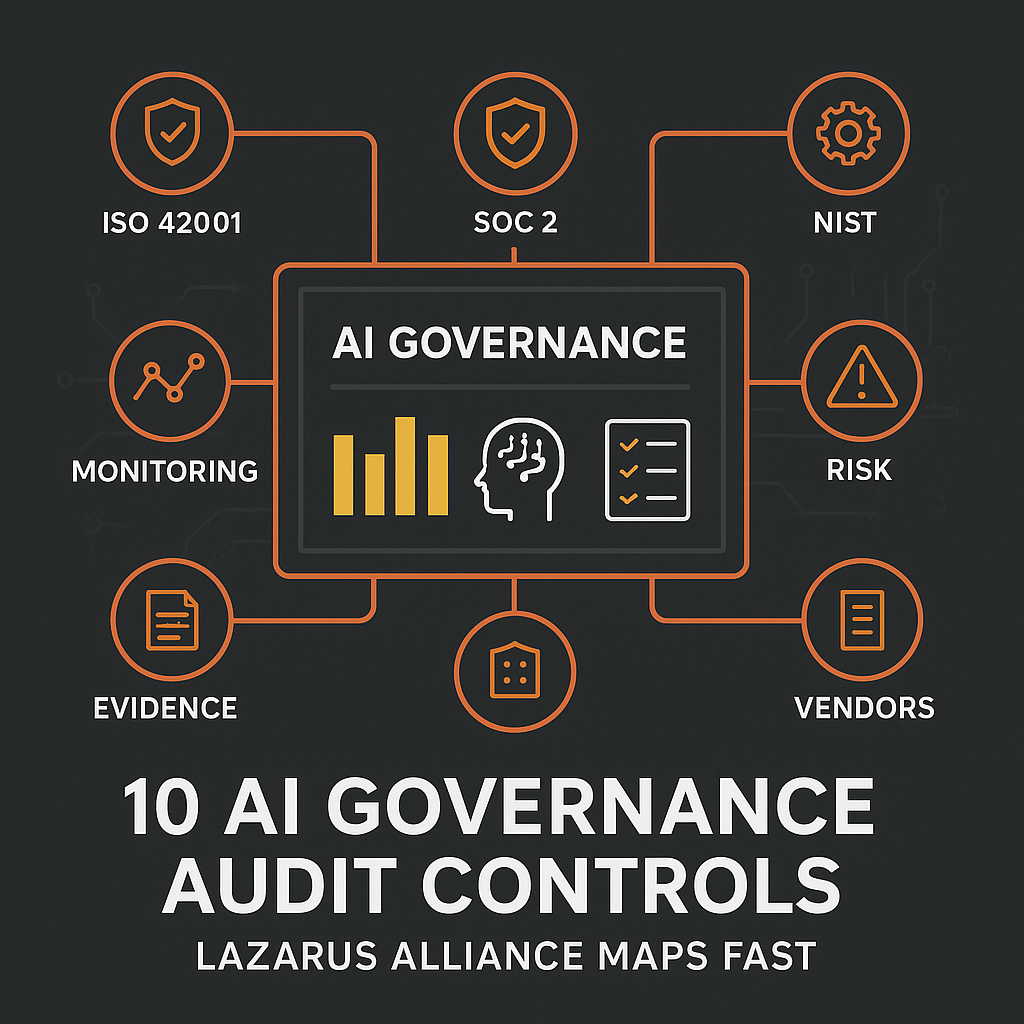
10 AI Governance Audit Controls Lazarus Alliance Maps Fast

Contrarian audit view: AI governance does not fail first at the model layer. It usually fails at the evidence layer. Boards ask whether the enterprise has safe, accountable AI; auditors ask whether the organization can prove inventory, ownership, data lineage, risk treatment, monitoring, supplier oversight, incident response, and management review across every material AI use case. That is why an effective AI governance audit must map ISO IEC 42001, SOC 2 AI controls, and NIST AI governance into one testable evidence model—not three parallel compliance projects.

For CISOs, compliance officers, product leaders, and IT directors, the practical question is not “Which AI framework should we pick?” The better question is: “Which ten controls will satisfy the largest number of AI assurance expectations, reduce vendor due diligence friction, and create defensible evidence for compliance assessments?” Lazarus Alliance approaches AI governance audit work through that lens: establish the management system, identify AI assets, evaluate risk, connect controls to business processes, and preserve evidence in a format an assessor can test.

Read More

7 HIPAA Security Rule Risks Lazarus Alliance Assesses

7 HIPAA Security Rule Risks Lazarus Alliance Assesses

Why HIPAA risk analysis fails when it becomes a paperwork exercise

The strongest HIPAA Security Rule programs do not begin with a template. They begin with a defensible understanding of where electronic protected health information, or ePHI, is created, received, maintained, transmitted, accessed, logged, backed up, and shared. The HIPAA Security Rule establishes national standards for protecting ePHI, and covered entities and business associates must implement administrative, physical, and technical safeguards appropriate to their environments, according to HHS, Summary of the HIPAA Security Rule.

The contrarian truth is that many healthcare organizations do not fail HIPAA because they lack security tools. They fail because risk analysis, evidence collection, vendor oversight, configuration management, and executive governance operate in separate lanes. Lazarus Alliance assesses HIPAA Security Rule risk as an integrated compliance and cybersecurity problem: the same identity, encryption, monitoring, vulnerability, incident response, and third-party controls that support HIPAA also support NIST 800-53, SOC 2, PCI DSS, FedRAMP, GovRAMP, CJIS, CMMC, ISO 27001, IRS 1075, C5, and LADMF readiness when properly mapped and evidenced.

Read More