CJIS v6.1 Assessments: 6 GRC Gaps Lazarus Alliance Tests

CJIS v6.1 Assessments: 6 GRC Gaps Lazarus Alliance Tests

CJIS v6.1 changes the assurance conversation. The organizations most exposed are not only police departments and state repositories; they are cloud platforms, SaaS providers, dispatch technology vendors, records-management providers, courts, municipalities, managed service providers, and integrators that can access, process, store, transmit, or support Criminal Justice Information, or CJI. The practical lesson is simple: CJIS v6.1 assessments are becoming evidence-driven GRC assessments, not policy checklists.

Public CJIS v6.1 summaries report that the updated policy is effective in 2026, aligns more closely with NIST SP 800-53 and NIST SP 800-63B expectations, requires MFA for every user account, introduces stronger incident-reporting and encryption expectations, and places certain Priority 2 through Priority 4 requirements in a transition period ending in 2027 while older and Priority 1 requirements remain auditable now Start With Identity, CJIS Security Policy. The FBI also maintains a CJIS Security Policy Resource Center for official policy resources and security addenda FBI, CJIS Security Policy Resource Center.

For Lazarus Alliance assessors, the modernization trend means one thing: if a vendor cannot show control ownership, operating evidence, and technical enforcement, the agency inherits risk. Below are six GRC gaps Lazarus Alliance tests during CJIS v6.1 readiness and vendor assurance reviews.
Read More

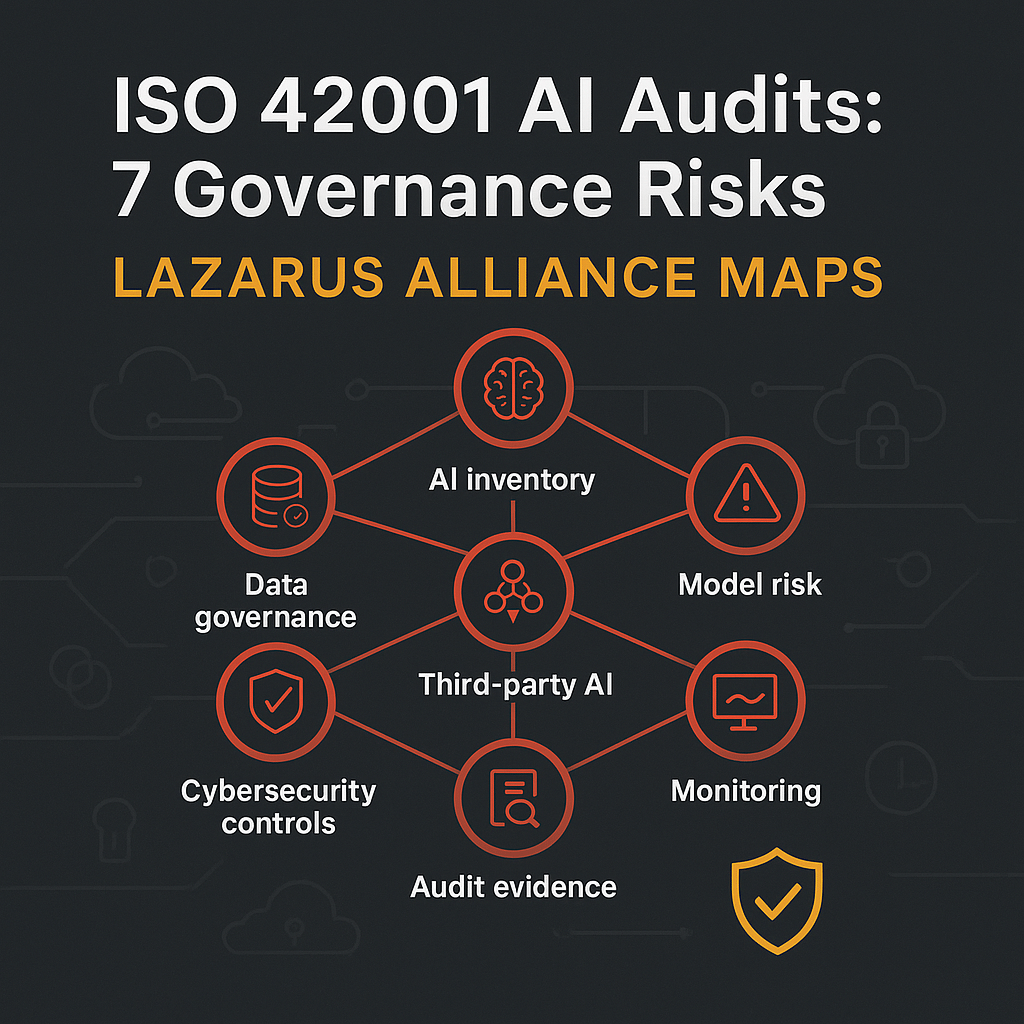
ISO 42001 AI Audits: 7 Governance Risks Lazarus Alliance Maps

ISO 42001 AI Audits: 7 Governance Risks Lazarus Alliance Maps

AI audit readiness is no longer a documentation exercise. The organizations that will pass an ISO 42001 AI governance audit with confidence are not the ones that merely publish an AI policy; they are the ones that can prove, with evidence, that AI risks are identified, assigned, tested, monitored, escalated, and improved through the same disciplined governance expected in mature cybersecurity audits and compliance assessments.

That distinction matters because ISO/IEC 42001 establishes requirements for an artificial intelligence management system, while the NIST AI Risk Management Framework organizes AI risk work around governance, mapping, measurement, and management activities ISO, ISO/IEC 42001 NIST, AI Risk Management Framework. In practice, an AI governance audit must connect board oversight, model risk, cybersecurity, privacy, third-party risk, incident response, and control evidence into one defensible assurance story.

Lazarus Alliance maps ISO 42001 audit readiness through the lens of enterprise assurance: what is in scope, what can fail, what evidence proves control operation, and where AI risk intersects with cybersecurity audits, SOC reporting, FedRAMP-style evidence discipline, HIPAA safeguards, PCI DSS obligations, CMMC and DFARS requirements, CJIS expectations, IRS 1075 controls, C5 cloud criteria, ISO 27001, and the LA DMF ecosystem. The result is not a generic AI checklist. It is a governance-risk map designed for CISOs, compliance officers, legal teams, product leaders, and audit committees that need assurance before customers, regulators, or examiners ask harder questions.

Read More