NIST CSF 2.0 Assessments: 6 Governance Wins With Lazarus Alliance

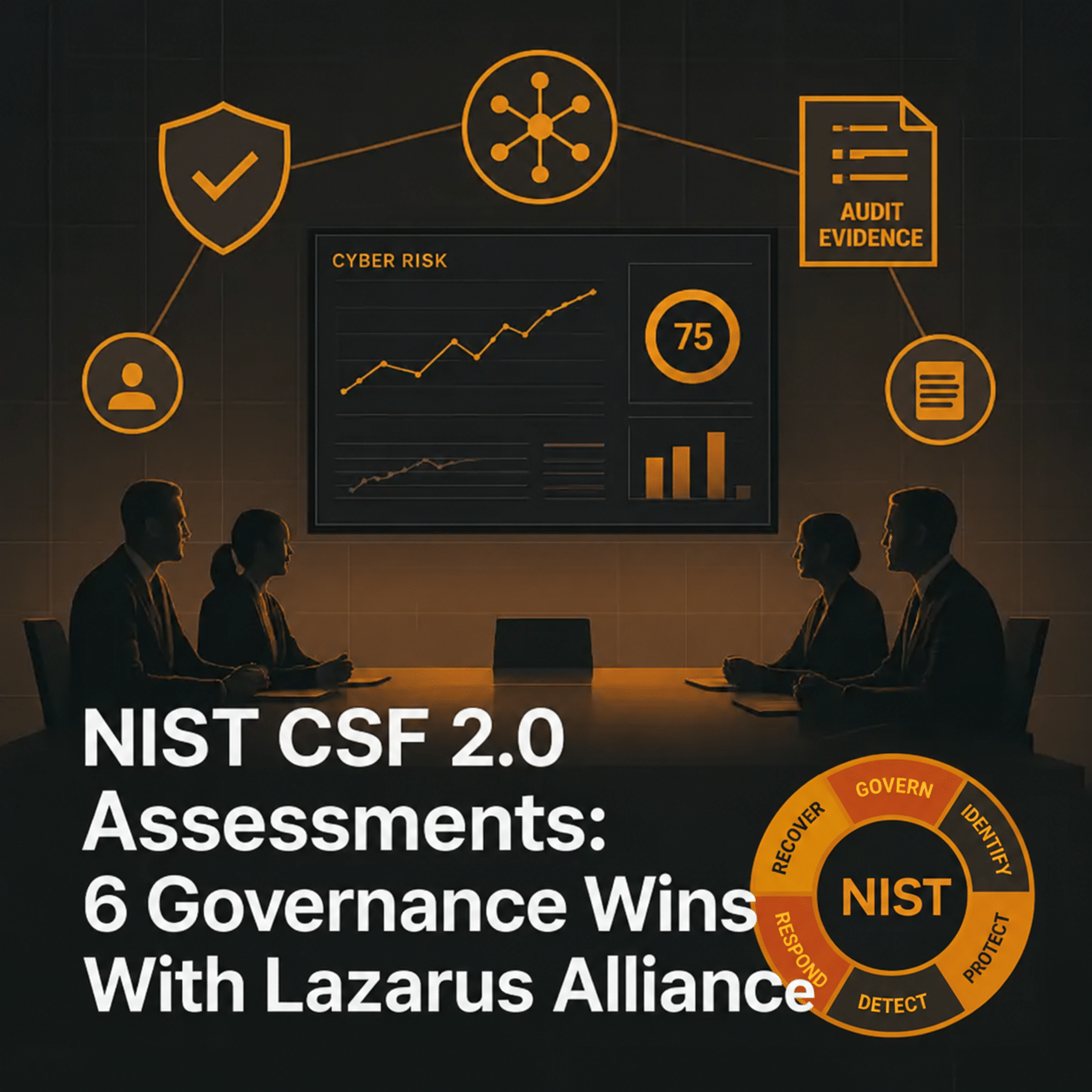
Business meeting on cyber risk and NIST CSF 2.0 assessments.

Enterprise cybersecurity leaders do not need another framework poster. They need a defensible way to prove that cyber risk is governed, funded, tested, reported, and improved. That is the practical value of a NIST CSF 2.0 assessment when it is performed as a governance-driven GRC assessment rather than a checklist exercise.

NIST CSF 2.0 organizes cybersecurity outcomes around six Functions: Govern, Identify, Protect, Detect, Respond, and Recover, with Govern positioned to establish cybersecurity risk management strategy, expectations, policy, oversight, roles, and supply-chain direction, according to NIST, The NIST Cybersecurity Framework 2.0. For boards, CISOs, general counsel, audit committees, and enterprise risk leaders, that shift matters: cybersecurity maturity is no longer just a technical control score; it is evidence that leadership can make risk-informed decisions.

Read More

ISO 27001 Audits: 9 ISMS Compliance Wins With Lazarus Alliance

ISO 27001 Audits: 9 ISMS Compliance Wins With Lazarus Alliance

The strongest ISO 27001 audit programs are no longer built around a binder of policies. They are built around evidence velocity: how quickly leadership can prove that information security governance, risk management, control operation, supplier oversight, and continual improvement are working across the real business. That matters because ISO/IEC 27001 remains a globally recognized management-system standard for establishing, implementing, maintaining, and continually improving an information security management system, or ISMS, according to ISO, ISO/IEC 27001 Information Security Management Systems.

Market demand is rising. The latest ISO Survey dataset reports 125,622 valid accredited ISO/IEC 27001 certificates, 226,262 covered sites, and a reported 29.9% certificate increase, according to ISO, The ISO Survey. For CISOs, compliance officers, IT directors, and procurement leaders, that growth changes the audit-readiness conversation. Certification is not just a badge; it is a structured way to show customers, regulators, boards, insurers, and partners that security decisions are governed, risk-based, measured, and continuously improved.

Read More

HIPAA Risk Analysis: 8 Lazarus Alliance Audit Actions

HIPAA Risk Analysis: 8 Lazarus Alliance Audit Actions

HIPAA risk analysis is no longer a paperwork exercise. In the current healthcare threat environment, the practical question is not whether an organization has a risk analysis document, but whether that document can withstand OCR scrutiny, support defensible risk management decisions, and prove that electronic protected health information, or ePHI, is protected across applications, cloud platforms, medical devices, vendors, and identity systems.

The contrarian lesson from modern HIPAA Security Rule readiness is simple: many organizations fail because they treat risk analysis as a compliance artifact instead of an evidence-backed operating model. The Security Rule requires covered entities and business associates to implement policies and procedures that prevent, detect, contain, and correct security violations, and it requires an accurate and thorough assessment of potential risks and vulnerabilities to the confidentiality, integrity, and availability of ePHI under the administrative safeguards at 45 CFR 164.308. OCR guidance likewise emphasizes that risk analysis must identify where ePHI is stored, received, maintained, or transmitted, and must assess threats, vulnerabilities, likelihood, impact, and risk levels in a documented manner, according to HHS OCR, Guidance on Risk Analysis.

For healthcare executives, CISOs, compliance officers, and IT directors, the modernization signal is unmistakable. The proposed HIPAA Security Rule update would add more explicit expectations for items such as technology asset inventories, network maps, vulnerability scanning, penetration testing, multifactor authentication, encryption, annual compliance audits, business associate verification, and recovery procedures, as described in the Federal Register, HIPAA Security Rule To Strengthen the Cybersecurity of Electronic Protected Health Information. Even before finalization, these items reflect where OCR enforcement and assessor expectations are heading: traceable evidence, repeatable control testing, and risk-based remediation.

Read More