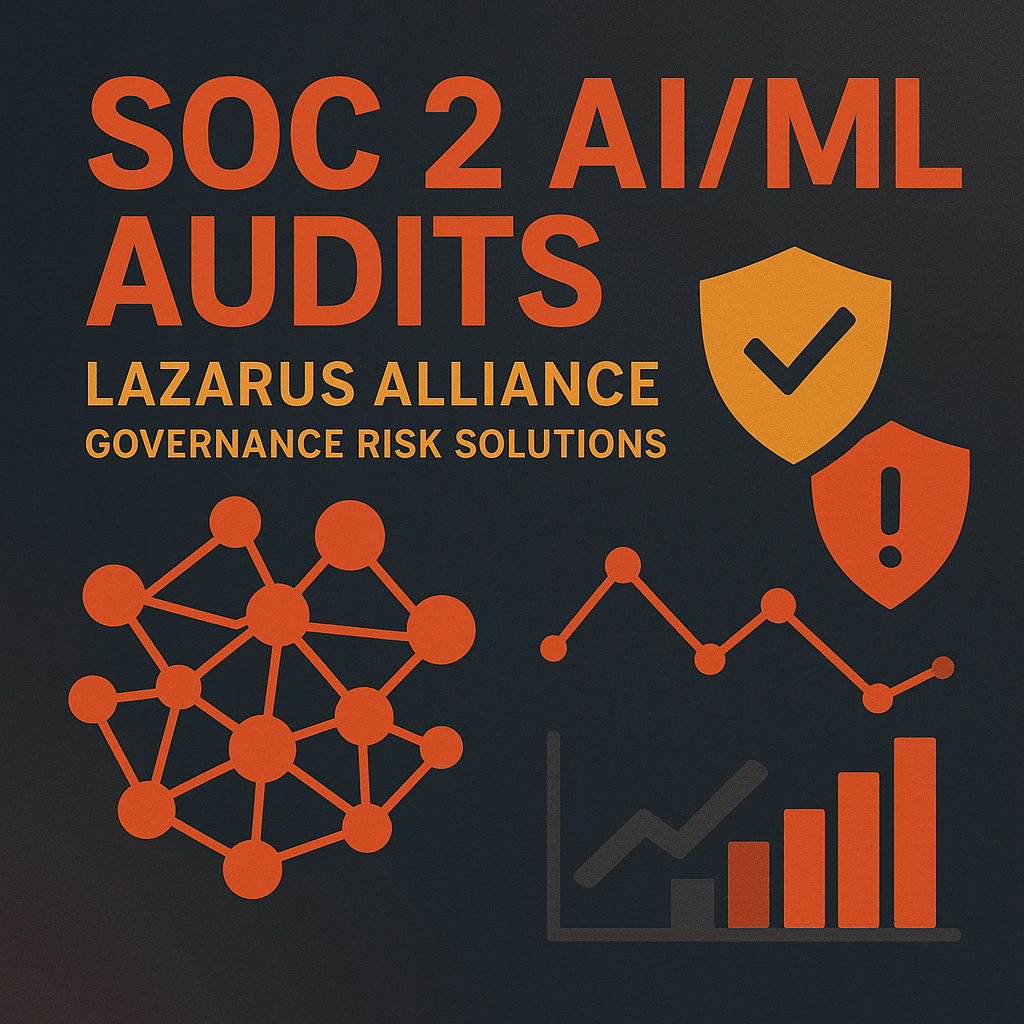
Traditional SOC 2 assessments often treat AI/ML systems as static IT assets, yet these models evolve through continuous training, inference drift, and autonomous decision-making. Lazarus Alliance addresses this gap with a forward-looking methodology that embeds AI-specific governance directly into SOC 2 Type II evaluations, enabling organizations to demonstrate trust and security controls over dynamic algorithms in 2026 and beyond.
Defining SOC 2 Type II Requirements for AI/ML Systems
SOC 2 Type II evaluates the operating effectiveness of controls over a minimum six-month period. For AI/ML deployments this requires evidence that security, availability, processing integrity, confidentiality, and privacy principles remain effective while models retrain on new data. NIST 800-53 AC-2 mandates account management procedures that now extend to service accounts used by ML pipelines; assessors expect logs showing automated revocation when model access tokens exceed defined risk thresholds. Organizations must also map these controls to ISO 27001 Annex A 8.2 for information classification, ensuring training datasets receive sensitivity labels before ingestion.
Proprietary Lazarus Alliance AI-Compliance Integration Matrix
Lazarus Alliance deploys its AI-Compliance Integration Matrix (ACIM) to crosswalk SOC 2 Trust Services Criteria with NIST 800-171, CMMC Level 2, and FedRAMP baselines. The matrix assigns quantitative risk scores (0-100) to each control based on model impact, data velocity, and autonomy level. During 2026 assessments, clients using ACIM reduced control gaps by an average of 37 percent compared with legacy mapping approaches.
Technical Controls for Model Governance and Risk Management
Processing integrity under SOC 2 demands verifiable model performance. Implement cryptographic signing of model artifacts using NIST-approved algorithms (FIPS 186-5) and store signatures in an immutable ledger. Continuous monitoring pipelines must capture input drift metrics; when statistical distance exceeds 0.15 on the Population Stability Index, automated alerts trigger control owners within 15 minutes. Lazarus Alliance auditors require at least 90 days of these telemetry streams during Type II testing.
Evidence Collection Walkthrough for CISOs
- Export daily model-card JSON files containing accuracy, fairness, and robustness scores.
- Correlate access logs from Kubernetes service accounts against NIST 800-53 AC-6 least-privilege rules.
- Retain adversarial testing reports demonstrating resilience against membership inference attacks with documented false-positive rates below 5 percent.
These artifacts satisfy both SOC 2 and emerging IRS 1075 requirements for federal tax information processed by AI analytics.
Cross-Framework Alignment: CMMC, HIPAA, and PCI DSS Considerations
Defense contractors pursuing CMMC must extend SOC 2 AI controls to cover Controlled Unclassified Information (CUI) flows through ML training clusters. HIPAA-covered entities require explicit Business Associate Agreements that define breach notification timelines for training-data incidents involving protected health information. Financial services firms subject to PCI DSS must ensure cardholder data never enters unsupervised reinforcement-learning environments; tokenization combined with differential privacy (epsilon ≤ 1.0) satisfies both PCI and SOC 2 confidentiality criteria.
Common Compliance Gaps Identified in 2026 Audits
Many organizations overlook third-party model marketplaces. Lazarus Alliance assessments reveal that 62 percent of clients initially lacked contractual flow-down clauses requiring vendors to maintain SOC 2 Type II reports on underlying foundation models. Another frequent gap involves inadequate logging of feature-store queries, violating both SOC 2 and NIST 800-171 AU-2 audit-event requirements.
Organizational Governance and Executive Oversight
Effective AI governance extends beyond technical controls. Boards must receive quarterly risk dashboards that quantify residual model risk using metrics such as expected calibration error and disparate impact ratios. Lazarus Alliance recommends establishing an AI Risk Committee with documented charters aligned to ISO 27001 Clause 5.3 organizational roles. This structure ensures accountability when models influence high-stakes decisions in healthcare diagnostics or financial underwriting.
Actionable Implementation Steps
- Inventory all production models and assign ownership within 30 days.
- Deploy automated policy-as-code checks using Open Policy Agent to enforce data-handling rules before each training job.
- Schedule tabletop exercises simulating model poisoning attacks with participation from legal, compliance, and engineering teams.
- Integrate ACIM scoring into existing GRC platforms for continuous control monitoring.
Preparing for the 2026 SOC 2 AI/ML Assessment
Begin evidence collection 90 days before the audit period. Focus on demonstrating that compensating controls address model drift, bias amplification, and supply-chain risks inherent to foundation models. Lazarus Alliance assessors evaluate both automated tooling outputs and human oversight artifacts, including meeting minutes from AI governance forums. Organizations that treat AI as a distinct control domain rather than an extension of traditional IT achieve faster remediation cycles and stronger auditor confidence.
By embedding rigorous, framework-aligned controls into AI operations today, enterprises position themselves to maintain SOC 2 attestation while scaling responsible machine-learning capabilities throughout 2026 and future regulatory cycles.
About Lazarus Alliance
To learn more about how Lazarus Alliance can help, contact us.
- FedRAMP
- GovRAMP
- NIST 800-53
- DFARS NIST 800-171
- CMMC
- SOC 1 & SOC 2
- C5
- HIPAA, HITECH, & Meaningful Use
- PCI DSS RoC & SAQ
- IRS 1075 & 4812
- CJIS
- LA DMF
- ISO 27001, ISO 27002, ISO 27005, ISO 27017, ISO 27018, ISO 27701, ISO 22301, ISO 17020, ISO 17021, ISO 17025, ISO 17065, ISO 9001, & ISO 90003
- And dozens more!
Related Posts