In 2026, state governments are accelerating cloud adoption while tightening security mandates, placing unprecedented pressure on technology leaders to achieve GovRAMP authorization without fragmenting their compliance programs across multiple jurisdictions.
GovRAMP Cloud Audits: Navigating State-Level Authorization in 2026
GovRAMP establishes a standardized risk management framework that enables cloud service providers (CSPs) to obtain state-level authorizations through rigorous third-party assessments. Unlike broader federal programs, GovRAMP tailors controls to the operational realities of state and local agencies, emphasizing data residency, incident response timelines, and integration with existing state procurement rules. As of 2026, more than 35 states reference GovRAMP baselines in their cloud solicitations, creating a de facto national standard for public-sector cloud security.
Core Components of the GovRAMP Authorization Boundary
The authorization boundary under GovRAMP encompasses all system components that process, store, or transmit state data. NIST 800-53 AC-2 requires organizations to define account types, establish conditions for group membership, and maintain automated mechanisms for account management. During audits, assessors examine evidence of automated provisioning workflows, revocation logs within 24 hours of personnel changes, and quarterly access reviews documented with timestamps and approver signatures. Failure to demonstrate continuous monitoring here remains one of the top three findings in 2026 GovRAMP assessments.
Mapping GovRAMP to Multi-Framework Compliance Strategies
Forward-thinking CISOs leverage GovRAMP assessments to satisfy overlapping requirements across CMMC Level 2, NIST 800-171, SOC 2 Type II, and ISO 27001. Lazarus Alliance applies a proprietary crosswalk matrix that aligns GovRAMP control families with DFARS NIST 800-171 safeguarding requirements and IRS 1075 protections for federal tax information. This matrix identifies 87% overlap between GovRAMP Moderate and CMMC practices, allowing organizations to reuse evidence packages while addressing state-specific addenda such as CJIS policy enforcement for law enforcement data.
Technical Implementation: Continuous Monitoring and Evidence Automation
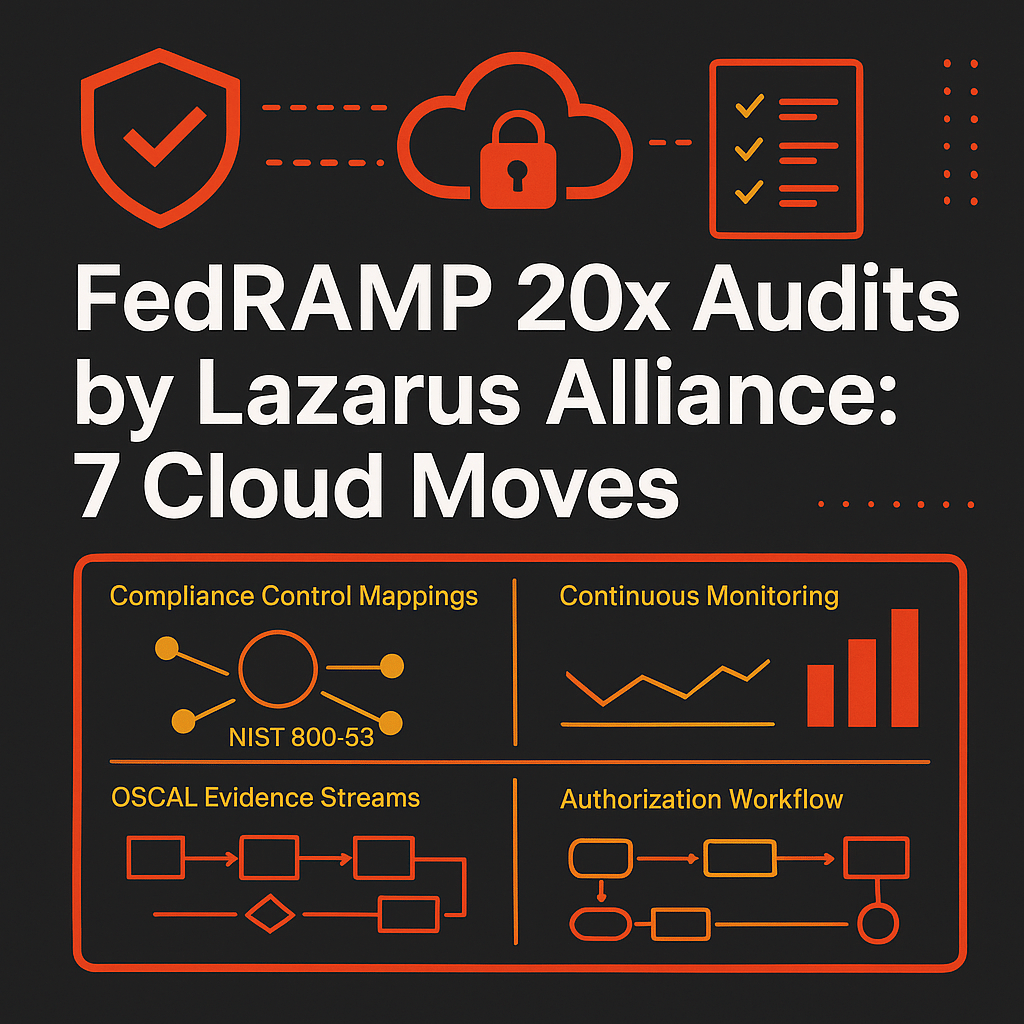
Effective GovRAMP programs deploy automated evidence collection for CA-7 continuous monitoring. Organizations configure SIEM rules to export daily control effectiveness metrics, including failed login thresholds (AU-6) and configuration drift alerts (CM-6). In one 2026 engagement, a healthcare technology provider reduced manual evidence gathering by 62% after implementing policy-as-code pipelines that mapped directly to GovRAMP security control traceability matrices. Assessors now expect machine-readable artifacts rather than static screenshots.
Common Compliance Gaps and Expert Remediation
Many organizations underestimate the organizational governance layer required by GovRAMP. While technical controls receive attention, RA-5 vulnerability management programs often lack documented risk acceptance decisions signed by the authorizing official within 30 days of scan completion. Lazarus Alliance auditors frequently observe gaps in supply chain risk management (SR-2), where CSPs fail to maintain current subcontractor authorization lists or conduct annual reassessments of critical dependencies. Addressing these requires embedding compliance responsibilities into vendor management playbooks rather than treating them as annual checkbox exercises.
Actionable Steps for Tech Leaders Preparing for GovRAMP
- Conduct a gap analysis using the latest GovRAMP baseline against current NIST 800-53 Rev. 5 control implementations, prioritizing high-impact controls such as AC-17 remote access and SC-7 boundary protection.
- Establish a cross-functional governance committee that meets bi-weekly to review control performance metrics and approve risk-based deviations.
- Integrate GovRAMP requirements into existing SOC 2 and ISO 27001 programs by updating the statement of applicability and control mapping documentation.
- Engage an accredited third-party assessment organization early to perform a readiness review focused on state-specific tailoring.
These steps create a repeatable methodology that scales across multiple state authorizations while maintaining a single source of truth for evidence.
Lazarus Alliance Perspective on Future-Proofing State Cloud Compliance
Our methodology emphasizes proactive alignment between GovRAMP and emerging state privacy regulations expected in 2027. By treating authorization as an ongoing program rather than a point-in-time milestone, organizations achieve measurable reductions in audit fatigue and faster procurement cycles. Quantitative benchmarks from 2026 client engagements show that mature GovRAMP programs complete state authorizations 40% faster than those relying on ad-hoc evidence collection. Technology leaders who embed these practices now position their organizations for seamless expansion into additional regulated verticals including HIPAA, PCI DSS, and C5 attestation requirements.
About Lazarus Alliance
To learn more about how Lazarus Alliance can help, contact us.
- FedRAMP
- GovRAMP
- NIST 800-53
- DFARS NIST 800-171
- CMMC
- SOC 1 & SOC 2
- C5
- HIPAA, HITECH, & Meaningful Use
- PCI DSS RoC & SAQ
- IRS 1075 & 4812
- CJIS
- LA DMF
- ISO 27001, ISO 27002, ISO 27005, ISO 27017, ISO 27018, ISO 27701, ISO 22301, ISO 17020, ISO 17021, ISO 17025, ISO 17065, ISO 9001, & ISO 90003
- And dozens more!
Related Posts