GovRAMP and C5 Cloud Audit: 8 Lazarus Alliance Steps

GovRAMP and C5 Cloud Audit: 8 Lazarus Alliance Steps

Public-sector cloud assurance is no longer a single certification project. It is an evidence operating model. A cloud service provider that sells to agencies, education, defense-adjacent buyers, healthcare programs, justice organizations, or European regulated entities may need to satisfy GovRAMP, BSI C5, FedRAMP, NIST 800-53, SOC 2, ISO 27001, HIPAA, PCI DSS, CJIS, IRS 1075, DFARS NIST 800-171, CMMC, and customer-specific procurement clauses with the same underlying control environment. The strategic mistake is treating each framework as a separate audit. The efficient approach is to build one defensible control architecture, one evidence fabric, and one continuous monitoring cadence that can be expressed in the language of each assurance regime.

That is the operating premise behind Lazarus Alliance’s eight-step method for GovRAMP and BSI C5 cloud audit readiness. The objective is not merely to pass an assessment. The objective is to make cloud compliance durable, repeatable, machine-readable where possible, and useful to executive decision-makers.
Read More

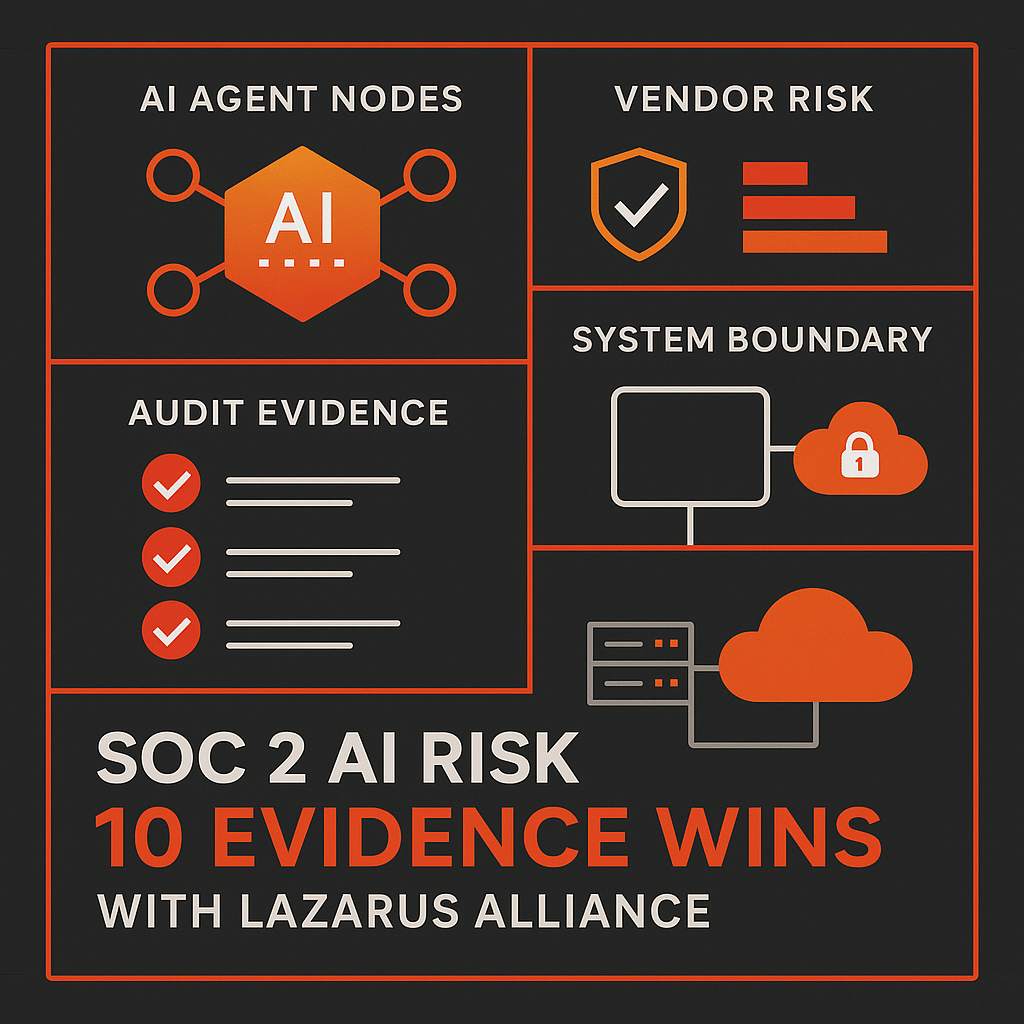
SOC 2 AI Risk: 10 Evidence Wins with Lazarus Alliance

SOC 2 AI Risk: 10 Evidence Wins with Lazarus Alliance

The hardest SOC 2 AI risk problem is not whether an AI tool is innovative; it is whether the auditor can see where the tool starts, what it can touch, who owns it, and what evidence proves it behaved as intended. AI agents, embedded copilots, retrieval-augmented generation, automated support bots, and vendor-hosted models create a new evidence challenge: they often act like users, integrations, processors, and decision engines at the same time.

For Lazarus Alliance, the practical answer is not to bolt a vague AI policy onto a SOC 2 audit. The answer is to convert AI risk into testable audit evidence mapped to system boundaries, vendor risk management, access control, logging, change management, privacy, confidentiality, and customer assurance. The AICPA explains that SOC 2 description criteria support evaluation of a service organization’s system across security, availability, processing integrity, confidentiality, and privacy, which means AI capabilities must be described and evidenced when they are relevant to the service commitment or system boundary AICPA & CIMA, SOC 2 Description Criteria.

This article gives CISOs, compliance officers, IT directors, and audit owners a field-tested evidence model: 10 SOC 2 evidence wins for AI agents, AI vendors, and AI system boundaries.

Read More

FedRAMP 20x Modernization: Risk Management Assessments by Lazarus

FedRAMP 20x Modernization: Risk Management Assessments by Lazarus

The FedRAMP 20x modernization initiative represents a fundamental shift from static documentation to dynamic, machine-readable risk intelligence. By replacing traditional System Security Plans with OSCAL packages and Key Security Indicators, the program demands that Cloud Service Providers demonstrate continuous risk posture rather than periodic snapshots. Lazarus Alliance brings specialized expertise in translating these new requirements into actionable compliance programs that align technical controls with organizational governance.

Read More