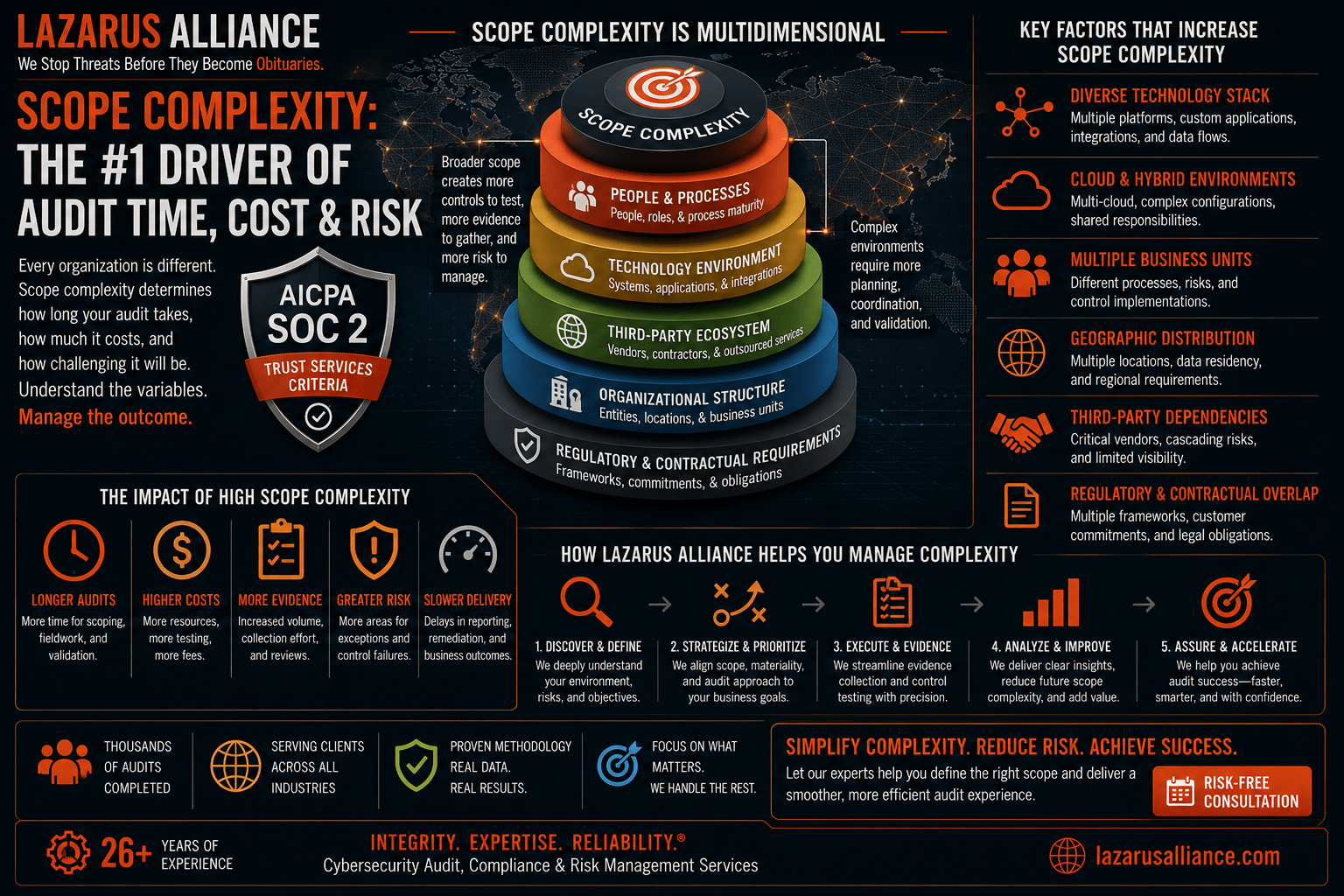
SOC 2 Scope & Complexity
Table of Contents
ToggleWhat Drives Effort, Exceptions, and Timeline — From N = 75 Examinations
January 2025 – June 2026 • Updated August 2026
1. Trust Services Criteria Selection
Criteria count expands the control population and evidence demand. Observed patterns:
- Security only — most common starting point; still the majority of first-time reports. Lowest evidence and testing load when the boundary is clear.
- Security + Availability — frequent for SaaS and infrastructure providers; adds availability monitoring, capacity, and continuity evidence.
- Security + Confidentiality — common when handling sensitive customer data; adds data classification, encryption, and disposal evidence.
- Three or more criteria — more common in renewals and enterprise-facing providers; materially higher evidence and testing load.
Adding criteria without corresponding operational maturity is a common source of exceptions and delay. A clean Security-only Type 1 or Type 2 almost always beats a rushed multi-criteria first report.
2. Primary Scope Drivers of Effort
System boundary clarity
Well-defined product or service boundaries reduced testing friction. Vague or shifting boundaries increased system description exceptions, sampling complexity, and clarification cycles. The system description must match the live environment.
Number of in-scope systems and locations
Multi-product or multi-region environments increased sampling and evidence volume. Each additional system or location multiplies access, change, logging, and configuration evidence requirements.
Subservice organizations
Critical vendors without current SOC reports created exceptions and follow-up. Organizations that inventoried critical subservice organizations early and obtained their SOC reports avoided last-minute gaps. Review of vendor reports must be documented.
Criteria count
Each additional Trust Services Category expands the control population. Security-only packages were leaner; multi-criteria packages required more evidence mapping and testing, especially for Type 2 observation periods.
Type 2 observation period length and stability
Longer periods require more samples and sustained control operation. Starting an observation period before controls are stable produced operating-effectiveness exceptions. Period length should match operational readiness — longer is not always better.
3. How Scope Interacts with Other Benchmark Metrics
| Metric (N = 75) | Value | Scope connection |
|---|---|---|
| Typical formal fieldwork | 6–10 weeks | Complex multi-criteria / multi-system scopes push the longer end |
| Examinations with ≥1 exception | 71% (53 of 75) | Boundary and vendor gaps are frequent exception sources |
| Required additional evidence | 88% (66 of 75) | Unclear scope drives clarification on system description and samples |
| Type 2 share | 73% (55 of 75) | Observation period multiplies evidence demand for broad scopes |
| First-time share | 42% (32 of 75) | First-time + broad scope is the highest-risk combination |
| Average evidence volume | ~1,450 artifacts | Increases with criteria count, systems, and Type 2 period length |
4. Common Scoping Mistakes
- Expanding criteria before the system description is solid. Security-only with a clear boundary outperforms multi-criteria with a vague description.
- Including systems that are not ready. In-scope systems with weak access, change, or logging evidence generate exceptions.
- Ignoring subservice organizations until fieldwork. Missing vendor SOC reports are a recurring, avoidable exception.
- Starting a Type 2 observation period too early. Unstable controls during the period produce operating-effectiveness findings.
- Treating the system description as a one-time document. Drift between description and production is a top exception area.
- Over-scoping for “marketing completeness.” Customers prefer a clean, limited report over a broad report full of exceptions.
5. Practical Scoping Guidance
- Start with a clear system description and boundary before expanding criteria.
- Prefer a clean Security-only Type 1 or Type 2 over a rushed multi-criteria first report.
- Identify critical subservice organizations early and obtain their SOC reports.
- For Type 2, align observation period length with operational readiness — longer is not always better if controls are not stable.
- Treat renewals as an opportunity to refine scope and system description, not only to “pass again.”
- Match scope to customer requirements. Do not add criteria that no customer has asked for until the core report is strong.
6. Related Benchmark Context (N = 75)
- Type 2 / Type 1: 73% / 27%
- First-time / Renewal: 42% / 58%
- Most common exception areas: access control, change management, logging/monitoring, risk/vendor management, system description accuracy
Full context: 2026 SOC 2 Audit Benchmark Report (Lazarus Alliance).
7. Authors & How to Cite
Lead Author
Michael D. Peters, CEO & Founder, Lazarus Alliance, Inc.
Delaware CPA firm principal; A2LA-accredited FedRAMP 3PAO; Authorized CMMC C3PAO; PCI DSS QSA.
How to Cite
Peters, M. D. (2026). SOC 2 Scope & Complexity. Lazarus Alliance, Inc. Data drawn from the 2026 SOC 2 Audit Benchmark Report (N = 75).
8. About Lazarus Alliance
Lazarus Alliance is a Delaware CPA firm providing SOC 2 examinations, an A2LA-accredited FedRAMP 3PAO, an authorized CMMC C3PAO (CPN 10251), a PCI DSS QSA, and a veteran-owned small business headquartered in Scottsdale, Arizona.
Lazarus Alliance, Inc.
27743 N. 70th Street, Suite 100, Scottsdale, AZ 85266
1-888-896-7580 • [email protected]
https://lazarusalliance.com
© 2026 Lazarus Alliance, Inc. All rights reserved. Proactive Cybersecurity®, Cybervisor®, and IT Audit Machine® are trademarks of Lazarus Alliance or its affiliates. Figures are observational aggregates from anonymized examinations and do not guarantee individual outcomes.
Scottsdale, Arizona • 1-888-896-7580 • lazarusalliance.com
Data Source
This analysis is based on the 2026 SOC 2 Audit Benchmark Report, Lazarus Alliance's aggregate analysis of 75 completed formal SOC 2 audit engagements conducted between January 2025 and June 2026.
Additional Analysis
- How Long Does a SOC 2 Audit Take?
- 7 Most Common SOC 2 Audit Exceptions
- How Much Evidence Does a SOC 2 Audit Require?
- SOC 2 Type 1 vs Type 2: What Our Audit Data Shows
- First SOC 2 Audit vs. Renewal: What the Data Shows
Talk with one of our experts
Our Lazarus Alliance Cybervisor™ teams have experience performing thousands of assessments for organizations providing services to clients around the world.
We're here to answer any questions you may have.