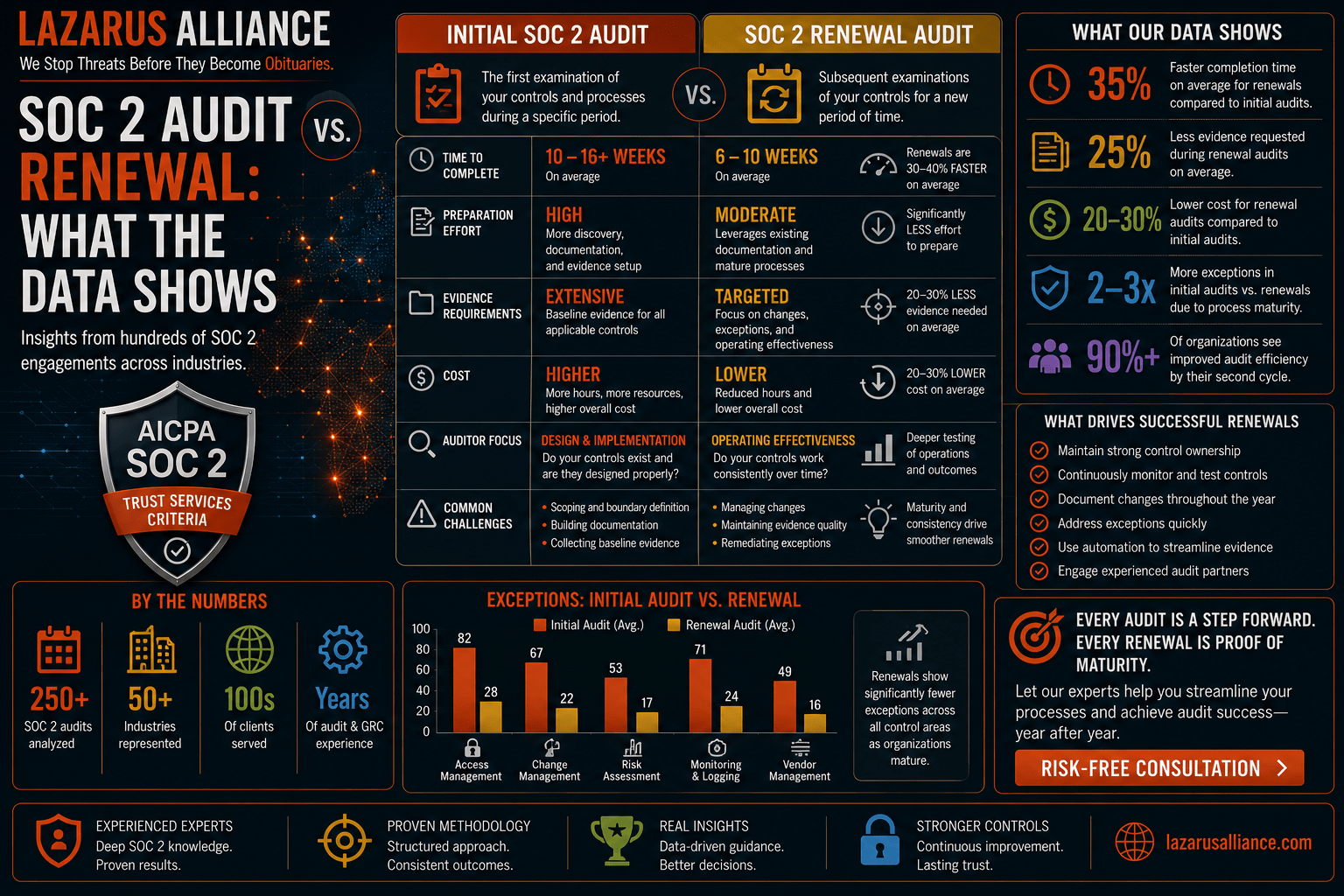
First SOC 2 Audit vs. Renewal:
What the Data Shows
Table of Contents
ToggleDuration, Exceptions, Evidence Readiness, and Practical Implications
Based on N = 75 completed examinations • January 2025 – June 2026 • Updated August 2026
(32 of 75)
(43 of 75)
Duration & Cycles
& Fewer Exceptions
1. Dataset Split
| Segment | Count | Share |
|---|---|---|
| First-time SOC 2 examination | 32 | 42% |
| Renewal examination | 43 | 58% |
First-Time vs Renewal (N = 75)
Relative Characteristics
2. Quantified Comparison (N = 75)
| Metric | First-Time (N = 32) | Renewal (N = 43) |
|---|---|---|
| Share of dataset | 42% (32 of 75) | 58% (43 of 75) |
| Median formal fieldwork | 9 weeks | 7 weeks |
| Examinations with ≥1 exception | 84% (27 of 32) | 60% (26 of 43) |
| Median exceptions (when present) | 2 | 1 |
| Average evidence artifacts | ~1,600 | ~1,350 |
| Required additional evidence | 94% (30 of 32) | 84% (36 of 43) |
| Average clarification cycles | 2.1 | 1.3 |
Key finding: First-time SOC 2 examinations were 40% more likely to contain at least one exception than renewals (84% vs 60%). They also required longer median fieldwork (9 vs 7 weeks) and more clarification cycles (2.1 vs 1.3).
3. Qualitative Patterns
| Attribute | First-Time | Renewal |
|---|---|---|
| System description | Often immature or first draft | Usually refined from prior year |
| Control ownership clarity | Still forming | Established |
| Evidence processes | Being built during the engagement | Institutionalized from prior year |
Duration
Formal fieldwork across the full dataset typically ran 6–10 weeks. First-time examinations more often extended toward the longer end — driven by system description refinement, incomplete evidence mapping, and mid-exam clarification. Renewals more often completed toward the shorter end when the prior year’s description and evidence processes were maintained.
Exceptions
Overall, 71% (53 of 75) of examinations had at least one exception (median 2 when present). First-time examinations generated exceptions more frequently, especially in access lifecycle evidence, change management trails, logging coverage, and system description accuracy. Renewals still produced exceptions, but profiles were generally more limited when prior-year issues had been closed.
Evidence
Average evidence volume was ~1,450 artifacts. 88% (66 of 75) of examinations required at least one additional evidence cycle. First-time packages more often lacked criteria mapping, observation-period samples (for Type 2), or complete vendor SOC reports. Renewal packages benefited from established folders, owners, and sampling approaches.
4. Why First-Time Examinations Take Longer
- System description is being written for the first time — boundary, CUECs, and infrastructure details are still being settled.
- Evidence processes are new — teams are learning what “good” samples look like for access, change, and logging.
- Control ownership is diffuse — who owns each control is not yet operationalized.
- Type 2 observation periods may start before controls are stable — producing operating-effectiveness exceptions.
- Vendor and subservice documentation is incomplete — critical SOC reports missing or not reviewed.
5. Why Renewals Run Cleaner
- System description is refined — prior-year feedback has been incorporated.
- Evidence owners and cadences exist — access reviews, change tickets, and log reviews are on a known schedule.
- Prior exceptions were closed — less open residual risk carried forward.
- Institutional knowledge of sampling — teams know what examiners will ask for.
- Vendor SOC report collection is habitual — fewer last-minute gaps.
6. Practical Recommendations
For first-time examinations
- Budget extra calendar time for system description quality — not only policy writing.
- Map evidence to Trust Services Criteria before fieldwork.
- If pursuing Type 2, stabilize controls before starting the observation period.
- Identify critical subservice organizations and obtain their SOC reports early.
- Expect exceptions (71% overall) and plan management response time.
- Consider Type 1 first if customers will accept it and controls need more operating time.
For renewals
- Treat renewal as a refinement opportunity, not only a repeat pass.
- Update the system description for any product, infrastructure, or boundary changes.
- Close prior-year exceptions fully and retain close-out evidence.
- Keep evidence cadences running year-round — do not restart collection at kickoff.
7. Related Benchmark Metrics (N = 75)
- Typical formal fieldwork: 6–10 weeks
- Type 2 / Type 1: 73% / 27%
- Examinations with ≥1 exception: 71% (53 of 75)
- Required additional evidence: 88% (66 of 75)
- Average evidence volume: ~1,450 artifacts
Full context: 2026 SOC 2 Audit Benchmark Report (Lazarus Alliance).
8. Authors & How to Cite
Lead Author
Michael D. Peters, CEO & Founder, Lazarus Alliance, Inc.
Delaware CPA firm principal; A2LA-accredited FedRAMP 3PAO; Authorized CMMC C3PAO; PCI DSS QSA.
How to Cite
Peters, M. D. (2026). First SOC 2 Audit vs. Renewal: What the Data Shows. Lazarus Alliance, Inc. Data drawn from the 2026 SOC 2 Audit Benchmark Report (N = 75).
9. About Lazarus Alliance
Lazarus Alliance is a Delaware CPA firm providing SOC 2 examinations, an A2LA-accredited FedRAMP 3PAO, an authorized CMMC C3PAO (CPN 10251), a PCI DSS QSA, and a veteran-owned small business headquartered in Scottsdale, Arizona.
Lazarus Alliance, Inc.
27743 N. 70th Street, Suite 100, Scottsdale, AZ 85266
1-888-896-7580 • [email protected]
https://lazarusalliance.com
© 2026 Lazarus Alliance, Inc. All rights reserved. Proactive Cybersecurity®, Cybervisor®, and IT Audit Machine® are trademarks of Lazarus Alliance or its affiliates. Figures are observational aggregates from anonymized examinations and do not guarantee individual outcomes.
Scottsdale, Arizona • 1-888-896-7580 • lazarusalliance.com
Data Source
This analysis is based on the 2026 SOC 2 Audit Benchmark Report, Lazarus Alliance's aggregate analysis of 75 completed formal SOC 2 audit engagements conducted between January 2025 and June 2026.
Additional Analysis
- How Long Does a SOC 2 Audit Take?
- 7 Most Common SOC 2 Audit Exceptions
- How Much Evidence Does a SOC 2 Audit Require?
- SOC 2 Type 1 vs Type 2: What Our Audit Data Shows
- Scope & Complexity
Talk with one of our experts
Our Lazarus Alliance Cybervisor™ teams have experience performing thousands of assessments for organizations providing services to clients around the world.
We're here to answer any questions you may have.