SOC 2 Type 1 vs Type 2:
What Our Audit Data Shows
Table of Contents
ToggleReport Type Mix, Duration, Evidence, and Exceptions from N = 75 Examinations
January 2025 – June 2026 • Updated August 2026
(55 of 75)
(20 of 75)
& Exception Load
First Report
1. Quantified Comparison (N = 75)
| Metric | Type 1 (N = 20) | Type 2 (N = 55) |
|---|---|---|
| Share of dataset | 27% (20 of 75) | 73% (55 of 75) |
| Median formal fieldwork | 6 weeks | 8 weeks |
| Examinations with ≥1 exception | 55% (11 of 20) | 76% (42 of 55) |
| Median exceptions (when present) | 1 | 2 |
| Average evidence artifacts | ~900 | ~1,650 |
| Required additional evidence | 75% (15 of 20) | 93% (51 of 55) |
| Average clarification cycles | 1.2 | 1.8 |
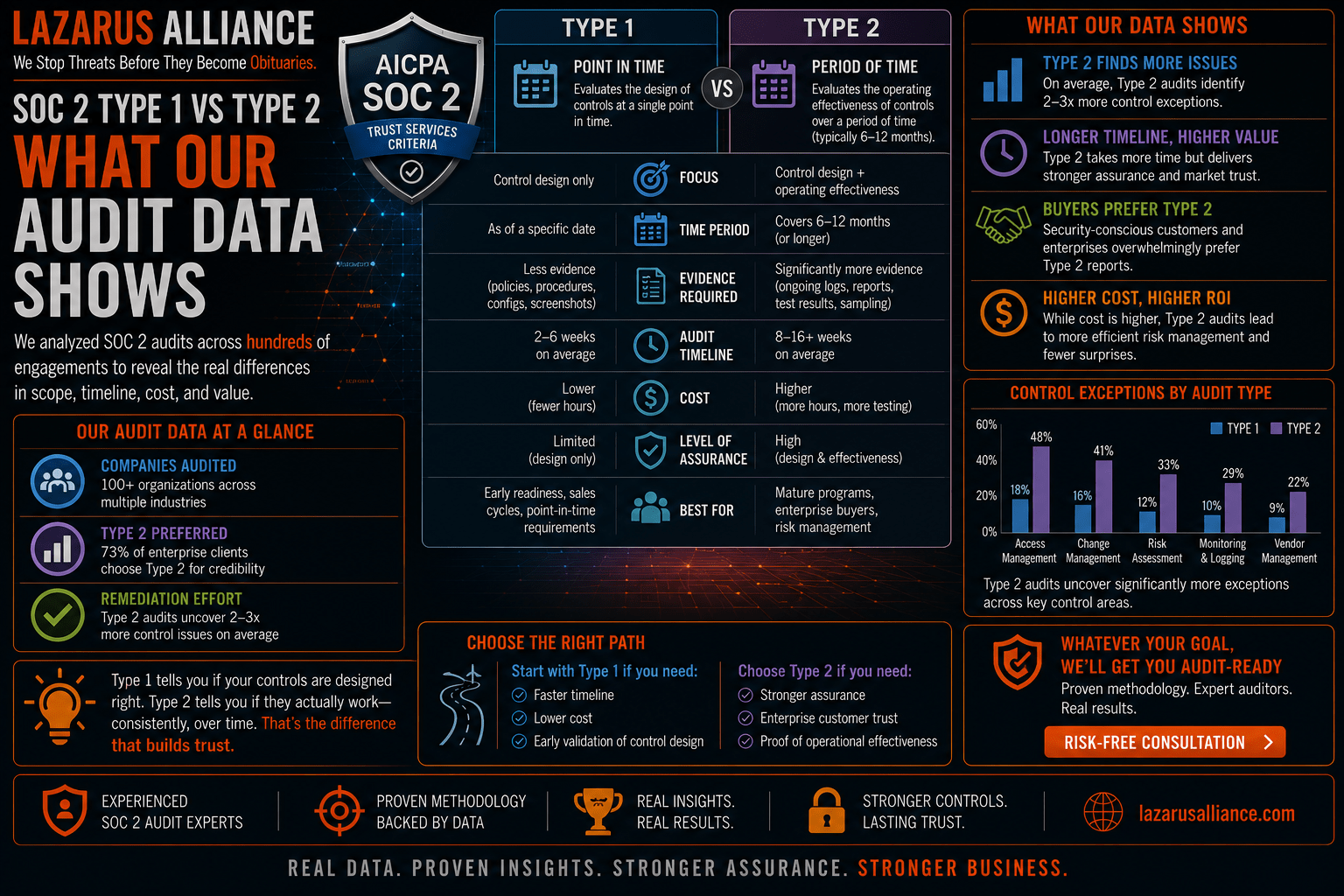
Key finding: Type 2 examinations were 38% more likely to contain at least one exception than Type 1 (76% vs 55%). They also required substantially more evidence (~1,650 vs ~900 average artifacts) and more clarification cycles (1.8 vs 1.2).
2. What Type 1 and Type 2 Actually Test
| Attribute | Type 1 | Type 2 |
|---|---|---|
| Focus | Design of controls at a point in time | Design + operating effectiveness over a period |
| Observation period | Not required | Required (commonly 3–12 months) |
| Evidence demand | Lower (point-in-time) | Higher (samples across the period) |
| Common use case | First report; rapid market need | Customer / enterprise requirement; ongoing assurance |
Report Type Mix (N = 75)
Relative Effort Characteristics
3. What the Data Showed
Mix and demand
Type 2 dominated the dataset (73%). Enterprise customers and many RFPs explicitly require Type 2. Type 1 remains relevant for organizations that need a first report quickly or whose customers accept a design-only opinion as an interim step.
Duration
Formal fieldwork across the full dataset typically ran 6–10 weeks. Type 1 examinations more often landed at the shorter end. Type 2 examinations more often used the full window, especially when observation-period samples were incomplete or the system description required refinement mid-exam.
The Type 2 observation period itself is outside formal fieldwork but is often the largest driver of overall calendar time to report delivery.
Evidence volume
Average evidence volume across all examinations was ~1,450 artifacts. Type 2 packages were generally larger because they must support operating-effectiveness testing over time. Type 1 packages could be leaner when system description and design evidence were complete.
Overall, 88% (66 of 75) of examinations required at least one additional evidence cycle — Type 2 examinations were more likely to need observation-period samples and sustained control evidence.
Exceptions
71% (53 of 75) of examinations had at least one exception (median 2 when present). Type 2 examinations surface more operating-effectiveness exceptions (e.g., access reviews not performed on cadence throughout the period, change tickets missing for part of the window, logging gaps). Type 1 exceptions more often relate to design completeness and system description accuracy.
4. When Type 1 Is the Right Choice
- You need a first SOC 2 report on a compressed timeline
- Customers will accept a point-in-time design opinion as an interim step
- Controls are designed but have not yet operated long enough for a credible Type 2 observation period
- You want to validate system description and control design before committing to a multi-month observation period
Type 1 is not a “lesser” report — it is a different assurance product. Mis-selling Type 1 as equivalent to Type 2 creates customer friction later.
5. When Type 2 Is the Right Choice
- Enterprise customers or contracts require Type 2
- You need ongoing assurance over a defined period, not only design at a point in time
- Controls are stable enough to support a planned observation period
- You are renewing and already have operational evidence processes in place
Moving from Type 1 to Type 2 is a step-up in evidence rigor. Organizations that treat Type 2 as “Type 1 plus a few more samples” under-prepare and generate avoidable exceptions.
6. Practical Recommendations
- Choose the report type based on customer need and control maturity, not only speed to first report.
- If starting with Type 1, design the system description and controls for Type 2 from day one — avoid a full redesign later.
- For Type 2, stabilize controls before starting the observation period. Unstable periods produce exceptions.
- Plan sampling across the full observation period, not only the weeks before fieldwork.
- Budget more evidence and clarification time for Type 2 — the data support a material increase in effort.
7. Related Benchmark Metrics (N = 75)
- Typical formal fieldwork: 6–10 weeks
- Examinations with ≥1 exception: 71% (53 of 75)
- Required additional evidence: 88% (66 of 75)
- First-time vs renewal: 42% / 58%
- Average evidence volume: ~1,450 artifacts
Full context: 2026 SOC 2 Audit Benchmark Report (Lazarus Alliance).
8. Authors & How to Cite
Lead Author
Michael D. Peters, CEO & Founder, Lazarus Alliance, Inc.
Delaware CPA firm principal; A2LA-accredited FedRAMP 3PAO; Authorized CMMC C3PAO; PCI DSS QSA.
How to Cite
Peters, M. D. (2026). SOC 2 Type 1 vs Type 2: What Our Audit Data Shows. Lazarus Alliance, Inc. Data drawn from the 2026 SOC 2 Audit Benchmark Report (N = 75).
9. About Lazarus Alliance
Lazarus Alliance is a Delaware CPA firm providing SOC 2 examinations, an A2LA-accredited FedRAMP 3PAO, an authorized CMMC C3PAO (CPN 10251), a PCI DSS QSA, and a veteran-owned small business headquartered in Scottsdale, Arizona.
Lazarus Alliance, Inc.
27743 N. 70th Street, Suite 100, Scottsdale, AZ 85266
1-888-896-7580 • [email protected]
https://lazarusalliance.com
© 2026 Lazarus Alliance, Inc. All rights reserved. Proactive Cybersecurity®, Cybervisor®, and IT Audit Machine® are trademarks of Lazarus Alliance or its affiliates. Figures are observational aggregates from anonymized examinations and do not guarantee individual outcomes.
Scottsdale, Arizona • 1-888-896-7580 • lazarusalliance.com
Data Source
This analysis is based on the 2026 SOC 2 Audit Benchmark Report, Lazarus Alliance's aggregate analysis of 75 completed formal SOC 2 audit engagements conducted between January 2025 and June 2026.
Additional Analysis
- How Long Does a SOC 2 Audit Take?
- 7 Most Common SOC 2 Audit Exceptions
- How Much Evidence Does a SOC 2 Audit Require?
- First SOC 2 Audit vs. Renewal: What the Data Shows
- Scope & Complexity
Talk with one of our experts
Our Lazarus Alliance Cybervisor™ teams have experience performing thousands of assessments for organizations providing services to clients around the world.
We're here to answer any questions you may have.