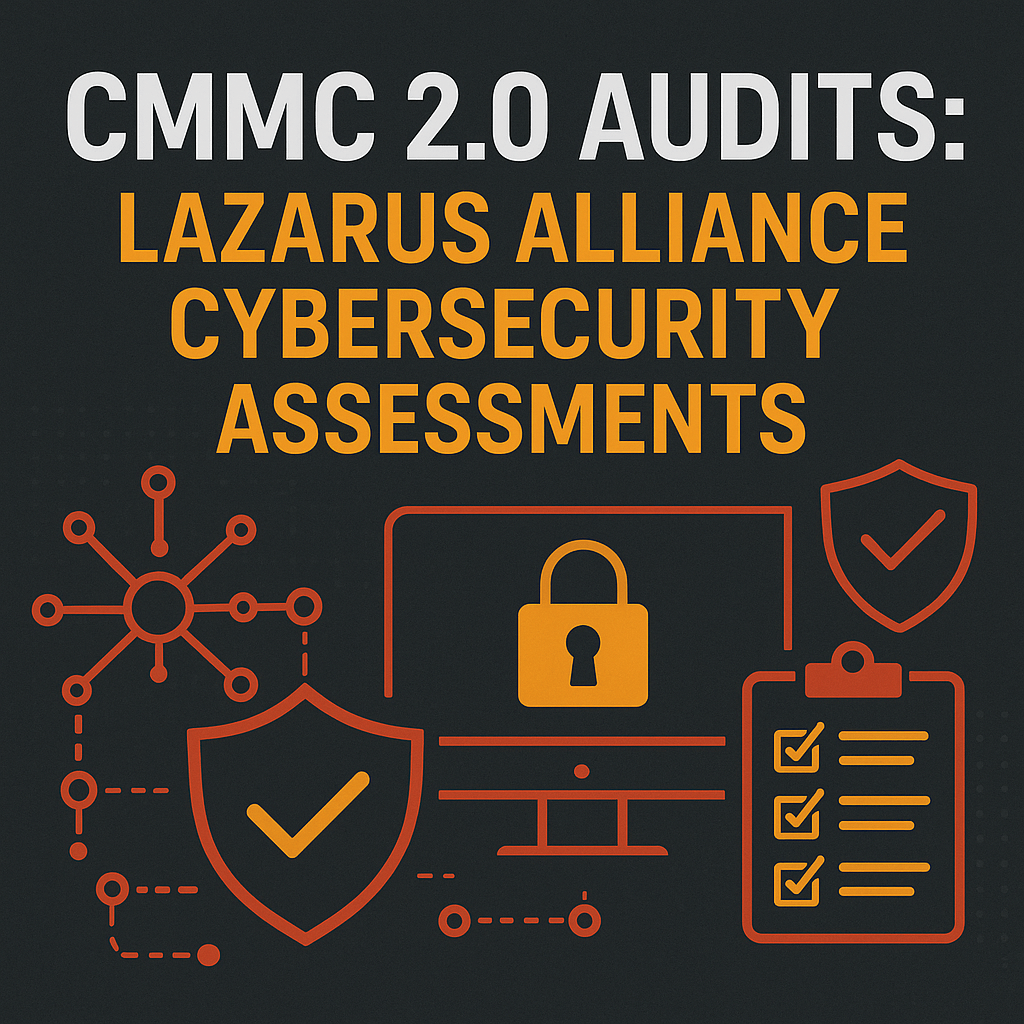
In 2026, defense contractors face a decisive shift where CMMC 2.0 audits move beyond documentation reviews to real-time validation of integrated risk controls. Lazarus Alliance delivers assessments that embed NIST 800-171 controls into enterprise governance, revealing gaps that traditional audits overlook.
CMMC 2.0 Final Rule Implementation: Strategic Implications for 2026
The CMMC 2.0 Final Rule, fully enforceable in 2026, mandates that Level 2 and Level 3 contractors demonstrate continuous control effectiveness rather than point-in-time attestations. NIST 800-171 control 3.1.1 requires limiting system access to authorized users, yet many organizations still rely on static role matrices that fail under dynamic supply-chain threats. Lazarus Alliance auditors test this through simulated access scenarios, measuring revocation times against the 24-hour benchmark specified in related NIST 800-53 AC-2 enhancements.
Key Regulatory Requirements Under the 2026 Landscape
Contractors must now map CMMC domains directly to NIST 800-171 Revision 3 controls while aligning with FedRAMP Moderate baselines for cloud environments. Lazarus Alliance assessments quantify this alignment using a proprietary crosswalk matrix that scores control overlap at the requirement level. For example, CMMC AC.L2-3.1.1 intersects with NIST 800-53 AC-2(3) and ISO 27001 A.9.2.1, allowing organizations to satisfy multiple frameworks with single evidence artifacts.
- Evidence must include automated logs showing failed access attempts blocked within 15 minutes.
- Governance policies require annual board-level risk reviews documented per SOC 2 CC1.2 criteria.
- Third-party supplier attestations must reference CJIS or IRS 1075 controls when handling sensitive data flows.
Lazarus Alliance Cybersecurity Assessment Methodology
Our methodology begins with a governance maturity scoring model that evaluates policy ownership, control ownership, and exception management processes. Auditors collect evidence through direct system queries rather than self-reported spreadsheets, reducing the common 40% discrepancy rate between documented and actual configurations observed in defense contractor environments.
Technical Control Validation Walkthrough
Consider a typical CMMC Level 2 assessment of media sanitization under MP.L2-3.8.3. Lazarus Alliance tests NIST 800-171 3.8.3 by attempting data recovery on decommissioned drives using forensic tools approved under NIST 800-88 guidelines. Findings are scored against a zero-trust benchmark where any recoverable PII triggers a Level 3 remediation ticket. This approach has identified residual data on 23% of sampled endpoints in recent 2026 engagements, far exceeding industry averages reported by DoD.
Integrating CMMC with NIST 800-53, ISO 27001, and SOC 2
Defense contractors often maintain overlapping obligations under HIPAA, PCI DSS, and FedRAMP. Lazarus Alliance deploys a unified control repository that maps CMMC practices to equivalent controls in these frameworks. NIST 800-53 SI-4 continuous monitoring requirements, for instance, satisfy both CMMC SI.L2-3.14.6 and ISO 27001 A.12.4.1 when implemented with SIEM correlation rules tuned to detect anomalous data exfiltration patterns exceeding 50 MB per session.
Common Compliance Gaps and Expert Analysis
One frequent misconception is that CMMC 2.0 self-assessments suffice for prime contractors. The Final Rule explicitly requires third-party certification for Level 2 environments handling CUI. Another gap appears in incident response planning: organizations document procedures yet fail to test them against the 72-hour reporting window mandated by DFARS 252.204-7012. Lazarus Alliance runs tabletop exercises that measure mean-time-to-report, with 2026 benchmarks showing top performers achieving under 48 hours.
Actionable Implementation Steps for CISOs
Begin by conducting a control-by-control gap analysis using the Lazarus Alliance CMMC Readiness Scorecard. Prioritize remediation of access control and audit logging domains, which account for 62% of initial assessment findings. Establish a cross-functional compliance committee that meets monthly to review metrics such as patch compliance rates above 95% and MFA coverage on all privileged accounts. Finally, schedule a pre-assessment with Lazarus Alliance to validate evidence collection processes before formal certification.
Future-Proofing Defense Contractor Compliance
As CMMC enforcement expands in 2027 and beyond, organizations that treat audits as isolated events will face contract disqualification. Lazarus Alliance embeds continuous monitoring dashboards that feed real-time control status into executive risk reports, aligning technical metrics with organizational governance requirements across NIST, ISO, and SOC 2 domains. This integrated approach transforms compliance from a cost center into a competitive differentiator for winning DoD contracts.
About Lazarus Alliance
To learn more about how Lazarus Alliance can help, contact us.
- FedRAMP
- GovRAMP
- NIST 800-53
- DFARS NIST 800-171
- CMMC
- SOC 1 & SOC 2
- C5
- HIPAA, HITECH, & Meaningful Use
- PCI DSS RoC & SAQ
- IRS 1075 & 4812
- CJIS
- LA DMF
- ISO 27001, ISO 27002, ISO 27005, ISO 27017, ISO 27018, ISO 27701, ISO 22301, ISO 17020, ISO 17021, ISO 17025, ISO 17065, ISO 9001, & ISO 90003
- And dozens more!
Related Posts