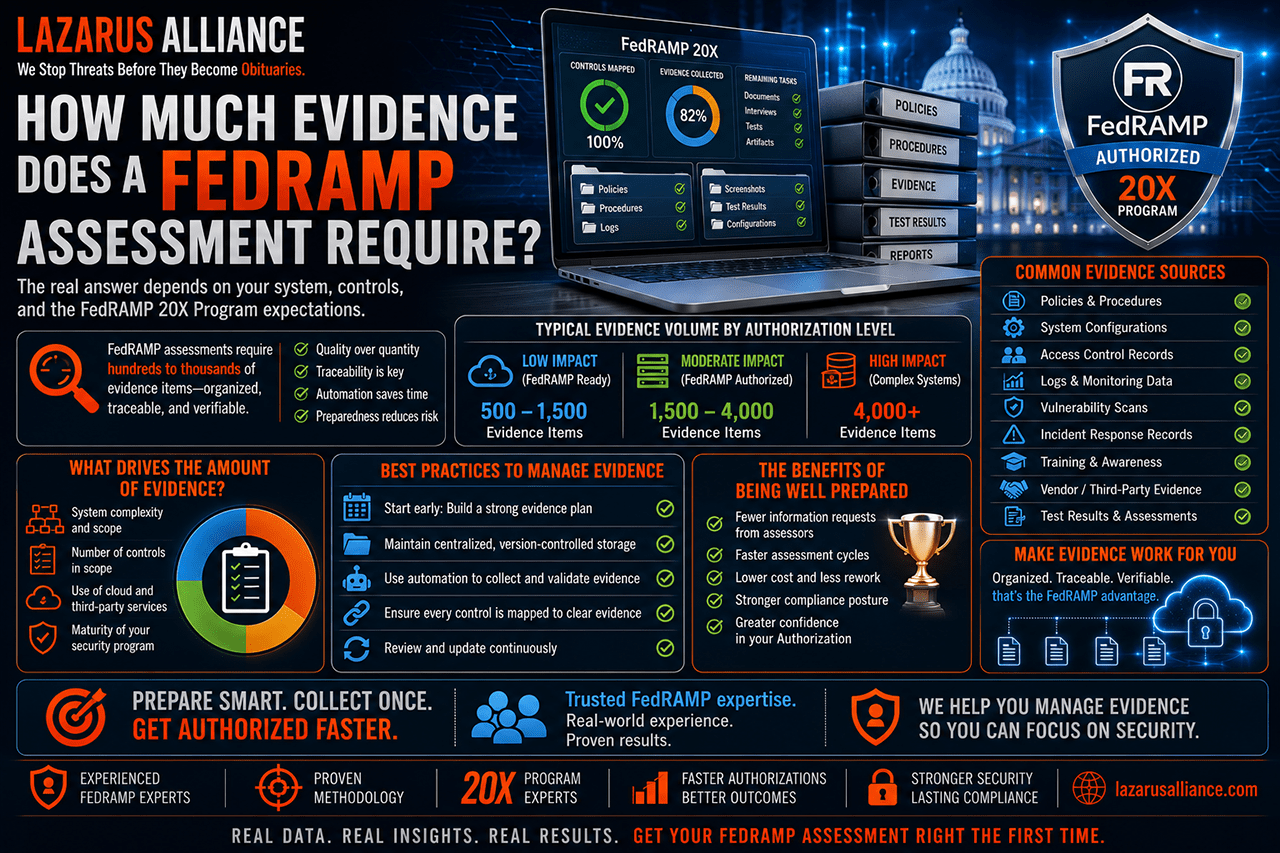
How Much Evidence Does a
FedRAMP Assessment Require?
Table of Contents
ToggleVolume, Quality, and What FedRAMP 3PAO Assessors Actually Need
Based on N = 12 completed formal assessments • January 2025 – June 2026 • Updated August 2026
Submitted
Range
Evidence (11 of 12)
Quantity
Matters
1. What Counts as “Evidence” in FedRAMP?
In a FedRAMP assessment, evidence is any artifact that demonstrates a control is implemented and operating within the authorization boundary. Typical categories include:
- System Security Plan (SSP) and control implementation statements
- Policies and procedures
- Architecture and data-flow diagrams
- Configuration baselines, inventories, and hardening evidence
- Screenshots and system outputs (with context)
- Audit / log samples
- Access reviews, account inventories, and ticketing records
- Vulnerability scan results and remediation tickets
- Continuous monitoring records and metrics
- Inheritance documentation and customer / shared responsibility matrices
- Training and personnel security evidence
Assessors evaluate whether the evidence is sufficient, recent, attributable to the authorization boundary, and mapped to the specific 800-53 control.
2. Observed Evidence Volume (N = 12)
| Metric | Value | Notes |
|---|---|---|
| Average discrete artifacts submitted | ~3,400 | N = 12 |
| Observed range | ~1,200 – 9,500 | Wide variation by boundary complexity and maturity |
| Assessments requiring additional evidence | 92% (11 of 12) | At least one clarification round |
| Most common additional requests | Logs, baselines, MFA/access paths, inheritance, continuous monitoring | After initial package review |
Additional Evidence Required (N = 12)
3. Volume vs. Quality
Raw file count is a poor success metric. In the dataset:
- Some tighter-boundary packages with fewer than 2,000 high-quality, control-mapped artifacts moved through assessment more efficiently.
- Larger packages (6,000+ files) sometimes generated more clarification requests when artifacts lacked context, dates, or clear control mapping.
What assessors consistently preferred:
- Control-tagged evidence (each artifact linked to one or more 800-53 controls)
- Timestamps and system identifiers on screenshots and exports
- Clear ownership and “last reviewed” dates on policies, baselines, and SSP sections
- Operational proof (tickets, logs, review records) alongside policy statements
- Accurate, current architecture and data-flow diagrams
- Living continuous monitoring evidence, not one-time reports
4. Most Common Evidence Deficiencies
These weaknesses appeared repeatedly and drove most additional-evidence requests:
- SSP and control statements misaligned with the implemented system
- Screenshots without context or timestamps — missing system name, date, or configuration path
- Incomplete or non-representative log samples
- Missing or generic configuration baselines — no authoritative, version-controlled baseline for production components
- Unsupported inheritance claims — no current customer responsibility matrix or shared-responsibility documentation
- Weak continuous monitoring artifacts — point-in-time outputs instead of ongoing operational evidence
- Vague or incomplete POA&M entries — missing milestones, residual risk, or ownership
5. How Boundary Complexity Affects Evidence Volume
| Boundary Profile | Share of Dataset | Evidence Tendency |
|---|---|---|
| Single-system / tightly bounded | 58% (7 of 12) | Generally lower volume, tighter control mapping, fewer residual findings |
| Complex multi-component / multi-service | 42% (5 of 12) | Higher volume, more inheritance validation, more frequent clarification rounds |
A well-documented, tightly bounded authorization boundary almost always produces a more efficient evidence package than an undifferentiated multi-service architecture with weak shared-responsibility clarity.
6. Practical Guidance for Evidence Packaging
- Map first, collect second. Create a control-to-evidence matrix before bulk collection.
- Require context on every artifact. System name, date, owner, and control ID.
- Prefer operational proof over policy alone. Tickets, logs, and review records close findings faster than narrative procedures.
- Keep the SSP and baselines living documents. Out-of-date architecture descriptions create immediate friction.
- Validate inheritance early. Unsupported or stale shared-responsibility claims are a recurring source of delay.
- Treat continuous monitoring as first-class evidence, not an afterthought.
- Expect clarification. Even strong packages often receive focused follow-up requests. Plan for at least one additional evidence cycle.
7. Related Benchmark Metrics (N = 12)
- Median formal assessment duration: 42 business days
- Assessments with ≥1 POA&M: 92% (11 of 12)
- Most frequent residual findings: Audit & Accountability, Configuration Management, Access Control, Identification & Authentication
Full context: 2026 FedRAMP Assessment Benchmark Report (Lazarus Alliance).
8. Authors & How to Cite
Lead Author
Michael D. Peters, CEO & Founder, Lazarus Alliance, Inc.
A2LA-accredited FedRAMP 3PAO leadership; Authorized CMMC C3PAO; PCI DSS QSA firm principal.
How to Cite
Peters, M. D. (2026). How Much Evidence Does a FedRAMP Assessment Require? Lazarus Alliance, Inc. Data drawn from the 2026 FedRAMP Assessment Benchmark Report (N = 12).
9. About Lazarus Alliance
Lazarus Alliance is an A2LA-accredited FedRAMP Third-Party Assessment Organization (3PAO), an authorized CMMC C3PAO (CPN 10251), a PCI DSS Qualified Security Assessor (QSA), and a veteran-owned small business headquartered in Scottsdale, Arizona.
Lazarus Alliance, Inc.
27743 N. 70th Street, Suite 100, Scottsdale, AZ 85266
1-888-896-7580 • [email protected]
https://lazarusalliance.com
© 2026 Lazarus Alliance, Inc. All rights reserved. Proactive Cybersecurity®, Cybervisor®, and IT Audit Machine® are trademarks of Lazarus Alliance or its affiliates. Figures are observational aggregates from anonymized assessments and do not guarantee individual outcomes.
Scottsdale, Arizona • 1-888-896-7580 • lazarusalliance.com
Data Source
This analysis is based on the 2026 FedRAMP Assessment Benchmark Report, Lazarus Alliance's aggregate analysis of 12 completed formal FedRAMP assessment engagements conducted between January 2025 and June 2026.
Additional Analysis
- How Long Does a FedRAMP Assessment Take?
- 7 Most Common FedRAMP Assessment Findings
- FedRAMP Authorization Boundary Complexity
- 7 Most Misunderstood FedRAMP Requirements Observed in Assessments
- FedRAMP POA&M Benchmarks
Talk with one of our experts
Our Lazarus Alliance Cybervisor™ teams have experience performing thousands of assessments for organizations providing services to clients around the world.
We're here to answer any questions you may have.