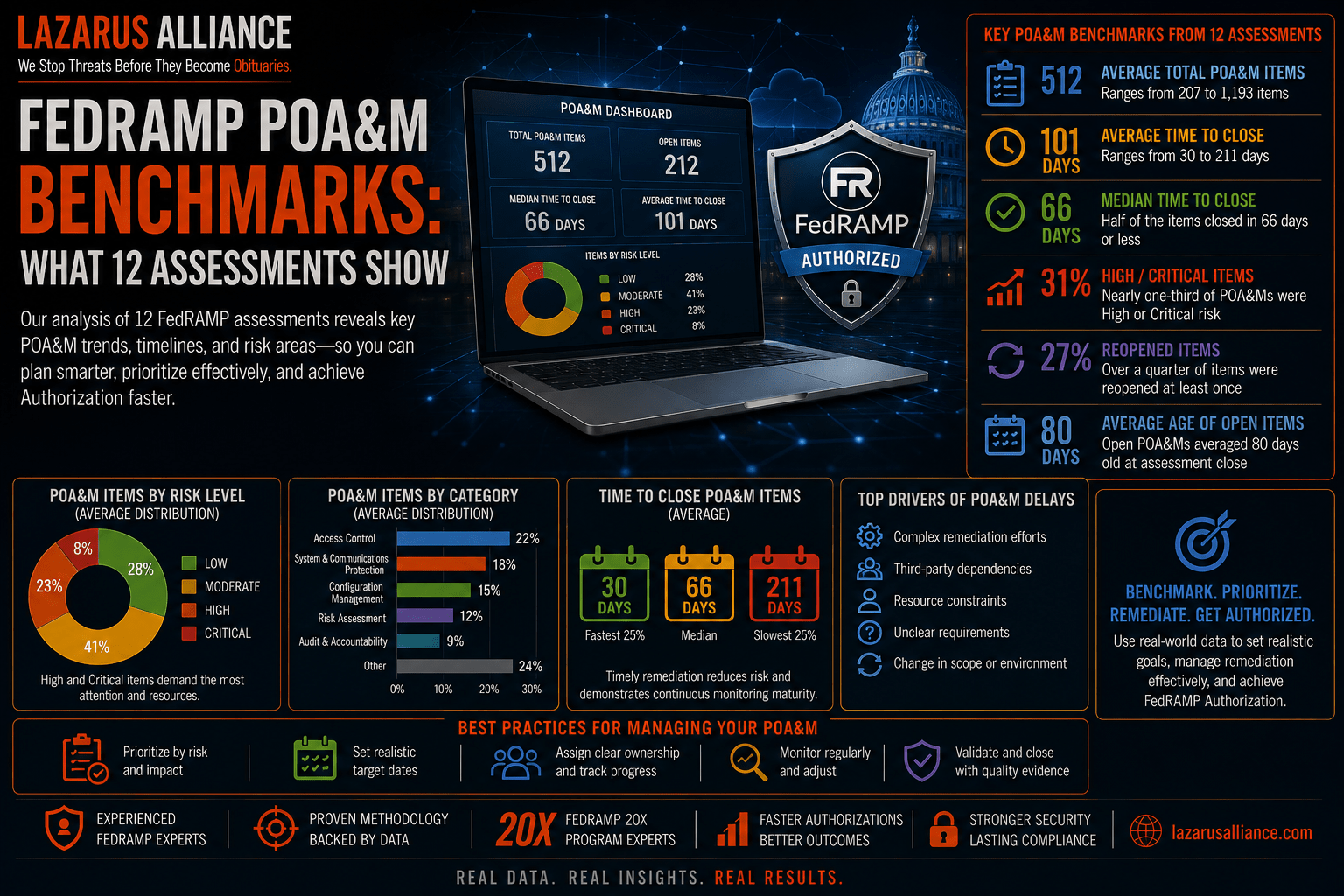
FedRAMP POA&M Benchmarks:
What 12 Assessments Show
Table of Contents
ToggleFrequency, Typical Counts, Categories, and Quality Guidance
Based on N = 12 completed formal assessments • January 2025 – June 2026 • Updated August 2026
≥1 POA&M (11 of 12)
When Present
Authorization Path
Zero Items
1. What a POA&M Is in FedRAMP
A Plan of Action and Milestones (POA&M) documents controls or control enhancements that are not fully satisfied at the time of assessment and the CSP’s plan to remediate them. POA&Ms are reviewed by the 3PAO and subsequently by the authorizing official (agency or JAB). Quality, specificity, and residual risk treatment matter as much as the mere presence of items.
POA&Ms are not the same as a failed assessment. They are the structured mechanism FedRAMP uses to acknowledge residual risk in a time-bounded, trackable way.
2. Observed Frequency (N = 12)
| Metric | Value | Denominator / Notes |
|---|---|---|
| Assessments with ≥1 POA&M item | 92% (11 of 12) | Full formal FedRAMP 3PAO assessments |
| Assessments with zero POA&M items | 8% (1 of 12) | |
| Median number of POA&M items (when present) | ~6 | Among assessments with findings |
| Typical expectation | Track and close on defined milestones | Quality of milestones and residual risk statements is scrutinized |
POA&M Presence (N = 12)
3. Most Common POA&M Categories
When residual findings were placed on a POA&M, they most often fell into these areas (aligned with the top residual findings overall):
- Audit & Accountability (AU) — incomplete event coverage, review cadence, or log protection
- Configuration Management (CM) — baselines not maintained; change control gaps; inventory drift
- Access Control (AC) — account lifecycle, least privilege, remote access evidence
- Identification & Authentication (IA) — MFA coverage and authenticator management
- System & Information Integrity (SI) — flaw remediation timelines and scanning coverage
- Continuous monitoring / CA family — weak ongoing operational evidence
Addressing these families during readiness is the highest-leverage way to reduce both residual findings and POA&M volume.
4. What a “Good” FedRAMP POA&M Looks Like
- Specific — tied to a named control or control enhancement and a concrete gap
- Time-bounded — clear milestone dates with realistic remediation steps
- Owned — named responsible party
- Residual risk stated — what risk remains until closed, and how it is accepted or mitigated in the interim
- Evidence-ready — the planned remediation will produce assessable artifacts
- Limited in scope — not a laundry list that effectively defers core implementation
Assessors and authorizing officials distinguish between a manageable set of well-scoped residual items and a POA&M that signals incomplete implementation. The former is normal; the latter raises risk and extends timelines.
5. POA&Ms and the Authorization Path
A limited, high-quality POA&M does not prevent authorization. In practice:
- 3PAO assessment documents residual findings and the CSP’s POA&M
- Agency or JAB review evaluates residual risk, milestones, and overall package maturity
- CSPs that close items on schedule and provide clear close-out evidence maintain momentum
- CSPs that produce vague POA&Ms or defer remediation experience longer review cycles and more follow-up questions
In this dataset, organizations that treated POA&M development as a disciplined project (owner, due date, residual risk, close-out evidence plan) moved through post-assessment steps more smoothly.
6. Practical Implications for CSPs
- Do not treat “zero POA&M” as the only success metric. 92% of assessments in this dataset had at least one item.
- Invest in POA&M quality. Specific milestones and residual risk statements reduce friction with both 3PAOs and authorizing officials.
- Pre-empt the top categories. AU, CM, AC, and IA account for a disproportionate share of residual findings and POA&M items.
- Plan close-out evidence from day one. Weak close-out packages create avoidable delay.
- Tighter authorization boundaries help. Cleaner scope correlated with more limited POA&M profiles.
7. Related Benchmark Metrics (N = 12)
- Median formal assessment duration: 42 business days
- Required additional evidence during assessment: 92% (11 of 12)
- Average evidence volume: ~3,400 artifacts
- Tightly bounded vs complex multi-component: 58% / 42%
Full context: 2026 FedRAMP Assessment Benchmark Report (Lazarus Alliance).
8. Authors & How to Cite
Lead Author
Michael D. Peters, CEO & Founder, Lazarus Alliance, Inc.
A2LA-accredited FedRAMP 3PAO leadership; Authorized CMMC C3PAO; PCI DSS QSA firm principal.
How to Cite
Peters, M. D. (2026). FedRAMP POA&M Benchmarks: What 12 Assessments Show. Lazarus Alliance, Inc. Data drawn from the 2026 FedRAMP Assessment Benchmark Report (N = 12).
9. About Lazarus Alliance
Lazarus Alliance is an A2LA-accredited FedRAMP Third-Party Assessment Organization (3PAO), an authorized CMMC C3PAO (CPN 10251), a PCI DSS Qualified Security Assessor (QSA), and a veteran-owned small business headquartered in Scottsdale, Arizona.
Lazarus Alliance, Inc.
27743 N. 70th Street, Suite 100, Scottsdale, AZ 85266
1-888-896-7580 • [email protected]
https://lazarusalliance.com
© 2026 Lazarus Alliance, Inc. All rights reserved. Proactive Cybersecurity®, Cybervisor®, and IT Audit Machine® are trademarks of Lazarus Alliance or its affiliates. Figures are observational aggregates from anonymized assessments and do not guarantee individual outcomes.
Scottsdale, Arizona • 1-888-896-7580 • lazarusalliance.com
Data Source
This analysis is based on the 2026 FedRAMP Assessment Benchmark Report, Lazarus Alliance's aggregate analysis of 12 completed formal FedRAMP assessment engagements conducted between January 2025 and June 2026.
Additional Analysis
- How Long Does a FedRAMP Assessment Take?
- 7 Most Common FedRAMP Assessment Findings
- How Much Evidence Does a FedRAMP Assessment Require?
- FedRAMP Authorization Boundary Complexity
- 7 Most Misunderstood FedRAMP Requirements Observed in Assessments
Talk with one of our experts
Our Lazarus Alliance Cybervisor™ teams have experience performing thousands of assessments for organizations providing services to clients around the world.
We're here to answer any questions you may have.